

Soil beneath our feet holds memories. When drought strikes an ecosystem, microscopic communities of bacteria and fungi don't simply disappear—they adapt, persist, and retain information about past stress events. This microbial memory, scientists now understand, directly influences which plant and animal species will survive future droughts. In 2026, as soil moisture decline emerges as a critical global concern[3], Drought Resilience Profiling in Biodiversity Surveys: Using Soil Microbe Memory to Predict Species Survival in 2026 represents a transformative approach for conservation professionals and developers working to meet biodiversity targets.
Traditional biodiversity surveys capture snapshots of visible species at a single point in time. They document what exists today but struggle to predict what will thrive tomorrow. By integrating soil microbial assessment into baseline surveys, biodiversity professionals can now unlock predictive insights about ecosystem resilience that were previously invisible. This approach is particularly relevant for Biodiversity Net Gain (BNG) projects, where long-term habitat success depends on understanding not just current species composition, but future survival probability under changing climate conditions.
Key Takeaways
- 🦠 Soil microbes retain "memory" of drought events that influences ecosystem recovery and species survival patterns for years afterward
- 📊 Microbial profiling enhances traditional biodiversity surveys by adding predictive capacity to identify which habitats will remain resilient under future drought conditions
- 🌱 eDNA monitoring technologies now enable rapid, cost-effective assessment of soil microbial communities across large survey areas[1]
- 🎯 BNG validation improves significantly when baseline assessments include soil health indicators that predict long-term habitat viability
- 🔬 Drought resilience profiling provides actionable data for adaptive management strategies in conservation and development projects
Understanding Soil Microbe Memory and Ecosystem Resilience
What Is Microbial Memory?
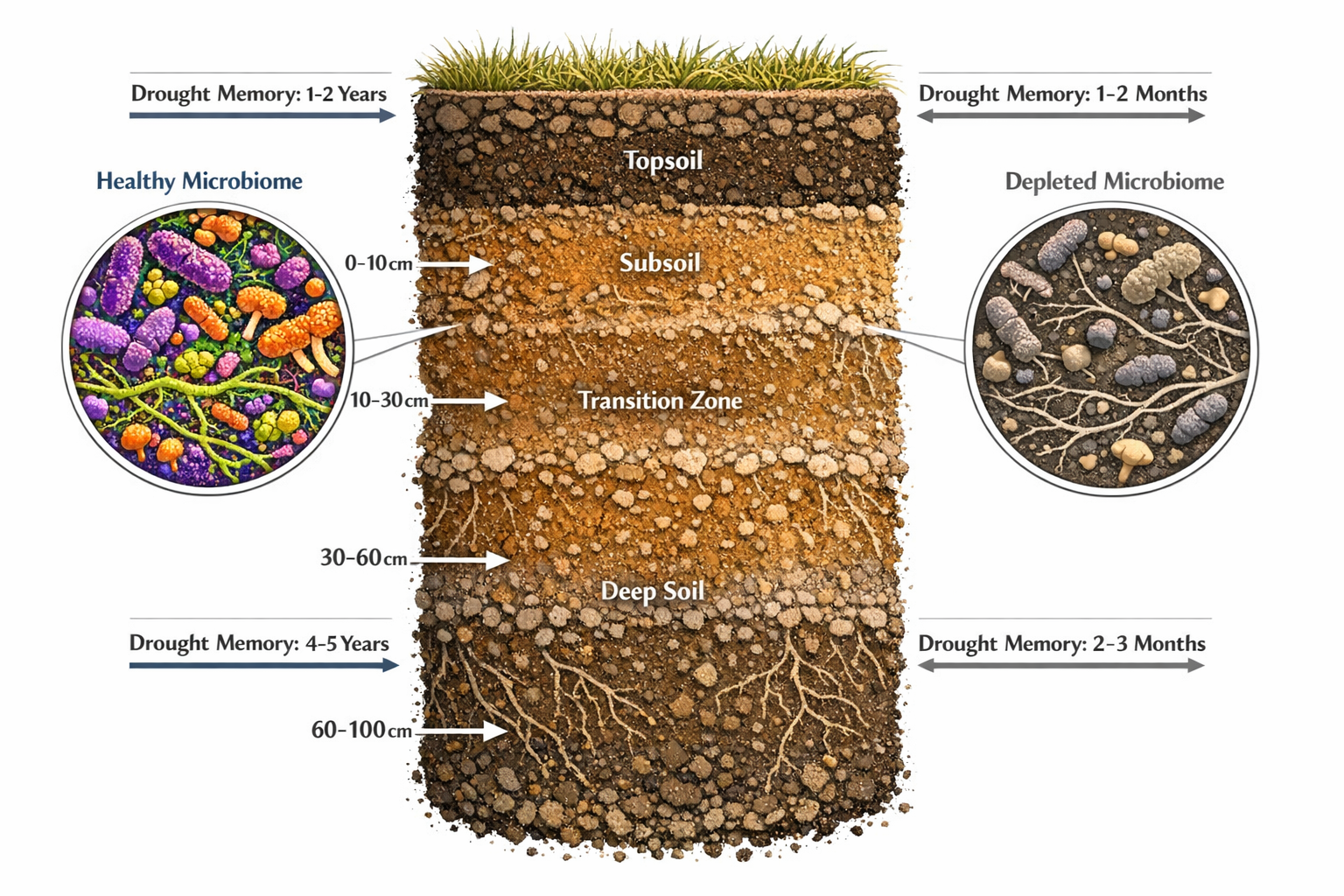
Soil microbiomes—the complex communities of bacteria, fungi, archaea, and other microscopic organisms—don't simply react to environmental stress. They remember it. When drought conditions stress an ecosystem, certain microbial species die off while others activate dormancy mechanisms or produce protective compounds. The survivors and their descendants carry forward genetic and epigenetic changes that alter how the entire soil community responds to subsequent drought events.
This phenomenon, known as microbial memory or ecological memory, manifests in several ways:
- Community composition shifts that persist for months or years after moisture returns
- Enhanced stress tolerance in microbial populations that experienced previous drought
- Altered nutrient cycling patterns that affect plant growth and survival
- Modified symbiotic relationships between soil microbes and plant roots
Why Microbial Memory Matters for Species Survival
Plants don't face drought alone. Their survival depends heavily on partnerships with soil microorganisms, particularly mycorrhizal fungi that extend root systems and improve water uptake. When soil microbial communities retain memory of past drought stress, they can:
- Respond faster to subsequent dry periods
- Provide enhanced support to plant partners through improved nutrient access
- Stabilize soil structure to reduce erosion and maintain water retention
- Influence which plant species can successfully establish and persist
Research demonstrates that biodiversity can enhance forest resistance to drought[4], with soil microbial diversity playing a crucial mediating role. Ecosystems with robust, diverse microbial communities show greater resilience when facing repeated climate stress events—exactly the conditions expected to intensify through 2026 and beyond.
The 2026 Soil Moisture Crisis
The 2026 Global Horizon Scan identifies soil moisture decline as an emerging critical issue with widespread implications for terrestrial and freshwater ecosystems, food production, and biodiversity conservation[3]. This isn't a distant future threat—it's happening now. As developers and land managers work to achieve biodiversity objectives, understanding which sites possess soil microbial communities capable of supporting species through drought becomes essential for project success.
Integrating Drought Resilience Profiling into Biodiversity Surveys
Traditional Survey Limitations
Standard biodiversity surveys typically focus on:
- Visible species counts (birds, mammals, plants, invertebrates)
- Habitat condition assessments based on vegetation structure
- Single-season snapshots that may miss seasonal or annual variation
- Above-ground indicators that overlook soil health
While these methods provide valuable baseline data for biodiversity impact assessments, they offer limited insight into future ecosystem performance. A site may appear species-rich today but lack the underground resilience infrastructure needed to maintain that diversity through drought stress.
Adding Soil Microbial Assessment
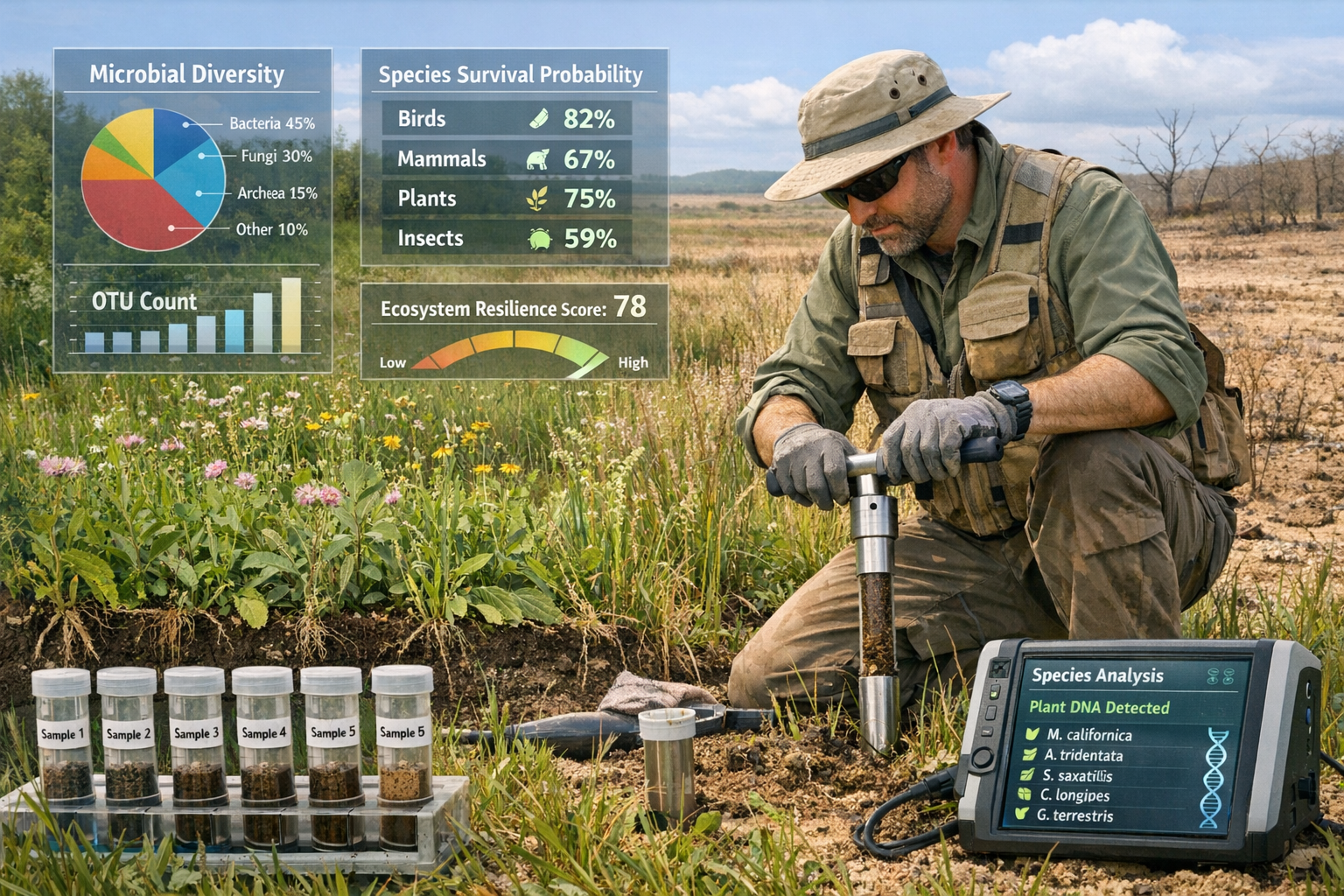
Drought Resilience Profiling in Biodiversity Surveys: Using Soil Microbe Memory to Predict Species Survival in 2026 involves integrating soil sampling and microbial analysis into standard survey protocols. This enhanced approach includes:
1. Soil Core Collection
Systematic collection of soil samples across survey areas at standardized depths (typically 0-10cm, 10-20cm, and 20-30cm). Sample locations should represent:
- Different habitat types within the site
- Varying topography and drainage patterns
- Areas with different land use histories
- Reference sites with known drought resilience
2. eDNA Analysis
Environmental DNA (eDNA) technologies have revolutionized biodiversity monitoring, demonstrating capacity to detect hundreds of species across large geographic areas[1]. For soil microbial assessment, eDNA sequencing provides:
- Rapid species identification across bacterial and fungal taxa
- Community composition profiles showing diversity and abundance
- Functional gene detection indicating stress tolerance capabilities
- Cost-effective scaling compared to traditional culturing methods
3. Microbial Diversity Metrics
Key indicators for drought resilience profiling include:
| Metric | What It Measures | Resilience Indicator |
|---|---|---|
| Species Richness | Total number of microbial taxa | Higher diversity = greater functional redundancy |
| Functional Diversity | Range of ecological roles present | More functions = better stress adaptation |
| Mycorrhizal Abundance | Symbiotic fungi supporting plants | Essential for drought tolerance |
| Stress-Tolerance Genes | Genetic markers for drought adaptation | Direct indicator of community memory |
| Community Stability | Consistency across samples | Stable communities resist disturbance |
4. Historical Stress Signatures
Analyzing soil samples for markers of past drought stress reveals microbial memory. These signatures include:
- Elevated proportions of drought-tolerant bacterial phyla
- Presence of spore-forming species
- Altered carbon-to-nitrogen ratios indicating stress responses
- Genetic markers for osmotic stress tolerance
Predictive Modeling for Species Survival
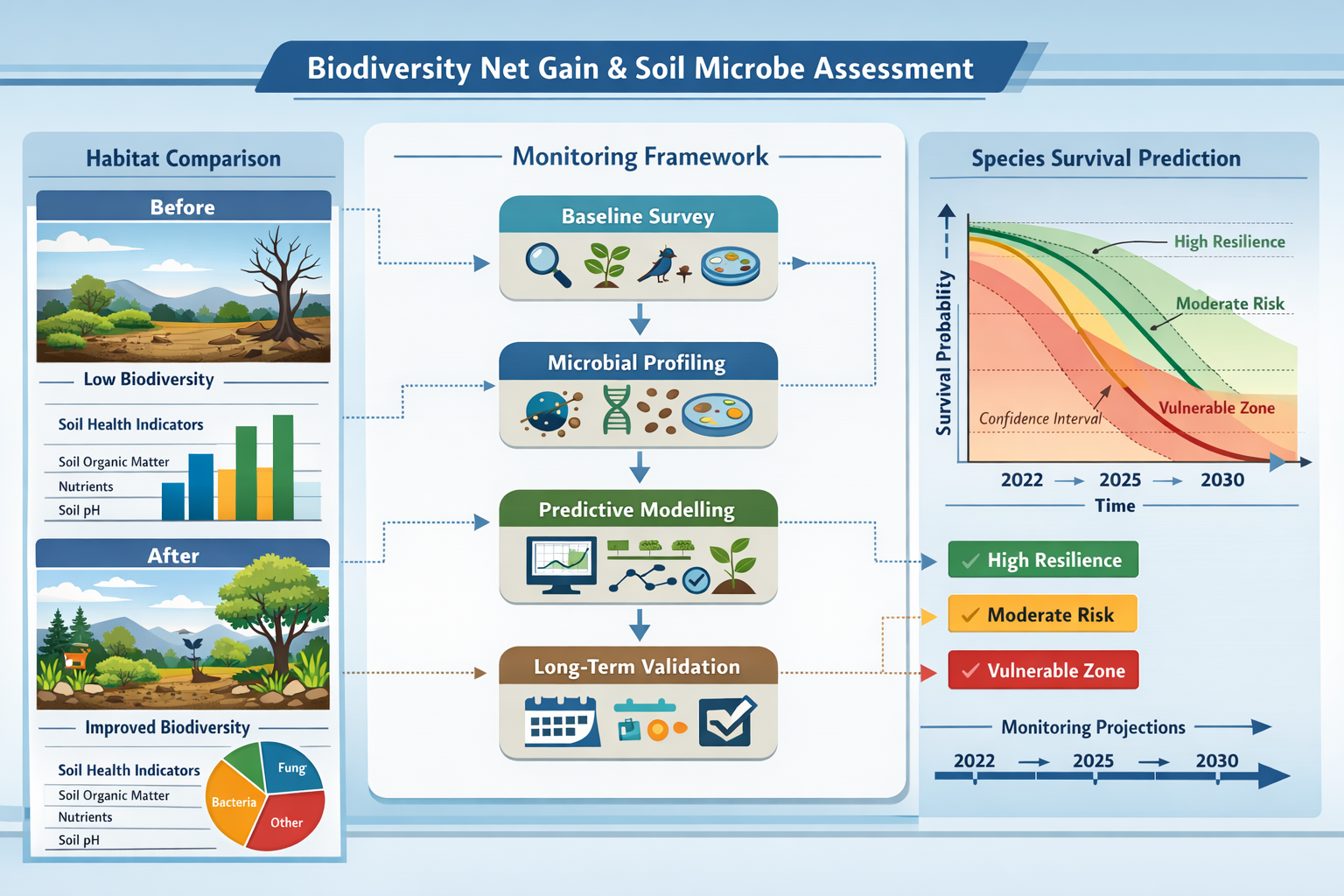
Once soil microbial data is collected, it can be integrated with traditional species survey data to create predictive models. These models estimate:
✅ Probability of plant species persistence under projected drought scenarios
✅ Habitat quality trajectories over 5, 10, and 30-year timeframes
✅ Risk zones where species loss is likely without intervention
✅ Optimal locations for habitat creation or enhancement in BNG delivery
This predictive capacity transforms biodiversity surveys from descriptive exercises into strategic planning tools.
Practical Applications for BNG and Conservation Projects
Enhancing Baseline Assessments
When conducting baseline biodiversity surveys for development projects, incorporating drought resilience profiling provides:
- More accurate habitat condition assessments that account for soil health
- Better site selection for habitat creation or enhancement
- Informed species selection for planting schemes based on soil microbial support capacity
- Risk mitigation by identifying sites vulnerable to climate-related failure
For developers working to create biodiversity plans, this information helps ensure that habitat investments will deliver intended outcomes over the required 30-year BNG monitoring period.
Validating Long-Term BNG Outcomes
One of the greatest challenges in Biodiversity Net Gain is demonstrating that created or enhanced habitats will maintain their ecological value over decades. Soil microbial assessment provides:
- Early warning indicators of habitat degradation before visible species loss occurs
- Objective metrics for monitoring habitat condition beyond species counts
- Adaptive management triggers that signal when intervention is needed
- Evidence of genuine ecological improvement versus temporary greening
Informing Habitat Creation Design
Understanding soil microbial communities at receptor sites helps designers:
- Match soil conditions between donor and receptor sites for translocations
- Amend soils appropriately to support target plant communities
- Select drought-tolerant species compatible with existing microbial partnerships
- Sequence planting to build microbial communities progressively
Optimizing Off-Site BNG Delivery
For landowners considering habitat banking or developers purchasing biodiversity units, drought resilience profiling helps:
- Identify high-quality receptor sites with strong resilience potential
- Price units appropriately based on long-term success probability
- Reduce delivery risk by avoiding sites with poor soil health
- Demonstrate due diligence in site selection and management planning
Case Study Applications
Consider a development project requiring 10% BNG through off-site habitat creation. Traditional surveys identify two potential receptor sites with similar current species composition. However, drought resilience profiling reveals:
Site A: Diverse soil microbial community with high mycorrhizal abundance and genetic markers indicating drought memory from previous stress events. Predictive modeling suggests 85% probability of maintaining target habitat condition through 2050.
Site B: Depleted soil microbial community with low functional diversity and no drought stress signatures. Modeling indicates 45% probability of habitat success under projected climate scenarios.
This information enables informed decision-making that protects both ecological outcomes and financial investments. The additional cost of soil assessment (typically £500-1,500 per site) is minimal compared to the risk of habitat failure requiring costly remediation or replacement.
Implementing Drought Resilience Profiling: Practical Steps
For Biodiversity Survey Practitioners
- Partner with soil science laboratories offering eDNA sequencing services
- Develop standardized protocols for soil sample collection and handling
- Train field teams in proper sampling techniques to avoid contamination
- Integrate soil data into existing survey report templates
- Build predictive modeling capacity or partner with specialists
For Developers and Planners
- Request soil microbial assessment as part of baseline biodiversity surveys
- Include drought resilience criteria in site selection for habitat creation
- Budget appropriately for enhanced survey protocols (typically 10-15% additional cost)
- Use resilience data to inform species selection and planting design
- Incorporate soil health monitoring into long-term BNG management plans
For Land Managers and Conservation Organizations
- Establish baseline soil health data across managed lands
- Monitor microbial community changes alongside traditional species monitoring
- Use resilience profiling to prioritize conservation interventions
- Adapt management practices based on soil health indicators
- Share data to build regional understanding of drought resilience patterns
Technology and Tools
Several emerging technologies support drought resilience profiling:
- Portable eDNA analysis devices enabling field-based species detection
- Smartphone apps for standardized soil sample documentation
- Cloud-based databases integrating soil and species data
- Machine learning algorithms improving predictive model accuracy
- Remote sensing integration combining satellite data with ground-truth soil assessment
As these tools become more accessible and affordable through 2026, drought resilience profiling will transition from specialized research application to standard practice in biodiversity surveys.
Challenges and Considerations
Technical Limitations
While promising, soil microbial assessment faces some constraints:
- Spatial variability requires adequate sample sizes for reliable characterization
- Temporal dynamics mean single-time sampling may miss seasonal patterns
- Interpretation complexity requires expertise to translate data into actionable insights
- Standardization gaps as methodologies continue evolving
Cost-Benefit Analysis
Enhanced survey protocols require additional investment. However, consider:
- Risk reduction from avoiding poor-quality receptor sites
- Improved outcomes leading to higher biodiversity unit values
- Reduced monitoring costs through early warning indicators
- Regulatory advantages as approaches mature and potentially become expected practice
Integration with Existing Frameworks
Drought resilience profiling complements rather than replaces traditional biodiversity surveys. It enhances existing BNG assessment methodologies by adding a predictive layer that strengthens long-term confidence in outcomes.
The Future of Biodiversity Monitoring in a Changing Climate
The 2026 horizon brings both challenges and opportunities for biodiversity conservation. As ecological drought becomes more frequent and severe, the ability to predict which ecosystems will remain resilient becomes increasingly valuable. Drought Resilience Profiling in Biodiversity Surveys: Using Soil Microbe Memory to Predict Species Survival in 2026 represents a significant advancement in conservation science that aligns with emerging policy priorities.
Upcoming initiatives like the Ecological Drought Collaborative Planning workshop[2] demonstrate growing recognition of the need for better drought monitoring tools and ecosystem resilience assessment. Biodiversity professionals who adopt soil microbial assessment now will be well-positioned to meet evolving regulatory expectations and deliver superior outcomes for both nature and development.
The integration of microbial memory assessment into biodiversity surveys also supports broader sustainability objectives, recognizing that healthy soils underpin climate resilience, carbon storage, and ecosystem services beyond simple species counts.
Conclusion
Soil microbes remember what ecosystems endure. By learning to read this microbial memory, biodiversity surveyors gain unprecedented ability to predict which species will survive, which habitats will thrive, and which conservation investments will deliver lasting value. Drought Resilience Profiling in Biodiversity Surveys: Using Soil Microbe Memory to Predict Species Survival in 2026 transforms biodiversity assessment from backward-looking documentation to forward-looking strategic planning.
As soil moisture decline intensifies globally[3], this approach moves from innovative to essential. Developers seeking to achieve 10% Biodiversity Net Gain with confidence, land managers working to build climate-resilient ecosystems, and conservation professionals validating long-term outcomes all benefit from understanding the hidden world beneath the surface.
Next Steps
For immediate implementation:
- Contact biodiversity survey providers to discuss incorporating soil microbial assessment into upcoming projects
- Review existing baseline data to identify sites where additional soil profiling would reduce uncertainty
- Engage with soil science specialists to understand available testing options and costs
- Pilot test the approach on a single site to build organizational capacity and understanding
- Stay informed about emerging research and methodological refinements through 2026
The species we can see depend on the microbes we cannot. By integrating drought resilience profiling into biodiversity surveys, conservation professionals ensure that today's habitat investments will support tomorrow's ecosystems—no matter what climate challenges emerge.
For expert guidance on implementing enhanced biodiversity surveys that incorporate soil health assessment, contact our team to discuss your project needs and explore how drought resilience profiling can strengthen your BNG outcomes.
References
[1] Closing Gap Between Biodiversity Commitments And Measuring Nature – https://sps.columbia.edu/news/closing-gap-between-biodiversity-commitments-and-measuring-nature
[2] Ecological Drought Collaborative Planning Response And Decision Making 2026 05 13 – https://www.drought.gov/events/ecological-drought-collaborative-planning-response-and-decision-making-2026-05-13
[3] Whats Next For Biodiversity Conservation Insights From The 2026 Horizon Scan – https://www.unep-wcmc.org/en/news/whats-next-for-biodiversity-conservation-insights-from-the-2026-horizon-scan
[4] onlinelibrary.wiley – https://onlinelibrary.wiley.com/doi/10.1111/ele.70351?af=R