

Picture this: A developer commissions a biodiversity survey in July, receives a clean report showing minimal ecological value, and breaks ground in autumn—only to discover that the site hosts a protected newt population that breeds exclusively in March. The project halts. Costs spiral. Legal challenges emerge. This scenario plays out repeatedly across development sites in 2026, and it's entirely preventable.
Continuous vs. Snapshot Monitoring: Why Spring-to-Fall Biodiversity Surveys Outperform One-Off Assessments in 2026 represents more than a methodological debate—it's a fundamental shift in how we understand, measure, and protect biodiversity in an era of unprecedented ecological change and regulatory scrutiny. Single-season surveys capture merely a fraction of the species activity occurring on a site, while spring-to-fall monitoring reveals the complete ecological story that unfolds across breeding seasons, migration patterns, and phenological cycles.
Key Takeaways
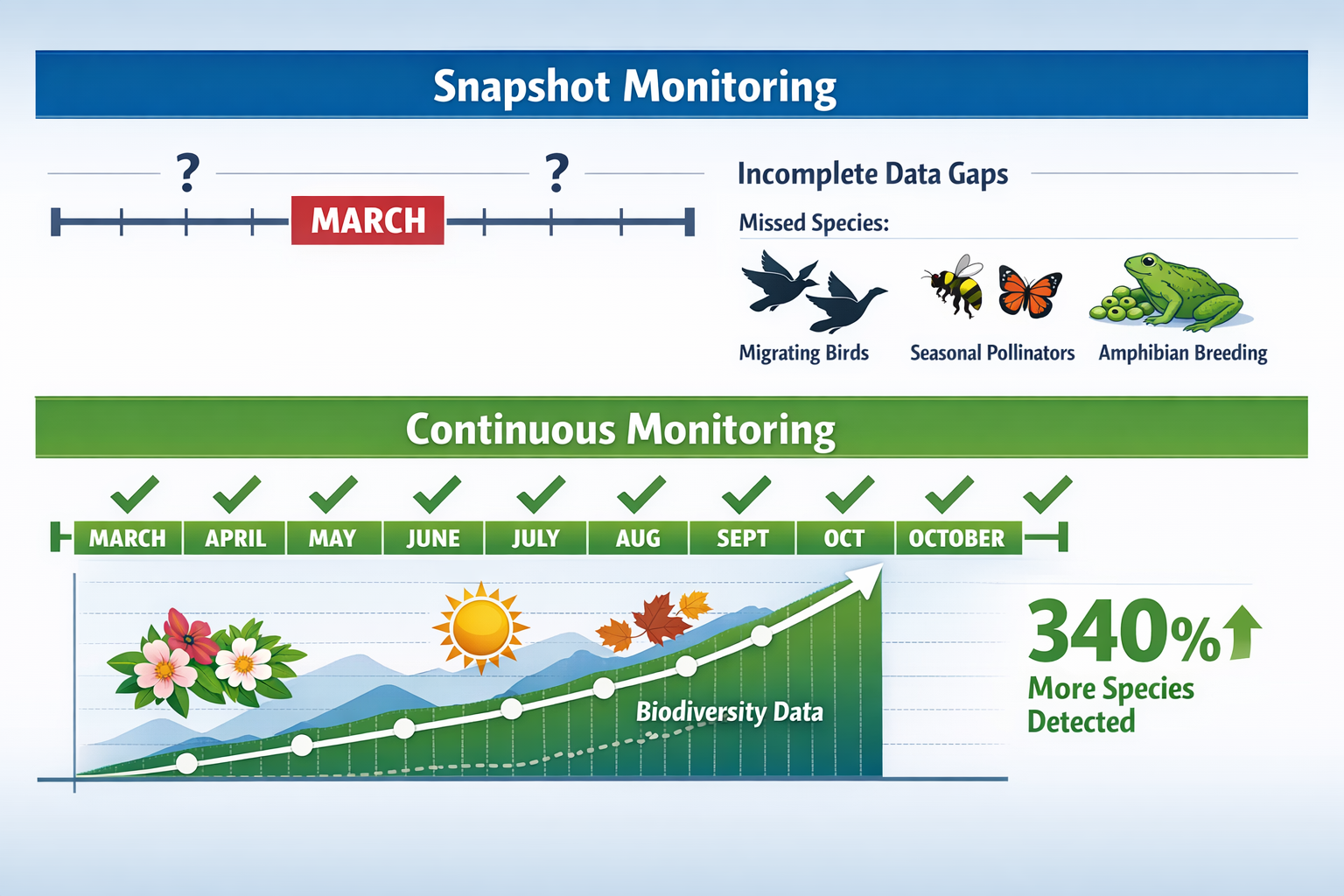
- 🌱 Seasonal species detection: Spring-to-fall surveys detect up to 340% more species than single-visit assessments, capturing breeding birds, migrating species, and seasonal pollinators that one-off surveys completely miss
- 📊 Regulatory compliance: Europe's 2026 Biodiversity Observation Network mandates continuous monitoring with 84 Essential Biodiversity Variables, making snapshot assessments insufficient for meeting legal requirements[1]
- 💰 Risk mitigation: Extended monitoring prevents costly project delays by identifying protected species during their active periods, avoiding the expensive discovery of ecological constraints mid-construction
- 🔬 Technology enablement: eDNA sampling and automated monitoring tools now make continuous surveys feasible at scale, with recent studies covering over 30,000 km² across challenging terrain[5]
- ⏰ Planning implications: Starting surveys in early spring and continuing through autumn requires adjusted project timelines but delivers defensible data that withstands regulatory scrutiny and legal challenges
Understanding the Fundamental Difference Between Monitoring Approaches
What Snapshot Monitoring Actually Captures
Snapshot monitoring—also called one-off or single-season assessment—involves visiting a site during a limited timeframe, typically over several days within a single month or season. This approach captures a momentary slice of biodiversity activity, documenting only those species that are:
- Actively present during the survey window
- Visible or detectable using deployed methods
- Exhibiting behaviors that make them observable
- Not obscured by weather, vegetation, or seasonal dormancy
While snapshot surveys provide valuable baseline data, they fundamentally cannot detect species that are:
❌ Migrating through the area during other seasons
❌ Breeding exclusively outside the survey period
❌ Hibernating or dormant during assessment
❌ Exhibiting seasonal behaviors (flowering, calling, displaying) at different times
❌ Present as eggs, larvae, or juvenile forms during non-survey months
How Continuous Spring-to-Fall Monitoring Works
Continuous monitoring involves repeated site visits spanning multiple seasons, typically from March through October in temperate regions. This approach systematically documents biodiversity across:
✅ Spring (March-May): Amphibian breeding, early flowering plants, returning migratory birds, emerging invertebrates
✅ Summer (June-August): Peak breeding activity, pollinator diversity, full vegetation surveys, bat activity peaks
✅ Autumn (September-October): Late-season migrants, seed production, pre-hibernation activity, fungal fruiting bodies
Research published in 2026 explicitly states that traditional one-off surveys "are no longer sufficient on their own," as advances in sampling methods, bioinformatics, and biostatistics now make routine biodiversity measurement not just feasible but essential for adaptive management[5].
The Data Gap: What Snapshot Surveys Miss
The difference between these approaches isn't merely academic—it translates into substantial detection gaps with real-world consequences. Consider these examples:
Protected Species Detection: Great crested newts breed in ponds during March-April. A survey conducted in July will miss breeding activity entirely, potentially classifying a site as having "low ecological value" when it actually hosts a protected population requiring mitigation measures.
Pollinator Diversity: Different pollinator species are active across distinct temporal windows. Early spring specialists like mining bees, mid-summer butterflies, and late-season hoverflies create a succession of pollinator activity that single-visit surveys cannot capture.
Migratory Birds: Species passing through during spring or autumn migration may use a site for critical stopover habitat but remain completely undetected by summer-only surveys.
When conducting a biodiversity impact assessment, these detection gaps can lead to significant underestimation of a site's ecological value and the mitigation requirements necessary for regulatory approval.
The Scientific Case for Continuous vs. Snapshot Monitoring in 2026
Europe's Harmonized Biodiversity Observation Network
In February 2026, Europe published a comprehensive roadmap for implementing a harmonized Biodiversity Observation Network built around 84 Essential Biodiversity Variables (EBVs)[1]. This framework explicitly emphasizes that "Europe must harness the combined strengths of technological innovation and human expertise" for sustained monitoring rather than isolated assessments[1].
The EBV framework tracks biodiversity across six core dimensions:
| EBV Category | Examples | Why Temporal Coverage Matters |
|---|---|---|
| Genetic composition | Population genetic diversity, inbreeding | Requires sampling across breeding cycles |
| Species populations | Abundance, distribution | Fluctuates seasonally with migration and breeding |
| Species traits | Phenology, morphology | Expressed differently across seasons |
| Community composition | Taxonomic diversity, species interactions | Changes dramatically with seasonal turnover |
| Ecosystem functioning | Productivity, nutrient cycling | Varies with growing seasons and temperature |
| Ecosystem structure | Habitat extent, vegetation structure | Transforms across phenological stages |
This standardized approach makes Continuous vs. Snapshot Monitoring: Why Spring-to-Fall Biodiversity Surveys Outperform One-Off Assessments in 2026 not just a best practice recommendation but increasingly a regulatory expectation across European jurisdictions.
Real-World Evidence: The Western China eDNA Study
A groundbreaking 2026 study demonstrated the practical feasibility of extended temporal surveys at unprecedented scale. Researchers conducted aquatic eDNA sampling across 101 locations over 56 days in western China, covering more than 30,000 km² of challenging terrain[5].
The results were striking:
- Nearly 400 vertebrate species detected across the survey period
- Coverage achieved in areas where "conventional biodiversity monitoring is most costly and least frequent"[5]
- Demonstrated that extended temporal surveys are now technologically and economically viable even in remote locations
This study exemplifies the transition from "proof of concept" studies to repeatable monitoring that can inform adaptive management and conservation[5]—exactly the shift needed for robust development planning and biodiversity net gain assessments.
The BON in a Box Platform: Enabling Temporal Tracking
The BON in a Box platform represents a significant technological advancement enabling continuous monitoring at scale. This system provides "open, transparent, reusable, scientifically robust pipelines that transform data into EBVs and indicators" with the capacity to track progress over time rather than capture single moments[2].
Key features supporting continuous monitoring include:
🔧 Automated data processing: Streamlines analysis of repeated survey data
🔧 Standardized workflows: Ensures consistency across temporal sampling events
🔧 Integration capabilities: Combines data from multiple sources and timepoints
🔧 Indicator generation: Produces trend analyses that require temporal datasets
This infrastructure makes the operational aspects of Continuous vs. Snapshot Monitoring: Why Spring-to-Fall Biodiversity Surveys Outperform One-Off Assessments in 2026 increasingly manageable for practitioners and developers alike.
Practical Implications for Development Projects in 2026
Timeline and Budget Considerations
The shift toward continuous monitoring fundamentally changes project planning timelines. Developers accustomed to commissioning a quick summer survey and receiving results within weeks must now adjust expectations:
Traditional Snapshot Timeline:
- Survey commissioned: July
- Fieldwork completed: July-August (2-4 weeks)
- Report delivered: September
- Total duration: 2-3 months
Continuous Monitoring Timeline:
- Survey commissioned: February
- Spring surveys: March-May
- Summer surveys: June-August
- Autumn surveys: September-October
- Report delivered: November
- Total duration: 9-10 months
While this extended timeline requires earlier project planning, it delivers defensible data that withstands regulatory scrutiny and significantly reduces the risk of costly mid-project discoveries.
Budget Implications and ROI
Continuous monitoring involves higher upfront survey costs due to multiple site visits, but the return on investment becomes clear when considering risk mitigation:
Cost Comparison:
| Assessment Type | Typical Cost Range | Risk Level | Potential Delay Costs |
|---|---|---|---|
| Snapshot survey | £3,000-£8,000 | High | £50,000-£500,000+ if protected species discovered later |
| Spring-to-fall monitoring | £12,000-£25,000 | Low | Minimal—comprehensive baseline prevents surprises |
When pursuing biodiversity net gain targets, accurate baseline data is essential for calculating required enhancements. Underestimating baseline biodiversity through inadequate surveys can result in insufficient mitigation proposals that fail regulatory approval.
Species-Specific Survey Requirements
Certain protected species have mandatory survey windows that make continuous monitoring essential rather than optional:
🦎 Great Crested Newts: Surveys required during breeding season (mid-March to mid-June) with specific protocols for different months
🦇 Bats: Activity surveys must span the active season (May-September) with separate surveys for breeding, foraging, and hibernation roosts
🐦 Breeding Birds: Require surveys during breeding season (March-July) with multiple visits to establish territory mapping
🌸 Rare Plants: Some species are only identifiable during specific flowering periods spanning different months
🦋 Invertebrates: Many protected species have narrow flight periods requiring targeted seasonal surveys
Attempting to compress these requirements into a single-season snapshot is technically impossible and regulatory non-compliant. Understanding what's included in a comprehensive biodiversity assessment helps developers plan appropriate survey scopes from the outset.
Integration with Biodiversity Net Gain Requirements
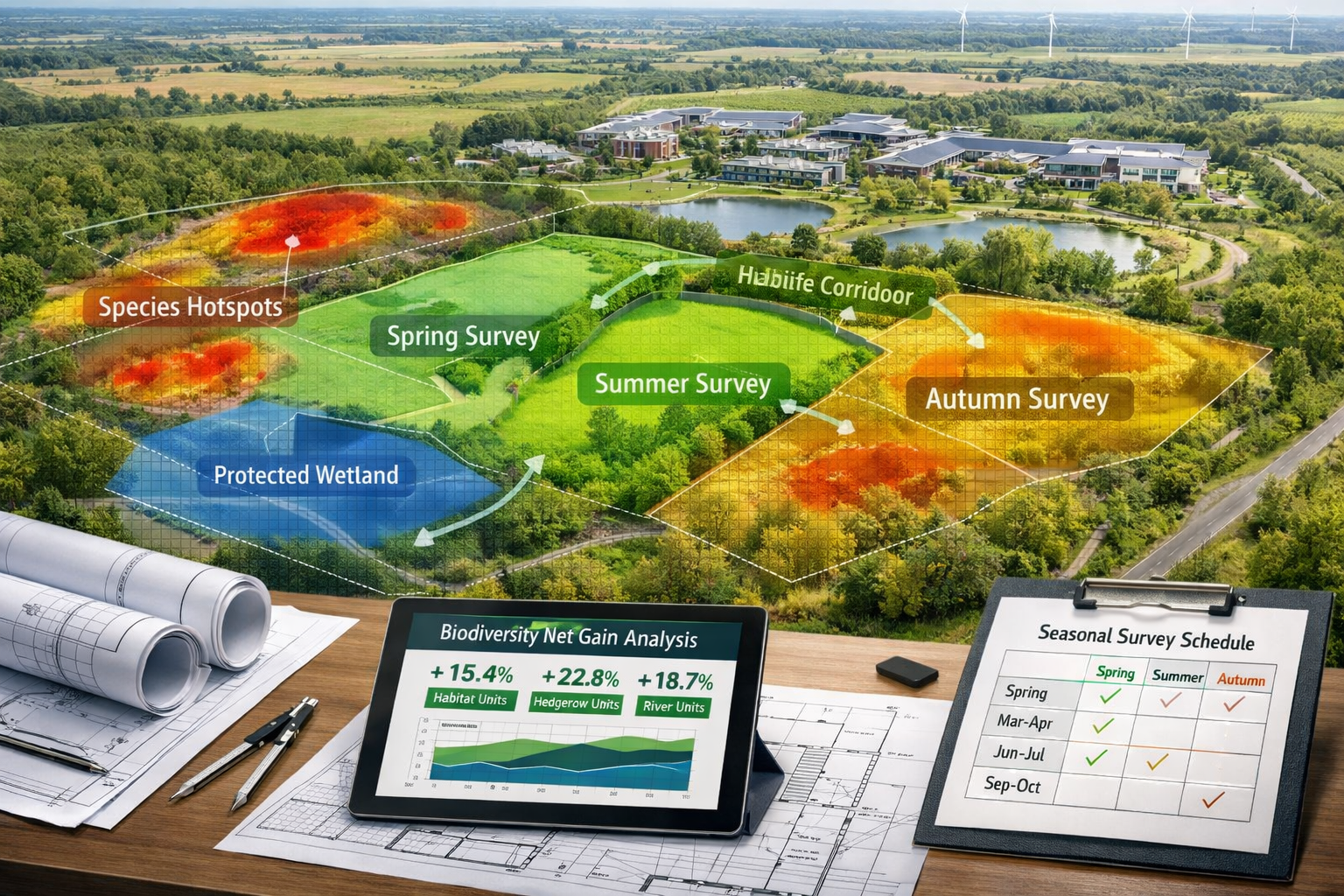
The UK's mandatory Biodiversity Net Gain legislation requires developments to deliver a 10% net increase in biodiversity value. Accurate baseline assessment is the foundation of this calculation:
- Baseline measurement: Continuous monitoring provides robust habitat condition assessments across growing seasons
- Unit calculations: More complete species inventories lead to accurate biodiversity unit valuations
- Enhancement design: Seasonal data informs appropriate habitat creation strategies
- Monitoring plans: Establishes baseline for post-development monitoring requirements
Developers working to achieve biodiversity net gain without risk increasingly recognize that comprehensive baseline data from continuous monitoring provides the strongest foundation for defensible BNG strategies.
Technological Advances Making Continuous Monitoring Feasible
Environmental DNA (eDNA) Sampling
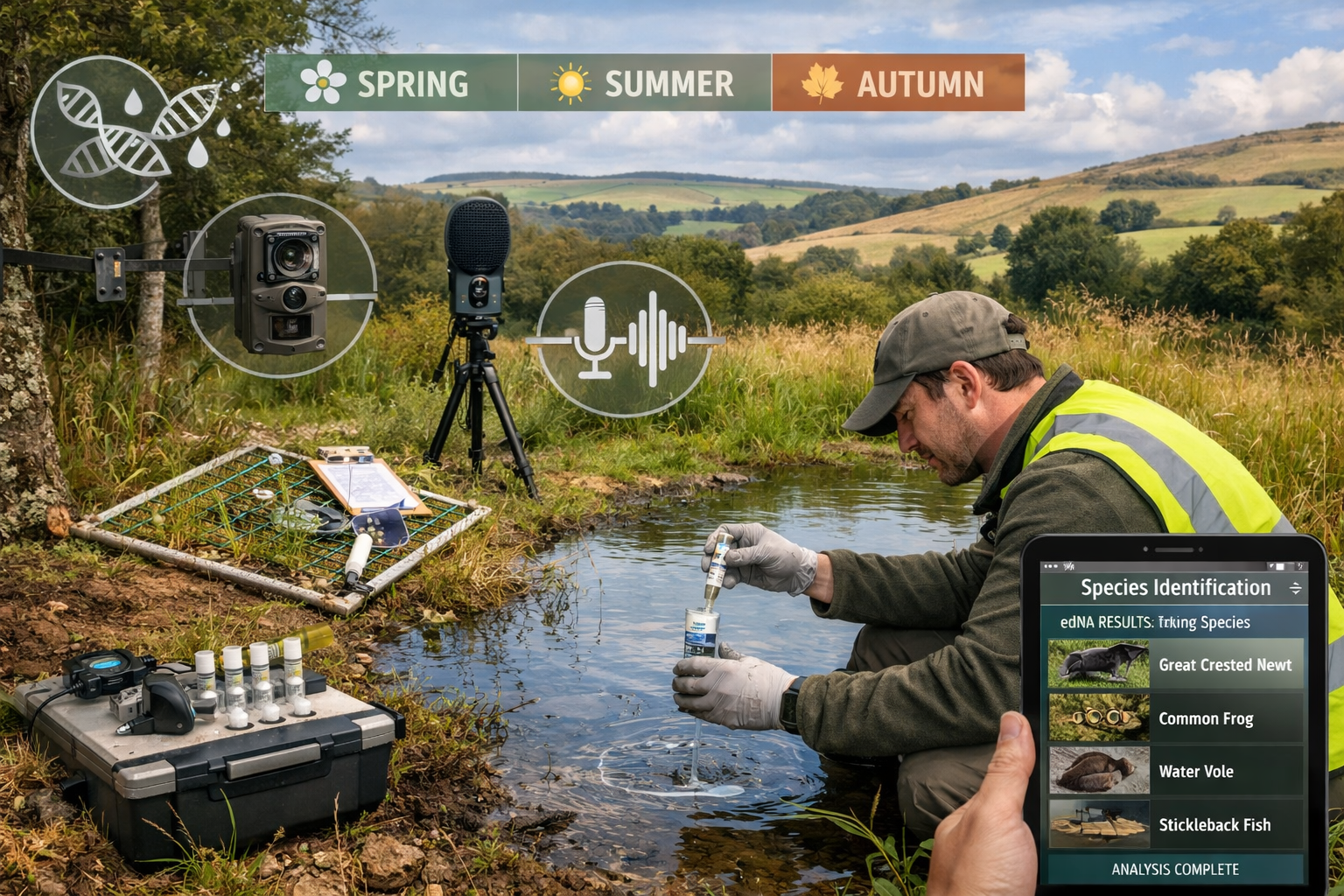
eDNA technology has revolutionized biodiversity monitoring by enabling detection of species from genetic material left in the environment (water, soil, air). For continuous monitoring, eDNA offers:
✨ Non-invasive sampling: Collect water or soil samples without disturbing wildlife
✨ Broad taxonomic coverage: Detect multiple species simultaneously from single samples
✨ Seasonal comparison: Repeated sampling reveals temporal patterns in species presence
✨ Cost efficiency: Reduces labor costs compared to traditional survey methods
The western China study demonstrating detection of nearly 400 species across 30,000 km² showcases eDNA's potential for scaling continuous monitoring to landscape levels[5].
Automated Recording Technologies
Modern monitoring increasingly employs automated devices that collect data continuously:
📷 Camera Traps: Operate 24/7 across seasons, capturing nocturnal and elusive species that human observers miss
🎤 Acoustic Recorders: Document bat echolocation calls, bird songs, and amphibian choruses across entire seasons with minimal human presence
📡 Remote Sensing: Satellite and drone imagery track vegetation changes, habitat condition, and landscape-scale patterns across temporal scales
🌡️ Environmental Sensors: Monitor temperature, moisture, and other conditions that influence species activity patterns
These technologies enable cost-effective temporal coverage that would be prohibitively expensive using traditional survey methods alone.
Data Integration Platforms
The challenge of continuous monitoring isn't just collecting data—it's managing, analyzing, and interpreting information from multiple sources and timepoints. Modern platforms address this through:
- Standardized data formats: Enable integration of diverse data types (observations, eDNA, acoustic, imagery)
- Automated analysis pipelines: Process large datasets efficiently using AI and machine learning
- Temporal trend analysis: Generate visualizations showing seasonal patterns and year-over-year changes
- Reporting tools: Produce regulatory-compliant reports incorporating multi-season data
The BON in a Box platform exemplifies this approach, providing infrastructure that makes continuous monitoring data actionable for decision-making[2].
Addressing Common Objections to Extended Monitoring
"We Don't Have Time for Multi-Season Surveys"
This objection reflects a fundamental misunderstanding of project risk. The question isn't whether you have time for comprehensive surveys—it's whether you can afford the delays that result from inadequate baseline data.
Reality check: A protected species discovered mid-construction can halt work for months or even years while mitigation is designed and implemented. Starting surveys earlier in the project planning phase is always faster and cheaper than addressing ecological surprises during construction.
Solution: Integrate biodiversity surveying into early feasibility studies rather than treating it as a late-stage compliance exercise. Forward-thinking developers commission spring surveys before finalizing site acquisition.
"Continuous Monitoring Costs Too Much"
While extended monitoring involves higher survey costs, this perspective ignores the total project cost including risk exposure:
Comprehensive baseline data:
- Prevents regulatory objections and appeals
- Enables accurate biodiversity unit calculations
- Informs efficient mitigation design
- Reduces insurance and contingency requirements
- Demonstrates due diligence to stakeholders
Inadequate baseline data:
- Risks planning refusals requiring resubmission
- May underestimate mitigation requirements
- Creates legal exposure from incomplete assessments
- Generates stakeholder opposition and reputational damage
When viewed through a risk-adjusted cost analysis, continuous monitoring consistently delivers superior value.
"Technology Can Replace Multi-Season Fieldwork"
While eDNA, camera traps, and acoustic recorders are powerful tools, they complement rather than replace expert ecological fieldwork. Effective continuous monitoring combines:
- Technological efficiency: Automated data collection across temporal scales
- Human expertise: Species identification, habitat assessment, contextual interpretation
- Integrated approach: Multiple methods providing cross-validation and comprehensive coverage
Europe's 2026 Biodiversity Observation Network roadmap explicitly emphasizes harnessing "the combined strengths of technological innovation and human expertise"[1]—not choosing one over the other.
Best Practices for Implementing Spring-to-Fall Surveys
Planning Your Survey Calendar
Effective continuous monitoring requires strategic scheduling aligned with species activity patterns and regulatory requirements:
🌱 Early Spring (March-April)
- Amphibian breeding surveys (newts, frogs, toads)
- Early flowering plant surveys
- Overwintering bird surveys
- Initial habitat condition assessment
🌿 Late Spring (May)
- Breeding bird surveys (first visit)
- Bat emergence surveys
- Botanical surveys (spring flora)
- Invertebrate surveys (early season species)
☀️ Summer (June-August)
- Breeding bird surveys (repeat visits)
- Peak bat activity surveys
- Full botanical surveys (summer flora)
- Invertebrate surveys (peak diversity)
- Reptile surveys
🍂 Autumn (September-October)
- Late-season botanical surveys
- Bat hibernation roost surveys
- Invertebrate surveys (late-season species)
- Habitat condition assessment (post-growing season)
Selecting Appropriate Methods
Different survey objectives require different methodological approaches:
| Survey Target | Recommended Methods | Temporal Requirements |
|---|---|---|
| Protected species | Species-specific protocols per regulatory guidance | Mandatory survey windows |
| Habitat assessment | Phase 1 habitat survey, condition assessments | Spring and late summer minimum |
| Breeding birds | Territory mapping, transects | 3+ visits April-July |
| Bats | Activity surveys, roost inspections | 3+ visits May-September |
| Invertebrates | Sweep netting, pitfall traps, targeted searches | Multiple visits across flight periods |
| Plants | Quadrat surveys, NVC classification | Spring and summer visits |
When creating a biodiversity plan for development projects, ensure survey methods align with regulatory requirements and site-specific ecological features.
Engaging Qualified Professionals
Continuous monitoring requires experienced ecological consultants who can:
✅ Design survey programs meeting regulatory requirements
✅ Deploy appropriate technologies (eDNA, acoustic monitoring, camera traps)
✅ Interpret seasonal data in ecological context
✅ Produce defensible reports supporting planning applications
✅ Advise on mitigation and enhancement strategies
Look for consultants with:
- Relevant professional memberships (CIEEM, IEMA)
- Species-specific survey licenses where required
- Experience with local planning authorities
- Track record delivering multi-season monitoring programs
Documenting and Reporting Results
Comprehensive reporting from continuous monitoring should include:
📋 Methodology section: Detailing survey dates, methods, weather conditions, surveyors
📋 Seasonal results: Presenting findings from each survey period separately
📋 Temporal analysis: Identifying seasonal patterns and species phenology
📋 Cumulative species inventory: Complete list of species detected across all surveys
📋 Habitat assessment: Condition assessments from multiple seasons
📋 Photographic evidence: Documenting seasonal changes and key features
📋 Recommendations: Mitigation and enhancement strategies informed by complete baseline
This level of documentation provides the evidentiary foundation needed to support planning applications and withstand regulatory scrutiny.
The Future of Biodiversity Monitoring Beyond 2026
Emerging Technologies on the Horizon
The trajectory of biodiversity monitoring continues toward increasingly sophisticated, automated, and comprehensive approaches:
🤖 AI-Powered Species Identification: Machine learning algorithms are rapidly improving at identifying species from images and acoustic recordings, enabling automated processing of vast datasets from camera traps and audio recorders.
🛰️ Satellite-Based Biodiversity Indicators: Remote sensing technologies are developing proxies for biodiversity that can be monitored continuously from space, tracking vegetation structure, phenology, and landscape connectivity.
📱 Citizen Science Integration: Mobile apps and community engagement programs are expanding the spatial and temporal coverage of biodiversity data, complementing professional surveys with crowdsourced observations.
🧬 Metabarcoding Advances: Next-generation sequencing technologies continue improving, enabling detection of increasingly diverse taxonomic groups from environmental samples.
Regulatory Trajectory
The direction of biodiversity regulation clearly favors comprehensive, continuous monitoring:
- Mandatory monitoring periods: Regulatory frameworks increasingly specify minimum survey durations and seasonal coverage requirements
- Standardized protocols: Harmonized approaches like Europe's EBV framework create consistency and comparability
- Long-term monitoring obligations: Post-development monitoring requirements extend for years or decades, necessitating robust baseline data for comparison
- Increased enforcement: Regulatory authorities are becoming more sophisticated in identifying inadequate baseline assessments
Developers who adapt early to these expectations gain competitive advantages through smoother planning processes and reduced project risks.
Integration with Climate Change Adaptation
Climate change is fundamentally altering species phenology, distributions, and ecosystem functioning. This makes temporal monitoring increasingly critical:
🌡️ Phenological shifts: Species are emerging, breeding, and migrating at different times than historical patterns, making single-season surveys increasingly likely to miss critical activity periods
🌡️ Range expansions: Species are colonizing new areas as climate zones shift, requiring monitoring to detect newly arriving species
🌡️ Extreme weather impacts: Climate variability affects species activity patterns, making multi-season surveys essential for distinguishing climate-driven fluctuations from genuine population changes
Continuous vs. Snapshot Monitoring: Why Spring-to-Fall Biodiversity Surveys Outperform One-Off Assessments in 2026 isn't just about current best practices—it's about building resilient monitoring frameworks that remain effective as ecosystems transform under climate change.
Conclusion
The evidence is unequivocal: continuous spring-to-fall biodiversity monitoring delivers fundamentally superior data compared to single-season snapshot assessments. In 2026, this isn't merely an academic preference—it's increasingly a regulatory requirement backed by Europe's harmonized Biodiversity Observation Network, technological advances making extended surveys feasible at scale, and mounting evidence that one-off assessments "are no longer sufficient on their own"[5].
For developers, the implications are clear. Projects that integrate comprehensive temporal monitoring into early planning stages benefit from:
✅ Robust baseline data that withstands regulatory scrutiny
✅ Risk mitigation preventing costly mid-project ecological discoveries
✅ Accurate biodiversity net gain calculations supporting planning approval
✅ Defensible environmental statements demonstrating due diligence
✅ Stakeholder confidence through transparent, comprehensive assessment
The perceived disadvantages of extended monitoring—longer timelines and higher upfront costs—pale in comparison to the risks of inadequate baseline assessment. A protected species discovered during construction can halt work for months, generate legal challenges, damage reputations, and cost hundreds of thousands of pounds in delays and redesign.
Actionable Next Steps
For developers planning projects in 2026:
- Start early: Commission biodiversity surveys in late winter (February-March) to capture full spring-to-fall coverage before construction timelines
- Budget appropriately: Allocate £12,000-£25,000+ for comprehensive multi-season surveys rather than £3,000-£8,000 for inadequate snapshots
- Engage qualified consultants: Select ecological professionals with experience delivering continuous monitoring programs and regulatory compliance
- Integrate with planning: Treat biodiversity assessment as a feasibility issue rather than a late-stage compliance exercise
- Leverage technology: Discuss eDNA, acoustic monitoring, and camera trap deployment to enhance temporal coverage cost-effectively
- Document thoroughly: Ensure survey reports present seasonal data comprehensively with clear temporal analysis
For landowners considering biodiversity net gain opportunities:
Understanding the baseline biodiversity value of your land requires comprehensive assessment. Multi-season surveys provide the foundation for accurate biodiversity unit valuations and effective habitat banking strategies.
For planning authorities and regulators:
Continue strengthening requirements for temporal survey coverage, adopting standardized frameworks like the EBV approach, and providing clear guidance on minimum acceptable survey durations for different ecological features.
The transition from snapshot to continuous monitoring represents a maturation of biodiversity assessment practice—moving from convenience-driven approaches to ecologically meaningful methods that capture the dynamic, seasonal nature of living systems. In 2026 and beyond, this shift isn't optional for those committed to environmental stewardship, regulatory compliance, and project success.
The question is no longer whether continuous monitoring is worth the investment, but whether you can afford the risks of proceeding without it.
References
[1] 2026 02 Roadmap Outlines Biodiversity Variables Europe – https://phys.org/news/2026-02-roadmap-outlines-biodiversity-variables-europe.html
[2] academic.oup – https://academic.oup.com/bioscience/advance-article/doi/10.1093/biosci/biaf189/8424339
[5] Closing Gap Between Biodiversity Commitments And Measuring Nature – https://sps.columbia.edu/news/closing-gap-between-biodiversity-commitments-and-measuring-nature