

The conservation landscape has transformed dramatically. As artificial intelligence sweeps through biodiversity research, field ecologists face an unprecedented challenge: how to harness powerful AI tools while maintaining the scientific integrity that underpins critical decisions like Biodiversity Net Gain (BNG) assessments. The AI Proliferation in Ecology Surveys: Ethical Protocols for Biodiversity Surveyors in 2026 represents more than technological advancement—it marks a fundamental shift in how professionals collect, analyze, and report ecological data.
Recent conferences, including SBDI Days 2026 held in February at the Swedish Museum of Natural History, have established "AI and Biodiversity: a Perfect Pair" as the central theme for this critical year[3][5]. Yet this partnership brings profound ethical questions. When AI algorithms identify species, predict habitat quality, or generate biodiversity metrics for development projects, surveyors must ensure these tools enhance rather than compromise data integrity.
This comprehensive guide addresses the AI Proliferation in Ecology Surveys: Ethical Protocols for Biodiversity Surveyors in 2026, providing practical frameworks for professionals navigating this technological revolution while maintaining accountability in their work.
Key Takeaways
- 🤖 AI tools like machine learning, computer vision, and e-DNA analysis are now standard in ecology surveys, but require strict ethical protocols to prevent data integrity issues
- ⚖️ Ethical frameworks focusing on fairness, accountability, and transparency are essential for responsible AI deployment in biodiversity assessments and BNG reporting
- 🔍 Primary risks include algorithmic bias, synthetic data contamination, and transparency failures that can compromise survey accuracy and regulatory compliance
- 📊 Validation protocols requiring human expert verification of AI-generated data are now mandatory best practices in professional biodiversity surveying
- 🌱 Integration with BNG requirements demands that AI-assisted surveys maintain rigorous standards for habitat assessment and species identification accuracy

Understanding AI Proliferation in Ecology Surveys: The 2026 Landscape
The Rise of AI as Conservation's Partner
Artificial intelligence has evolved from experimental tool to essential partner in biodiversity research. The transformation accelerated through 2025 and into 2026, with machine learning, digital twins, genetic monitoring using environmental DNA (e-DNA), remote sensing, and robotic biotracking emerging as primary methodologies[1]. These technologies promise unprecedented efficiency in species identification, habitat mapping, and ecological monitoring.
For biodiversity surveyors working on development projects requiring BNG compliance, AI tools offer compelling advantages:
- Automated species identification from camera trap images and acoustic recordings
- Rapid habitat classification using satellite and drone imagery analysis
- Large-scale data processing that would take human teams months to complete
- Pattern recognition for detecting rare or cryptic species
- Predictive modeling for habitat quality and biodiversity value assessments
Current AI Technologies Reshaping Field Surveys
Computer vision AI tools represent the most visible transformation in ecology surveys. Advanced deep learning approaches including convolutional neural networks, instance segmentation, vision transformers, attention mechanisms, and self/few-shot learning now enable automated species identification and monitoring[6]. These systems can automatically identify, count, and categorize organisms from large image datasets, significantly reducing manual effort and errors.
Environmental DNA (e-DNA) analysis combined with AI algorithms allows surveyors to detect species presence from water, soil, or air samples without direct observation. This methodology proves particularly valuable for conducting biodiversity impact assessments where traditional survey methods might miss elusive species.
Remote sensing and satellite imagery analysis powered by machine learning enables habitat mapping at unprecedented scales. AI algorithms can classify vegetation types, assess habitat connectivity, and predict biodiversity hotspots—critical information for achieving Biodiversity Net Gain targets.
The Ethical Imperative
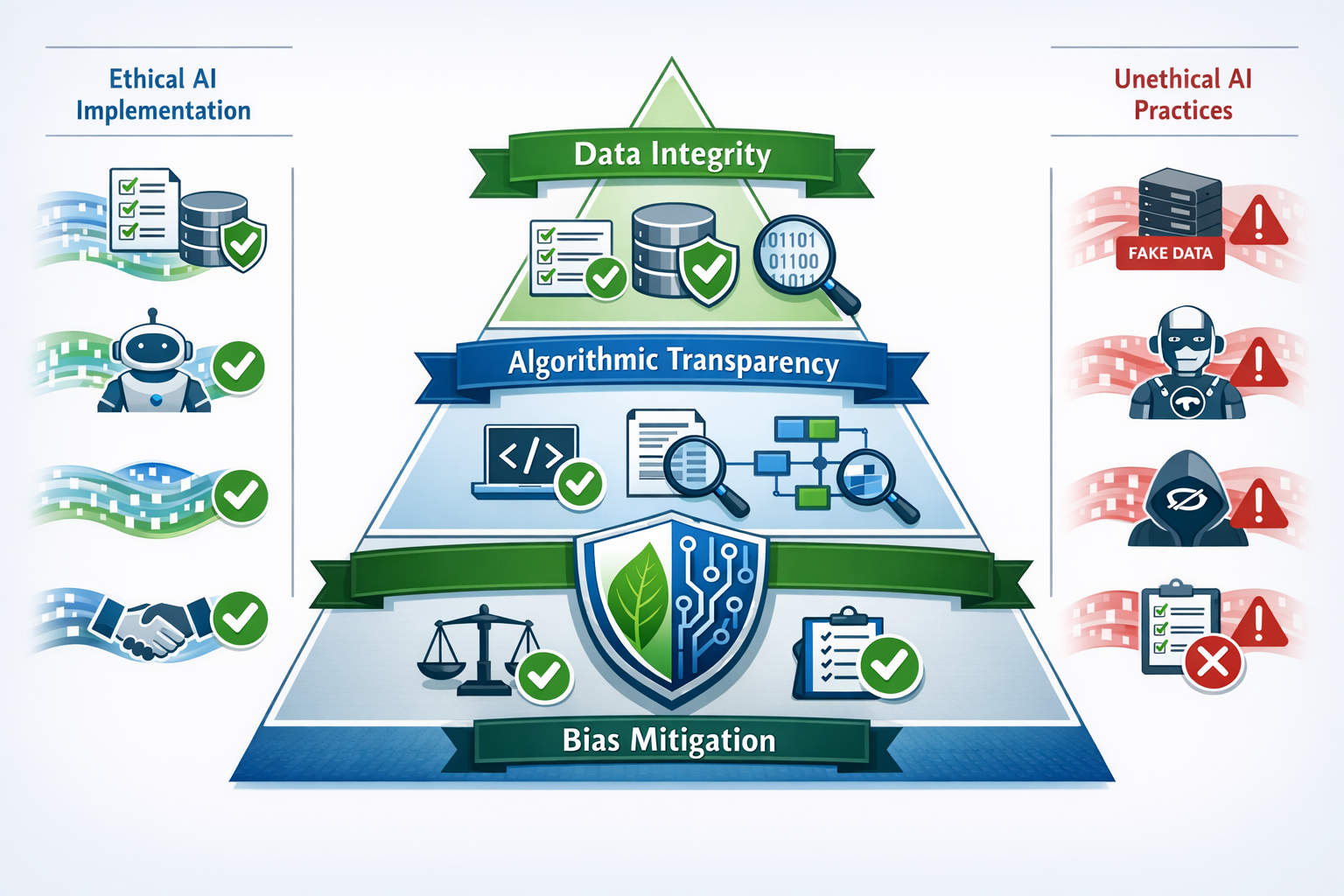
The rapid adoption of AI tools has outpaced the development of ethical guidelines. Ethical considerations of generative AI are now a primary focus in biodiversity research, with specific emphasis on responsible frameworks and addressing AI-generated problems like synthetic data creation, biased data, fake data, and algorithmic bias[3].
Professional surveyors must recognize that AI tools are not neutral. They carry embedded assumptions, training biases, and limitations that can compromise data quality if not properly managed. For professionals providing BNG assessments, these issues have direct regulatory and legal implications.
Core Ethical Challenges in AI-Assisted Biodiversity Surveys
Algorithmic Bias and Species Misidentification
One of the most significant challenges facing biodiversity surveyors involves algorithmic bias—systematic errors in AI predictions that stem from training data limitations. Computer vision systems trained predominantly on common species may struggle with rare or regionally specific organisms, leading to misidentification or missed detections.
Challenges being addressed in AI biodiversity tools include similar species identification, subtle differences between specimens, variable life stages, incomplete specimens, and algorithmic bias[6]. For example, an AI system trained primarily on adult butterflies might fail to recognize larval stages or pupae, creating gaps in biodiversity assessments.
Real-World Implications
For surveyors conducting baseline surveys for development projects, species misidentification can have cascading consequences:
- Underestimation of protected species presence leading to inadequate mitigation measures
- Incorrect habitat quality assessments affecting BNG calculations
- Regulatory compliance failures when surveys don't meet statutory requirements
- Legal liability if development proceeds based on flawed ecological data
Synthetic Data and Data Integrity Issues
The proliferation of synthetic data—AI-generated information used to augment training datasets—presents a subtle but serious threat to data integrity. While synthetic data helps address training data scarcity, it can introduce artifacts and patterns that don't reflect real ecological systems.
Data quality and responsible innovation have become core discussion topics in professional conferences[1], reflecting growing awareness that AI tools must be validated against ground truth data collected through traditional methods.
Transparency and the "Black Box" Problem
Many advanced AI systems, particularly deep neural networks, operate as "black boxes"—producing accurate results without providing clear explanations of their decision-making process. This opacity creates problems for professional surveyors who must:
- Justify survey methodologies to regulatory authorities
- Defend findings in planning appeals or legal proceedings
- Demonstrate due diligence in professional practice
- Maintain audit trails for BNG monitoring and reporting
Frameworks addressing fairness, accountability, and scientific transparency in AI adoption are being developed to ensure ethical alignment of AI tools in biodiversity research[3]. These frameworks emphasize the need for explainable AI systems that can articulate the reasoning behind species identifications and habitat assessments.
Data Ownership and Privacy Concerns
AI systems require massive datasets for training and validation. This creates questions about:
- Intellectual property rights for ecological data
- Data sharing protocols between organizations and researchers
- Sensitive location data for endangered species
- Commercial use of publicly funded biodiversity information
For surveyors working with developers on BNG projects, clear agreements about data ownership, storage, and usage are essential components of ethical practice.
Ethical Protocols for Biodiversity Surveyors in 2026
Establishing Validation Frameworks
The cornerstone of ethical AI use in ecology surveys is rigorous validation. Professional surveyors must implement multi-layered verification protocols:
1. Ground Truth Validation
Every AI-assisted survey should include ground truth sampling—traditional survey methods conducted by qualified ecologists to verify AI findings. Recommended protocols include:
- Minimum 10-15% manual verification of AI-identified species
- Focused validation on rare, protected, or legally significant species
- Habitat-specific calibration testing AI performance across different ecosystem types
- Seasonal validation to account for phenological variations
2. Expert Review Requirements
AI outputs should never bypass expert review. Establish clear workflows where:
- Qualified ecologists review all AI-generated species lists and abundance estimates
- Taxonomic specialists verify identifications of rare or difficult species groups
- Senior surveyors approve final reports incorporating AI-derived data
- Peer review processes validate methodologies for complex or high-stakes projects
3. Confidence Threshold Standards
AI systems typically provide confidence scores for their predictions. Surveyors should establish clear thresholds:
| Confidence Level | Required Action | Use in BNG Reports |
|---|---|---|
| >95% | Accept with spot-check verification | Acceptable for baseline data |
| 80-95% | Requires expert review | Use with documented caveats |
| 60-80% | Manual verification mandatory | Supplementary data only |
| <60% | Reject; use traditional methods | Not acceptable |
Implementing Transparency Protocols
Transparency separates ethical AI use from problematic deployment. Biodiversity surveyors should adopt these practices:
Documentation Requirements
Every survey report using AI tools should include:
- Detailed methodology section describing AI tools, algorithms, and training data sources
- Validation procedures explaining how AI outputs were verified
- Confidence metrics for key findings and identifications
- Limitations acknowledgment clearly stating AI tool constraints
- Human oversight documentation identifying qualified reviewers
This level of transparency proves particularly important for BNG assessments where regulatory authorities may scrutinize methodologies.
Explainable AI Selection
When selecting AI tools, prioritize systems that provide:
- Decision pathway visualization showing how identifications were made
- Feature importance metrics indicating which characteristics drove classifications
- Alternative hypotheses presenting other possible identifications with probabilities
- Training data transparency disclosing datasets used for model development
Addressing Algorithmic Bias
Professional surveyors must actively work to identify and mitigate algorithmic bias:
Pre-Deployment Testing
Before using any AI tool in professional surveys:
- Test against known reference collections from your geographic region
- Evaluate performance across taxonomic groups relevant to your work
- Assess seasonal and life stage coverage to identify gaps
- Document failure modes and species groups requiring extra scrutiny
- Compare results with traditional survey methods on pilot sites
Ongoing Bias Monitoring
Establish systems to detect bias in routine use:
- Track discrepancies between AI predictions and expert verifications
- Maintain bias logs documenting systematic errors or patterns
- Report issues to AI tool developers for model improvement
- Update validation protocols based on identified weaknesses
Data Governance and Security
Ethical AI use requires robust data governance:
Data Management Protocols
- Secure storage with encryption and access controls for sensitive biodiversity data
- Clear retention policies specifying how long AI training and validation data are kept
- Anonymization procedures for location data of vulnerable species
- Backup systems ensuring data preservation for long-term BNG monitoring
Contractual Safeguards
When working with developers on BNG projects, ensure contracts address:
- Data ownership rights for AI-generated and traditional survey data
- Usage restrictions preventing inappropriate data sharing or commercial exploitation
- Quality assurance responsibilities defining who validates AI outputs
- Liability provisions clarifying accountability for data errors

Practical Implementation for BNG and Development Projects
Integrating AI Tools with BNG Requirements
The UK's Biodiversity Net Gain framework demands rigorous, defensible biodiversity assessments. AI tools can support this work while maintaining compliance:
Habitat Assessment and Classification
AI-powered remote sensing can accelerate habitat mapping, but surveyors must:
- Validate habitat classifications through field visits to representative sample areas
- Cross-reference AI outputs with UK Habitat Classification system requirements
- Document condition assessments using traditional survey methods, not AI alone
- Maintain photographic evidence supporting AI-derived habitat classifications
Species Surveys and Baseline Data
When using AI for species identification in BNG baseline surveys:
- Prioritize protected species verification through traditional methods
- Use AI for preliminary screening of large datasets (camera traps, acoustic recordings)
- Require expert confirmation for all legally significant species detections
- Maintain survey effort records showing both AI and traditional methods employed
Case Study: AI-Assisted Ecological Impact Assessment
Consider a residential development project requiring a comprehensive biodiversity impact assessment:
Traditional Approach:
- 6 months of seasonal surveys
- Manual identification of thousands of specimens
- Limited coverage due to resource constraints
- Potential for human error in identification
Ethical AI-Assisted Approach:
- AI acoustic monitoring captures 24/7 bird and bat calls
- Computer vision processes camera trap images for mammal surveys
- Remote sensing maps habitat extent and quality
- But: Expert ecologists verify all protected species detections
- But: Traditional transect surveys validate AI abundance estimates
- But: Qualified botanists ground-truth vegetation classifications
- But: Senior ecologist reviews and approves all AI-derived conclusions
Result: More comprehensive data collection with maintained integrity and regulatory compliance.
Quality Assurance Checklists
Professional surveyors should use standardized checklists for AI-assisted surveys:
Pre-Survey Checklist:
- AI tools selected are appropriate for target species and habitats
- Validation protocols established with clear thresholds
- Expert reviewers identified and available
- Ground truth sampling plan developed
- Data governance agreements in place
During Survey Checklist:
- AI outputs reviewed daily for obvious errors
- Confidence scores recorded for all identifications
- Anomalies flagged for expert review
- Traditional survey methods conducted in parallel
- Field notes document AI tool performance
Post-Survey Checklist:
- Validation sampling completed to protocol standards
- Expert review conducted for all key findings
- Discrepancies between AI and traditional methods investigated
- Methodology fully documented in survey report
- Limitations clearly stated in conclusions
Building Professional Competency in Ethical AI Use
Training and Certification
The AI Proliferation in Ecology Surveys: Ethical Protocols for Biodiversity Surveyors in 2026 requires new professional competencies. Surveyors should seek training in:
- AI fundamentals including machine learning concepts and limitations
- Bias recognition and mitigation strategies
- Data quality assessment for AI training and validation datasets
- Ethical frameworks specific to biodiversity and conservation applications
- Regulatory compliance for AI use in statutory surveys
Professional bodies and organizations are developing certification programs to verify competency in ethical AI use for ecological surveys.
Staying Current with Evolving Standards
The field evolves rapidly. Professional surveyors should:
- Participate in conferences like SBDI Days focusing on AI in biodiversity research
- Join professional networks discussing ethical AI implementation
- Review emerging guidelines from regulatory authorities and professional associations
- Contribute to standards development through consultation responses and working groups
- Maintain continuing professional development records documenting AI competency
Institutional Policies and Professional Standards
Organizations employing biodiversity surveyors should establish clear institutional policies:
Minimum Policy Components:
- Approved AI tools list with documented validation and limitations
- Mandatory review procedures for AI-assisted surveys
- Quality assurance protocols specific to AI outputs
- Professional indemnity considerations for AI-related errors
- Client communication standards explaining AI use and validation
Collaboration and Knowledge Sharing
Contributing to the Evidence Base
Ethical practice includes contributing to collective knowledge:
- Publish validation studies comparing AI and traditional methods
- Share bias detection findings with AI tool developers
- Participate in benchmark datasets for training and testing AI systems
- Document case studies of successful and problematic AI implementations
- Engage in peer review of AI-assisted survey methodologies
Cross-Sector Partnerships
The Swedish Biodiversity Data Infrastructure (SBDI) in partnership with SciLifeLab's Planetary Biology Strategic Area demonstrates the value of collaborative approaches to establishing protocols for responsible AI use[5]. Biodiversity surveyors should engage with:
- Academic researchers developing and testing AI tools
- Technology developers creating biodiversity-focused AI systems
- Regulatory authorities establishing standards for AI use in statutory surveys
- Conservation organizations implementing AI at scale
- Developer clients requiring BNG compliance
Future Outlook: AI Ethics Beyond 2026
Emerging Technologies and Challenges
The AI landscape continues to evolve. Biodiversity surveyors should prepare for:
Generative AI for Ecological Modeling:
- AI systems that create synthetic ecological scenarios for impact prediction
- Requires even more rigorous validation and transparency protocols
- Potential for misuse in minimizing predicted impacts
Autonomous Survey Systems:
- Robotic platforms conducting surveys with minimal human oversight
- Questions about professional responsibility and quality assurance
- Need for clear protocols defining acceptable autonomy levels
Real-Time AI Integration:
- AI systems providing instant feedback during field surveys
- Risk of confirmation bias if surveyors rely too heavily on AI suggestions
- Importance of maintaining independent professional judgment
Regulatory Evolution
Expect regulatory frameworks to evolve:
- Mandatory disclosure of AI use in statutory surveys
- Standardized validation requirements for AI-assisted BNG assessments
- Professional liability clarifications for AI-related errors
- Data quality standards specific to AI-generated biodiversity information
Surveyors working on BNG projects should monitor regulatory developments and adapt practices accordingly.
Conclusion
The AI Proliferation in Ecology Surveys: Ethical Protocols for Biodiversity Surveyors in 2026 represents both tremendous opportunity and significant responsibility. AI tools offer unprecedented capabilities for species identification, habitat mapping, and ecological monitoring—capabilities that can enhance the quality and scope of biodiversity surveys supporting critical conservation decisions.
Yet these powerful tools demand equally powerful ethical frameworks. Professional biodiversity surveyors must commit to rigorous validation, transparent methodology, bias mitigation, and expert oversight. The integrity of ecological data—particularly for regulatory applications like Biodiversity Net Gain assessments—depends on maintaining high standards even as technology advances.
Actionable Next Steps for Biodiversity Surveyors
- Audit your current AI tool use against the ethical protocols outlined in this guide
- Develop institutional policies governing AI deployment in your surveys
- Establish validation protocols with clear thresholds and expert review requirements
- Invest in professional development to build AI literacy and ethical competency
- Document your methodologies thoroughly in all survey reports
- Engage with professional networks to share experiences and learn from peers
- Stay informed about regulatory developments affecting AI use in biodiversity surveys
- Prioritize transparency with clients about AI capabilities and limitations
The conservation community stands at a pivotal moment. By embracing ethical protocols for AI use, biodiversity surveyors can harness technological innovation while maintaining the scientific integrity that underpins effective conservation action. The future of biodiversity protection depends on getting this balance right.
For guidance on implementing these protocols in your BNG projects, contact our team of experienced biodiversity surveyors who can help navigate the intersection of AI technology and regulatory compliance.
References
[1] Sbdi Days 2026 Artificial Intelligence In Ecology And Biodiversity Research – https://www.gbif.org/event/cf8bf0-2793-4319-8998-69a6a33/sbdi-days-2026-artificial-intelligence-in-ecology-and-biodiversity-research
[3] Sbdi Days 2026 Artificial Intelligence In Ecology And Biodiversity Research 9077 – https://lyyti.events/p/SBDI_Days_2026__Artificial_Intelligence_in_Ecology_and_Biodiversity_Research_9077
[5] Sbdi Days 2026 – https://www.lifewatch.eu/events/sbdi-days-2026/
[6] 2026 Lu06 Ai Driven Computer Vision For Automated Monitoring Of Marine Biodiversity And Climate Impacts – https://centa.ac.uk/studentship/2026-lu06-ai-driven-computer-vision-for-automated-monitoring-of-marine-biodiversity-and-climate-impacts/