

}
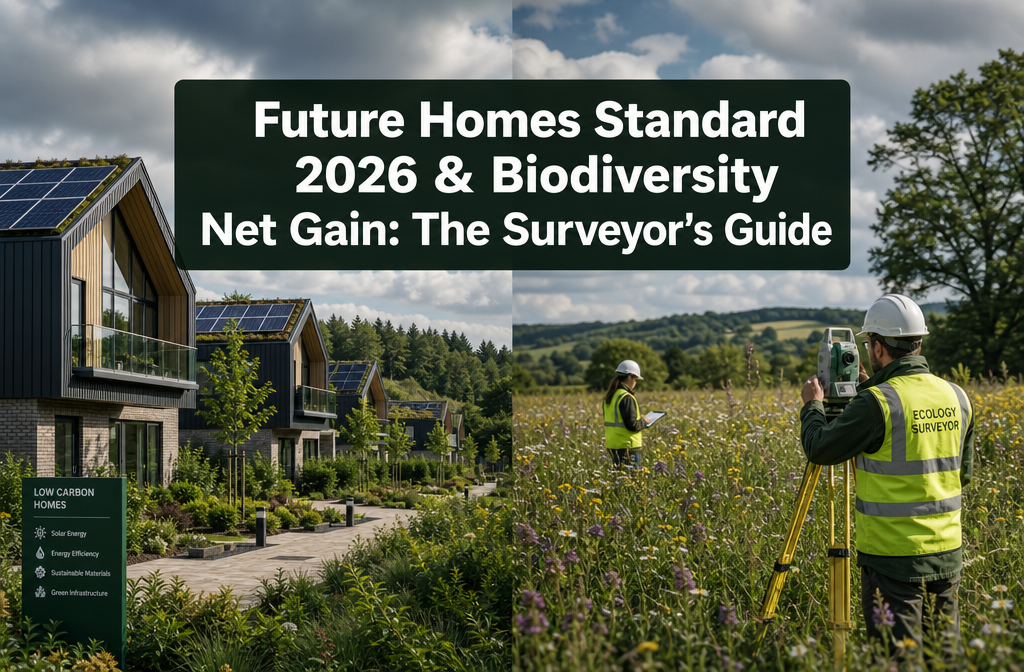
Eighty-four percent of home builders still find Biodiversity Net Gain implementation challenging — and that figure was recorded before the Future Homes Standard arrives to simultaneously transform how every new home in England is designed and built. For developers, planning consultants, ecologists, and chartered surveyors, 2026 is the year these two regulatory regimes collide on the same site, the same planning application, and the same viability appraisal.
This guide is written for practitioners who need to understand precisely how Future Homes Standard 2026 Biodiversity Net Gain integration surveyors must operate: balancing carbon performance obligations, EPC targets, and Minimum Energy Efficiency Standards (MEES) alongside statutory BNG conditions, habitat surveys, off-site unit procurement, and 30-year monitoring obligations. Getting this integration right is no longer optional — it is a prerequisite for viable, consented residential development.
Key Takeaways 🌿
- The Future Homes Standard (FHS) requires new homes to produce approximately 75–80% less carbon than homes built under previous regulations — a transformative uplift in fabric and systems performance.
- Statutory Biodiversity Net Gain (BNG) of at least 10% is now a legal pre-commencement condition for nearly all planning permissions in England, measured using the statutory biodiversity metric.
- Surveyors must treat FHS and BNG as parallel obligations — one sits within Building Regulations, the other within the planning system — and integrate both into site appraisal, masterplanning, and lifecycle cost modelling.
- Significant BNG regulatory changes confirmed for 2026 include new exemptions, removal of the self-build exemption, and extension to Nationally Significant Infrastructure Projects (NSIPs) from November 2026.
- Early-stage ecology surveys and metric calculations are essential: retrofitting BNG into a scheme after layout is fixed is expensive, slow, and often viability-threatening.
Table of Contents
- The Dual Regulatory Landscape: FHS and BNG in 2026
- What the Future Homes Standard Means for Site Design
- How BNG Works: The Surveyor's Workflow
- Future Homes Standard 2026 Biodiversity Net Gain Integration: On-Site vs Off-Site Delivery
- Key 2026 BNG Regulatory Changes Surveyors Must Know
- Planning Reform Context: 1.5M Homes, New Towns, and Station Zones
- RICS Guidance, Whole-Life Carbon, and Evolving Professional Standards
- Future Homes Standard 2026 Biodiversity Net Gain Integration Surveyors: Practical Checklist
- FAQ
- Conclusion
1. The Dual Regulatory Landscape: FHS and BNG in 2026 {#dual-regulatory}
Two major regulatory frameworks now govern residential development in England simultaneously, yet they operate through entirely separate legal mechanisms.
The Future Homes Standard is delivered through Building Regulations (Part L and associated parts). When it comes into force, it will require new dwellings to achieve approximately 75–80% fewer carbon emissions than homes built under the 2013 standards. This means near-elimination of fossil fuel heating, very high fabric efficiency, and mandatory low-carbon heating systems such as heat pumps. The FHS is a building-level obligation: it governs what is constructed, not how land is used.
Statutory Biodiversity Net Gain, by contrast, is a planning-level obligation under Schedule 7A of the Town and Country Planning Act 1990, inserted by the Environment Act 2021. It requires most new developments to deliver at least 10% more biodiversity value than the pre-development baseline, measured using Natural England's statutory biodiversity metric. BNG applies to large sites from 12 February 2024 and small sites from 2 April 2024. Gains must be secured for a minimum of 30 years.
💡 Key insight: FHS and BNG are not integrated within a single regulatory instrument. Surveyors must manage them as parallel tracks — one through Building Control, one through the planning system — while ensuring their combined land-take, cost, and programme implications are modelled together from day one.
For a clear overview of the BNG framework, see Biodiversity Net Gain Explained.
2. What the Future Homes Standard Means for Site Design {#fhs-site-design}
The FHS will fundamentally alter the physical footprint and cost profile of new homes. Key implications for surveyors include:
- Fabric-first approach: Higher insulation values, triple glazing, and airtightness targets increase build costs and may alter roofline or wall thickness — both of which interact with site layout and density calculations.
- Mechanical Ventilation with Heat Recovery (MVHR): Adds plant space requirements and affects dwelling floor plans.
- Heat pump integration: Requires external plant space, acoustic separation from boundaries, and often larger radiators or underfloor heating — all of which affect site coverage ratios.
- PV panels and green/brown roofs: Many FHS-compliant schemes will use rooftop renewables. Green or brown roofs can simultaneously contribute to BNG habitat units, creating a genuine integration opportunity.
- EPC and MEES compliance: All new homes must achieve high EPC ratings. Surveyors advising on build-to-rent or affordable housing portfolios must ensure FHS compliance aligns with MEES requirements for lettable properties.
The combined effect is that FHS adds cost and constrains layout options at the same time as BNG requires land to be set aside for habitat creation. Viability consultants are increasingly being asked to model both pressures together in Section 106 and CIL negotiations.
3. How BNG Works: The Surveyor's Workflow {#bng-workflow}
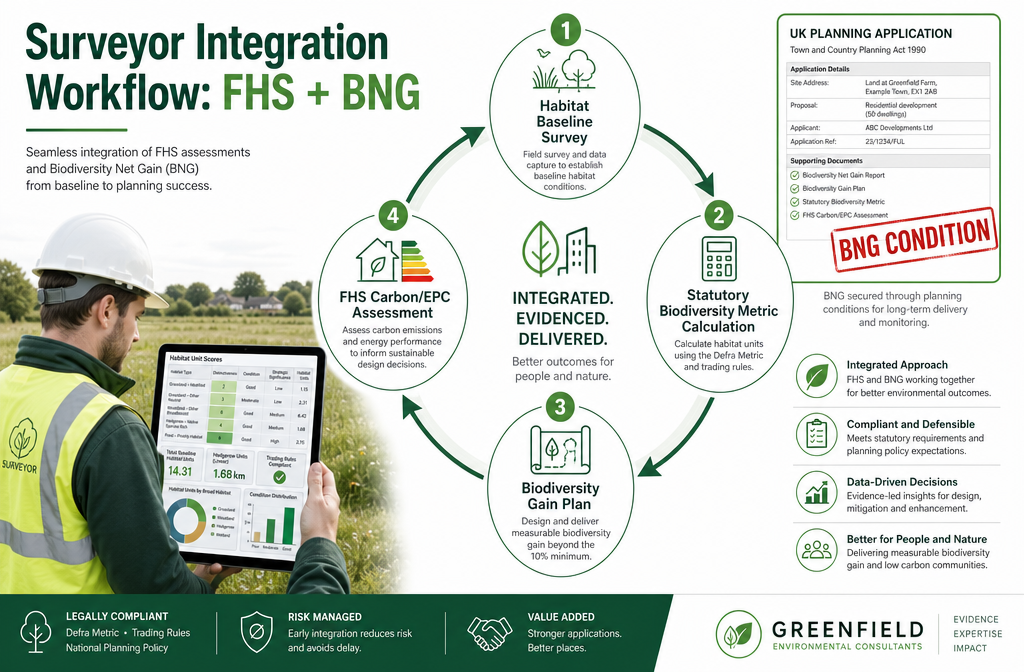
Understanding the BNG discharge workflow is essential for any surveyor involved in residential development. The statutory process requires:
| Step | Action | Who Leads |
|---|---|---|
| 1 | Baseline habitat survey using Phase 1 / UKHab methodology | Ecologist |
| 2 | Statutory biodiversity metric calculation (pre-development) | Ecologist / Surveyor |
| 3 | Post-development metric calculation (on-site gains) | Ecologist / Masterplanner |
| 4 | Biodiversity Gain Plan (BGP) preparation and submission | Ecologist / Planning Consultant |
| 5 | Habitat Management & Monitoring Plan (HMMP) where significant on-site gains proposed | Ecologist |
| 6 | Legal securing of gains (planning condition, S106, or conservation covenant) | Solicitor / Surveyor |
| 7 | Off-site unit procurement and registration on national BNG site register (if required) | Surveyor / Land Agent |
| 8 | 30-year monitoring and reporting | Land Manager / Ecologist |
For a detailed breakdown of what a BNG assessment contains, see What is in a Biodiversity Net Gain Assessment?
Surveyors play a critical role at steps 4, 6, and 7 — integrating ecology outputs into legal instruments, land value models, and procurement strategies. The NHBC has explicitly recommended that baseline ecology studies are commissioned early and in the correct format for planning, treating BNG as a core planning risk equivalent to drainage or highways.
Local planning authorities can also set BNG targets above 10% in Local Plans. Where this applies, surveyors must factor the additional land-take and habitat creation costs into development appraisals before site acquisition.
4. Future Homes Standard 2026 Biodiversity Net Gain Integration: On-Site vs Off-Site Delivery {#onsite-offsite}
One of the most consequential decisions in any residential scheme is whether to deliver BNG on-site, off-site, or through a combination of both. This decision directly interacts with FHS-driven site design.
On-Site BNG Delivery
On-site habitat creation — wildflower meadows, hedgerow networks, sustainable drainage systems (SuDS) with ecological value, green roofs — can be embedded into masterplans. However, it competes for land with:
- FHS-compliant external plant (heat pumps, MVHR exhausts)
- Car-free or low-car layouts required by some local plans
- Affordable housing quantum
- Adoptable open space requirements
Green roofs offer a genuine dual benefit: they contribute to FHS thermal performance and can generate biodiversity units if designed to the right specification. Surveyors should encourage early dialogue between ecologists and architects on this point.
Off-Site BNG Delivery
Where on-site delivery is constrained — which is common on smaller urban sites — developers can purchase biodiversity units from off-site habitat banks or use statutory biodiversity credits as a last resort. For guidance on sourcing off-site units, see Biodiversity Net Gain: Off-site or On-site Delivery? and Buy Biodiversity Units.
⚠️ Important: Statutory credits (government-sold credits of last resort) are priced at a significant premium to market-rate habitat bank units. Surveyors should model off-site unit costs carefully — and not assume statutory credits are the default.
For a practical guide on achieving Biodiversity Net Gain without the risk, early procurement of off-site units through a reputable habitat bank significantly reduces programme risk.
5. Key 2026 BNG Regulatory Changes Surveyors Must Know {#2026-changes}
A significant package of BNG changes confirmed in April 2026 will materially alter the cost and land-take calculus for many schemes. Surveyors must be aware of the following:
Changes Expected by 31 July 2026
- ✅ General exemption for sites ≤0.2 ha (red-line boundary): Small residential infill sites below this threshold will be exempt from statutory BNG. This is significant relief for small-site housebuilders also facing FHS cost uplifts.
- ✅ General exemption for temporary developments up to five years duration.
- ❌ Removal of the self-build and custom-build BNG exemption: Self-builders will now be subject to BNG requirements — a change that affects viability for custom-build plots.
- ⚖️ Disapplication of the biodiversity gain hierarchy for minor development: Off-site units will be placed on equal footing with on-site habitat creation for minor schemes, removing the current preference for on-site delivery. This simplifies procurement for small developers.
For a detailed summary of secondary BNG legislation, see Secondary BNG legislation: Summary.
Extension to NSIPs from November 2026
BNG will be extended to Nationally Significant Infrastructure Projects from 2 November 2026 (delayed from May 2026). The NSIP regime is more front-loaded: biodiversity impacts and mitigation must be addressed at the pre-application stage. For surveyors working on large mixed-use or infrastructure-linked housing — such as strategic sites along new transport corridors — this front-loading will influence land assembly, phasing timelines, and option valuations.
Forthcoming Consultations (Not Yet Bankable)
The government has signalled further consultations during 2026 on:
- A possible brownfield housing exemption (consulted up to 2.5 ha, likely lower in practice)
- Exemptions for schemes whose primary purpose is biodiversity conservation
- Reform of the spatial risk multiplier system to allow units from wider geographic areas
- Eventual replacement of the metric with a map-based online tool
⚠️ Surveyor's note: These are proposals, not confirmed policy. Do not factor them into current site appraisals or planning submissions until enacted.
For small-site specific guidance, see BNG for Small Development Projects.
6. Planning Reform Context: 1.5M Homes, New Towns, and Station Zones {#planning-reform}
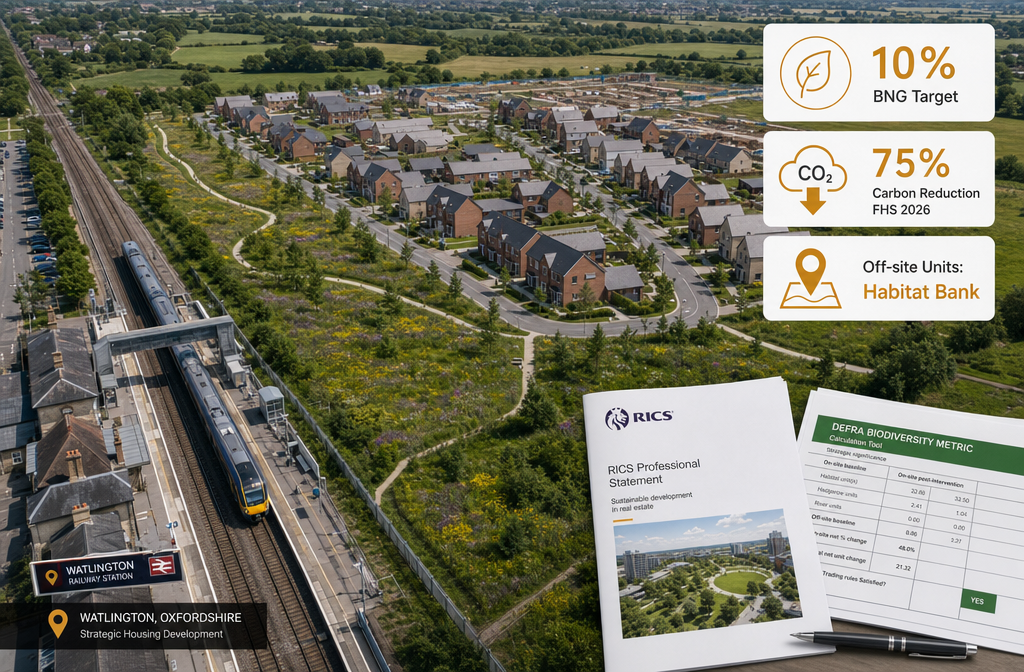
The government's target of 1.5 million new homes over this Parliament, combined with proposals for seven new towns and a presumption of approval for homes near railway stations, creates both opportunity and complexity for surveyors integrating FHS and BNG.
Key planning reform implications:
- New towns and strategic sites: Large-scale settlements will require landscape-scale BNG strategies, potentially involving multiple habitat banks, conservation covenants, and long-term management trusts. Surveyors must model these obligations across multi-phase programmes spanning decades.
- Station zone presumption of approval: Sites near stations are often brownfield or urban fringe — precisely the sites where baseline biodiversity can be low (making BNG easier to achieve) but where FHS compliance costs are highest due to existing infrastructure constraints.
- Housing delivery pressure: The 84% of housebuilders reporting BNG implementation challenges — combined with FHS cost uplifts — creates real viability pressure. Surveyors advising on Viability Assessments submitted to local planning authorities must quantify both cost streams transparently.
- Local Plan BNG uplifts: Some local authorities are setting BNG targets above 10%. Surveyors must check Local Plan policies at the earliest stage of site appraisal.
For planners navigating BNG requirements, 8 Things You Need to Know about Biodiversity Net Gain as a Planner provides a practical foundation.
7. RICS Guidance, Whole-Life Carbon, and Evolving Professional Standards {#rics-guidance}
RICS is actively evolving its professional guidance to reflect the dual obligations of carbon performance and biodiversity. Key developments for chartered surveyors include:
Whole-Life Carbon Reporting
RICS whole-life carbon assessment guidance requires surveyors to account for embodied carbon (construction materials, transport, waste) as well as operational carbon (energy in use). The FHS dramatically reduces operational carbon but may increase embodied carbon through higher-specification materials and heat pump systems. Surveyors must model both streams to give clients an accurate whole-life carbon picture.
Natural Capital and Ecosystem Services
RICS is developing guidance on natural capital accounting that intersects directly with BNG. Habitat units have a quantifiable economic value — both as a planning obligation and as a tradeable commodity in the habitat banking market. Surveyors with competence in natural capital valuation are increasingly sought after by developers assembling large strategic sites.
Professional Competence in BNG
RICS members advising on development appraisals are expected to demonstrate awareness of BNG obligations and their financial implications. Surveyors who cannot quantify BNG costs — including off-site unit procurement, legal securing costs, and 30-year management contributions — risk providing incomplete advice that exposes clients to viability risk.
8. Future Homes Standard 2026 Biodiversity Net Gain Integration Surveyors: Practical Checklist {#checklist}
Use this checklist at each stage of a residential development project:
🏗️ Pre-Acquisition / Site Appraisal
- Commission Phase 1 habitat survey before heads of terms
- Run indicative statutory metric calculation to estimate BNG unit shortfall
- Model FHS fabric and systems cost uplift in development appraisal
- Check Local Plan for BNG targets above 10%
- Confirm whether site is ≤0.2 ha (potential exemption from July 2026)
- Identify off-site habitat bank options and indicative unit costs
📐 Masterplanning / Pre-Application
- Integrate habitat areas into site layout from concept stage
- Explore green/brown roof options for dual FHS/BNG benefit
- Confirm heat pump plant locations do not conflict with habitat zones
- Prepare draft Biodiversity Gain Plan for pre-application discussions
- Engage legal team on conservation covenant or S106 structure
📋 Planning Application
- Submit Biodiversity Gain Plan with metric calculations
- Submit Habitat Management & Monitoring Plan (where required)
- Secure off-site unit agreements (if applicable) and register on national BNG site register
- Ensure FHS compliance strategy is documented in Design and Access Statement
🌱 Post-Consent / Construction
- Discharge BNG pre-commencement condition before breaking ground
- Implement HMMP monitoring schedule (minimum 30 years)
- Ensure FHS Building Control sign-off aligns with BNG condition discharge
FAQ {#faq}
Q1: Does the Future Homes Standard include any biodiversity requirements?
No. The FHS operates through Building Regulations and focuses exclusively on energy performance and carbon emissions. BNG is a separate planning obligation. However, both apply to the same development, so surveyors must manage them together.
Q2: Can green roofs count towards both FHS compliance and BNG units?
Yes — in principle. A well-designed biodiverse green roof can contribute to the statutory biodiversity metric and improve a building's thermal performance, contributing to FHS compliance. The design must meet ecological specifications for BNG credit; a purely functional drainage roof will not qualify.
Q3: What happens if a site cannot achieve 10% BNG on-site?
Developers must follow the biodiversity gain hierarchy: maximise on-site gains first, then purchase off-site habitat units from a registered habitat bank, and use statutory biodiversity credits only as a last resort. From July 2026, minor developments will be able to use off-site units on equal footing with on-site habitat creation.
Q4: Are small sites (under 0.2 ha) exempt from BNG?
A general exemption for sites with a red-line boundary of 0.2 ha or less is expected to come into force by 31 July 2026. Until that date, small sites that came into the regime from 2 April 2024 remain subject to BNG requirements. Always verify current exemption status before advising clients.
Q5: How should surveyors handle BNG costs in Viability Assessments?
BNG costs — including baseline survey fees, metric calculations, off-site unit procurement, legal securing costs, and long-term management contributions — should be itemised as a distinct cost line in development appraisals. Do not bundle them into a generic "planning obligations" figure, as this obscures the true cost impact and may be challenged by local planning authorities.
Q6: When will the Future Homes Standard come into force?
The government has confirmed the FHS is expected to come into force in 2026, but the precise commencement date for the final Building Regulations amendments has not been confirmed in published guidance at the time of writing. Surveyors should monitor MHCLG updates and not assume a specific date until formally enacted.
Conclusion {#conclusion}
The convergence of the Future Homes Standard and statutory Biodiversity Net Gain in 2026 represents the most significant combined regulatory shift for residential development in England in a generation. For Future Homes Standard 2026 Biodiversity Net Gain integration surveyors, the message is clear: these two regimes must be managed together, not in sequence.
The surveyors, ecologists, and planning consultants who will thrive are those who can model FHS cost uplifts and BNG unit shortfalls in the same appraisal spreadsheet, commission baseline ecology surveys before heads of terms are signed, and advise clients on off-site unit procurement with the same confidence they bring to construction cost planning.
Actionable Next Steps
- Audit your current project pipeline — identify which schemes are subject to BNG and which will also need to comply with FHS. Model the combined cost and land-take implications now.
- Commission baseline ecology surveys early — ideally before site acquisition. Late surveys are the single biggest cause of BNG-related planning delays.
- Explore green roof and SuDS design — for dual FHS/BNG benefit on constrained urban sites.
- Monitor the July 2026 BNG regulatory changes — particularly the ≤0.2 ha exemption and the removal of the biodiversity gain hierarchy for minor development.
- Engage with RICS guidance updates on whole-life carbon and natural capital — these will increasingly define professional competence standards for surveyors in this space.
- Connect with specialist BNG surveyors who can provide metric calculations, Biodiversity Gain Plans, and off-site unit procurement support. For comprehensive guidance, visit Biodiversity Surveyors or explore the How to Achieve 10% Biodiversity Net Gain resource.
The 1.5 million homes target is ambitious. Meeting it — while delivering genuine biodiversity gains and near-zero carbon homes — will require surveyors who can integrate across disciplines, regulatory frameworks, and timescales. That integration starts now.
Meta Title: Future Homes Standard 2026 & BNG Integration for Surveyors
Meta Description: Learn how surveyors integrate Future Homes Standard 2026 with Biodiversity Net Gain obligations — covering habitat surveys, off-site units, BNG conditions, and RICS guidance.
Tags: Future Homes Standard 2026, Biodiversity Net Gain, BNG integration, chartered surveyors, biodiversity metric, off-site habitat units, planning reform, FHS building regulations, whole-life carbon, habitat banking, BNG small sites, RICS guidance