

Up to half of all tropical insect species could experience dangerous heat stress or complete heat coma within just eight hours of exposure to temperatures scientists now predict for 2100[1]. This stark finding from a landmark Nature study published in March 2026 fundamentally changes how ecologists must approach biodiversity surveys in the world's most species-rich regions. For professionals conducting biodiversity impact assessments, understanding Insect Heat Limits in Biodiversity Surveys: Adaptive Protocols for Ecologists Under 2026 Tropical Climate Thresholds has become essential for capturing accurate baseline data before populations decline beyond recovery.
The research analyzed 2,300 insect species across Peru and Kenya, revealing that many lowland tropical insects already operate with minimal safety margins between their current environment and their biological heat tolerance limits[2][3]. This vulnerability creates an urgent need for survey methodologies that account for thermal stress, optimal collection timing, and the rapidly narrowing windows when insects remain active and detectable.
Key Takeaways
- Critical vulnerability identified: Up to 50% of tropical insects face dangerous heat stress at predicted 2100 temperatures, with lowland species showing minimal adaptive capacity[1][4]
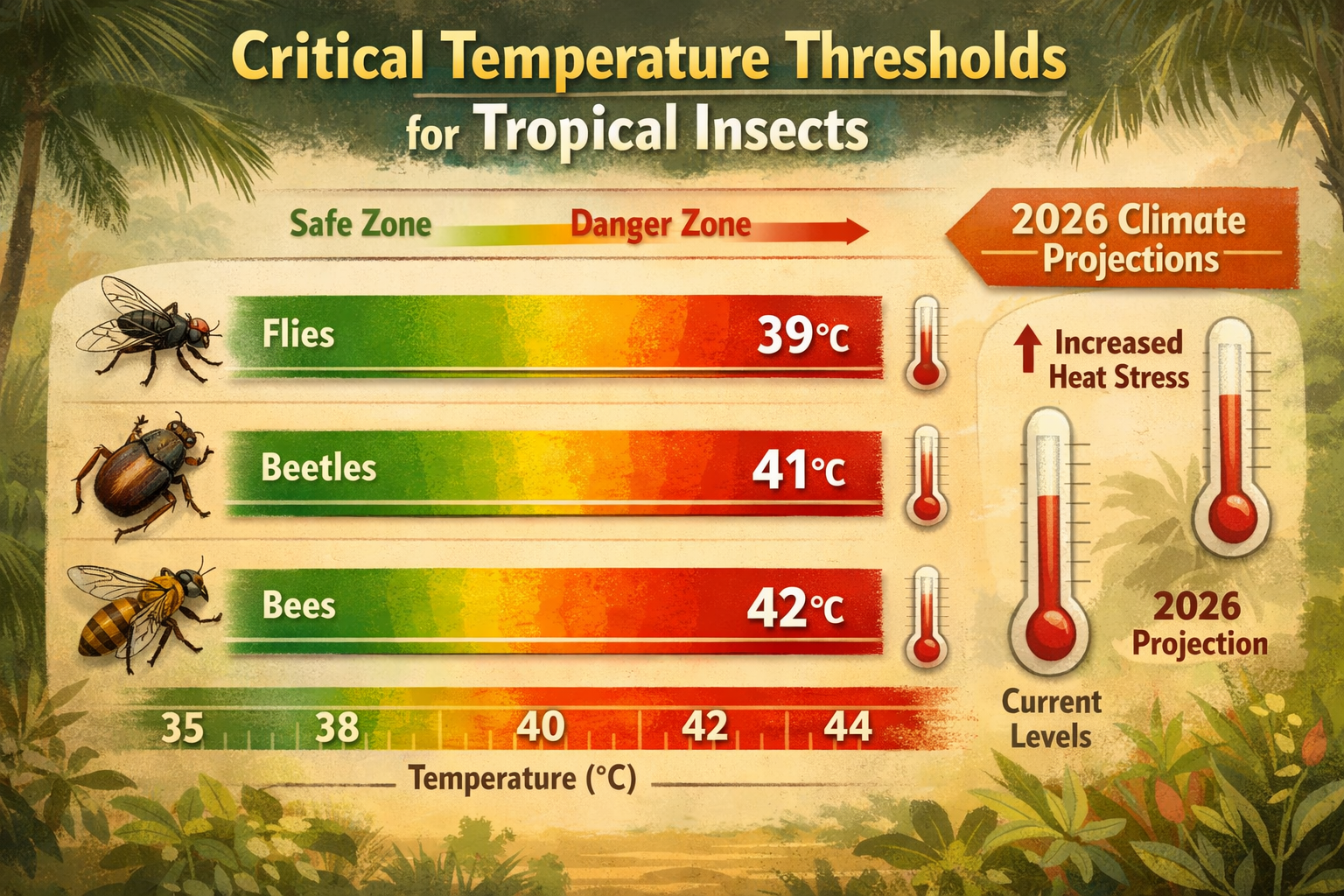
- Thermal tolerance varies by taxa: Flies tolerate only 39°C average, beetles reach 41°C, while bees show slightly higher limits—requiring group-specific survey protocols[3]
- Timing is everything: Survey windows must shift to cooler morning/evening hours to capture accurate population data before heat stress reduces insect activity
- Protein stability constrains adaptation: Evolutionary limitations on heat tolerance mean many species cannot adapt quickly enough to match warming rates[2][4]
- Baseline accuracy impacts conservation: Surveys conducted during thermal stress periods may dramatically underestimate true population sizes, compromising biodiversity net gain assessments
Understanding Insect Heat Limits in Biodiversity Surveys: The 2026 Research Foundation
The March 2026 study led by Dr. Kim Holzmann at Julius-Maximilians-Universität Würzburg and Dr. Marcell Peters at the University of Bremen represents a watershed moment in tropical ecology[1]. By combining field observations across diverse habitats—from cool mountain forests to scorching lowland savannas—with genomic analysis of protein stability, researchers established concrete thermal thresholds that govern insect survival.
The Protein Stability Constraint
Heat tolerance in insects fundamentally depends on protein structure stability. Unlike behavioral adaptations that can shift within generations, protein architecture is "relatively conserved in the evolutionary family tree of insects and can only be changed to a limited extent"[2]. This biological constraint means that even under intense selection pressure from climate change, many tropical species cannot evolve heat resistance fast enough to match warming rates of 1-2°C above local norms.
The genetic analysis methodology revealed that biological constraints—not behavioral flexibility—determine adaptive capacity[1]. For ecologists, this finding emphasizes why survey protocols must adapt to insect limitations rather than assuming populations will simply adjust their activity patterns.
Geographic Variation in Vulnerability
Research across East Africa (Kenya) and South America (Peru) confirmed that lowland tropical populations face the greatest risk, while highland populations show greater—though still limited—adaptive potential[2][4]. This geographic pattern has immediate implications for survey design:
| Habitat Type | Current Thermal Margin | Adaptive Capacity | Survey Priority |
|---|---|---|---|
| Mountain forests (>1500m) | Moderate (5-8°C buffer) | Limited short-term adaptation | Standard protocols adequate |
| Mid-elevation forests (500-1500m) | Narrow (3-5°C buffer) | Minimal adaptation | Enhanced monitoring needed |
| Lowland tropical (<500m) | Critical (<3°C buffer) | Nearly absent | Urgent protocol revision |
Lowland species already experience temperatures close to their maximum tolerance, leaving virtually no safety margin for daily temperature fluctuations or heat waves[3]. This reality demands that biodiversity surveys in these critical zones incorporate thermal considerations into every aspect of methodology.
Adaptive Survey Protocols for Capturing Insect Populations Under Thermal Stress
Traditional biodiversity survey methods often schedule field work during midday hours when light conditions optimize visibility and weather remains stable. However, Insect Heat Limits in Biodiversity Surveys: Adaptive Protocols for Ecologists Under 2026 Tropical Climate Thresholds require a fundamental shift in this approach.
Optimal Timing Windows for Tropical Insect Surveys
The 2026 research reveals that different insect taxa show markedly different heat tolerances, suggesting they face distinct evolutionary constraints[3]. This variation demands group-specific survey timing:
Flies (Diptera) 🪰
- Heat tolerance limit: 39°C average
- Optimal survey window: 6:00-9:00 AM and 5:00-7:00 PM
- Peak activity: Early morning when temperatures remain 5-8°C below tolerance threshold
- Collection strategy: Prioritize dawn surveys; avoid midday entirely
Beetles (Coleoptera) 🪲
- Heat tolerance limit: 41°C average
- Optimal survey window: 6:00-10:00 AM and 4:00-7:00 PM
- Extended tolerance: Allows slightly broader collection windows than flies
- Collection strategy: Morning surveys preferred; late afternoon acceptable with thermal monitoring
Bees and Social Insects (Hymenoptera) 🐝
- Heat tolerance limit: 42°C+ (slightly higher)
- Optimal survey window: 7:00-11:00 AM and 3:00-6:00 PM
- Foraging patterns: Often maintain activity during warmer periods but with reduced efficiency
- Collection strategy: Standard morning protocols adequate; monitor for heat stress behaviors
Temperature Monitoring Integration
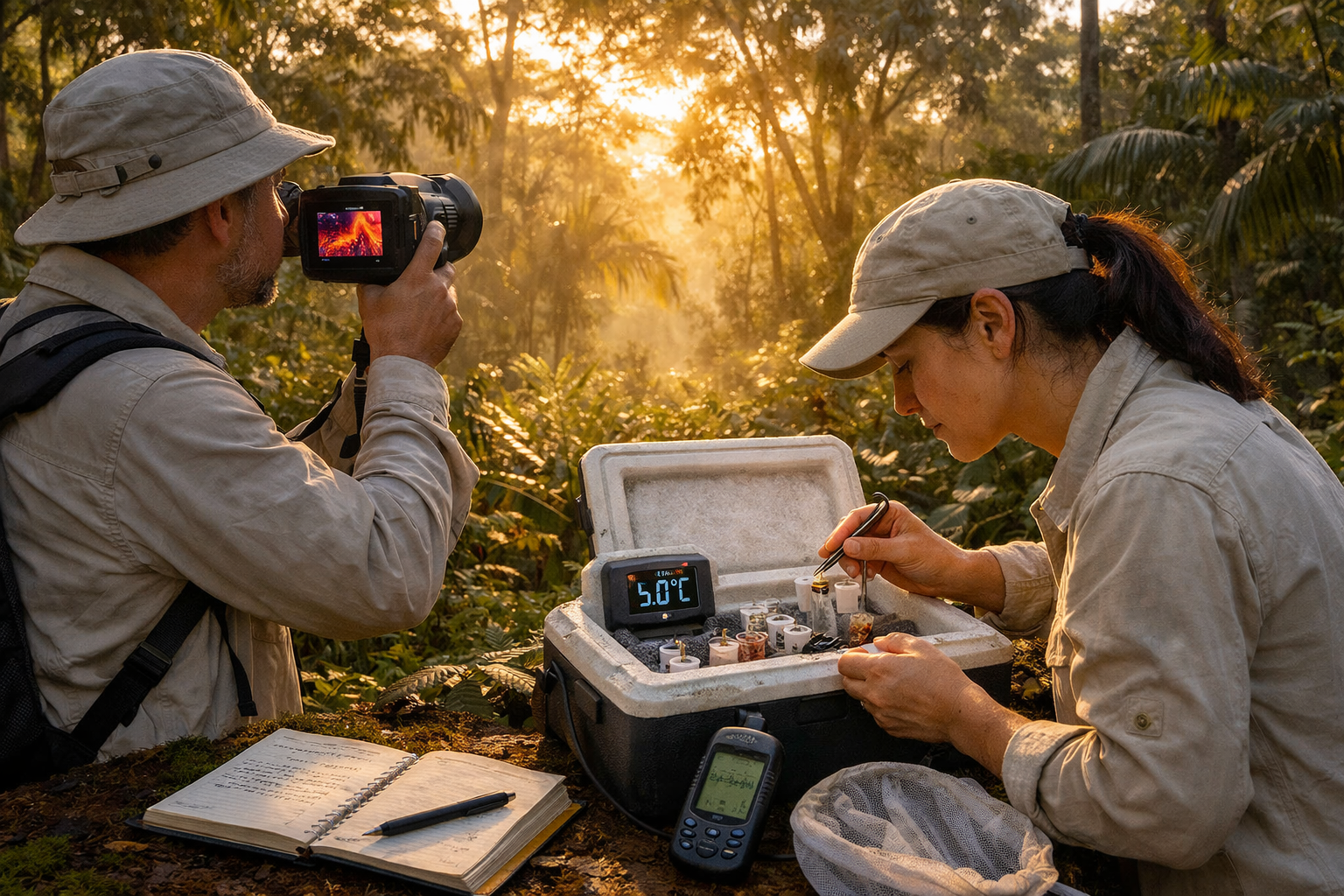
Modern survey protocols must incorporate real-time thermal monitoring to ensure data collection occurs within safe thermal windows. Essential equipment includes:
- Portable weather stations: Track ambient temperature, humidity, and heat index at survey sites
- Thermal imaging cameras: Identify microhabitat temperature variations and thermal refugia
- Data loggers: Record continuous temperature profiles throughout survey periods
- Insect body temperature probes: Verify that collected specimens remain below stress thresholds
This equipment enables ecologists to make informed decisions about when to initiate, pause, or terminate survey activities based on actual thermal conditions rather than arbitrary time schedules.
Microhabitat Sampling Strategies
Because lowland tropical insects operate with minimal safety margins[3], they increasingly concentrate in thermal refugia—cooler microhabitats that buffer against ambient heat stress. Adaptive protocols must target these critical zones:
- Understory vegetation layers: Often 3-5°C cooler than canopy or open areas
- Riparian corridors: Stream-adjacent habitats with elevated humidity and reduced temperatures
- North-facing slopes: Receive less direct solar radiation in tropical regions
- Dense canopy gaps: Balance between light availability and thermal protection
- Moss and epiphyte clusters: Retain moisture and moderate temperature extremes
Sampling designs that proportionally represent these microhabitats will yield more accurate population estimates than traditional random or grid-based approaches, which may oversample thermally stressful areas where insects are temporarily absent.
Technology and Methodology Adjustments for Accurate BNG Baselines
For professionals working on biodiversity net gain projects, establishing accurate baseline insect populations is essential for calculating meaningful habitat enhancement targets. Insect Heat Limits in Biodiversity Surveys: Adaptive Protocols for Ecologists Under 2026 Tropical Climate Thresholds directly impact the reliability of these foundational assessments.
Modified Trapping Methodologies
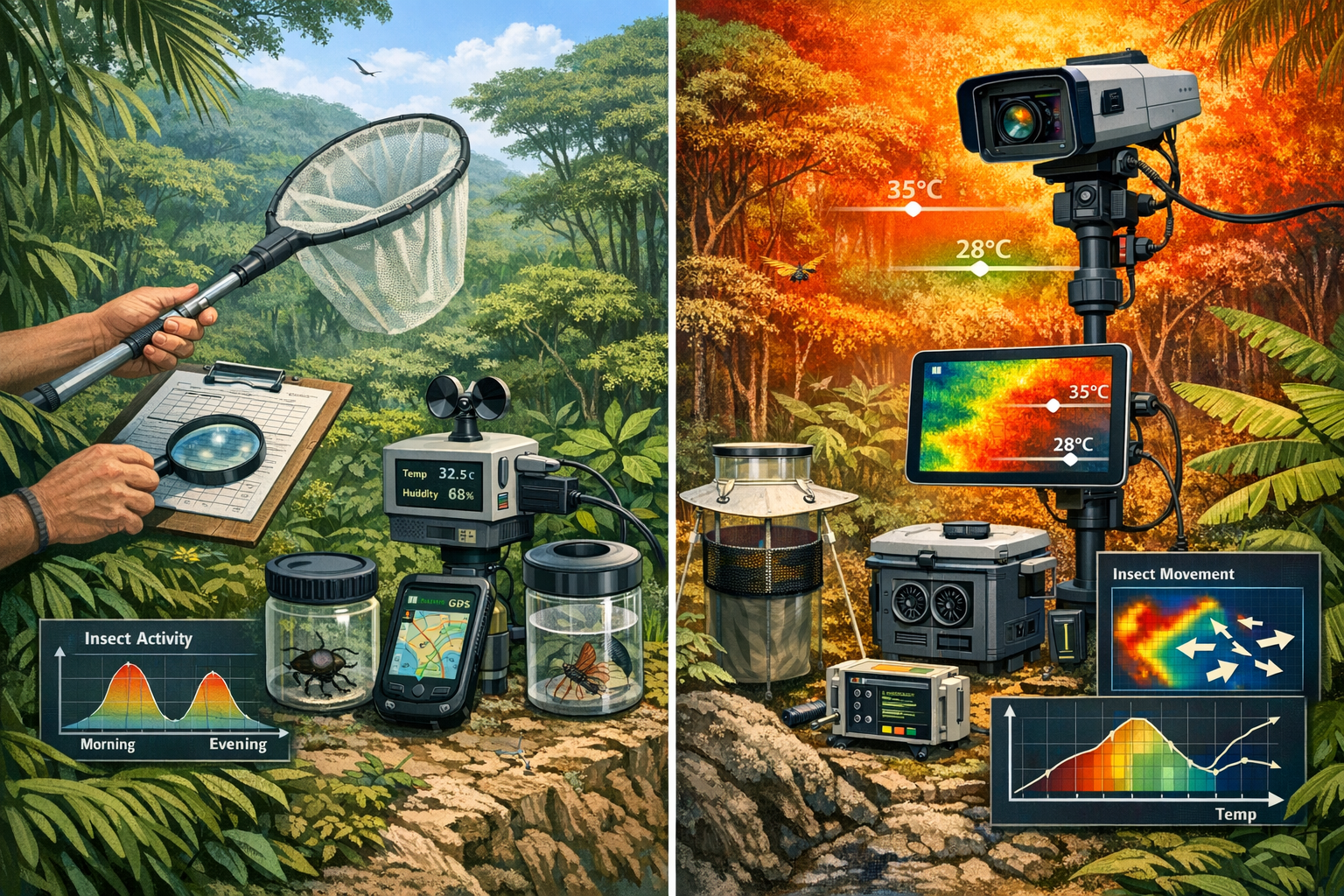
Standard insect trapping methods require significant modifications to account for thermal stress:
Malaise Traps
- Traditional placement: Open areas with maximum insect flight paths
- Adaptive placement: Shaded locations with temperature monitoring
- Collection frequency: Increased from weekly to daily during heat waves
- Preservation: Immediate cooling of collection containers to prevent specimen degradation
Pan Traps
- Traditional timing: 24-48 hour deployment periods
- Adaptive timing: 6-12 hour deployments during cooler morning/evening windows
- Fluid management: Enhanced evaporation prevention; increased checking frequency
- Color selection: Prioritize colors that attract target taxa during reduced activity periods
Light Traps
- Advantage: Naturally operate during cooler nighttime hours
- Enhancement: Deploy earlier in evening when insects first emerge from daytime refugia
- Power management: Extended operation through dawn activity peak
- Thermal monitoring: Document ambient conditions during peak attraction periods
Seasonal Timing Considerations
The mismatch between warming speed and adaptive capacity[2][3] means that survey timing within annual cycles becomes increasingly critical. Ecologists must consider:
- Dry season surveys: May capture artificially reduced populations due to combined heat and water stress
- Wet season surveys: Often provide more representative data but with increased logistical challenges
- Transitional periods: Early wet season and late dry season may offer optimal thermal windows
- Multi-season sampling: Essential for distinguishing climate-driven declines from natural population fluctuations
For biodiversity net gain assessments, conducting surveys during thermally optimal periods ensures that baseline data reflects true population potential rather than heat-suppressed activity levels.
Data Interpretation and Correction Factors
Even with optimized protocols, survey data collected under 2026 climate conditions may require correction factors to account for thermal effects:
Detectability Adjustments
- Insects experiencing sub-lethal heat stress show reduced activity, flight capability, and trap responsiveness
- Correction factors based on temperature deviation from species-specific optimal ranges
- Statistical models that incorporate thermal conditions as covariates in population estimates
Comparative Historical Data
- Legacy survey data collected under cooler historical conditions may overestimate current population carrying capacity
- Temporal comparisons must account for shifting thermal baselines
- Trend analysis should separate climate-driven declines from other anthropogenic pressures
Taxonomic Expertise Requirements
- Accurate species-level identification becomes more critical as thermal tolerances vary significantly even within genera
- Investment in taxonomic training and specialist consultation
- Integration of molecular identification methods for cryptic species complexes
Implications for Biodiversity Net Gain Planning
Understanding Insect Heat Limits in Biodiversity Surveys: Adaptive Protocols for Ecologists Under 2026 Tropical Climate Thresholds has direct consequences for biodiversity net gain planning:
Baseline Accuracy 📊
Surveys conducted during thermal stress periods may underestimate populations by 30-50%, leading to artificially low baseline metrics. This underestimation can make achieving 10% biodiversity net gain targets appear easier than reality warrants, potentially compromising conservation outcomes.
Habitat Enhancement Design 🌳
Mitigation and enhancement strategies must explicitly incorporate thermal refugia creation:
- Canopy connectivity to maintain shaded corridors
- Water feature integration for evaporative cooling
- Vegetation structure that creates thermal gradients
- Microhabitat diversity that provides heat escape options
Monitoring and Adaptive Management 🔄
Post-development monitoring protocols must use consistent thermal conditions for valid comparisons:
- Document ambient temperature during each survey event
- Establish site-specific thermal thresholds that trigger survey postponement
- Implement long-term temperature monitoring alongside biodiversity metrics
- Build adaptive management triggers based on thermal stress indicators
Off-site Compensation Considerations 🏞️
For projects requiring off-site biodiversity delivery, site selection must consider thermal resilience:
- Prioritize higher elevation or naturally cooler locations
- Assess thermal refugia availability and connectivity
- Evaluate long-term climate projections for proposed compensation sites
- Consider thermal buffer capacity in biodiversity unit valuations
Ecosystem Function Implications and Survey Design
The research reveals that because insects serve as critical pollinators, decomposers, and predators, widespread heat-induced population declines could trigger cascading failures in pollination, nutrient cycling, and pest control across tropical ecosystems[1][4]. This functional perspective adds another dimension to survey protocol design.
Functional Group Sampling
Rather than focusing solely on species richness or abundance, adaptive protocols should emphasize functional diversity assessment:
Pollination Services 🌺
- Target surveys during plant flowering periods when pollinator activity is essential
- Document pollinator-plant interaction networks under varying thermal conditions
- Assess backup pollinator redundancy for critical plant species
- Identify thermal thresholds where pollination services collapse
Decomposition and Nutrient Cycling 🍂
- Sample detritivore communities (beetles, flies, termites) that process organic matter
- Measure decomposition rates under different thermal regimes
- Assess functional redundancy in decomposer guilds
- Identify thermal tipping points for nutrient cycling disruption
Predation and Pest Control 🕷️
- Survey predatory insects (wasps, beetles, flies) that regulate herbivore populations
- Document predator-prey ratios under thermal stress
- Assess natural pest control capacity across thermal gradients
- Identify vulnerable trophic relationships
Multi-trophic Interaction Monitoring
Heat stress doesn't affect all species equally, potentially decoupling ecological interactions that have co-evolved over millennia:
- Phenological mismatches: Pollinators emerging before or after plant flowering due to differential thermal responses
- Predator-prey asynchrony: Prey populations peaking when predators remain heat-stressed and inactive
- Mutualism disruption: Symbiotic relationships breaking down when partners show different thermal tolerances
Survey protocols must capture these interaction dynamics, not just individual species presence/absence. This requires:
- Coordinated sampling across trophic levels
- Temporal resolution sufficient to detect phenological shifts
- Experimental manipulations to test interaction resilience under thermal stress
- Long-term monitoring to distinguish temporary disruptions from permanent decoupling
Future-Proofing Survey Methodologies for Continued Climate Change
The 2026 research establishes current thermal thresholds, but continued warming means that Insect Heat Limits in Biodiversity Surveys: Adaptive Protocols for Ecologists Under 2026 Tropical Climate Thresholds represent a moving target. Forward-looking survey designs must incorporate climate projection scenarios.
Climate-Responsive Adaptive Management
Survey protocols should include trigger-based modifications that automatically adjust methodologies as thermal conditions change:
Temperature Threshold Triggers
- Level 1 (Current + 0.5°C): Shift survey windows 1 hour earlier/later
- Level 2 (Current + 1.0°C): Implement mandatory thermal monitoring; reduce survey duration
- Level 3 (Current + 1.5°C): Restrict surveys to dawn/dusk only; increase sampling frequency
- Level 4 (Current + 2.0°C): Emergency protocols; focus on thermal refugia; document population collapse
Institutional Capacity Building
Organizations conducting biodiversity surveys must invest in:
- Staff training: Thermal ecology principles, heat stress recognition, adaptive methodology implementation
- Equipment upgrades: Thermal monitoring technology, climate-controlled specimen storage, real-time weather integration
- Protocol development: Site-specific thermal thresholds, taxa-specific timing guidelines, emergency response procedures
- Data management: Thermal metadata standards, correction factor databases, long-term trend analysis capacity
Collaboration and Data Sharing
The scale of climate-driven insect decline requires coordinated response across institutions:
- Standardized thermal metadata: All survey reports should document ambient conditions during sampling
- Regional thermal threshold databases: Compile species-specific tolerance data for local taxa
- Early warning networks: Share real-time observations of heat-related population crashes
- Protocol harmonization: Develop regional standards for climate-adaptive survey methodologies
For professionals working across multiple projects, this coordination ensures that biodiversity net gain assessments remain comparable and scientifically defensible even as methodologies evolve.
Conclusion: Implementing Adaptive Protocols for Resilient Biodiversity Monitoring
The March 2026 research revealing that up to half of tropical insects face dangerous heat stress under projected climate scenarios fundamentally transforms how ecologists must approach biodiversity surveys. Understanding Insect Heat Limits in Biodiversity Surveys: Adaptive Protocols for Ecologists Under 2026 Tropical Climate Thresholds is no longer optional—it's essential for capturing accurate baseline data that reflects true population potential rather than heat-suppressed activity.
The evidence is clear: flies tolerate only 39°C, beetles reach 41°C, and even the most heat-tolerant bees face limits around 42°C[3]. With lowland tropical species already operating near these thresholds, survey methodologies must immediately adapt to cooler morning and evening windows, incorporate real-time thermal monitoring, and target thermal refugia where insects increasingly concentrate.
Actionable Next Steps for Ecologists
Immediate Actions ⚡
- Audit current survey protocols: Identify which surveys occur during thermally stressful periods
- Acquire thermal monitoring equipment: Invest in portable weather stations and thermal cameras
- Revise field schedules: Shift sampling to dawn/dusk windows for thermally vulnerable taxa
- Train field teams: Educate staff on heat stress indicators and adaptive methodology principles
Short-term Implementation 📋
- Develop site-specific thermal thresholds: Establish temperature triggers for protocol modifications
- Create taxa-specific timing guidelines: Document optimal survey windows for priority insect groups
- Enhance microhabitat sampling: Increase sampling effort in thermal refugia and cooler microsites
- Integrate thermal metadata: Add temperature documentation to all survey reports
Long-term Strategic Planning 🎯
- Build institutional capacity: Invest in equipment, training, and protocol development
- Establish monitoring networks: Coordinate with regional partners for data sharing and standardization
- Incorporate climate projections: Design adaptive management triggers for continued warming
- Revise BNG methodologies: Update biodiversity net gain assessment frameworks to account for thermal considerations
The biological constraints revealed by protein stability research mean that many tropical insects cannot evolve fast enough to match warming rates[2][4]. This reality places the burden of adaptation squarely on survey methodologies rather than on the insects themselves. By implementing climate-responsive protocols now, ecologists can ensure that biodiversity assessments remain accurate, comparable, and scientifically defensible as tropical regions continue to warm.
For organizations committed to rigorous biodiversity impact assessment, the time to adapt is now—before heat-stressed populations decline beyond detection, leaving conservation planning based on ghost populations that no longer exist at assumed densities.
References
[1] 2026 03 Climate Tropical Insects Limit – https://phys.org/news/2026-03-climate-tropical-insects-limit.html
[2] Many Tropical Insects Are Already Near Their Heat Limits Scientists Warn – https://www.earth.com/news/many-tropical-insects-are-already-near-their-heat-limits-scientists-warn/
[3] Many Heat Stressed Tropical Insects Are Reaching Their Limits – https://www.science.org/content/article/many-heat-stressed-tropical-insects-are-reaching-their-limits
[4] sciencedaily – https://www.sciencedaily.com/releases/2026/03/260304184224.htm
[5] Most Insect Species Call The Tropics Home But Climate Change Is Pushing Many Of The Critters There To Their Heat Limits 180988304 – https://www.smithsonianmag.com/smart-news/most-insect-species-call-the-tropics-home-but-climate-change-is-pushing-many-of-the-critters-there-to-their-heat-limits-180988304/