

Between January 2023 and September 2025, bleaching-level heat stress impacted 84.4% of the world's coral reef area—the most severe global bleaching event ever recorded [3]. As ocean temperatures continue to rise through 2026, marine ecologists face an unprecedented challenge: how to accurately assess biodiversity on reefs that are fundamentally transforming before our eyes. The Coral Bleaching Crisis: Marine Biodiversity Survey Protocols for Climate-Stressed Reefs in 2026 represents a critical evolution in marine conservation methodology, combining advanced thermal monitoring, underwater drone technology, and rapid assessment techniques to capture real-time data on ecosystems in flux.
This comprehensive guide provides marine biologists, conservation organizations, and environmental consultants with practical protocols for conducting biodiversity surveys on climate-stressed reefs, ensuring accurate baseline data collection even as coral ecosystems undergo dramatic shifts.
Key Takeaways
- Record-breaking bleaching: The fourth global bleaching event (2023-2025) affected 84.4% of world's reefs across 83 countries, demanding updated survey methodologies
- Integrated monitoring approach: Combining satellite thermal data, underwater drones, and traditional dive surveys provides comprehensive biodiversity assessment
- Standardized protocols essential: Consistent survey methods enable meaningful comparison across bleaching events and geographic regions
- Technology-enhanced accuracy: ROVs, photogrammetry, and eDNA sampling improve data quality while reducing surveyor risk in degraded environments
- Resilience-focused frameworks: Modern protocols assess not just current biodiversity but recovery potential and climate adaptation capacity
Understanding the Scale of the Current Coral Bleaching Crisis
The fourth global coral bleaching event, officially declared by NOAA on April 15, 2024, represents an ecological emergency of unprecedented proportions [3]. Unlike previous events, this crisis has demonstrated both extreme geographic reach and sustained duration, with impacts extending well into 2026.
Global Impact Statistics
Mass coral bleaching has been confirmed in at least 83 countries and territories as of late 2025 [3]. To put this in perspective, the previous record-holder—the 2014-2017 Third Global Bleaching Event—affected approximately 51% of the world's coral reefs [6]. The current event has surpassed that figure by more than 30 percentage points, making it the most geographically extensive bleaching crisis in recorded history.
The Great Barrier Reef alone experienced its sixth mass bleaching event since 2016 in 2025, marking only the second occurrence of consecutive years of bleaching (2016-2017 and 2024-2025) [1]. During the March 2024 event, 60% of 1,036 surveyed reefs in the Northern and Central regions suffered moderate or severe bleaching [1].
Why Traditional Survey Methods Fall Short
🔬 Critical Challenge: Standard biodiversity survey protocols were developed for relatively stable reef ecosystems, not for environments undergoing rapid, widespread transformation.
Traditional coral reef surveys typically involve:
- Annual or biannual assessment cycles
- Fixed monitoring sites with historical baseline data
- Visual estimation of coral cover and species composition
- Assumption of seasonal stability between surveys
These methods become problematic when:
- Bleaching events occur rapidly (within 2-4 weeks of heat stress)
- Recovery timelines are uncertain (ranging from months to never)
- Mortality rates vary dramatically by species, location, and depth
- Thermal stress continues beyond traditional survey windows
The need for updated Coral Bleaching Crisis: Marine Biodiversity Survey Protocols for Climate-Stressed Reefs in 2026 stems directly from these limitations. Modern protocols must capture both the immediate impacts of bleaching and the ongoing recovery or degradation trajectories.
Core Components of Modern Marine Biodiversity Survey Protocols
Effective biodiversity assessment on climate-stressed reefs requires a multi-layered approach that combines remote sensing, in-water surveys, and laboratory analysis. Similar to how biodiversity impact assessments require systematic methodology for terrestrial environments, marine surveys demand rigorous, repeatable protocols.
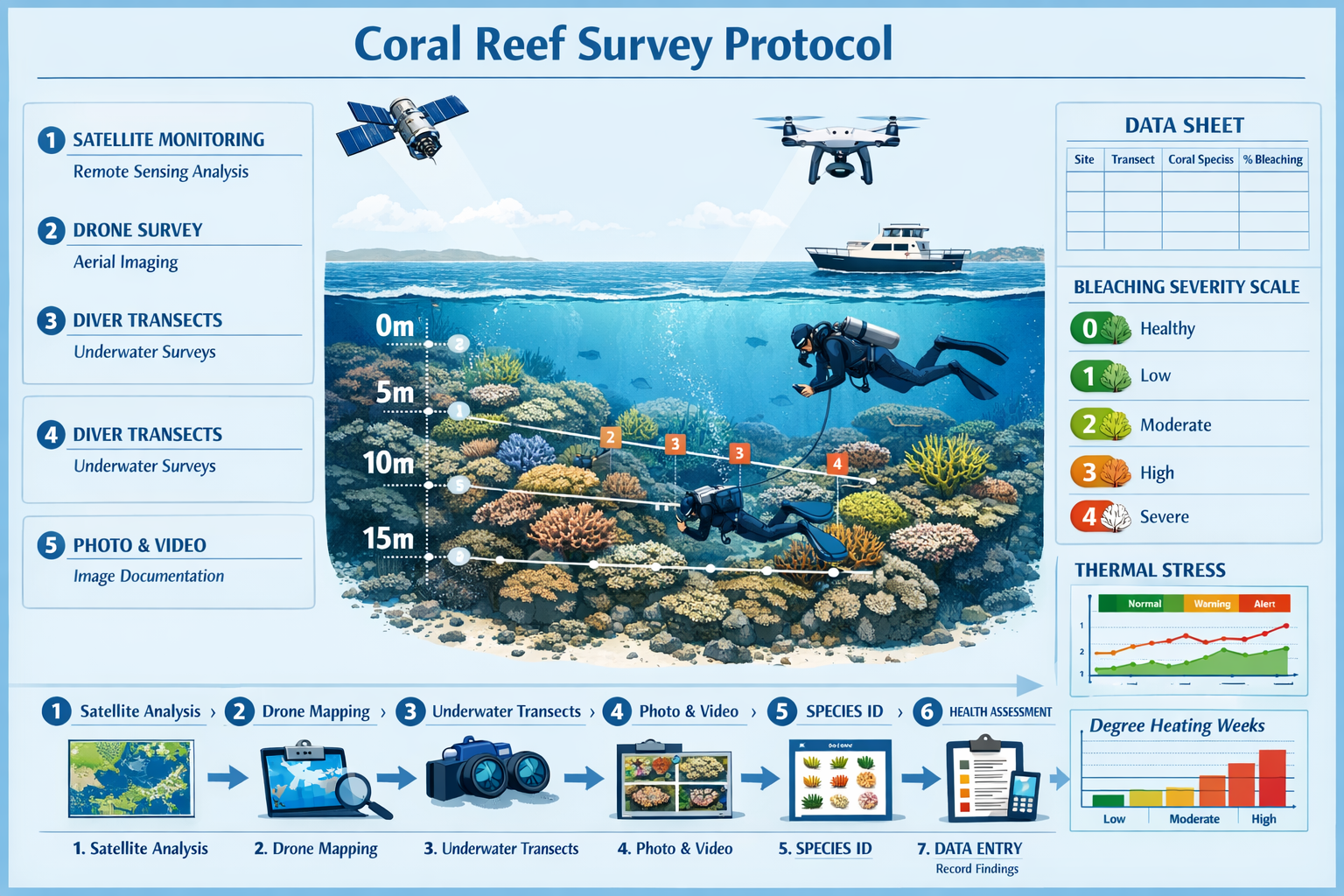
1. Satellite-Based Thermal Monitoring
The foundation of contemporary Coral Bleaching Crisis: Marine Biodiversity Survey Protocols for Climate-Stressed Reefs in 2026 begins before surveyors enter the water. NOAA Coral Reef Watch's satellite-derived heat stress measures provide critical pre-survey intelligence [6].
Key Metrics to Monitor:
| Metric | Description | Bleaching Threshold |
|---|---|---|
| Sea Surface Temperature (SST) | Daily temperature readings | >1°C above maximum monthly mean |
| Degree Heating Weeks (DHW) | Accumulated thermal stress | 4 DHW = bleaching likely; 8+ DHW = mortality risk |
| Bleaching Alert Level | Standardized warning system | Alert Level 2 = widespread bleaching expected |
| HotSpot Values | Temperature anomalies | Positive values indicate stress conditions |
During the 2014-2017 event, heat stress reached levels so extreme that NOAA Coral Reef Watch created new, higher bleaching alert levels previously unnecessary [6]. These enhanced alert systems now provide surveyors with advance warning of 2-4 weeks before visible bleaching occurs.
2. Underwater Drone and ROV Deployment
Remotely Operated Vehicles (ROVs) and Autonomous Underwater Vehicles (AUVs) have revolutionized survey efficiency and safety. These technologies are particularly valuable when:
- Surveying deeper reef zones (>30 meters) where bleaching patterns differ
- Covering large geographic areas quickly during acute bleaching events
- Reducing surveyor exposure to potentially hazardous conditions
- Capturing high-resolution photographic transects for later analysis
ROV Survey Protocol:
- ✅ Establish grid pattern covering representative reef zones
- ✅ Maintain consistent altitude (1-2 meters above substrate)
- ✅ Record continuous video with overlapping still images every 2 meters
- ✅ Document depth, temperature, and GPS coordinates throughout
- ✅ Flag areas requiring detailed diver assessment
3. Standardized Diver Assessment Techniques
Despite technological advances, trained scientific divers remain essential for detailed biodiversity assessment. The Coral Bleaching Crisis: Marine Biodiversity Survey Protocols for Climate-Stressed Reefs in 2026 incorporates refined diver methodologies developed through the analysis of 15,066 reef surveys globally [2].
Belt Transect Method (Enhanced):
- Transect dimensions: 50m length × 2m width (100m² per transect)
- Minimum transects per site: 6-10 (depending on reef complexity)
- Bleaching severity scale: 0 (no bleaching) to 4 (>90% bleached)
- Species-level documentation: Record bleaching response by coral genus
- Associated fauna: Document fish abundance, invertebrate presence
Photo-Quadrat Technique:
- 0.5m × 0.5m quadrats at 1-meter intervals along transect
- Minimum 50 quadrats per site
- Standardized camera settings and lighting
- Photogrammetric analysis for 3D reef structure modeling
The systematic review published February 25, 2026, analyzing 220 studies from 1996-2025, confirms that consistent methodology across surveys enables meaningful comparison of bleaching impacts and recovery trajectories [4].
Advanced Technologies Enhancing Survey Accuracy
Environmental DNA (eDNA) Sampling
Environmental DNA sampling has emerged as a powerful complement to visual surveys, particularly for cryptic species and mobile fauna that may be underrepresented in traditional counts.
eDNA Protocol for Bleached Reefs:
- Collect 2-liter water samples at multiple depths (surface, 5m, 10m, 15m)
- Filter samples through 0.22μm membrane filters within 24 hours
- Preserve filters in preservation buffer at -20°C
- Sequence using metabarcoding for species identification
- Compare results with visual survey data for validation
eDNA is particularly valuable for detecting:
- Fish species diversity before and after bleaching events
- Presence of coral larvae during recovery phases
- Microbial community shifts associated with coral stress
- Invasive species that may colonize degraded reefs
Photogrammetry and 3D Reef Mapping
Structure-from-Motion (SfM) photogrammetry creates detailed 3D models of reef architecture, enabling precise measurement of:
- Structural complexity: Rugosity indices that correlate with biodiversity
- Coral colony volume: Tracking growth or shrinkage over time
- Dead coral coverage: Distinguishing recent mortality from historical loss
- Recovery patterns: Identifying recruitment zones and growth rates
This technology proves especially valuable for biodiversity net gain assessments, providing quantifiable metrics for restoration success.
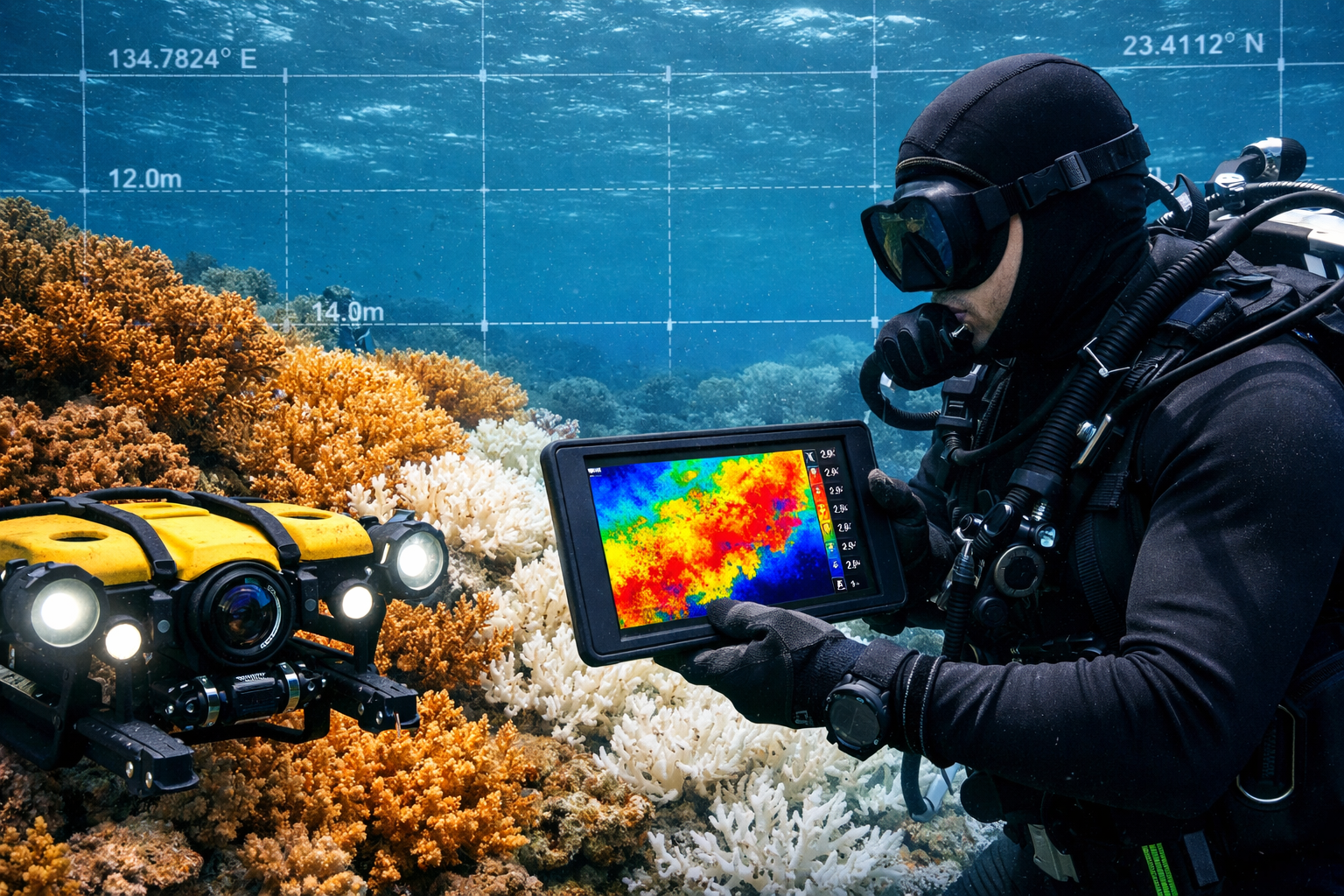
Thermal Imaging Underwater
Emerging underwater thermal imaging technology allows surveyors to detect temperature microclimates that may provide thermal refugia for coral communities. These cooler pockets can indicate:
- Upwelling zones with cooler deep water
- Shaded areas with reduced thermal stress
- Priority conservation sites with natural resilience
- Potential coral translocation destinations
Implementing Coral Bleaching Crisis Survey Protocols: Step-by-Step Framework
Phase 1: Pre-Survey Planning (2-4 weeks before fieldwork)
Satellite Data Review:
- Access NOAA Coral Reef Watch for target region
- Document DHW accumulation and bleaching alert levels
- Identify high-priority survey sites based on thermal stress patterns
- Coordinate timing with predicted bleaching peak or recovery window
Stakeholder Coordination:
Similar to benefitting nature and developers through systematic surveys, marine biodiversity protocols require coordination with:
- Local marine park authorities
- Research institutions with historical data
- Community stakeholders and traditional knowledge holders
- Government environmental agencies
Equipment Preparation:
- ✅ Calibrate underwater cameras and sensors
- ✅ Test ROV/AUV systems in controlled conditions
- ✅ Prepare data sheets with site-specific information
- ✅ Organize eDNA sampling kits and preservation materials
- ✅ Verify GPS and depth measurement accuracy
Phase 2: Field Survey Execution (5-10 days depending on site number)
Day 1-2: Reconnaissance and Site Establishment
- Conduct preliminary ROV surveys to assess overall conditions
- Establish permanent monitoring stations with GPS markers
- Document water quality parameters (temperature, salinity, pH, dissolved oxygen)
- Capture wide-angle photographic overview of each site
Day 3-7: Detailed Biodiversity Assessment
- Execute standardized transect surveys (minimum 6 per site)
- Collect photo-quadrat data at 1-meter intervals
- Perform species-level coral identification and bleaching severity scoring
- Document fish assemblages using timed swim counts
- Collect eDNA water samples at multiple depths
- Record invertebrate abundance and diversity
Day 8-10: Validation and Gap-Filling
- Review preliminary data for completeness
- Resurvey sites with data quality concerns
- Conduct targeted searches for rare or indicator species
- Capture additional photogrammetry sequences for 3D modeling
Phase 3: Post-Survey Analysis (2-4 weeks)
Data Processing:
- Process photogrammetry into 3D reef models
- Analyze photo-quadrats using CoralNet or similar AI-assisted tools
- Calculate bleaching severity indices and coral cover percentages
- Process eDNA samples and conduct metabarcoding analysis
- Compile fish and invertebrate species lists
Comparative Analysis:
The comprehensive analysis published February 10, 2026, involving nearly 200 co-authors from 143 institutions, demonstrated that global-scale comparison requires standardized metrics [2]. Key calculations include:
- Bleaching prevalence: Percentage of colonies showing any bleaching
- Bleaching severity: Mean severity score across all colonies
- Mortality rate: Percentage of recently dead coral
- Community composition shifts: Changes in dominant coral genera
- Biodiversity indices: Shannon diversity, Simpson's index, species richness
Addressing Challenges in Climate-Stressed Reef Surveys
Challenge 1: Distinguishing Bleaching from Mortality
Problem: Bleached corals may appear similar to recently dead coral covered in algae.
Solution: Multi-temporal surveys with 4-6 week intervals during bleaching events. Document:
- Tissue condition (intact vs. degraded)
- Polyp extension (visible at night on bleached but living coral)
- Algal colonization patterns (rapid on dead coral)
- Fluorescence under blue light (persists in stressed but living coral)
Challenge 2: Survey Timing Optimization
Problem: Bleaching and recovery occur on different timelines across reef zones and species.
Solution: Implement adaptive survey scheduling based on satellite data:
- Acute phase: Survey 2-4 weeks after DHW reaches 4
- Peak bleaching: Survey when DHW reaches 8-10
- Early recovery: Survey 4-6 weeks after thermal stress subsides
- Long-term monitoring: Quarterly surveys for first year post-bleaching
Challenge 3: Surveyor Safety in Degraded Environments
Problem: Degraded reefs may have unstable structures, increased predator activity, or poor visibility.
Solution: Enhanced safety protocols including:
- Increased use of ROV technology for initial assessment
- Buddy system with surface support for all dives
- Reduced bottom time on structurally compromised reefs
- Alternative survey methods (drop cameras, baited remote underwater video) when conditions are hazardous
Resilience Assessment and Recovery Monitoring
Modern Coral Bleaching Crisis: Marine Biodiversity Survey Protocols for Climate-Stressed Reefs in 2026 extend beyond damage assessment to evaluate recovery potential. The systematic review confirms that evidence-based protocols emphasize four primary resilience strategies [4]:
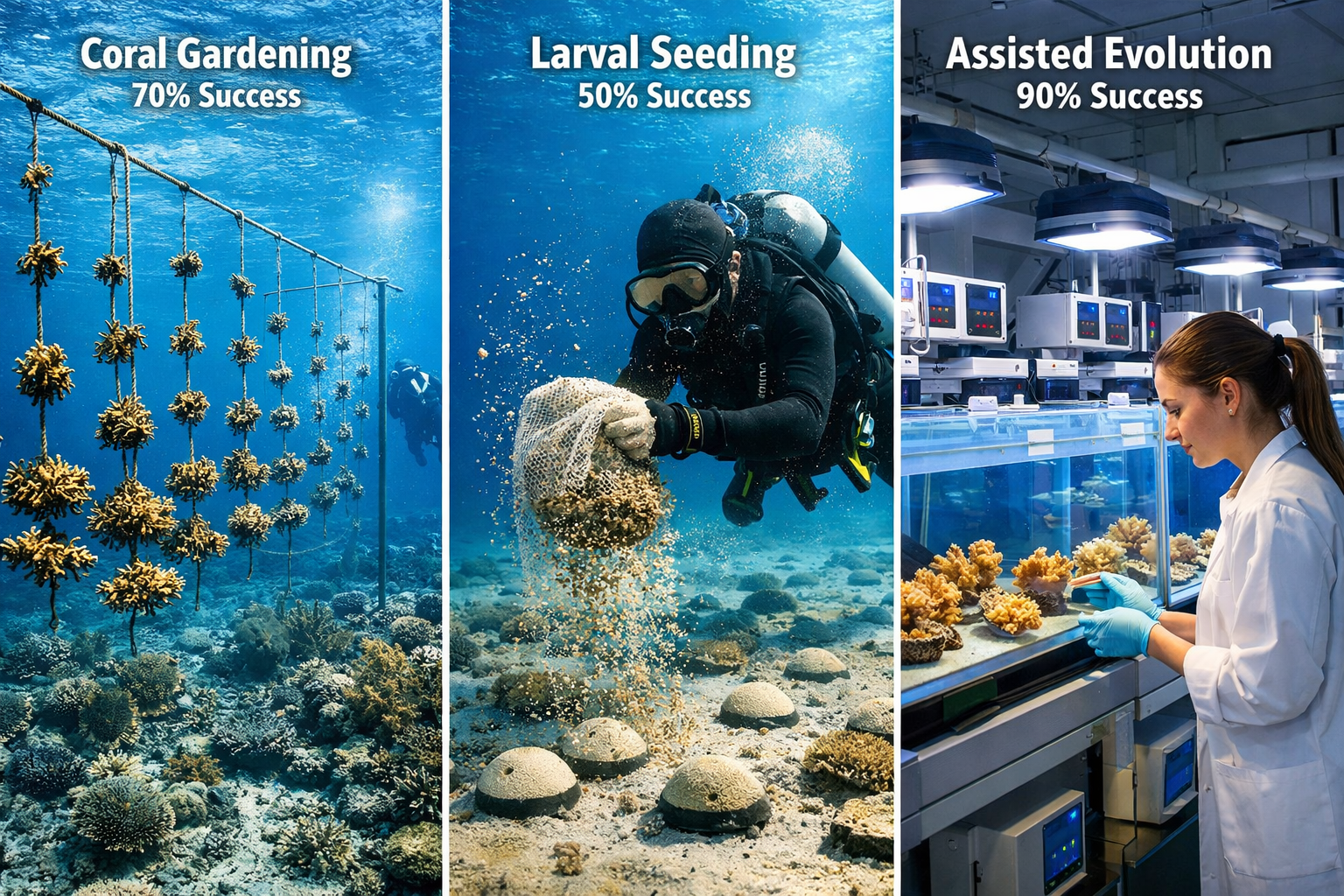
1. Coral Gardening Potential
Survey protocols should identify:
- Coral fragments suitable for nursery propagation
- Healthy donor colonies for fragment collection
- Suitable substrate for coral outplanting
- Areas with favorable conditions for restoration
2. Larval Restoration Opportunities
Assessment of natural recruitment includes:
- Presence of reproductive coral colonies
- Settlement substrate availability
- Larval connectivity with upstream reefs
- Timing of spawning events for intervention planning
3. Assisted Evolution Candidates
Identification of heat-tolerant genotypes through:
- Documentation of colonies surviving extreme bleaching
- Genetic sampling for stress-tolerance markers
- Comparison of bleaching response across coral families
- Selection of candidates for selective breeding programs
4. Marine Protected Area Design
Survey data informs climate-smart MPA planning by identifying:
- Thermal refugia: Sites with consistently lower thermal stress
- Connectivity corridors: Areas facilitating larval exchange
- High-diversity zones: Regions maintaining species richness despite stress
- Recovery hotspots: Sites showing rapid post-bleaching recovery
This approach aligns with principles similar to achieving biodiversity net gain, where systematic assessment informs strategic conservation action.
Data Management and Reporting Standards
Database Integration
Effective Coral Bleaching Crisis: Marine Biodiversity Survey Protocols for Climate-Stressed Reefs in 2026 require integration with global monitoring networks:
Essential Data Repositories:
- NOAA Coral Reef Watch: Submit bleaching observations to validate satellite predictions
- ReefBase: Contribute to global coral reef database
- OBIS (Ocean Biodiversity Information System): Share species occurrence data
- Global Coral Reef Monitoring Network: Standardized reporting for international comparison
Reporting Framework
Comprehensive survey reports should include:
-
Executive Summary (2-3 pages)
- Overall bleaching severity and extent
- Biodiversity impact assessment
- Priority conservation recommendations
-
Methods Section (5-10 pages)
- Detailed protocol description
- Equipment specifications
- Quality control measures
- Limitations and uncertainties
-
Results Section (10-20 pages)
- Site-by-site assessment with maps
- Statistical analysis of bleaching patterns
- Species lists and biodiversity metrics
- Photographic documentation
- Comparative analysis with historical data
-
Discussion and Recommendations (5-10 pages)
- Ecological implications of findings
- Recovery prognosis
- Management recommendations
- Future monitoring priorities
-
Appendices
- Raw data tables
- Species identification references
- GPS coordinates of survey sites
- Photographic archives
Understanding what goes into comprehensive biodiversity assessments provides valuable context for marine survey reporting standards.
Training and Capacity Building for 2026 Protocols
Essential Competencies for Marine Surveyors
Technical Skills:
- 🤿 Advanced scientific diving certification (minimum 100 logged dives)
- 📊 Coral taxonomy and identification (genus-level minimum)
- 🎥 Underwater photography and videography
- 💻 Data analysis software proficiency (R, Python, or specialized coral analysis tools)
- 🔬 eDNA sampling and processing techniques
Knowledge Requirements:
- Climate change impacts on marine ecosystems
- Coral physiology and bleaching mechanisms
- Fish and invertebrate identification
- Statistical analysis and experimental design
- GIS and remote sensing applications
Certification Programs
Several institutions now offer specialized training in climate-stressed reef assessment:
- International Coral Reef Society workshops [7]
- NOAA Coral Reef Conservation Program training
- Reef Check EcoDiver certification with bleaching module
- University-based marine biodiversity survey courses
Regional Considerations and Adaptive Protocols
Indo-Pacific vs. Caribbean Protocols
While core methodologies remain consistent, regional adaptations account for:
Indo-Pacific Reefs:
- Higher coral diversity (>500 species) requires genus-level identification
- Complex reef structures with multiple zones
- Greater depth range (0-40m surveys common)
- Monsoon seasonality affects survey timing
Caribbean Reefs:
- Lower coral diversity (~60 species) enables species-level surveys
- Simpler reef structures with fewer zones
- Shallower maximum depths (0-20m typically)
- Hurricane impacts complicate bleaching assessment
Depth-Stratified Sampling
The analysis of 15,066 reef surveys revealed that bleaching severity varies significantly with depth [2]. Protocols should include:
- Shallow zone (0-5m): Highest thermal stress, often most severe bleaching
- Mid-depth zone (5-15m): Intermediate stress, variable bleaching response
- Deep zone (15-30m): Potential thermal refugia, lower bleaching prevalence
- Mesophotic zone (30-150m): Deep reef assessment for refuge populations
Integration with Global Conservation Frameworks
Alignment with International Initiatives
Coral Bleaching Crisis: Marine Biodiversity Survey Protocols for Climate-Stressed Reefs in 2026 support multiple global conservation objectives, similar to how biodiversity initiatives inform climate policy:
UN Sustainable Development Goals:
- SDG 14: Life Below Water (direct contribution)
- SDG 13: Climate Action (documenting climate impacts)
- SDG 15: Life on Land (coastal ecosystem connectivity)
Post-2020 Global Biodiversity Framework:
- Target 2: Restoration of degraded ecosystems
- Target 3: Protected area coverage and effectiveness
- Target 8: Climate change adaptation and mitigation
Paris Agreement:
- Documenting climate change impacts
- Informing adaptation strategies
- Supporting loss and damage assessments
Economic Valuation of Survey Data
High-quality biodiversity survey data enables:
- Insurance claims for reef-dependent industries
- Ecosystem service valuations
- Cost-benefit analysis of restoration interventions
- Damage assessments for legal proceedings
- Investment decisions for conservation finance
Future Directions: Emerging Technologies and Methods
Artificial Intelligence and Machine Learning
AI-assisted coral identification and bleaching assessment are rapidly advancing:
- Automated image analysis: CoralNet and similar platforms reduce processing time by 70-80%
- Predictive modeling: Machine learning algorithms forecast bleaching risk with increasing accuracy
- Species recognition: Computer vision identifies coral species from video footage
- Anomaly detection: AI flags unusual patterns requiring expert review
Real-Time Monitoring Networks
Permanent sensor arrays provide continuous data:
- Temperature loggers at multiple reef depths
- pH and dissolved oxygen sensors
- Automated cameras capturing daily images
- Acoustic monitoring for fish populations
- Integration with satellite data for comprehensive assessment
Citizen Science Integration
Expanding survey capacity through trained volunteers:
- Recreational divers contribute photo-quadrat data
- Snorkelers survey shallow reef zones
- Beach observers report coral spawn timing
- Mobile apps facilitate data submission and quality control
Conclusion: Building Resilience Through Rigorous Assessment
The Coral Bleaching Crisis: Marine Biodiversity Survey Protocols for Climate-Stressed Reefs in 2026 represents more than a technical manual—it embodies a fundamental shift in how marine conservation approaches rapidly changing ecosystems. With 84.4% of the world's coral reefs affected by the current bleaching event [3], the need for accurate, standardized, and actionable biodiversity assessment has never been more critical.
Key Action Steps for Implementation
For Research Institutions:
- ✅ Adopt standardized protocols aligned with global monitoring networks
- ✅ Invest in ROV technology and photogrammetry equipment
- ✅ Establish long-term monitoring sites with permanent markers
- ✅ Contribute data to international repositories
- ✅ Collaborate across institutions for comparative analysis
For Conservation Organizations:
- ✅ Integrate survey data into adaptive management strategies
- ✅ Use assessment results to prioritize restoration investments
- ✅ Communicate findings to policymakers and stakeholders
- ✅ Support capacity building in under-resourced regions
- ✅ Advocate for emission reductions based on documented impacts
For Marine Park Managers:
- ✅ Implement regular survey schedules aligned with thermal stress patterns
- ✅ Use survey data to inform zoning and protection decisions
- ✅ Identify thermal refugia for enhanced protection
- ✅ Monitor recovery trajectories to evaluate management effectiveness
- ✅ Engage local communities in citizen science initiatives
For Funding Agencies:
- ✅ Prioritize grants for standardized, long-term monitoring programs
- ✅ Support technology development for survey efficiency
- ✅ Fund training programs for next-generation marine surveyors
- ✅ Enable data sharing and synthesis across projects
- ✅ Invest in both assessment and intervention research
The Path Forward
The systematic review analyzing 220 studies confirms that while the 2023-2025 global bleaching event impacted approximately 84% of reefs with documented major biodiversity loss, emerging resilience pathways offer hope [4]. Coral gardening, larval restoration, assisted evolution, and strategically designed marine protected areas—all informed by rigorous survey data—provide evidence-based strategies for reef persistence.
The protocols outlined in this guide enable marine ecologists to capture accurate biodiversity data even as ecosystems transform. By combining satellite thermal monitoring, underwater drone technology, standardized diver assessments, and emerging tools like eDNA sampling and photogrammetry, surveyors can document not only what is being lost, but also what remains—and what might be saved.
As we navigate through 2026 and beyond, the coral reefs that survive will likely be those we understand best. Every survey contributes to that understanding, building the knowledge foundation necessary for effective conservation action. The time for rigorous, standardized, climate-informed biodiversity assessment is now.
For organizations seeking to implement these protocols or requiring expert guidance on marine biodiversity surveys, professional biodiversity surveyors can provide the technical expertise and methodological rigor essential for meaningful assessment in this era of rapid environmental change.
References
[1] Coral Bleaching – https://www.barrierreef.org/the-reef/threats/coral-bleaching
[2] New Paper February 10 2026 3 – https://striresearch.si.edu/connolly-lab/new-paper-february-10-2026-3/
[3] Coral Bleaching Report – https://coralreefwatch.noaa.gov/satellite/research/coral_bleaching_report.php
[4] Climate Change Impacts On Coral Reefs And Emerging Resilience Pathways A Systematic Review – https://news-oceanacidification-icc.org/2026/02/25/climate-change-impacts-on-coral-reefs-and-emerging-resilience-pathways-a-systematic-review/
[5] Coral Bleaching How Warming Seas Are Transforming The Worlds Reefs – https://news.mongabay.com/2026/02/coral-bleaching-how-warming-seas-are-transforming-the-worlds-reefs/
[6] Coral Warnings – https://stri.si.edu/story/coral-warnings
[7] Sessions And Themes – https://www.icrs2026.nz/sessions-and-themes