

The ocean floor, once considered too remote for industrial exploitation, now stands at the threshold of a mining revolution. In January 2026, regulatory changes accelerated the path toward commercial deep-sea mining, with Japan successfully extracting rare earth metals from the seabed just weeks later. As mining companies file applications to extract minerals from 65,000 square kilometers of international waters, ecologists face an urgent challenge: how do we monitor and quantify biodiversity impacts in ecosystems where 80% of the seabed remains unmapped? [1]
Understanding Deep Sea Mining Impacts on Biodiversity: Survey Protocols for Ecologists Monitoring High-Seas Extraction Sites has never been more critical. The proposed extraction methods—essentially vacuuming the top four inches of the seabed—threaten to crush living organisms, destroy substrate habitat, and create sediment plumes affecting the entire water column. [1] With studies showing that seafloor life would take many decades to recover from mining, if it recovers at all, establishing robust baseline monitoring protocols before extraction begins is essential. [1]
Key Takeaways
- 🌊 Regulatory acceleration: The January 2026 NOAA rule streamlined deep-sea mining permits, cutting environmental assessment periods in half and triggering immediate industry expansion [1]
- 🔬 Baseline data crisis: With 80% of the seabed unmapped, ecologists lack fundamental baseline data to understand what biodiversity would be destroyed by extraction activities [1]
- 🧬 Integrated monitoring approach: Combining eDNA sampling with ROV transects provides the most comprehensive baseline assessment for fragile abyssal ecosystems
- ⏰ Irreversible timeline: Deep-sea ecosystems developed over millions of years in stable conditions may never recover from mining disturbance, making pre-extraction monitoring critical [1]
- 📊 International governance gap: The International Seabed Authority's rule book for mineral extraction in international waters remains incomplete as of 2026 [3]
Understanding Deep Sea Mining Operations and Their Ecological Footprint
What Is Deep Sea Mining?
Deep-sea mining targets mineral-rich deposits found on the ocean floor at depths between 1,000 and 6,000 meters. These deposits include polymetallic nodules, cobalt-rich ferromanganese crusts, and seafloor massive sulfides containing valuable metals like nickel, copper, cobalt, and rare earth elements essential for batteries, electronics, and renewable energy technologies.
The extraction process involves deploying remotely operated vehicles (ROVs) or specialized mining equipment that collects nodules and sediment from the seafloor. The material is then transported through a riser pipe to a surface vessel for processing. This seemingly straightforward operation creates multiple environmental disturbances:
- Direct habitat destruction: Removal of substrate eliminates the physical structure organisms depend on
- Sediment plumes: Disturbed material creates clouds that can travel hundreds of kilometers, affecting organisms throughout the water column
- Noise pollution: Mining equipment generates acoustic disturbances in otherwise silent ecosystems
- Light pollution: Artificial lighting disrupts organisms adapted to complete darkness
The 2026 Regulatory Landscape Shift
The regulatory environment for Deep Sea Mining Impacts on Biodiversity: Survey Protocols for Ecologists Monitoring High-Seas Extraction Sites changed dramatically in early 2026. On January 21, NOAA finalized a rule that consolidated exploration and commercial mining applications into a single process, significantly reducing the time allocated for environmental assessments and public comment periods. [1]
The immediate industry response demonstrated the pent-up demand for seabed minerals. The Metals Company filed to mine 65,000 square kilometers of the Pacific's Clarion-Clipperton Zone—more than double its original request—immediately following the NOAA rule. [1] This area represents an ecosystem about which scientists have minimal baseline knowledge.
Meanwhile, Japan achieved a significant milestone on February 2, 2026, becoming the first country to successfully extract rare earth metals from the deep seabed near Minamitori Island in the central Pacific Ocean. Japanese officials called this achievement a "first step toward industrialisation of domestically produced rare earth metals." [3]
These developments occurred against the backdrop of the BBNJ Agreement (Agreement on the Conservation and Sustainable Use of Marine Biological Diversity of Areas beyond National Jurisdiction), which entered into force on January 17, 2026. This agreement requires countries to advance marine protected areas in international waters and establish minimum environmental impact assessment standards for deep-sea mining. [4]
Biodiversity at Risk: Understanding Abyssal Ecosystems
Unique Characteristics of Deep-Sea Biodiversity
The diversity of abyssal plane species relates directly to largely unchanged environmental conditions over millions of years, which allowed many species to develop and thrive in these stable ecosystems. [1] This evolutionary context makes deep-sea biodiversity particularly vulnerable to disturbance.
Deep-sea ecosystems exhibit several unique characteristics:
| Characteristic | Ecological Significance | Mining Impact |
|---|---|---|
| Extreme stability | Temperature, pressure, and chemistry remain constant over millennia | Any disturbance represents unprecedented change |
| Slow metabolism | Organisms grow and reproduce slowly due to limited food availability | Recovery from disturbance takes decades or centuries |
| High endemism | Many species exist nowhere else on Earth | Local extinction means global extinction |
| Substrate dependency | Polymetallic nodules serve as attachment surfaces and habitat | Nodule removal eliminates habitat structure |
| Food limitation | Ecosystems depend on organic matter falling from surface waters | Sediment plumes can interfere with feeding |
The United Nations University identifies deep-sea mining as having "wide-ranging, long-lasting, irreversible effects on marine ecosystems" with potential for biodiversity loss, ecosystem disruption, and toxin/sediment plume release. [2] This assessment underscores why establishing comprehensive monitoring protocols before extraction begins is essential.
Known Biodiversity Hotspots in Mining Zones
The Clarion-Clipperton Zone (CCZ), located between Hawaii and Mexico, represents the primary target for polymetallic nodule mining. This region spans approximately 6 million square kilometers and contains an estimated 21 billion tons of nodules. Despite its economic importance, scientific understanding of CCZ biodiversity remains limited.
Research expeditions have documented:
- Over 5,000 species in the CCZ, with estimates suggesting 90% remain undescribed by science
- Glass sponges that can live for thousands of years, providing habitat for other organisms
- Xenophyophores, single-celled organisms that can grow to the size of grapefruits
- Specialized fish species adapted to extreme pressure and darkness
- Microbial communities with potentially unique biochemical capabilities
Similar to how conducting a biodiversity impact assessment requires understanding baseline conditions for terrestrial development projects, deep-sea mining necessitates comprehensive pre-extraction baseline data. However, the scale and accessibility challenges of deep-sea environments make this task exponentially more complex.
Survey Protocols for Monitoring Deep Sea Mining Impacts on Biodiversity
Establishing Baseline Conditions Before Extraction
Deep Sea Mining Impacts on Biodiversity: Survey Protocols for Ecologists Monitoring High-Seas Extraction Sites must begin with comprehensive baseline assessments. Without understanding what exists before mining begins, quantifying impacts becomes impossible.
Essential Baseline Survey Components
1. Habitat Mapping and Characterization 🗺️
- Multibeam sonar surveys: Create high-resolution bathymetric maps showing seafloor topography
- Side-scan sonar: Identify substrate types and nodule distribution patterns
- Sub-bottom profiling: Understand sediment layers and geological structure
- Photographic transects: Document visual appearance of undisturbed seafloor
2. Biological Community Assessment 🦑
- ROV video transects: Systematically record megafauna (visible organisms) along predetermined paths
- Box core sampling: Collect sediment samples containing infauna (organisms living within sediment)
- Trawl sampling: Capture mobile organisms for taxonomic identification
- Baited camera systems: Attract and document scavenging species
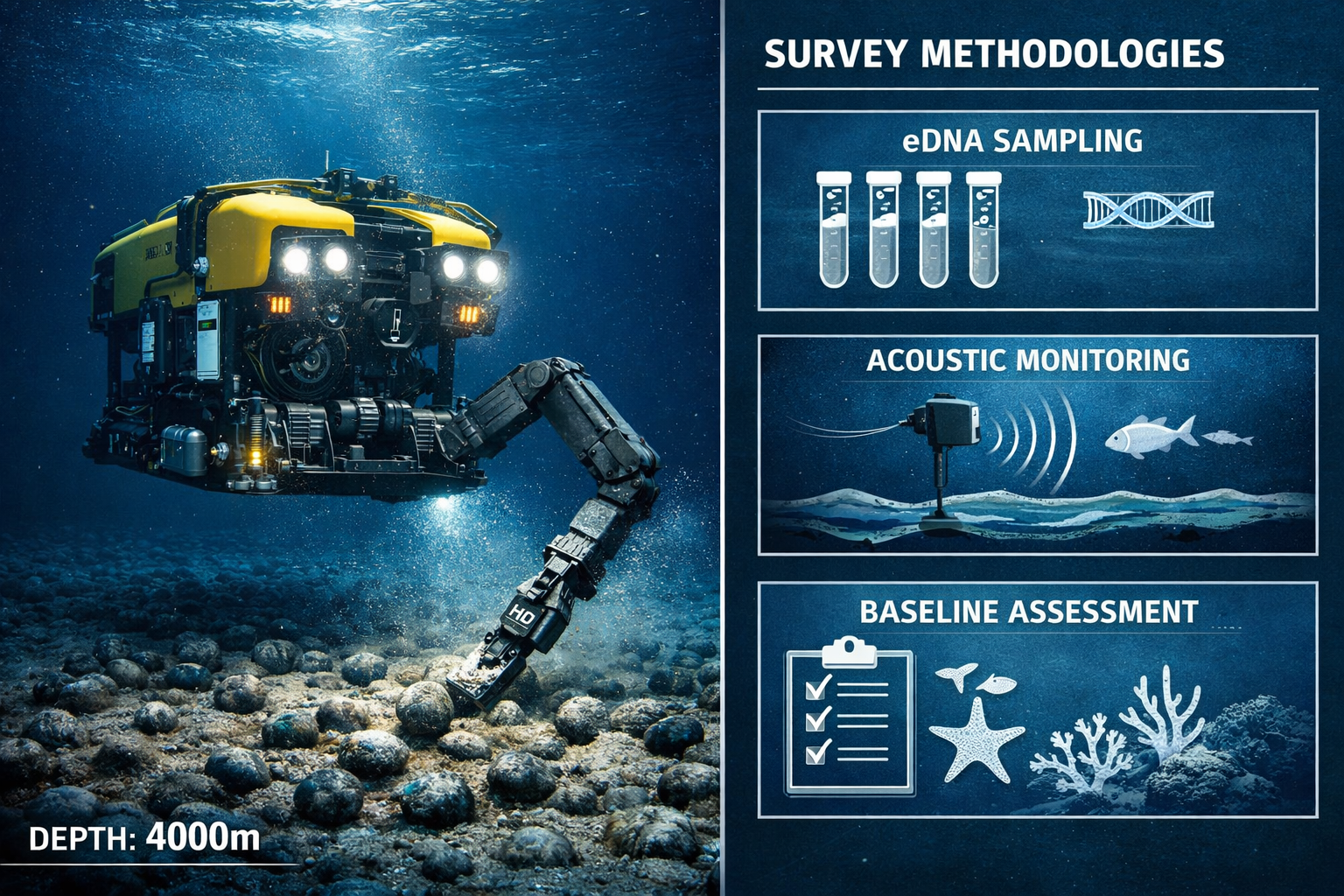
3. Environmental DNA (eDNA) Sampling 🧬
Environmental DNA represents a revolutionary approach to biodiversity assessment in deep-sea environments. This technique analyzes genetic material shed by organisms into the water column, providing a comprehensive picture of biodiversity without requiring physical specimen collection.
eDNA Protocol for Deep-Sea Environments:
- Water column sampling: Collect water samples at multiple depths (near-bottom, mid-water, near-surface)
- Sediment pore water sampling: Extract interstitial water from sediment cores
- Filtration: Process water samples through fine filters (0.22-0.45 μm) to capture DNA
- Preservation: Immediately preserve filters in appropriate buffer solutions
- Laboratory analysis: Extract DNA and sequence using metabarcoding techniques
- Bioinformatics: Compare sequences to reference databases to identify species
The advantage of eDNA sampling is its ability to detect rare species, cryptic organisms, and species that avoid visual surveys. When integrated with traditional methods, eDNA provides a more complete baseline assessment.
4. Sediment and Water Quality Baseline 💧
- Particle size distribution: Characterize sediment composition
- Organic matter content: Measure food availability for benthic organisms
- Metal concentrations: Establish natural background levels
- Turbidity measurements: Document natural sediment suspension levels
- Chemical parameters: Record pH, dissolved oxygen, salinity, and temperature
Monitoring Protocols During Active Mining Operations
Once extraction begins, monitoring protocols must shift to impact detection and quantification. This phase requires more frequent sampling and expanded spatial coverage to track disturbance spread.
Active Mining Monitoring Framework
Spatial Design:
- Reference sites: Undisturbed areas with similar characteristics to mining zones
- Near-field sites: Immediately adjacent to extraction activities (0-100m)
- Mid-field sites: Intermediate distance from extraction (100m-5km)
- Far-field sites: Distant areas potentially affected by sediment plumes (5-50km)
Temporal Design:
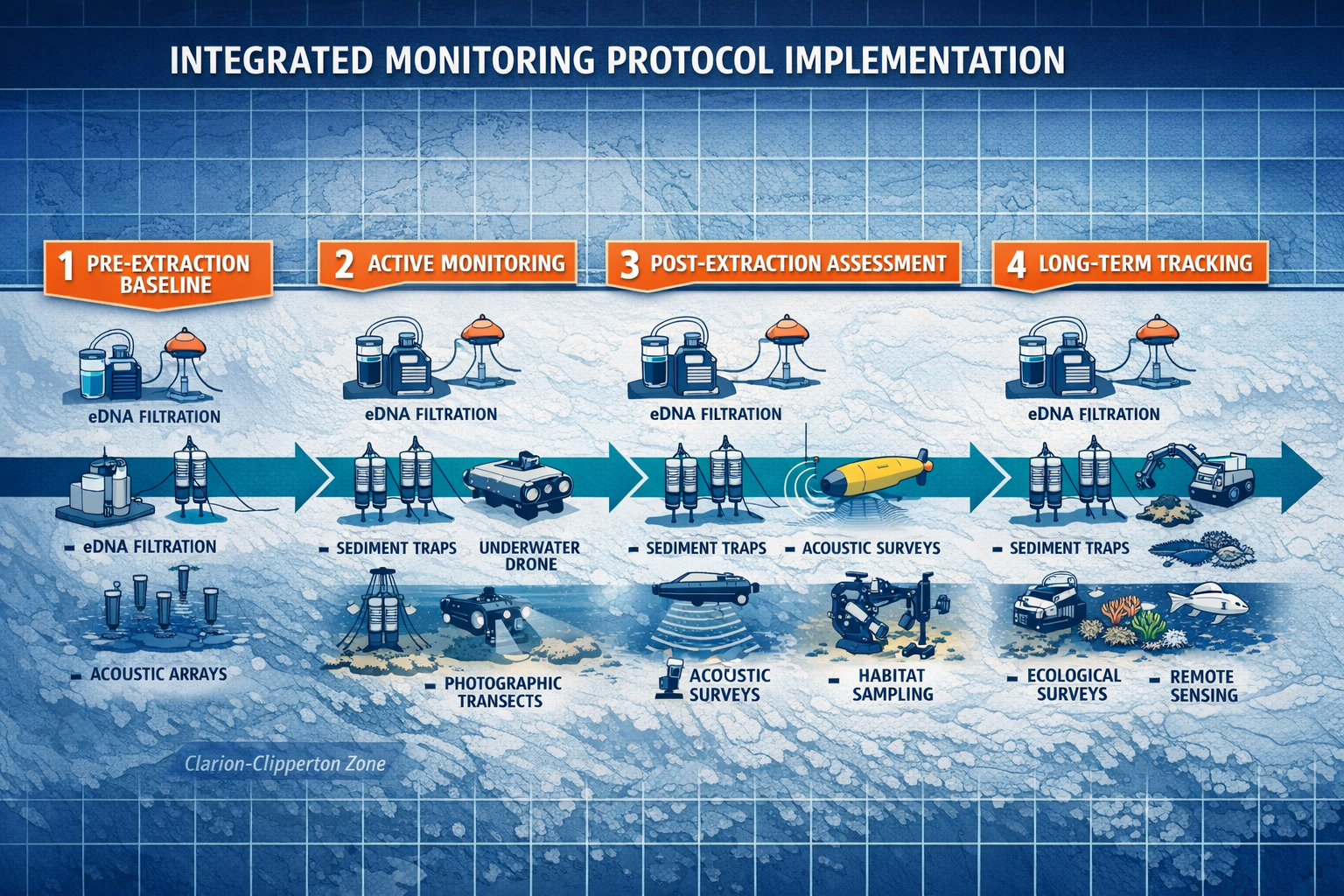
- Pre-mining baseline: Comprehensive surveys conducted before extraction
- During mining: Monthly monitoring at near-field sites, quarterly at mid and far-field sites
- Post-mining: Continued monitoring for decades to assess recovery
Key Monitoring Parameters:
| Parameter | Method | Frequency | Purpose |
|---|---|---|---|
| Sediment plume extent | Turbidity sensors, satellite imagery | Continuous/daily | Track disturbance spread |
| Megafauna abundance | ROV video transects | Monthly | Detect population changes |
| Species composition | eDNA metabarcoding | Quarterly | Identify community shifts |
| Habitat structure | Photographic surveys | Quarterly | Document physical changes |
| Recovery indicators | Repeated sampling at fixed stations | Annually | Assess ecosystem resilience |
Post-Extraction Assessment and Long-Term Monitoring
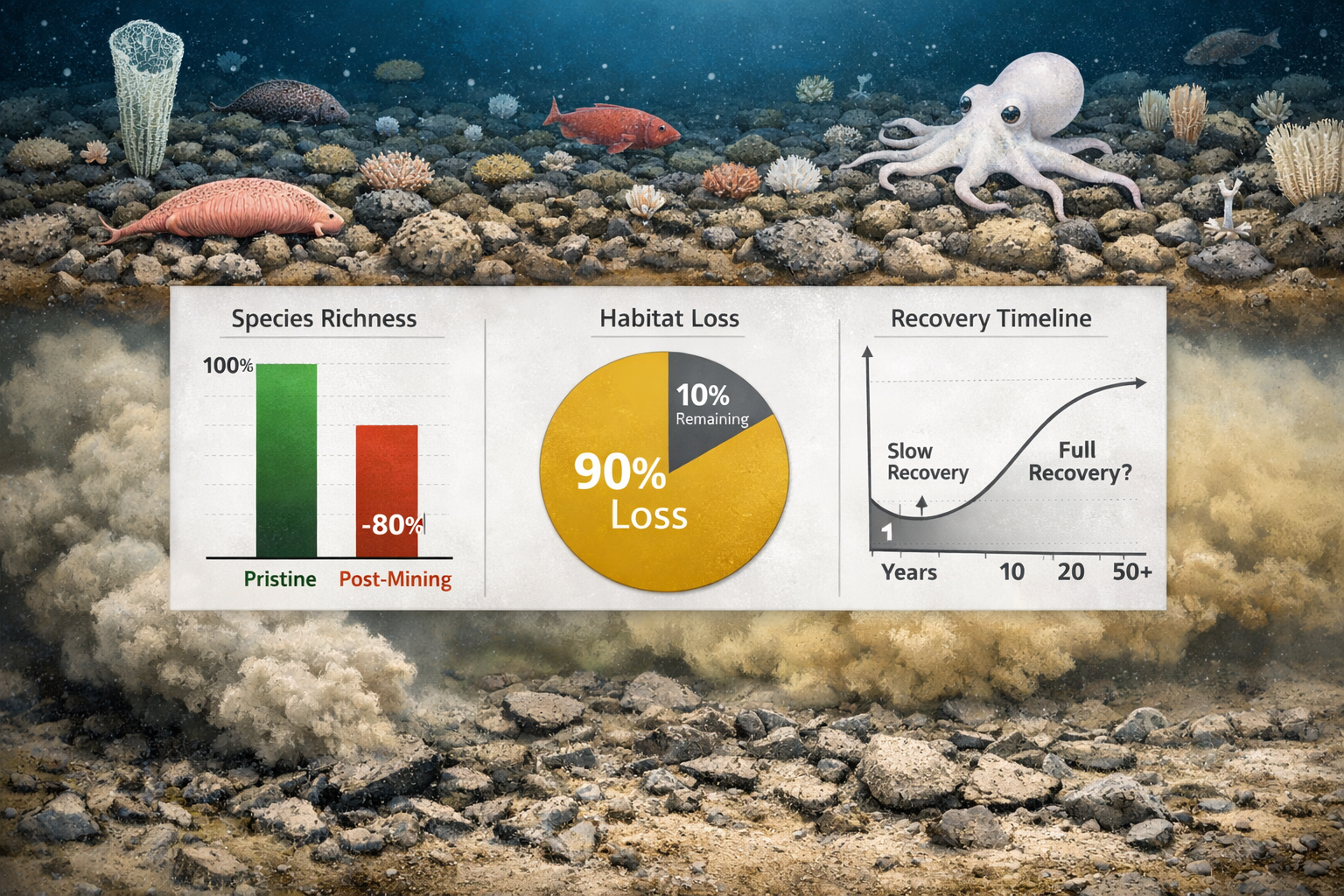
The most critical aspect of Deep Sea Mining Impacts on Biodiversity: Survey Protocols for Ecologists Monitoring High-Seas Extraction Sites may be long-term post-extraction monitoring. Given that seafloor life would take many decades to recover from mining—if it recovers at all [1]—monitoring must continue for extended periods.
Long-Term Monitoring Objectives:
- Recovery trajectory assessment: Document whether and how ecosystems recover
- Colonization patterns: Identify which species recolonize disturbed areas first
- Functional recovery: Determine if ecosystem functions (nutrient cycling, carbon storage) return
- Cumulative impact evaluation: Understand how multiple mining operations affect regional biodiversity
Similar to how terrestrial projects require biodiversity net gain assessments to ensure development leaves nature in a better state, deep-sea mining should theoretically demonstrate no net loss of biodiversity. However, the irreversible nature of deep-sea impacts makes achieving net gain virtually impossible with current technology.
Integrating eDNA and ROV Transects for Comprehensive Baseline Assessments
Why Integration Matters
Neither eDNA sampling nor ROV video transects alone provides a complete picture of deep-sea biodiversity. Each method has strengths and limitations:
eDNA Strengths:
- Detects rare and cryptic species
- Captures microbial diversity
- Requires smaller sample volumes
- Less invasive than physical collection
eDNA Limitations:
- Cannot provide abundance estimates for most species
- DNA degrades over time, making temporal resolution uncertain
- Reference databases remain incomplete for deep-sea species
- Cannot distinguish live organisms from recently deceased ones
ROV Video Transect Strengths:
- Provides visual documentation of habitat structure
- Allows abundance and size estimation for megafauna
- Documents behavior and species interactions
- Creates permanent visual records
ROV Video Transect Limitations:
- Only detects visible organisms
- Misses small organisms and those hidden in sediment
- Requires taxonomic expertise for species identification
- Time-intensive to analyze footage
Integrated Protocol Framework
An optimal approach combines both methods systematically:
Phase 1: Broad-Scale eDNA Reconnaissance 🔍
Conduct initial eDNA sampling across the proposed mining area to identify biodiversity hotspots and species distribution patterns. This provides a cost-effective way to survey large areas and prioritize locations for detailed study.
Phase 2: Targeted ROV Transects 📹
Deploy ROV transects at locations identified through eDNA analysis as having high biodiversity or unique communities. ROV surveys provide visual context and quantitative data on megafauna populations.
Phase 3: Integrated Sampling Stations 📊
Establish permanent monitoring stations where both eDNA and ROV surveys occur simultaneously. This allows direct comparison between methods and validation of eDNA results against visual observations.
Phase 4: Adaptive Monitoring 🔄
Use results from both methods to refine sampling strategies. If eDNA detects species not observed in ROV transects, adjust ROV survey protocols to target those organisms. If ROV surveys reveal habitat features associated with high biodiversity, increase eDNA sampling in similar areas.
This integrated approach mirrors principles used in biodiversity net gain delivery, where multiple assessment methods provide more robust results than single-method approaches.
Challenges and Solutions in Deep-Sea Biodiversity Monitoring
Technical Challenges
Challenge 1: Extreme Depth and Pressure ⚓
Operating equipment at depths of 4,000-6,000 meters requires specialized technology capable of withstanding pressures exceeding 600 atmospheres. Standard sampling equipment fails under these conditions.
Solutions:
- Deploy pressure-rated ROVs and autonomous underwater vehicles (AUVs)
- Use specialized sampling devices designed for deep-sea operations
- Implement redundant systems to prevent complete mission failure
- Develop pressure-compensated eDNA filtration systems
Challenge 2: Limited Accessibility and High Costs 💰
Deep-sea research expeditions cost hundreds of thousands to millions of dollars, limiting the frequency and extent of monitoring.
Solutions:
- Coordinate multi-institutional expeditions to share costs
- Utilize autonomous systems that can operate without ship support
- Develop cost-effective sampling methods that maximize data per expedition
- Establish international monitoring networks to pool resources
Challenge 3: Taxonomic Knowledge Gaps 🔬
With 90% of deep-sea species undescribed, identifying organisms from samples or video footage presents enormous challenges.
Solutions:
- Build comprehensive reference collections and DNA databases
- Train machine learning algorithms to identify organisms from video
- Establish international collaboration networks for taxonomic expertise
- Use morphospecies approaches (grouping by appearance) when formal identification isn't possible
Scientific and Regulatory Challenges
Challenge 4: Establishing Meaningful Impact Thresholds 📉
Without understanding natural variability in deep-sea ecosystems, determining what level of change constitutes "significant impact" remains arbitrary.
Solutions:
- Conduct long-term monitoring at reference sites to characterize natural variability
- Establish statistically robust baseline datasets before mining begins
- Develop ecosystem-specific impact criteria based on functional traits
- Apply precautionary principles when uncertainty exists
Challenge 5: International Coordination 🌐
Mining in international waters involves multiple countries, companies, and regulatory bodies with different standards and priorities.
Solutions:
- Strengthen the International Seabed Authority's regulatory framework
- Harmonize monitoring protocols across jurisdictions
- Require public data sharing from all mining operations
- Establish independent scientific oversight committees
The International Seabed Authority secretary general called on EU officials in February 2026 to "quickly agree on an international rule book on the extraction of critical minerals in international waters," acknowledging the urgent need for coordinated governance. [3]
The Path Forward: Precautionary Approaches and Biodiversity Net Gain
The Growing Moratorium Movement
As of 2026, 40 countries and dozens of private companies, non-governmental organizations, and scientists are calling for a moratorium on deep-sea mining. [4] This coalition argues that proceeding with extraction before understanding ecosystem impacts violates the precautionary principle.
Former Seychelles president and Swiss philanthropist leadership called for a "precautionary pause on deep-sea mining due to the potential harmful effects of this extractive activity on biodiversity, food security and the economy." [3] This perspective emphasizes that the risks of proceeding outweigh the benefits of accessing seabed minerals.
Can Biodiversity Net Gain Apply to Deep-Sea Mining?
Terrestrial development increasingly operates under biodiversity net gain principles, where projects must leave biodiversity in a measurably better state than before development. Just as achieving biodiversity net gain requires careful planning and monitoring for land-based projects, similar principles could theoretically apply to deep-sea mining.
However, several factors make net gain virtually impossible for deep-sea mining:
Irreversibility: The evolutionary timescales over which deep-sea ecosystems developed mean that destroyed habitats cannot be recreated within human timescales. [1]
Lack of Restoration Technology: Unlike terrestrial habitats where restoration techniques exist, no proven methods can restore deep-sea ecosystems after mining disturbance.
Unknown Baseline: With 80% of the seabed unmapped [1], calculating baseline biodiversity to measure against is impossible for most areas.
Spatial Scale: Mining operations covering tens of thousands of square kilometers exceed any feasible compensation or offset area.
These challenges suggest that if deep-sea mining proceeds, the focus must shift from net gain to minimizing loss through:
- Restricting mining to the smallest possible areas
- Establishing large marine protected areas as compensation
- Requiring decades of post-mining monitoring
- Developing and implementing best-available technology to reduce impacts
Conclusion: Urgent Action Needed for Ecologists Monitoring Extraction Sites
The acceleration of deep-sea mining in 2026 has created an urgent need for robust, scientifically sound monitoring protocols. Deep Sea Mining Impacts on Biodiversity: Survey Protocols for Ecologists Monitoring High-Seas Extraction Sites must be implemented immediately—before irreversible damage occurs to ecosystems that took millions of years to develop.
The integrated approach combining eDNA sampling with ROV transects provides the most comprehensive baseline assessment currently available. This methodology allows ecologists to detect both visible megafauna and cryptic species, creating a more complete picture of biodiversity at risk.
However, technology alone cannot solve the fundamental challenge: proceeding with industrial-scale extraction in ecosystems we barely understand violates basic principles of environmental stewardship. With studies demonstrating that seafloor life would take many decades to recover from mining—if it recovers at all [1]—and the United Nations University warning of "wide-ranging, long-lasting, irreversible effects" [2], the precautionary approach suggests delaying extraction until comprehensive baseline data exists and restoration technology develops.
Actionable Next Steps for Ecologists and Stakeholders
For Research Ecologists: 🔬
- Establish baseline monitoring stations in proposed mining areas immediately
- Develop standardized protocols for eDNA collection and analysis in deep-sea environments
- Build comprehensive reference databases for deep-sea species identification
- Publish baseline data openly to inform regulatory decisions
For Regulatory Agencies: 📋
- Require comprehensive baseline surveys before issuing any mining permits
- Mandate long-term monitoring extending decades after extraction ceases
- Establish clear, science-based impact thresholds that trigger mining suspension
- Coordinate internationally to harmonize monitoring standards
For Mining Companies: ⚒️
- Fund independent scientific monitoring throughout all project phases
- Implement best-available technology to minimize environmental footprints
- Share all environmental data publicly and transparently
- Consider whether extraction can proceed ethically given current knowledge gaps
For Conservation Organizations: 🌊
- Support expansion of marine protected areas in international waters
- Advocate for strengthened International Seabed Authority regulations
- Fund independent monitoring and research
- Educate policymakers and the public about deep-sea biodiversity value
The decisions made in 2026 and the coming years will determine whether humanity proceeds wisely with deep-sea resource extraction or repeats historical patterns of exploitation followed by regret. By implementing comprehensive Deep Sea Mining Impacts on Biodiversity: Survey Protocols for Ecologists Monitoring High-Seas Extraction Sites, the scientific community can provide the evidence needed for informed decision-making—even if that evidence ultimately suggests that some resources are better left undisturbed.
Just as biodiversity impact assessments guide responsible terrestrial development, rigorous monitoring protocols must guide any deep-sea extraction. The difference is that terrestrial ecosystems often offer opportunities for restoration and compensation. For the deep sea, prevention of damage may be the only viable conservation strategy.
References
[1] Threats Of Permitting Deep Sea Mining – https://oceanfdn.org/threats-of-permitting-deep-sea-mining/
[2] Deep Sea Mining – https://unu.edu/cpr/brief/deep-sea-mining
[3] Cropped 11 February 2026 Aftershocks Of Us Withdrawals Biodiversity And Business Risks Deep Sea Mining Tensions – https://www.carbonbrief.org/cropped-11-february-2026-aftershocks-of-us-withdrawals-biodiversity-and-business-risks-deep-sea-mining-tensions/
[4] Nations To Discuss Future Of Deep Sea Mining Amid A Changing Policy Landscape – https://www.pew.org/en/research-and-analysis/articles/2026/03/09/nations-to-discuss-future-of-deep-sea-mining-amid-a-changing-policy-landscape