

When biodiversity measurement becomes a yearly trend rather than a scientific discipline, the results blur like photographs taken in motion. In 2026, as regulatory frameworks for Biodiversity Net Gain mature across the UK, the temptation to chase annual headlines threatens the foundational principle that makes ecological restoration credible: robust, weather-independent baseline establishment. Understanding Evergreen Baselines in Dynamic Ecosystems: Non-2026 Protocols for Reliable Biodiversity Net Gain Metrics offers surveyors, developers, and landowners a timeless framework for accurate, defensible measurements that transcend seasonal anomalies and political cycles[1].
The challenge facing ecological professionals today extends beyond simple species counting. Dynamic ecosystems shift with rainfall patterns, temperature fluctuations, and natural succession cycles that can mislead single-year assessments[1]. A drought year might suggest declining amphibian populations, while an unusually wet spring could inflate bird nesting success metrics—neither reflecting the site's true baseline condition. This article provides a comprehensive guide to establishing evergreen baselines that withstand scrutiny across development timelines, regulatory reviews, and the 30-year monitoring periods increasingly required for biodiversity net gain compliance.
Key Takeaways
- 🌿 Evergreen baselines require multi-season data collection across multiple years to avoid weather-driven distortions in biodiversity measurements
- 📊 Standardized protocols using Essential Biodiversity Variables (EBVs) create defensible metrics that regulatory bodies and stakeholders can verify independently[8]
- ⏱️ Full-cycle monitoring from pre-development through 30-year post-intervention periods ensures accountability and adaptive management opportunities
- 🎯 Weather-independent methodologies separate natural variation from genuine habitat change, protecting developers from unfair baseline inflation
- 🔄 Dynamic ecosystem protocols acknowledge natural succession while maintaining measurement consistency for accurate net gain calculations
Understanding Evergreen Baselines in Dynamic Ecosystems
What Makes a Baseline "Evergreen"?
An evergreen baseline represents the stable ecological condition of a site that remains valid across time periods, independent of short-term environmental fluctuations. Unlike snapshot assessments that capture a single moment, evergreen baselines integrate data from multiple seasons and years to establish a representative picture of biodiversity value[5].
The concept draws from forestry management principles where "evergreen" signifies continuous validity rather than seasonal relevance. In biodiversity contexts, this means:
- Multi-temporal data collection spanning at least two full annual cycles
- Weather normalization techniques that account for rainfall, temperature, and seasonal anomalies
- Reference condition comparisons against regional habitat benchmarks
- Adaptive baseline updates that incorporate natural succession without compromising measurement integrity
The Dynamic Ecosystem Challenge
Ecosystems never stand still. A grassland habitat experiences natural fluctuations in species composition based on grazing pressure, rainfall patterns, and competitive dynamics among plant communities[1]. These dynamics create measurement challenges when establishing baselines for biodiversity impact assessments.
Key dynamic factors include:
| Dynamic Factor | Impact on Baseline | Mitigation Strategy |
|---|---|---|
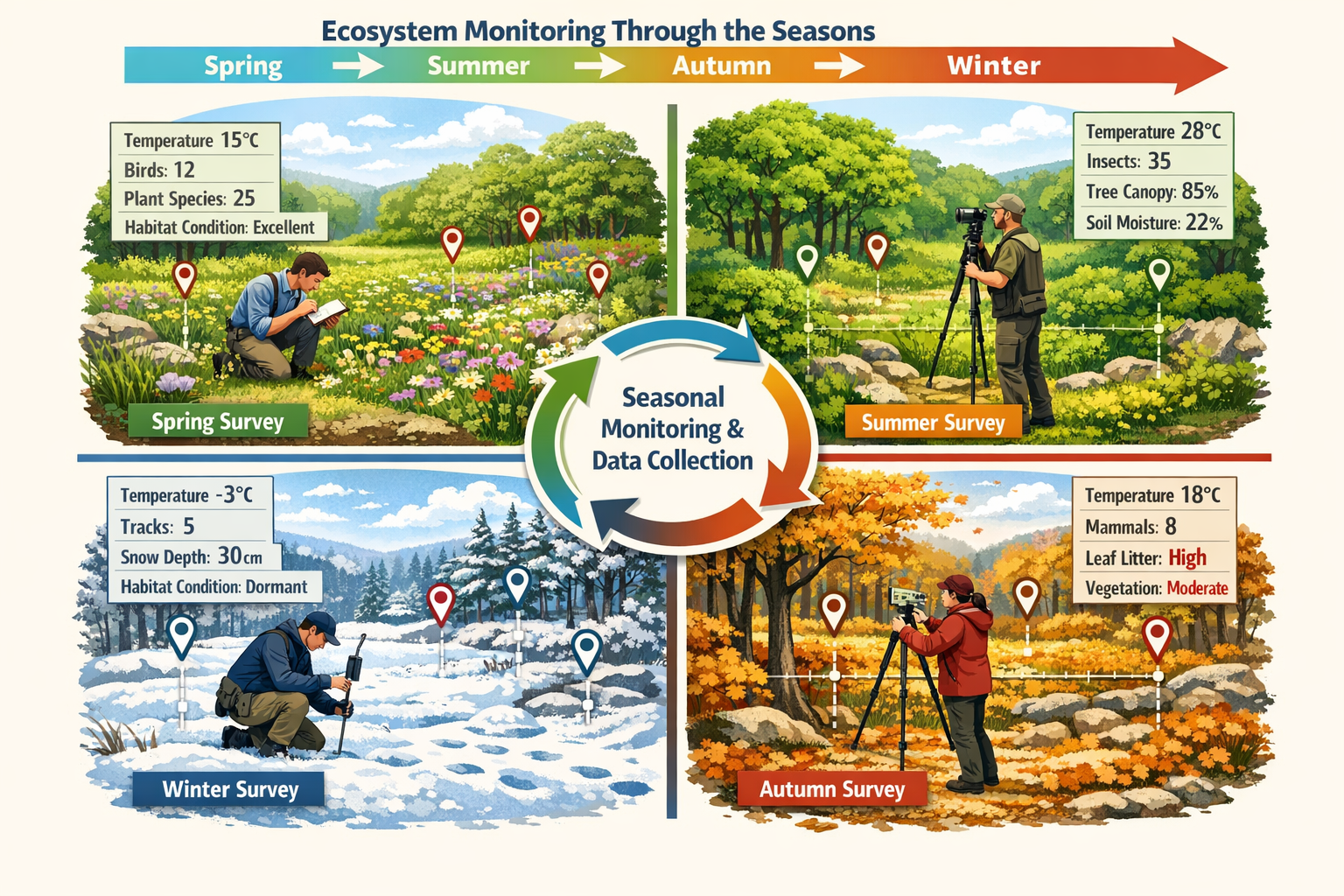
| Seasonal variation | Species detectability changes | Survey across all four seasons |
| Weather anomalies | Population fluctuations | Multi-year data collection |
| Natural succession | Gradual habitat change | Reference historical data |
| Management history | Legacy effects persist | Document land use history |
| Edge effects | Boundary condition variability | Extended survey buffers |
Recent research highlights that biodiversity monitoring in 2026 must account for these complexities while maintaining practical feasibility for development projects[1]. The balance between scientific rigor and commercial viability defines successful baseline protocols.
Non-2026 Protocols: Beyond Annual Trend Cycles
Why "Non-2026" Matters
The phrase "Non-2026 Protocols" signals a critical departure from trend-driven, year-specific approaches to biodiversity measurement. While the 2026 Global Horizon Scan identified 15 emerging conservation issues[2], the fundamental principles of robust baseline establishment remain constant across decades.
Non-2026 protocols emphasize:
- Temporal independence – Methodologies valid in 2020, 2026, or 2030
- Technology neutrality – Core principles work with evolving survey tools
- Regulatory flexibility – Frameworks adaptable to changing policy requirements
- Scientific consistency – Measurement standards grounded in ecological theory
This approach protects stakeholders from the "methodology churn" that occurs when baseline protocols change with every policy update or technological advancement. A developer establishing baselines in 2024 needs confidence that measurements will remain valid through the 2026 Biodiversity Net Gain implementation and beyond.
Essential Biodiversity Variables (EBVs) Framework
The Essential Biodiversity Variables framework provides the foundation for evergreen baselines by standardizing what gets measured across different ecosystems and temporal scales[8]. Developed through international collaboration, EBVs offer a common language for biodiversity assessment that transcends regional differences.
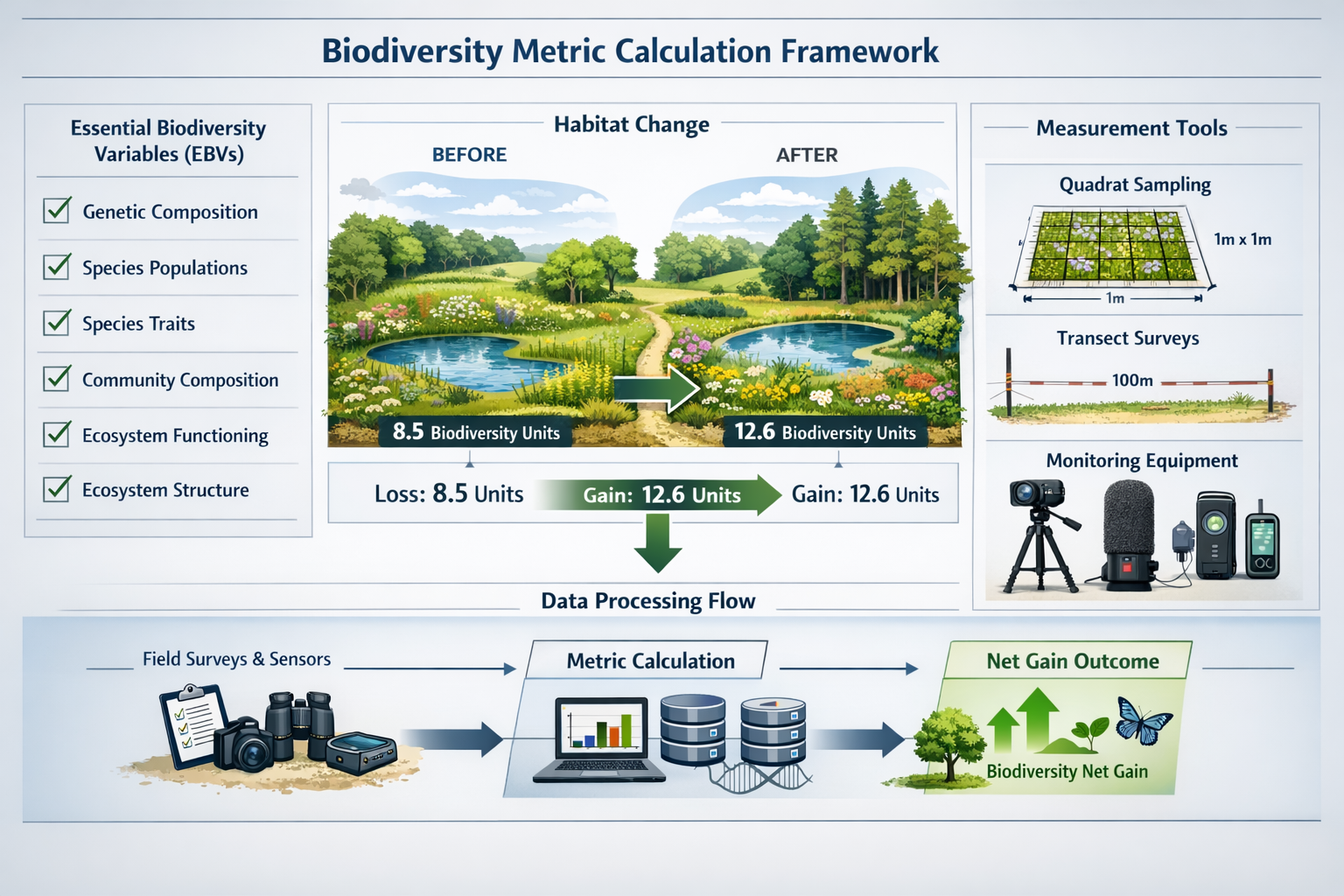
The six EBV classes include:
- 🧬 Genetic composition – Genetic diversity within populations
- 🦎 Species populations – Abundance and distribution of organisms
- 🌱 Species traits – Functional characteristics affecting ecosystem roles
- 🌍 Community composition – Species assemblages and diversity patterns
- ⚙️ Ecosystem functioning – Productivity, nutrient cycling, and energy flow
- 🏞️ Ecosystem structure – Habitat configuration and physical characteristics
For practical biodiversity baseline surveys, focusing on species populations, community composition, and ecosystem structure provides the most actionable data for net gain calculations[5]. These variables directly inform the habitat condition assessments and distinctiveness ratings used in UK Biodiversity Metric calculations.
Standardized Measurement Frameworks
Reliable biodiversity metrics require standardization across three dimensions: spatial consistency, temporal consistency, and methodological consistency[4]. Without standardization, comparing baseline conditions across sites or monitoring change over time becomes scientifically indefensible.
Spatial consistency ensures that survey effort scales appropriately with site size and habitat complexity. A 0.5-hectare urban development site requires different survey intensity than a 50-hectare rural agricultural conversion, but both must follow proportional protocols.
Temporal consistency addresses the timing and frequency of surveys. Phase 1 habitat surveys provide broad-brush characterization, while Phase 2 protected species surveys target specific taxa during optimal detection periods. The Biodiversity Net Gain framework requires both levels integrated into a coherent baseline.
Methodological consistency standardizes survey techniques, equipment, and data recording. Using identical quadrat sizes, transect spacing, and identification keys across survey seasons eliminates methodological artifacts that could be misinterpreted as genuine ecological change.
"The technical challenges in biodiversity measurement and disclosure require frameworks that balance scientific rigor with practical implementation across diverse stakeholder groups." [7]
Reliable Biodiversity Net Gain Metrics Through Full-Cycle Monitoring
Pre-Development Baseline Establishment
The foundation of defensible biodiversity net gain begins with comprehensive pre-development baseline surveys that capture site conditions before any intervention[5]. This phase determines the biodiversity units that must be maintained or enhanced through the development process.
Critical baseline components include:
- Habitat mapping – Detailed spatial delineation of habitat types using UK Habitat Classification
- Condition assessment – Evaluation of habitat quality using standardized condition sheets
- Distinctiveness ratings – Assignment of biodiversity value based on habitat rarity and ecological function
- Strategic significance – Identification of habitats with special conservation importance
- Connectivity analysis – Assessment of habitat linkages and ecological networks
For small development projects, simplified baseline protocols may apply, but the fundamental requirement for multi-season data collection remains. A single summer survey cannot capture the full biodiversity value of a site that supports overwintering birds, spring amphibian breeding, or autumn fungal fruiting.
Intervention Implementation Monitoring
Once development begins, continuous monitoring documents how site conditions change during construction and habitat creation phases. This "intervention period" often represents the highest risk for biodiversity loss and requires careful oversight.
Monitoring priorities during intervention:
- Protected species compliance – Verification that mitigation measures function as designed
- Habitat creation quality control – Ensuring created habitats meet specification standards
- Invasive species management – Early detection and control of non-native species
- Soil condition preservation – Protecting soil structure and seed banks in retained areas
- Hydrological regime maintenance – Confirming drainage patterns support target habitats
The transition from baseline to post-intervention conditions must be documented with the same methodological rigor as initial surveys. This creates an unbroken chain of evidence demonstrating net gain achievement or identifying where adaptive management interventions are needed.
Long-Term Outcome Verification
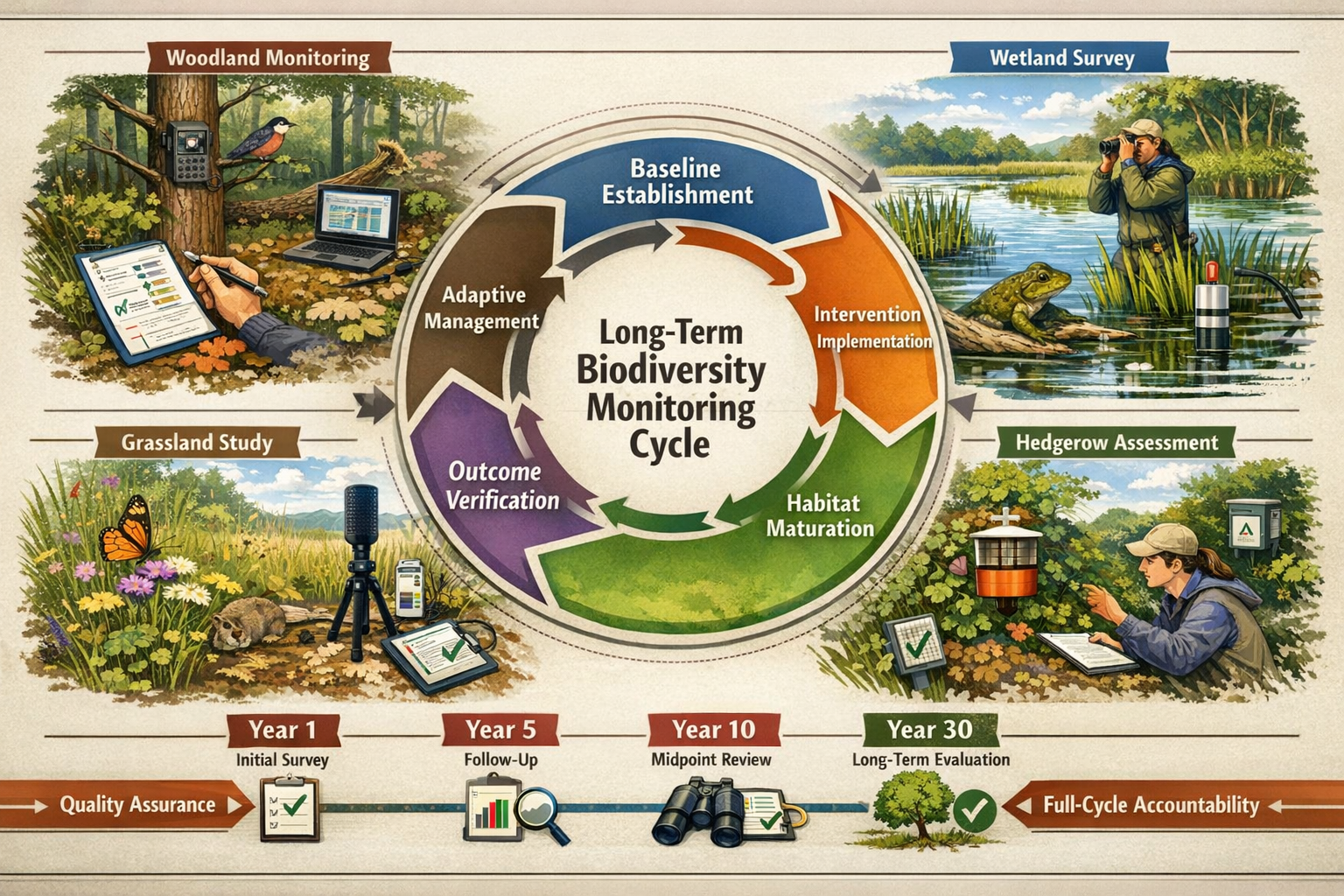
Biodiversity Net Gain obligations extend 30 years beyond development completion, requiring long-term monitoring protocols that verify habitat maturation and species colonization[4]. This extended timeframe acknowledges that woodland habitats, wetland communities, and species-rich grasslands develop slowly.
Long-term monitoring intervals typically follow:
- Years 1-5: Annual surveys documenting establishment success
- Years 6-15: Biennial surveys tracking habitat maturation
- Years 16-30: Surveys every 3-5 years confirming stable target conditions
This monitoring schedule balances the need for outcome verification against practical cost considerations. However, achieving biodiversity net gain without risk requires genuine commitment to this long-term accountability.
Adaptive Management Integration
No habitat creation or enhancement scheme performs exactly as predicted. Weather patterns shift, species colonization follows unexpected pathways, and management interventions produce variable results. Adaptive management provides the framework for responding to monitoring results while maintaining net gain commitments.
The adaptive management cycle includes:
- Monitoring data collection – Systematic observation of habitat conditions
- Performance evaluation – Comparison against target conditions and success criteria
- Cause analysis – Identification of factors preventing target achievement
- Management adjustment – Implementation of corrective interventions
- Outcome verification – Assessment of whether adjustments improved performance
For developers, adaptive management clauses in biodiversity net gain strategies protect against unforeseen ecological challenges while demonstrating good-faith commitment to positive outcomes. For landowners providing off-site biodiversity units, adaptive management increases the likelihood of successful habitat establishment and unit generation.
Practical Implementation for Surveyors and Developers
Survey Design Principles
Implementing Evergreen Baselines in Dynamic Ecosystems: Non-2026 Protocols for Reliable Biodiversity Net Gain Metrics requires careful survey design that balances scientific requirements with project constraints. Professional ecologists must navigate between ideal sampling intensity and commercially viable survey effort.
Key design considerations:
- Stratified sampling – Survey effort allocated proportionally across habitat types
- Replicate surveys – Multiple visits within optimal detection periods for target taxa
- Reference site comparisons – Benchmarking against high-quality examples of target habitats
- Statistical power analysis – Ensuring sample sizes adequate for detecting meaningful change
- Quality assurance protocols – Peer review and data validation procedures
The cost of biodiversity assessments correlates directly with survey intensity and duration. However, inadequate baseline surveys create greater long-term costs through disputed net gain calculations, regulatory delays, and potential enforcement actions.
Technology and Tools
Modern biodiversity surveying increasingly incorporates technological tools that enhance data quality and efficiency while maintaining compatibility with evergreen baseline principles[1]. These tools complement rather than replace traditional field survey methods.
Emerging technologies include:
- Environmental DNA (eDNA) – Water and soil sampling detecting species presence through genetic traces
- Acoustic monitoring – Automated recording units documenting bird and bat activity
- Remote sensing – Satellite and drone imagery mapping habitat extent and condition
- Mobile data collection – Tablet and smartphone apps standardizing field data recording
- AI species identification – Machine learning algorithms assisting with image and sound identification
While these technologies offer advantages, they must be validated against traditional survey methods and integrated into standardized protocols before replacing established techniques in regulatory contexts.
Common Pitfalls and Solutions
Even experienced practitioners encounter challenges implementing robust baseline protocols. Understanding common pitfalls helps avoid measurement errors that compromise net gain calculations.
Frequent issues include:
| Pitfall | Consequence | Solution |
|---|---|---|
| Single-season surveys | Missing seasonal species | Multi-season survey program |
| Optimal weather bias | Inflated species detection | Survey across weather conditions |
| Inconsistent methodologies | Temporal comparison impossible | Standardized protocols document |
| Inadequate spatial coverage | Unrepresentative sampling | Stratified survey design |
| Poor data documentation | Results not replicable | Comprehensive metadata recording |
For planners navigating biodiversity net gain requirements, understanding these technical challenges helps set realistic timelines and budgets for ecological assessments. Baseline establishment cannot be rushed without compromising data quality.
Regulatory Context and Future Directions
Current UK Biodiversity Net Gain Requirements
The UK's mandatory Biodiversity Net Gain framework, implemented through the Environment Act 2021, requires most development projects to deliver at least 10% net gain in biodiversity value[5]. This regulatory requirement makes robust baseline establishment not merely good practice but legal necessity.
Key regulatory elements include:
- Statutory biodiversity metric – Standardized calculation tool for measuring biodiversity units
- Habitat management plans – 30-year commitments for created and enhanced habitats
- Local planning authority oversight – Verification of net gain delivery before planning approval
- Biodiversity gain site register – National database tracking off-site habitat provision
- Statutory biodiversity credits – Government-provided units for exceptional circumstances
Understanding how architects can solve biodiversity net gain challenges requires integrating ecological considerations from initial site selection through detailed design. Evergreen baselines inform these design decisions by clarifying existing biodiversity assets and constraints.
International Perspectives
While UK regulations drive current practice, international frameworks increasingly influence biodiversity measurement standards. The 2026 Global Horizon Scan identified emerging issues including climate-driven range shifts, synthetic biology applications, and novel ecosystem formation[2]—all factors that reinforce the need for adaptable, evergreen baseline methodologies.
Global initiatives like the Taskforce on Nature-related Financial Disclosures (TNFD) push corporate biodiversity measurement toward standardized, comparable metrics[6]. These frameworks demand measurement approaches that work across jurisdictions, ecosystem types, and temporal scales—precisely the characteristics of Non-2026 Protocols for baseline establishment.
Future Measurement Innovations
Biodiversity measurement continues evolving as scientific understanding deepens and technology advances. Future innovations will likely enhance rather than replace evergreen baseline principles[4].
Anticipated developments include:
- Real-time biodiversity monitoring – Sensor networks providing continuous habitat condition data
- Predictive modeling integration – Machine learning forecasting habitat trajectory under different management scenarios
- Functional diversity metrics – Moving beyond species counts to ecosystem service provision
- Genetic diversity assessment – Routine incorporation of population genetics into baseline surveys
- Blockchain verification – Immutable records of monitoring data and net gain delivery
For landowners considering biodiversity unit provision, these innovations may reduce monitoring costs while increasing buyer confidence in unit quality. However, the fundamental requirement for multi-year baseline establishment will persist regardless of technological advancement.
Conclusion
Establishing Evergreen Baselines in Dynamic Ecosystems: Non-2026 Protocols for Reliable Biodiversity Net Gain Metrics represents the essential foundation for credible, defensible biodiversity net gain delivery. As regulatory frameworks mature in 2026 and beyond, the temptation to pursue expedient, single-season assessments must be resisted in favor of scientifically robust, multi-temporal baseline establishment that captures true site conditions independent of weather anomalies and seasonal variation[1].
The protocols outlined in this guide—multi-season data collection, standardized Essential Biodiversity Variables, weather-normalized metrics, and full-cycle monitoring from pre-development through 30-year verification—provide surveyors, developers, and landowners with the methodological framework necessary for successful net gain outcomes. These approaches transcend annual policy cycles and technological trends, offering timeless principles grounded in ecological science.
Actionable Next Steps
For professionals implementing biodiversity net gain projects:
- Commission multi-season baseline surveys covering at least two full annual cycles before finalizing development designs
- Adopt standardized protocols using Essential Biodiversity Variables and the statutory biodiversity metric
- Establish long-term monitoring commitments with clear adaptive management triggers and responsibilities
- Document methodologies comprehensively ensuring future surveyors can replicate measurements exactly
- Engage qualified ecological consultants with demonstrated expertise in dynamic ecosystem assessment
For those seeking expert guidance on biodiversity net gain implementation, professional ecological consultancies provide the specialized knowledge necessary to navigate complex baseline establishment requirements while maintaining project viability.
The transition from weather-blurred annual trends to robust, evergreen baselines represents not merely technical improvement but fundamental transformation in how development projects engage with natural systems. By embracing protocols that acknowledge ecosystem dynamism while maintaining measurement consistency, the biodiversity net gain framework can deliver genuine conservation outcomes that persist across decades—the ultimate measure of success in ecological restoration and enhancement.
References
[1] Why Monitor Biodiversity In 2026 – https://evolito.earth/stories/why-monitor-biodiversity-in-2026
[2] Whats Next For Biodiversity Conservation Insights From The 2026 Horizon Scan – https://www.unep-wcmc.org/en/news/whats-next-for-biodiversity-conservation-insights-from-the-2026-horizon-scan
[4] Biodiversity Metrics – https://www.icebergdatalab.com/news/environmental_news/biodiversity-metrics
[5] Biodiversity Baseline Surveys – https://www.ground-control.co.uk/services/biodiversity-net-gain/biodiversity-baseline-surveys/
[6] Closing Gap Between Biodiversity Commitments And Measuring Nature – https://sps.columbia.edu/news/closing-gap-between-biodiversity-commitments-and-measuring-nature
[7] Biodiversity Margin To Mainstream – https://www.integrumesg.com/insights/biodiversity-margin-to-mainstream
[8] 2026 02 Roadmap Outlines Biodiversity Variables Europe – https://phys.org/news/2026-02-roadmap-outlines-biodiversity-variables-europe.html