

The silent threat lurking in grasslands, wetlands, and woodland edges across infrastructure development sites may surprise even the most experienced ecology surveyors. Fibre optic drone cables—ultra-thin, nearly invisible threads abandoned after drone operations—are emerging as a significant wildlife hazard that demands immediate attention in 2026. Recent research from Ukrainian environmental scientists has revealed that these cables can persist in the environment for over 600 years, creating entanglement risks for birds, mammals, and reptiles while fragmenting critical habitats[2]. For ecology surveyors working on infrastructure projects, understanding and mitigating these risks has become essential for achieving Biodiversity Net Gain (BNG) compliance and protecting vulnerable species.
Fibre Optic Drone Cables in Biodiversity Surveys: Risk Protocols for Ecology Surveyors in 2026 Infrastructure Projects represents a critical evolution in ecological survey methodology. As drone technology becomes increasingly prevalent in construction, telecommunications, and energy sectors, the environmental footprint of these operations extends far beyond their immediate operational phase. The cables themselves—often measuring just 0.05-0.2mm in diameter—become virtually undetectable in vegetation, yet pose substantial risks to wildlife and ecosystem integrity[1][7].
Key Takeaways
- 🦅 Wildlife entanglement risk: Fibre optic drone cables can persist for 600+ years and entangle birds, mammals, and reptiles in development sites
- 📋 New survey protocols required: Ecology surveyors must implement systematic cable detection and documentation procedures for BNG compliance in 2026
- ♻️ Microplastic contamination: Degraded cables release PFAS and microplastics into soil and water systems, affecting long-term habitat quality
- 🏗️ Infrastructure project requirements: Development sites must now include cable risk assessments as part of biodiversity impact evaluations
- ✅ Practical mitigation tools: Field inspection checklists and removal protocols help surveyors address cable hazards systematically
Understanding the Emerging Threat of Fibre Optic Drone Cables
What Are Fibre Optic Drone Cables?
Fibre optic drone cables represent a relatively new technology that has gained widespread adoption across multiple sectors. These ultra-thin cables, typically made from plastic polymers including polyethylene and polypropylene, connect drones to ground control stations via physical tethers[2]. Unlike wireless drones, fibre optic variants maintain constant, jam-proof communication through these physical connections.
The cables measure between 0.05mm to 0.2mm in diameter—roughly the thickness of a human hair—making them extremely difficult to detect in natural environments[1]. Their translucent or dark coloring further camouflages them against soil, vegetation, and water surfaces. While originally developed for military applications where signal security was paramount, these systems have expanded into commercial infrastructure projects including:
- Telecommunications installations
- Energy infrastructure surveys
- Pipeline inspection operations
- Construction site monitoring
- Environmental assessment flyovers
The Environmental Persistence Problem
The most alarming characteristic of these cables is their extraordinary longevity. Research published in March 2026 indicates that fibre optic drone cables can remain in the environment for more than 600 years without significant degradation[2][4]. This persistence stems from their polymer composition, which resists natural breakdown processes.
When cables are abandoned—either accidentally during operations or deliberately after use—they create long-term environmental hazards. The cables:
- Remain functional as entanglement hazards for centuries
- Fragment into microplastics over extended periods
- Release PFAS (per- and polyfluoroalkyl substances) into surrounding ecosystems[2][3]
- Accumulate in soil and water systems
- Persist through multiple habitat succession cycles
"The environmental legacy of fibre optic drone operations extends far beyond the operational phase. Cables abandoned today will remain as wildlife hazards for generations of species yet unborn." — Ukrainian Environmental Research Group, 2026[4]
Wildlife Entanglement and Habitat Fragmentation Risks
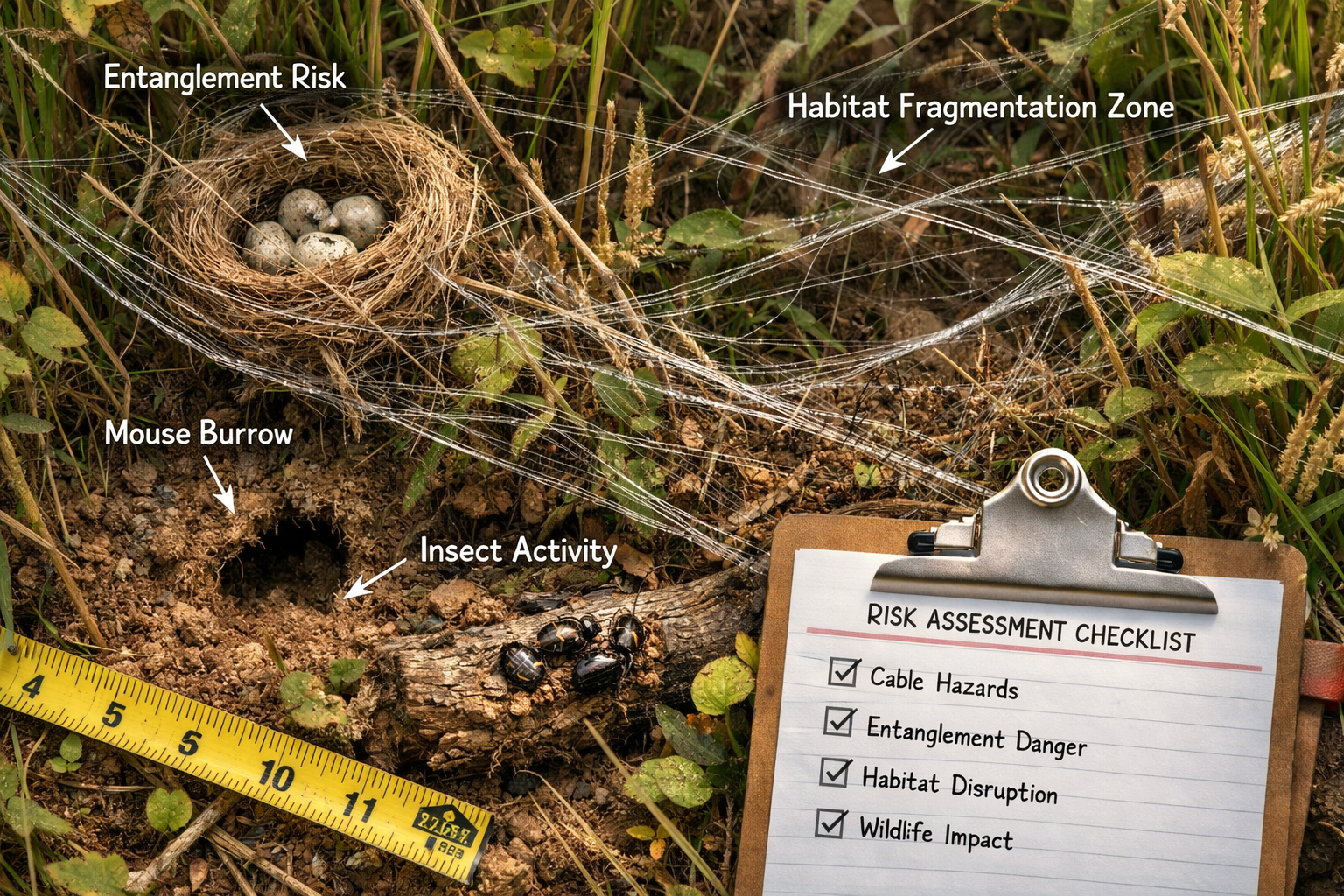
The physical characteristics that make fibre optic cables effective for drone operations—thinness, strength, and flexibility—also make them particularly dangerous to wildlife. Documented risks include:
Entanglement Hazards:
- Birds: Legs, wings, and necks become wrapped in cables during foraging or nesting activities
- Small mammals: Rodents, hedgehogs, and rabbits encounter cables at ground level
- Reptiles: Snakes and lizards become ensnared while moving through vegetation
- Amphibians: Cables crossing water bodies trap frogs and newts during breeding migrations
Habitat Fragmentation:
- Cables create physical barriers across movement corridors
- Dense cable accumulations deter species from using otherwise suitable habitat
- Ground-nesting birds avoid areas with visible cable debris
- Invertebrate communities experience disruption from cable presence in soil layers
Research from conflict zones where fibre optic drones have been extensively deployed shows significant cable accumulation in previously pristine habitats[1][7]. These findings have direct implications for UK infrastructure projects, where biodiversity impact assessments must now account for cable-related risks.
Microplastic and Chemical Contamination
Beyond physical entanglement, degrading cables contribute to the growing microplastic pollution crisis. As cables break down through mechanical stress, UV exposure, and environmental weathering, they release:
- Microplastic particles (fragments smaller than 5mm)
- Nanoplastics (particles below 100nm)
- PFAS compounds used in cable manufacturing[2][3]
- Plasticizers and stabilizing chemicals
These contaminants enter food chains through multiple pathways:
- Soil absorption by plant roots
- Ingestion by invertebrates and soil organisms
- Water contamination affecting aquatic species
- Bioaccumulation in predator species at higher trophic levels
For ecology surveyors conducting baseline assessments, this chemical dimension adds complexity to traditional habitat quality evaluations. Sites with historical drone operations may harbor hidden contamination that affects biodiversity net gain calculations.
Risk Protocols for Ecology Surveyors in 2026 Infrastructure Projects
Pre-Survey Site Assessment and Cable Detection
Before commencing standard biodiversity surveys, ecology professionals must now incorporate cable risk assessment protocols into their preliminary site evaluations. This systematic approach ensures comprehensive documentation of potential hazards.
Phase 1: Desktop Assessment
| Assessment Component | Action Required | Documentation |
|---|---|---|
| Historical drone use | Review planning records, contractor logs, aerial survey history | Identify high-risk zones |
| Previous infrastructure | Check telecommunications, energy, construction projects | Map potential cable sources |
| Site access patterns | Identify drone launch/landing areas | Prioritize survey locations |
| Habitat sensitivity | Cross-reference with protected species records | Assess vulnerability levels |
Phase 2: Visual Field Inspection
Systematic visual surveys should follow established transect methodologies but with enhanced attention to cable indicators:
- Ground-level searches: Walk transects at 2-meter spacing in high-risk areas
- Vegetation inspection: Part grass and low vegetation to expose hidden cables
- Water body margins: Check shorelines, stream banks, and wetland edges
- Fence lines and structures: Examine where cables commonly snag
- Tree canopies: Use binoculars to spot cables caught in branches
Detection Equipment:
- UV torches (cables may fluoresce under specific wavelengths)
- Metal detectors (for cables with metallic components)
- High-resolution photography for documentation
- GPS devices for precise location recording
- Sample collection kits for laboratory analysis
Field Inspection Checklists for Cable Hazard Assessment
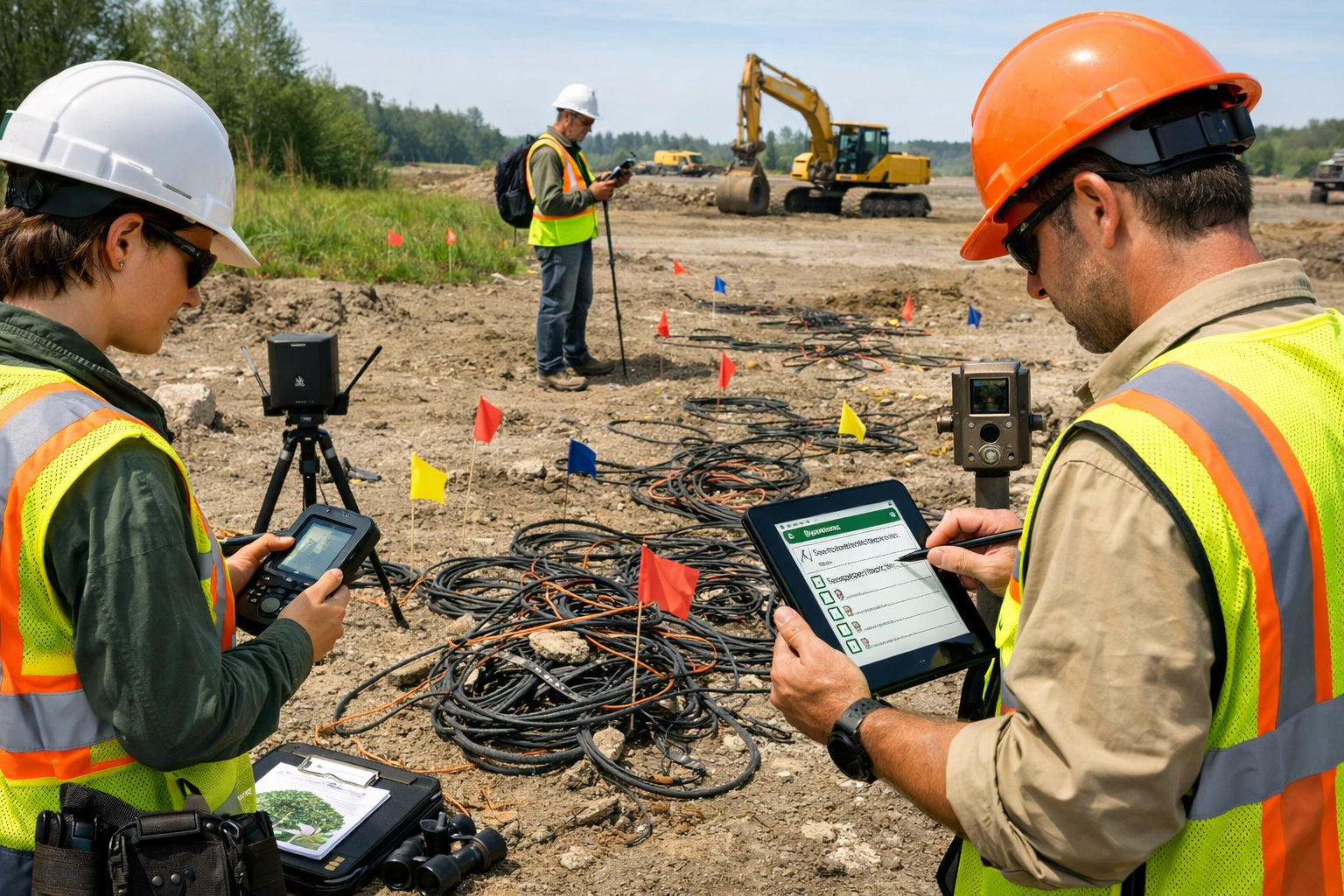
Standardized checklists ensure consistent documentation across survey teams and projects. The following protocols align with BNG assessment requirements while addressing cable-specific risks.
Cable Presence and Distribution Checklist:
✅ Location Data
- GPS coordinates (minimum 10-figure grid reference)
- Habitat type classification
- Proximity to water bodies, hedgerows, or woodland
- Distance from known drone operation areas
- Elevation and topography notes
✅ Cable Characteristics
- Estimated length of cable sections
- Diameter measurements (use digital calipers)
- Color and opacity
- Condition (intact, fraying, fragmented)
- Entanglement complexity (single strand vs. tangled mass)
✅ Ecological Context
- Habitat quality score (using standard metrics)
- Evidence of wildlife activity (tracks, nests, burrows)
- Proximity to protected species locations
- Vegetation density and height
- Seasonal accessibility factors
✅ Risk Assessment
- Entanglement hazard level (low/medium/high/critical)
- Contamination potential
- Habitat fragmentation severity
- Priority for removal (urgent/scheduled/monitor)
- Required specialist intervention
Integration with Biodiversity Net Gain Protocols
For surveyors working on infrastructure development projects, cable risk assessment must integrate seamlessly with existing BNG requirements. The presence of fibre optic cables affects multiple aspects of biodiversity calculations:
Baseline Habitat Assessment Adjustments:
When cables are present, habitat condition scores may require downward adjustment based on:
- Physical disturbance: Cable presence indicates site degradation
- Wildlife accessibility: Entanglement risks reduce habitat functionality
- Contamination status: Microplastic presence affects soil and water quality
- Management feasibility: Cable removal costs impact habitat restoration budgets
Metric Calculation Implications:
The statutory biodiversity metric used for BNG calculations should reflect cable-related impacts:
- Habitat distinctiveness: May remain unchanged unless cables alter habitat classification
- Habitat condition: Reduce score by 1-2 condition bands where significant cable accumulation exists
- Strategic significance: Consider if cables affect connectivity or protected species
- Temporal multipliers: Cable removal and habitat recovery time affects delivery timelines
Cable Removal and Disposal Protocols
Once cables are identified and documented, systematic removal becomes essential for site remediation and BNG delivery. Ecology surveyors should coordinate with contractors to ensure proper protocols:
Safe Removal Procedures:
- Pre-removal survey: Document exact locations with photographic evidence
- Protected species checks: Ensure no active nests, hibernation sites, or breeding activity
- Seasonal timing: Schedule removal during low-sensitivity periods for target species
- Systematic collection: Work methodically to prevent cable fragmentation
- Habitat disturbance minimization: Use hand tools in sensitive areas
- Waste segregation: Separate cables from vegetation and soil debris
Disposal Requirements:
- Specialist waste contractors: Cables require proper plastic waste processing
- Contamination assessment: Test heavily degraded cables for PFAS content
- Recycling potential: Some intact cables may be recyclable through specialist facilities
- Documentation: Maintain waste transfer notes for regulatory compliance
- Chain of custody: Track cable removal from site to final disposal
Post-Removal Monitoring:
Following cable extraction, surveyors should implement monitoring protocols to assess:
- Habitat recovery rates
- Wildlife recolonization patterns
- Residual contamination levels
- Effectiveness of removal techniques
- Long-term habitat quality improvements
This monitoring data feeds into BNG compliance reporting and demonstrates effective mitigation.
Practical Implementation for 2026 Infrastructure Projects
Contractor Coordination and Site Management
Effective cable risk management requires collaboration between ecology surveyors, infrastructure developers, and construction contractors. Clear communication protocols ensure cable hazards are addressed throughout project lifecycles.
Pre-Construction Phase:
Ecology surveyors should work with project planners to:
- Include cable risk assessments in Environmental Impact Assessments (EIAs)
- Specify cable detection requirements in tender documents
- Establish baseline conditions before drone operations commence
- Define responsibilities for cable management and removal
- Set budget allocations for remediation work
During Construction:
Active monitoring during infrastructure development helps prevent new cable accumulation:
- Drone operation protocols: Require contractors to recover all cables immediately after use
- Daily site inspections: Check for abandoned cables in work areas
- Incident reporting: Document any cable-related wildlife encounters
- Adaptive management: Adjust procedures based on observed risks
- Stakeholder communication: Keep ecology teams informed of drone activities
Post-Construction:
Final site assessments should verify cable-free conditions:
- Comprehensive final surveys across entire development footprint
- Certification of cable removal completion
- Habitat restoration verification
- Handover documentation for site managers
- Long-term monitoring recommendations
Regulatory Compliance and Reporting
In 2026, cable risk management intersects with multiple regulatory frameworks that ecology surveyors must navigate. Understanding these requirements ensures projects meet legal obligations while protecting biodiversity.
Biodiversity Net Gain Mandatory Requirements:
Since the implementation of mandatory BNG in England, development projects must demonstrate:
- 10% net gain in biodiversity value
- Baseline assessments that accurately reflect site conditions (including cable contamination)
- Habitat creation or enhancement that accounts for cable removal costs
- 30-year management plans that prevent future cable accumulation
- Monitoring and reporting that tracks cable-related habitat improvements
Cable presence affects these calculations by:
- Reducing baseline habitat quality scores
- Increasing costs for habitat enhancement
- Extending timelines for habitat recovery
- Complicating on-site versus off-site delivery decisions
Environmental Protection Legislation:
Beyond BNG, cable management relates to:
- Wildlife and Countryside Act 1981: Preventing harm to protected species through entanglement
- Environmental Protection Act 1990: Proper waste disposal and contamination prevention
- Water Resources Act 1991: Preventing cable-related pollution of watercourses
- Conservation of Habitats and Species Regulations 2017: Protecting European protected species from cable hazards
Documentation Requirements:
Comprehensive record-keeping supports regulatory compliance:
- Photographic evidence of cable locations and removal
- GPS coordinates and habitat mapping
- Risk assessment scores and mitigation measures
- Waste disposal certificates
- Monitoring reports showing habitat recovery
- Incident logs for any wildlife casualties
Training and Professional Development
As cable risk assessment becomes standard practice, ecology surveyors require updated training and competencies. Professional development should cover:
Technical Skills:
- Cable detection and identification techniques
- Risk assessment methodologies
- Removal supervision and verification
- Contamination sampling procedures
- Specialist equipment operation
Regulatory Knowledge:
- BNG metric adjustments for cable impacts
- Waste management regulations
- Protected species legislation
- Health and safety protocols
- Reporting requirements
Practical Experience:
- Supervised field assessments on cable-affected sites
- Case study analysis of successful remediation projects
- Contractor coordination exercises
- Incident response simulations
- Peer review and quality assurance processes
Professional bodies and training providers are developing accredited cable risk assessment courses for ecology professionals. These qualifications demonstrate competency to clients and regulatory authorities while ensuring consistent standards across the industry.
Cost Implications and Project Budgeting
Infrastructure developers must account for cable risk management in project budgets. Ecology surveyors play a crucial role in helping clients understand these financial implications:
Survey Cost Components:
- Enhanced baseline assessments (additional survey time)
- Specialist detection equipment
- Laboratory analysis for contamination assessment
- Extended monitoring periods
- Specialist consultant input
Remediation Costs:
- Cable removal contractor fees
- Waste disposal charges
- Habitat restoration work
- Additional BNG unit purchases if baseline scores are reduced
- Extended project timelines
Risk Mitigation Investments:
- Drone operation protocols and training
- Cable tracking systems
- Preventive monitoring programs
- Insurance provisions
- Contingency budgets
For small development projects, these costs may represent a significant proportion of environmental budgets. However, early identification and systematic management typically prove more cost-effective than addressing cable issues during construction or post-completion.
Case Studies and Practical Applications
Infrastructure Project Example: Telecommunications Installation
A 2026 telecommunications project in southern England provides a practical example of effective cable risk management. The development involved installing new mobile network infrastructure across a 50-hectare site containing priority grassland habitat and hedgerow networks.
Initial Assessment Findings:
- Pre-construction surveys identified abandoned cables from previous drone surveys (2023-2024)
- Approximately 2.3 kilometers of cable scattered across the site
- Evidence of bird entanglement (deceased songbird found wrapped in cable)
- Cables concentrated near proposed infrastructure locations
- Habitat condition scores reduced by one band due to cable presence
Mitigation Approach:
The ecology team implemented a phased removal strategy:
- Priority removal: Cleared cables from nesting bird habitat before breeding season
- Systematic collection: Removed remaining cables during winter months
- Habitat restoration: Reseeded disturbed areas with native species
- Monitoring program: Quarterly surveys to verify no new cables appeared
- Contractor protocols: Strict requirements for immediate cable recovery during construction
Outcomes:
- Habitat condition scores improved post-removal
- No wildlife casualties during construction phase
- BNG delivery achieved through combination of on-site enhancement and biodiversity unit purchases
- Project completed within revised timeline and budget
- Monitoring data showed successful habitat recovery within 18 months
Lessons Learned and Best Practices
Experience from early cable risk management projects reveals several key lessons for ecology surveyors:
Early Detection Matters:
- Desktop assessments rarely reveal cable presence
- Physical site visits remain essential
- Seasonal variation affects cable visibility (easier to detect in winter when vegetation is low)
- Multiple survey visits increase detection success rates
Collaboration is Critical:
- Strong relationships with contractors improve compliance
- Clear communication prevents misunderstandings
- Shared responsibility models work better than adversarial approaches
- Regular site meetings maintain focus on cable management
Documentation Protects All Parties:
- Comprehensive photographic records prevent disputes
- GPS data enables verification and quality assurance
- Detailed removal logs demonstrate due diligence
- Monitoring reports track long-term success
Adaptive Management Works:
- Initial protocols may require adjustment based on site-specific conditions
- Flexibility in scheduling improves outcomes
- Learning from incidents strengthens future practice
- Sharing experiences across projects accelerates improvement
Conclusion
Fibre Optic Drone Cables in Biodiversity Surveys: Risk Protocols for Ecology Surveyors in 2026 Infrastructure Projects represents a critical evolution in ecological survey practice. The emerging evidence of long-term environmental persistence, wildlife entanglement risks, and microplastic contamination demands immediate integration of cable risk assessment into standard survey methodologies[2][4]. For ecology professionals working on infrastructure developments, these protocols are no longer optional—they are essential components of comprehensive biodiversity impact assessment and BNG compliance.
The systematic approach outlined in this guide provides practical tools for surveyors to:
✅ Detect and document cable presence during baseline assessments
✅ Assess risks to wildlife and habitat quality using standardized checklists
✅ Coordinate removal activities with contractors and developers
✅ Integrate findings into BNG metric calculations and reporting
✅ Monitor outcomes to verify successful habitat recovery
As drone technology continues expanding across infrastructure sectors, the environmental legacy of fibre optic cables will persist for centuries unless proactive management becomes standard practice. The 600-year persistence of these materials means that decisions made on 2026 projects will affect biodiversity for generations[2].
Actionable Next Steps for Ecology Surveyors
Immediate Actions:
- Review current survey protocols to incorporate cable detection procedures
- Acquire necessary equipment for cable identification and documentation
- Update risk assessment templates to include cable-specific criteria
- Communicate with existing clients about enhanced survey requirements
- Engage with professional development opportunities for cable risk training
Short-Term Implementation (3-6 months):
- Pilot cable assessment protocols on upcoming projects
- Develop site-specific checklists tailored to different habitat types
- Build contractor relationships to establish cable management expectations
- Create documentation templates for efficient reporting
- Compile case studies from early implementation experiences
Long-Term Strategic Development:
- Contribute to industry guidance development through professional bodies
- Advocate for regulatory clarity on cable risk management requirements
- Develop specialist expertise to differentiate professional services
- Monitor emerging research on cable impacts and mitigation effectiveness
- Share knowledge through publications, conferences, and peer networks
The integration of cable risk protocols into biodiversity surveys represents both a challenge and an opportunity for ecology professionals. Those who develop expertise in this emerging field will be well-positioned to deliver comprehensive, compliant, and effective environmental assessments for infrastructure projects throughout 2026 and beyond.
For developers seeking to navigate these new requirements, partnering with experienced ecology surveyors who understand cable risk management is essential. Contact biodiversity specialists to ensure your infrastructure projects meet 2026 regulatory standards while protecting valuable wildlife habitats from this emerging threat.
References
[1] Fiber Optic Drones In Ukraine Military Advantage And Emerging Environmental Risks – https://uwecworkgroup.info/fiber-optic-drones-in-ukraine-military-advantage-and-emerging-environmental-risks/
[2] Plastic Pollution From Fibre Optic Drones May Threaten Wildlife For Years – https://ceobs.org/plastic-pollution-from-fibre-optic-drones-may-threaten-wildlife-for-years/
[3] Tangled Battlefields Addressing The Environmental Concerns Of Fiber Optic Drones In Ukraine – https://www.napforum.org/policy-briefs/tangled-battlefields-addressing-the-environmental-concerns-of-fiber-optic-drones-in-ukraine
[4] pravda.com.ua – https://www.pravda.com.ua/eng/news/2026/03/09/8024568/
[7] Fiber Optic Web How The Use Of Drones On The Frontlines Impacts The Environment – https://uwecworkgroup.info/fiber-optic-web-how-the-use-of-drones-on-the-frontlines-impacts-the-environment/