

The promise of Biodiversity Net Gain (BNG) restoration hinges on more than just planting seeds and hoping for the best. In 2026, ecology surveyors face mounting pressure to demonstrate measurable habitat improvements, and soil inoculation has emerged as a powerful tool in the restoration toolkit. Yet without rigorous field validation protocols, even the most promising soil inoculation strategies remain unproven claims rather than verified conservation outcomes. Understanding Soil Inoculation for BNG Restoration: Field Validation Protocols for Ecology Surveyors is now essential for professionals tasked with documenting genuine biodiversity gains.
Recent developments in the UK's BNG framework have sharpened the focus on evidence-based restoration. With BNG for nationally significant infrastructure projects scheduled to go live in May 2026[2], ecology surveyors must establish clear methodologies for measuring soil health improvements and habitat establishment success. This article examines proven field validation techniques that quantify microbial activity, assess habitat quality gains, and provide the documentation needed to satisfy regulatory requirements.
Key Takeaways
- Mycorrhizal inoculants show proven ROI of $1.50-$3 per dollar invested when properly applied and validated in low-organic matter restoration soils[1]
- Baseline soil testing protocols require standardized fertility assessments across 3-5 management zones, costing $50-150 per sample set[1]
- Field validation must measure both microbial activity and habitat condition using quantifiable metrics that demonstrate BNG compliance
- Rhizobium inoculants are industry-standard for legume establishment in restoration projects, with established effectiveness protocols[1]
- Documentation requirements for BNG projects demand systematic monitoring schedules with photographic evidence and laboratory analysis
Understanding Soil Inoculation in BNG Restoration Context
What Is Soil Inoculation?
Soil inoculation involves introducing beneficial microorganisms into degraded or newly established restoration sites to accelerate ecosystem recovery. These biological amendments typically include mycorrhizal fungi, rhizobium bacteria, and diverse microbial consortia that enhance nutrient cycling, improve soil structure, and support plant establishment.
For achieving biodiversity net gain projects, soil inoculation addresses a critical challenge: many restoration sites suffer from depleted soil biology due to previous agricultural intensification, construction disturbance, or contamination. Without healthy microbial communities, even carefully selected native plant species struggle to establish and thrive.
Why Validation Matters for BNG Compliance
The UK's mandatory 10% BNG requirement demands verifiable habitat improvements, not aspirational planting schemes. Ecology surveyors must document that restoration interventions—including soil inoculation—produce measurable ecological gains. This validation serves multiple purposes:
✅ Regulatory compliance: Demonstrates adherence to BNG statutory requirements
✅ Risk mitigation: Identifies failing restoration strategies before they jeopardize project approval
✅ Financial accountability: Justifies expenditure on biological amendments with evidence-based outcomes
✅ Adaptive management: Provides data for adjusting restoration approaches in real-time
Recent case studies highlight this necessity. The Potland Burn habitat bank project in Northumberland successfully validated a 275-hectare restoration site, enabling a £10 billion data centre investment to proceed with enabling works starting in October 2025[4]. This validation confirmed eligibility under Rule 4 of BNG requirements, demonstrating how proper protocols unlock development opportunities while securing genuine biodiversity outcomes.
Commercial Solutions and Market Developments
The growing demand for validated BNG restoration has spawned specialized products. Companies like RootGrow BNG now offer mycorrhizal fungi formulations specifically marketed for biodiversity net gain applications[3]. These commercial inoculants promise enhanced plant health and accelerated ecosystem establishment, but their effectiveness requires independent field validation by qualified ecology surveyors.
Establishing Baseline Soil Conditions for Validation

Pre-Inoculation Assessment Protocols
Effective validation begins before any inoculation occurs. Baseline soil testing establishes the starting point against which all improvements are measured. Ecology surveyors should implement comprehensive soil assessment protocols that include:
Standard Fertility Testing
Conduct laboratory analysis for:
- NPK levels (nitrogen, phosphorus, potassium)
- Soil pH (affects nutrient availability and microbial activity)
- Cation Exchange Capacity (CEC) (indicates nutrient retention potential)
- Micronutrient profile (zinc, boron, sulfur, manganese)
- Organic matter content (baseline for biological activity)
For UK projects, ensure testing laboratories meet ISO 10390 and ISO 11277 accredited standards[1]. Budget approximately £40-120 per sample set, with sampling across 3-5 distinct management zones depending on site heterogeneity.
Microbial Baseline Assessment
Beyond chemical analysis, establish biological baselines:
- Soil respiration rates (CO₂ production indicating microbial activity)
- Microbial biomass carbon (total living microorganism mass)
- Fungal-to-bacterial ratio (ecosystem maturity indicator)
- Enzyme activity assays (functional capacity for nutrient cycling)
These biological metrics provide the foundation for demonstrating inoculation effectiveness. Without pre-treatment measurements, surveyors cannot definitively attribute improvements to the inoculation intervention.
Sampling Strategy and Statistical Validity
Proper sampling design ensures validation data withstands scrutiny. Implement these best practices:
Stratified random sampling: Divide the restoration site into homogeneous zones based on topography, previous land use, and proposed habitat types. Within each zone, collect samples from randomly selected points to avoid bias.
Adequate replication: Minimum of 5-8 soil cores per management zone, composited to create representative samples. For statistical comparison between inoculated and control areas, maintain at least 3 replicate plots per treatment.
Temporal sampling: Collect baseline samples immediately before inoculation, then establish a monitoring schedule (typically 3, 6, 12, and 24 months post-inoculation) to track temporal changes.
Depth considerations: Standard sampling depth is 0-15 cm for most habitat types, but collect additional samples from 15-30 cm depth in woodland restoration projects where deeper rooting is expected.
Addressing Common Soil Deficiencies
Research consistently identifies specific nutrient deficiencies across restoration sites. Zinc, boron, and sulfur deficiencies appear frequently in UK, European, and Australian soils[1]. Ecology surveyors should flag these deficiencies in baseline assessments, as they may require correction through foliar applications (costing £6-12 per acre) in addition to microbial inoculation.
Understanding these baseline conditions helps surveyors distinguish between improvements attributable to inoculation versus those resulting from conventional nutrient amendments. This distinction is crucial for accurate validation reporting.
Field Validation Protocols for Soil Inoculation Effectiveness
Measuring Microbial Community Response
The primary goal of soil inoculation is establishing robust microbial communities that support long-term habitat functionality. Ecology surveyors should employ multiple assessment methods to validate microbial establishment:
Mycorrhizal Colonization Assessment
For projects using mycorrhizal inoculants—which show expected returns of $1.50-$3 per dollar invested in low-organic matter soils[1]—validation must confirm fungal colonization of plant roots:
Root staining and microscopy: Collect root samples from indicator plant species at 6 and 12 months post-inoculation. Clear roots with KOH solution, stain with trypan blue or acid fuchsin, and quantify mycorrhizal colonization percentage under microscope. Target colonization rates of 40-70% for grassland species, 60-85% for woodland species.
Hyphal density measurement: Extract soil samples and measure mycorrhizal hyphal length using the gridline intersection method. Successful inoculation typically produces 2-10 meters of hyphae per gram of soil in established grassland habitats.
Functional assessment: Conduct plant growth response trials comparing inoculated versus non-inoculated seedlings in site soil. Measure biomass production, phosphorus uptake, and drought tolerance as indicators of functional mycorrhizal benefit.
Rhizobium Effectiveness for Legume Establishment
For restoration schemes incorporating leguminous species (critical for nitrogen fixation in many biodiversity net gain projects), rhizobium inoculants are considered industry-standard and proven effective[1]. Validation protocols include:
- Nodulation surveys: Excavate legume roots at 8-12 weeks after emergence and count active nodules (pink/red interior indicating nitrogen fixation)
- Acetylene reduction assays: Quantify nitrogen fixation rates in field-collected nodules
- Plant tissue nitrogen analysis: Compare nitrogen content in inoculated versus control legume populations
Compost Tea and Biological Amendment Validation
When projects employ compost tea or other liquid biological amendments, validation becomes more challenging due to rapid microbial turnover. Quality compost tea brewed from thermophilic compost can boost soil biology by 20-40%[1], but effectiveness depends heavily on application timing and environmental conditions.
Validation approach for compost tea applications:
- Pre-application microbial counts: Enumerate total bacteria and fungi in the compost tea product using dilution plating or direct microscopy
- Soil microbial activity monitoring: Measure soil respiration rates at 24 hours, 1 week, and 1 month post-application
- Plant response indicators: Document germination rates, early seedling vigor, and establishment success compared to control areas
- Repeat application assessment: Most compost tea benefits are transient; validation should track cumulative effects over multiple applications
Habitat Condition Assessment Integration
Soil inoculation validation must extend beyond microbial metrics to demonstrate actual habitat quality improvements. Integrate soil biological assessments with standard biodiversity impact assessment protocols:
Vegetation establishment metrics:
- Plant species richness (number of native species established)
- Percentage ground cover by target species
- Presence of indicator species characteristic of target habitat type
- Absence of invasive or undesirable species
Structural habitat indicators:
- Vegetation height diversity
- Litter layer development (indicating nutrient cycling)
- Soil aggregate stability (improved by fungal hyphae)
- Water infiltration rates (enhanced by improved soil structure)
Faunal response indicators:
- Invertebrate diversity surveys (soil fauna respond rapidly to improved soil health)
- Earthworm abundance and diversity (excellent indicators of soil biological function)
- Pollinator visitation rates (reflects flowering plant establishment success)
Creating Control Areas for Comparison
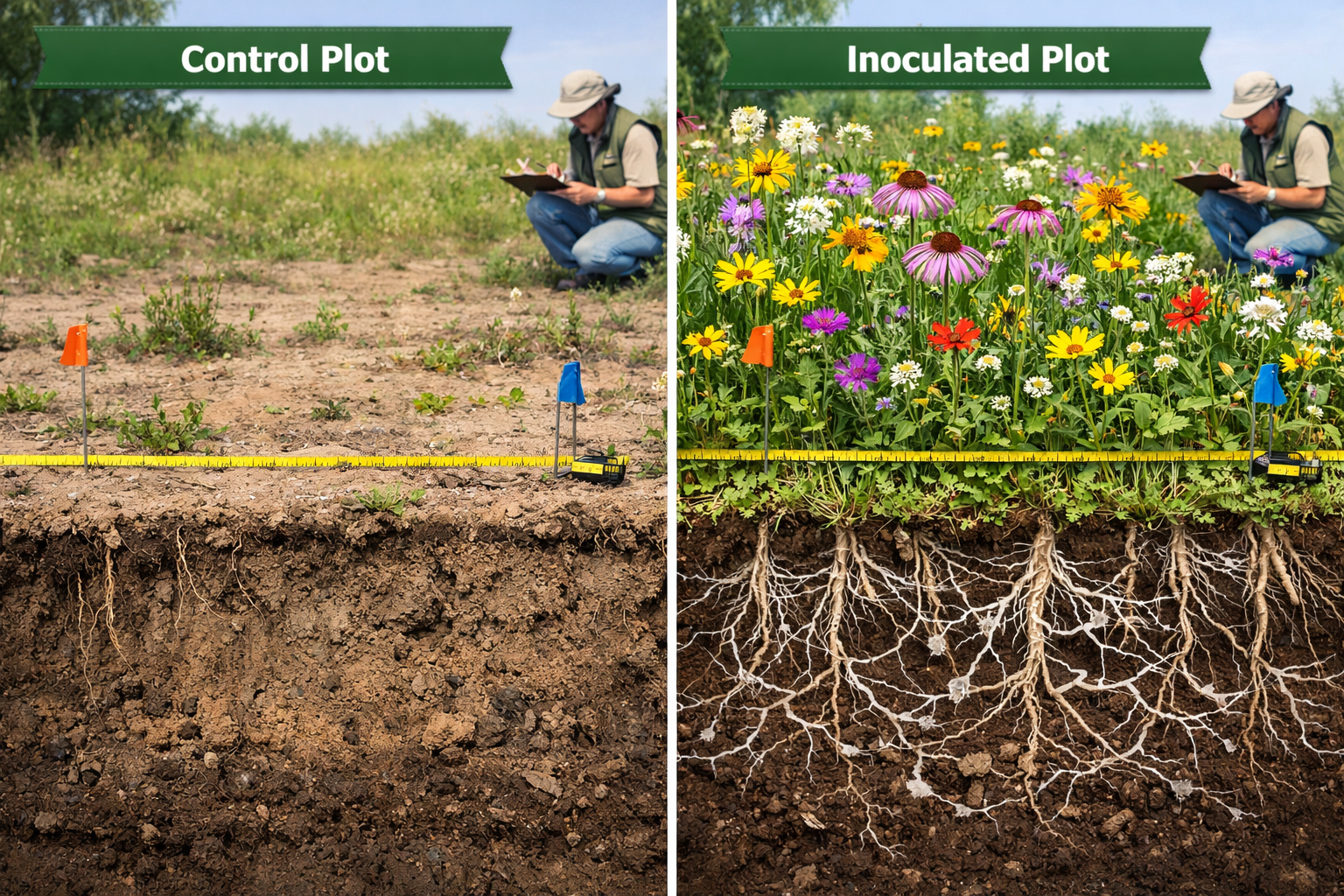
Rigorous validation requires control areas that receive identical treatment except for inoculation. Design control plots that:
- Match inoculated areas in size, topography, and baseline soil conditions
- Receive the same seed mixes, planting densities, and management interventions
- Are located sufficiently distant (minimum 10 meters) to prevent microbial cross-contamination
- Undergo identical monitoring and sampling protocols
Statistical comparison between inoculated and control areas provides the strongest evidence of inoculation effectiveness. Use appropriate statistical tests (t-tests, ANOVA, or non-parametric alternatives) to determine whether observed differences are statistically significant.
Documentation and Reporting Requirements for BNG Validation
Photographic Documentation Standards
Visual evidence provides powerful validation of restoration progress. Establish systematic photographic monitoring:
Fixed-point photography: Install permanent marker posts at multiple locations across the restoration site. Photograph from identical positions and angles at each monitoring interval. Include date stamps and scale references (meter sticks or known-size objects).
Macro-photography of soil and root samples: Document mycorrhizal colonization, soil structure, and root development with close-up photography. These images support technical reports and communicate results to non-specialist stakeholders.
Drone aerial imagery: For larger restoration sites, quarterly aerial photography documents spatial patterns of vegetation establishment and identifies areas requiring remedial intervention.
Laboratory Analysis Documentation
Maintain comprehensive records of all laboratory testing:
- Chain of custody forms: Document sample collection dates, locations, and handling procedures
- Laboratory accreditation certificates: Verify that testing facilities meet required standards
- Raw data sheets: Retain original laboratory results, not just summary statistics
- Quality assurance/quality control (QA/QC) data: Include laboratory blanks, duplicates, and reference standards
This documentation demonstrates due diligence and supports validation claims if regulatory authorities request evidence.
Monitoring Schedule and Adaptive Management
Develop a monitoring timeline that aligns with BNG reporting requirements. Typical schedules include:
Year 1: Intensive monitoring (quarterly assessments) to detect early establishment issues
Years 2-5: Semi-annual monitoring to track habitat maturation
Years 6-30: Annual monitoring throughout the BNG management period
Document any adaptive management interventions triggered by monitoring results. If validation reveals poor inoculation effectiveness, ecology surveyors should recommend corrective actions such as:
- Supplementary inoculation applications
- Adjustment of soil pH or nutrient levels to support microbial activity
- Modification of vegetation management to reduce competition stress
- Additional native species introduction to increase plant diversity
Integration with BNG Metric Calculations
Soil inoculation validation data should inform biodiversity net gain assessment calculations. Improved habitat condition scores in the Defra Metric reflect successful restoration interventions including effective soil inoculation.
Document how validation results support specific condition assessment criteria:
- Habitat distinctiveness: Successful establishment of characteristic plant communities
- Habitat condition: Achievement of target vegetation structure, species composition, and soil health indicators
- Strategic significance: Contribution to local habitat networks and ecological connectivity
For guidance on landowners participating in BNG schemes, clear documentation of soil inoculation effectiveness provides confidence that habitat creation will deliver promised biodiversity units.
Practical Considerations for Ecology Surveyors
Equipment and Resource Requirements
Implementing comprehensive validation protocols requires appropriate equipment and budget allocation:
Field equipment:
- Soil sampling augers or cores (multiple depths)
- GPS units for precise sample location recording
- Portable pH meters and electrical conductivity meters
- Root washing equipment for mycorrhizal assessment
- Photographic equipment (camera, drone, macro lens)
- Sample storage containers and coolers
Laboratory access:
- Accredited soil testing laboratory for chemical analysis
- Microscopy facilities for mycorrhizal colonization assessment
- Microbial enumeration capabilities (or contracted services)
Budget considerations:
Budget £2,000-5,000 for comprehensive baseline assessment of a typical 5-hectare restoration site, with annual monitoring costs of £800-2,000 depending on intensity. These costs should be incorporated into project planning from the outset.
Training and Competency Requirements
Ecology surveyors conducting soil inoculation validation should possess:
- Understanding of soil science fundamentals (chemistry, biology, physics)
- Practical experience with soil sampling techniques
- Familiarity with mycorrhizal and rhizobial biology
- Knowledge of UK habitat classification and condition assessment
- Statistical analysis skills for data interpretation
Professional development opportunities include courses offered by the British Society of Soil Science and specialist training in BNG metric application.
Common Pitfalls and How to Avoid Them
Pitfall 1: Inadequate baseline data
Solution: Never skip pre-inoculation sampling, regardless of project timeline pressures. Without baseline data, validation is impossible.
Pitfall 2: Contaminated samples
Solution: Clean sampling equipment between plots, especially when comparing inoculated and control areas. Use sterile gloves and containers.
Pitfall 3: Inappropriate inoculant selection
Solution: Match inoculant products to target plant species and habitat types. Not all mycorrhizal fungi colonize all plant species.
Pitfall 4: Environmental factors confounding results
Solution: Record weather conditions, management interventions, and any disturbances during the monitoring period. These contextual factors help interpret validation data.
Pitfall 5: Insufficient replication
Solution: Resist the temptation to reduce sample numbers to save costs. Statistical validity requires adequate replication.
Economic and Strategic Considerations
Cost-Benefit Analysis of Soil Inoculation
The documented ROI of mycorrhizal inoculants—$1.50-$3 per dollar invested[1]—makes soil inoculation economically attractive for BNG restoration projects. However, this return depends on proper application and validation.
Ecology surveyors should help clients understand that validation costs are not optional extras but essential components of risk management. Failed restoration attempts require costly remediation and may delay project completion, potentially incurring penalties under BNG regulations.
Strategic Value for Developers and Landowners
For developers navigating BNG requirements, validated soil inoculation protocols offer several strategic advantages:
Accelerated habitat establishment: Faster achievement of target habitat condition reduces management period costs and uncertainty.
Reduced off-site unit purchases: Effective on-site restoration may reduce the need to buy biodiversity units from habitat banks, lowering overall project costs.
Enhanced marketability: Developments demonstrating genuine environmental stewardship through validated restoration may achieve premium valuations.
Regulatory confidence: Robust validation documentation reduces the risk of regulatory challenges or enforcement actions.
For landowners considering selling biodiversity units, validated soil inoculation protocols increase habitat bank credibility and may command higher unit prices.
Future Developments and Research Directions
Investment in soil health research continues to grow. A €1.45 million project on soil health announced in February 2026[7] reflects increasing recognition of soil's central role in ecosystem restoration. Ecology surveyors should stay informed about emerging research that may refine validation protocols.
Areas of active development include:
- Molecular techniques for rapid microbial community characterization (DNA sequencing, qPCR)
- Remote sensing applications for landscape-scale soil health monitoring
- Standardized bioassays for functional assessment of soil biological activity
- Integration of soil metrics into updated versions of the Defra Metric
Conclusion
Soil Inoculation for BNG Restoration: Field Validation Protocols for Ecology Surveyors represents a critical intersection of restoration ecology, regulatory compliance, and practical field science. As the UK's BNG framework matures in 2026 and beyond, the ability to demonstrate measurable habitat improvements through rigorous validation will separate successful restoration projects from those that fail to deliver promised biodiversity gains.
Ecology surveyors equipped with comprehensive validation protocols provide essential value to developers, landowners, and the broader conservation community. By establishing clear baselines, implementing standardized monitoring, and documenting results with scientific rigor, surveyors transform soil inoculation from an experimental intervention into a proven restoration tool.
Actionable Next Steps
For ecology surveyors looking to implement or improve soil inoculation validation protocols:
- Develop site-specific sampling plans that establish adequate baselines before any inoculation occurs
- Invest in appropriate equipment and laboratory partnerships to ensure testing meets accreditation standards
- Create standardized documentation templates that capture all required validation data
- Establish control areas in every restoration project to enable statistical comparison
- Build monitoring schedules into project timelines and budgets from the planning stage
- Pursue professional development in soil science and microbial ecology to enhance competency
- Engage with emerging research to refine protocols as new validation techniques become available
The successful integration of validated soil inoculation into BNG restoration projects requires collaboration between ecology surveyors, soil scientists, restoration practitioners, and regulatory authorities. By embracing evidence-based protocols and maintaining high standards of documentation, the ecology profession can ensure that soil inoculation delivers genuine, measurable contributions to biodiversity recovery across the UK's developing landscape.
For additional guidance on benefitting nature and developers through effective BNG implementation, consult with qualified ecology professionals who can tailor validation protocols to your specific project requirements.
References
[1] How To Restore Soil Health 7 Proven Steps For 2026 – https://farmlifehq.com/how-to-restore-soil-health-7-proven-steps-for-2026/
[2] Li Responds To Government Changes To Bng And Updated Nppf – https://landscapeinstitute.org/news/li-responds-to-government-changes-to-bng-and-updated-nppf/
[3] rootgrowbng.co.uk – https://rootgrowbng.co.uk
[4] A Biodiversity Net Gain Solution For A High Value Brownfield Site – https://naturalengland.blog.gov.uk/2026/01/07/a-biodiversity-net-gain-solution-for-a-high-value-brownfield-site/
[7] Week In Soil 13 February 2026 – https://www.sustainablesoils.org/week-in-soil/week-in-soil-13-february-2026/