

Wildlife populations worldwide face an unprecedented crisis in 2026, but the solution isn't as simple as addressing one threat at a time. Groundbreaking research reveals that Interactive Threat Modeling for Vertebrate Populations: Survey Techniques to Counter Multi-Pressure Declines in 2026 offers a revolutionary approach to understanding and reversing biodiversity loss. When multiple threats like disease, invasive species, and climate change collide, their combined impact creates dramatically variable population trajectories that traditional single-threat assessments completely miss. For biodiversity surveyors and conservation professionals, mastering these interactive modeling techniques isn't just academic—it's essential for delivering effective biodiversity net gain assessments that actually work.
Recent analysis of over 3,000 vertebrate population time series from the Living Planet Database has exposed a startling truth: threat combinations drive biodiversity loss far more than random environmental fluctuations [1]. This discovery fundamentally changes how professionals must approach conservation planning and survey design.
Key Takeaways
- Interactive threats show 10x more variable impacts than single threats, with both the most positive and most negative population trends occurring when multiple pressures combine [1]
- Exploitation remains the #1 priority, offering 81.62% relative improvement in population trends when addressed, followed by habitat loss at 16.87% improvement [1]
- Bayesian modeling protocols now enable surveyors to predict threat interactions with unprecedented accuracy, accounting for synergistic, antagonistic, and additive effects across ecosystems [1]
- Counterfactual scenario analysis provides "what-if" simulations that identify which threat combinations to prioritize for maximum conservation impact [3]
- Coordinated multi-pressure interventions are essential—tackling threats individually will not halt ongoing biodiversity loss in vertebrate populations [3]
Understanding Interactive Threat Modeling for Vertebrate Populations in 2026
What Makes Threat Interactions Different from Single Pressures?
Traditional conservation approaches treat threats as isolated problems. A development project might assess habitat loss separately from pollution impacts, or climate change independently from invasive species. However, Interactive Threat Modeling for Vertebrate Populations: Survey Techniques to Counter Multi-Pressure Declines in 2026 recognizes that nature doesn't work in isolation.
When multiple threats combine, they can interact in three distinct ways:
| Interaction Type | Definition | Example Impact |
|---|---|---|
| Synergistic 🔥 | Combined effects worse than predicted | Pollution + climate change = extreme population crashes |
| Antagonistic 🛡️ | Combined effects better than predicted | Habitat protection buffers against climate impacts |
| Additive ➕ | Effects combine predictably | Two moderate threats = moderate combined decline |
Research analyzing 3,129 population time series across 4,392 vertebrate species demonstrates that interactive threats contribute significantly more to population declines than spatial or temporal variation [1]. This means the combinations of pressures—not random environmental fluctuations—are driving biodiversity loss.
The Six Primary Threat Categories
The statistical framework for Interactive Threat Modeling for Vertebrate Populations examines six distinct threat categories [1]:
- Climate change 🌡️ – Temperature shifts, precipitation changes, extreme weather events
- Invasive species 🦠 – Non-native competitors, predators, and disease vectors
- Habitat loss/degradation 🏗️ – Land conversion, fragmentation, quality decline
- Exploitation 🎣 – Overharvesting, hunting, fishing, poaching
- Pollution ☠️ – Chemical contamination, nutrient loading, plastic waste
- Disease 🦠 – Pathogens, parasites, emerging infectious diseases
These six categories create 36 possible threat combinations, each producing unique population responses that require specialized survey techniques and modeling approaches [1].
Why Traditional Single-Threat Assessments Fall Short
Conventional biodiversity impact assessments often evaluate threats in isolation, missing critical interaction effects. Consider pollution and climate change: individually, pollution shows a -2.83% annual population decline, while climate change shows -1.42% [1]. But when combined, their confidence intervals explode—pollution ranges from -44.96% to +50.77% per year, and climate change from -30.06% to +33.70% per year [1].
This extreme uncertainty in combined effects means that:
- Risk assessments based on single threats dramatically underestimate potential impacts
- Conservation interventions targeting one pressure may fail due to unaddressed interactions
- Biodiversity net gain strategies require multi-pressure modeling to ensure success
"Conservation action must be coordinated across multiple pressures. Tackling threats one at a time will not be enough to halt ongoing biodiversity loss." — Dr. Duncan O'Brien, University of Bristol [3]
Advanced Survey Techniques for Multi-Pressure Assessment

Implementing Bayesian Modeling Protocols
Interactive Threat Modeling for Vertebrate Populations: Survey Techniques to Counter Multi-Pressure Declines in 2026 relies on sophisticated multilevel Bayesian linear models that account for spatial and temporal autocorrelation [1]. These statistical approaches separate true threat effects from random environmental variation across freshwater, marine, and terrestrial ecosystems.
For biodiversity surveyors, implementing Bayesian protocols involves:
Data Collection Requirements:
- Minimum 5-year population time series data
- Standardized threat classification across survey sites
- Spatial coordinates for autocorrelation analysis
- Temporal sampling intervals consistent within species groups
- Ecosystem-specific covariates (temperature, precipitation, land use)
Model Structure Elements:
- Population-level effects – Overall threat impacts across all populations
- Species-level random effects – Variation in threat sensitivity by species
- Spatial autocorrelation terms – Geographic clustering of threat responses
- Temporal autocorrelation terms – Year-to-year population dynamics
- Interaction terms – Combined effects of multiple threats
This approach allows surveyors to distinguish whether observed population changes result from specific threat combinations or natural variation, providing the evidence base needed for effective biodiversity net gain planning.
Counterfactual Scenario Modeling
One of the most powerful tools in Interactive Threat Modeling for Vertebrate Populations is counterfactual analysis—"what-if" simulations that estimate how populations would respond if specific threats were reduced or eliminated [3].
The methodology involves:
- Baseline scenario – Current population trends under existing threat combinations
- Single-threat removal – Predicted trends if one threat is eliminated
- Multi-threat removal – Predicted trends if multiple threats are addressed
- Comparative analysis – Ranking interventions by predicted population improvement
Recent counterfactual modeling revealed critical priorities [1]:
- Removing exploitation → 81.62% relative improvement (highest priority)
- Eliminating habitat loss → 16.87% relative improvement (secondary priority)
- Addressing climate change → Variable effects depending on other threats present
- Controlling invasive species → Strongest benefits in marine ecosystems
These findings directly inform conservation strategies for developers and landowners seeking to maximize biodiversity outcomes.
Field Survey Protocols for Multi-Threat Detection
Effective Interactive Threat Modeling requires comprehensive field data collection that captures all relevant pressures. Modern survey protocols integrate:
Habitat Assessment Components:
- Structural habitat quality metrics (vegetation cover, water quality, soil conditions)
- Fragmentation analysis using GIS mapping
- Land use change detection through temporal satellite imagery
- Edge effect quantification in modified landscapes
Direct Threat Indicators:
- Evidence of exploitation (hunting signs, fishing pressure, harvest rates)
- Invasive species presence and abundance surveys
- Pollution monitoring (water chemistry, soil contaminants, air quality)
- Disease surveillance (pathogen testing, mortality events, health assessments)
Climate Vulnerability Metrics:
- Temperature and precipitation trend analysis
- Extreme weather event frequency
- Phenological mismatch indicators
- Range shift documentation
Population Monitoring Techniques:
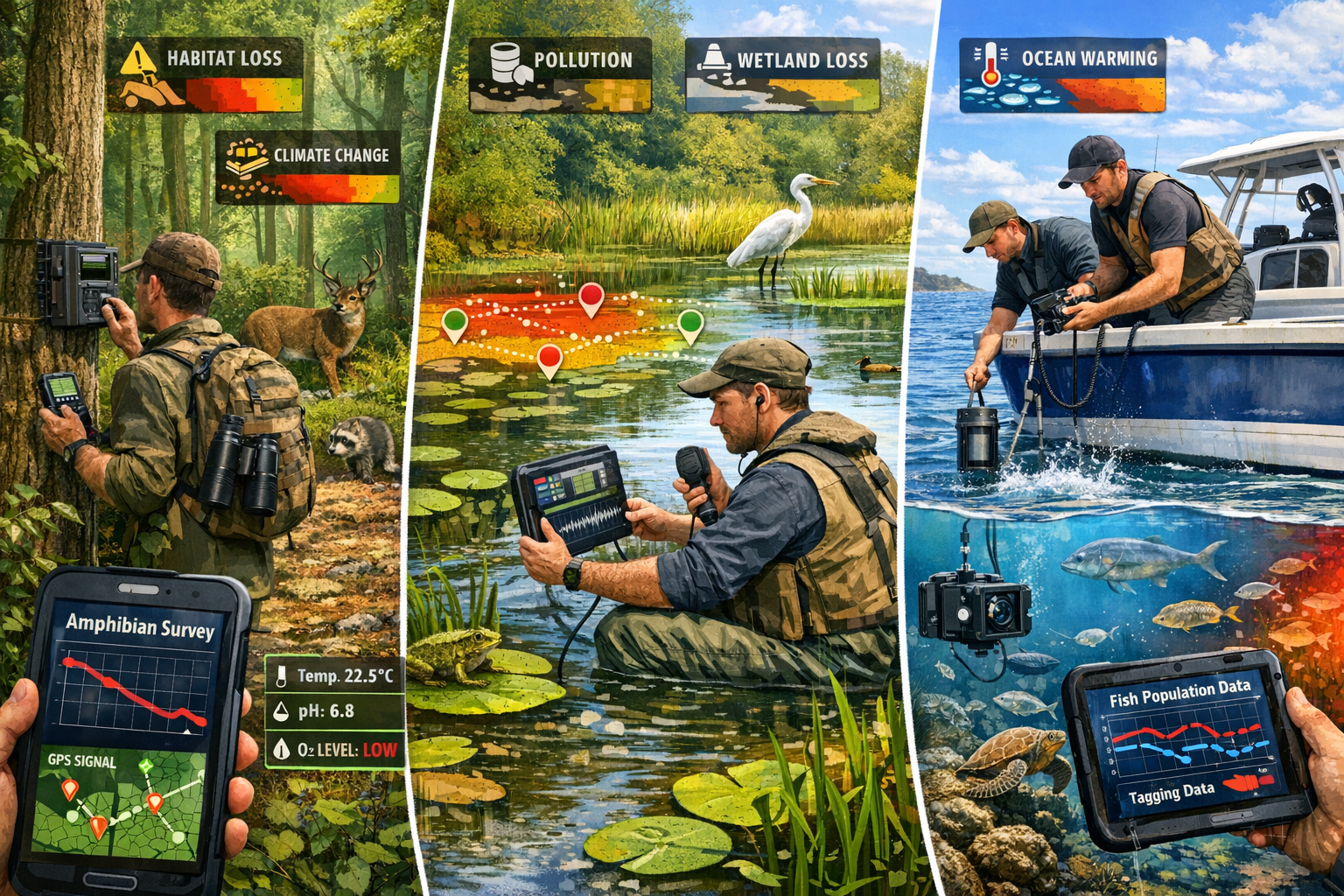
- Camera trap networks for terrestrial mammals
- Acoustic monitoring for birds and amphibians
- Mark-recapture studies for demographic analysis
- Environmental DNA (eDNA) sampling for aquatic species
- Drone-based surveys for large-scale population estimates
These comprehensive approaches ensure that biodiversity assessments capture the full spectrum of interactive threats affecting vertebrate populations.
Applying Interactive Threat Modeling to Biodiversity Net Gain in 2026
Prioritizing Conservation Interventions
Interactive Threat Modeling for Vertebrate Populations: Survey Techniques to Counter Multi-Pressure Declines in 2026 transforms how professionals prioritize conservation actions. The evidence is clear: exploitation and habitat loss are the most widespread threats affecting vertebrate populations globally [7], but their relative importance varies by ecosystem and species group.
For practical implementation:
High-Priority Interventions (81.62% improvement potential):
- Establish protected areas with enforcement against poaching and overharvesting
- Implement sustainable harvest quotas based on population modeling
- Create wildlife corridors reducing roadkill and human-wildlife conflict
- Deploy anti-poaching technology and community-based monitoring
Secondary-Priority Interventions (16.87% improvement potential):
- Restore degraded habitats using native species assemblages
- Reconnect fragmented landscapes through ecological corridors
- Implement on-site and off-site biodiversity delivery strategies
- Protect high-quality existing habitats from conversion
Context-Dependent Interventions (variable effects):
- Climate adaptation measures (effectiveness depends on other threats present)
- Invasive species control (highest impact in marine and island ecosystems)
- Pollution remediation (synergistic benefits when combined with habitat restoration)
- Disease management (critical for populations already stressed by other threats)
This evidence-based prioritization ensures that limited conservation resources deliver maximum population recovery, directly supporting biodiversity net gain objectives.
Integrating Multi-Pressure Modeling into Development Projects
For developers and planners working under UK biodiversity requirements, Interactive Threat Modeling for Vertebrate Populations offers a pathway to more effective outcomes. Traditional approaches might address habitat loss through compensation but ignore exploitation pressure from increased human access or pollution from construction runoff.
Best Practice Integration Steps:
- Baseline Multi-Threat Assessment – Document all existing pressures affecting target vertebrate populations, not just habitat quantity
- Interaction Analysis – Model how development-related threats will combine with existing pressures using Bayesian frameworks
- Counterfactual Planning – Test multiple mitigation scenarios to identify strategies addressing the most impactful threat combinations
- Coordinated Mitigation Design – Develop biodiversity plans that address multiple pressures simultaneously
- Adaptive Monitoring – Implement long-term population monitoring to validate predicted responses and adjust management
This approach aligns with emerging BNG strategy questions about ensuring genuine conservation outcomes rather than just metric compliance.
Case Study Applications Across Ecosystems
Interactive Threat Modeling for Vertebrate Populations applies differently across ecosystem types:
Terrestrial Systems:
- Primary threats: habitat loss + exploitation
- Key interactions: fragmentation amplifies edge effects and increases poaching access
- Survey focus: camera trapping, habitat quality assessment, human disturbance metrics
- Mitigation priority: protected area establishment with access management
Freshwater Systems:
- Primary threats: pollution + habitat degradation
- Key interactions: nutrient loading + invasive species create regime shifts
- Survey focus: water quality monitoring, eDNA sampling, riparian habitat assessment
- Mitigation priority: watershed-scale pollution control + habitat restoration
Marine Systems:
- Primary threats: exploitation + climate change
- Key interactions: overfishing + warming = population collapse risk
- Survey focus: fisheries-independent surveys, temperature monitoring, trophic cascade indicators
- Mitigation priority: harvest restrictions + climate refugia protection
Understanding these ecosystem-specific patterns enables targeted biodiversity strategies that address the most relevant threat combinations.
Measuring Success: Population Response Metrics
Effective Interactive Threat Modeling requires robust metrics to evaluate whether interventions are working. Key performance indicators include:
Short-term Metrics (1-3 years):
- Threat intensity reduction (measured directly: pollution levels, harvest rates, habitat quality)
- Immediate behavioral responses (species recolonization, increased reproduction)
- Habitat condition improvements (vegetation recovery, water quality gains)
Medium-term Metrics (3-10 years):
- Population trend reversals (declining populations stabilize or increase)
- Demographic structure improvements (age distribution, sex ratios)
- Range expansion into restored or protected areas
Long-term Metrics (10+ years):
- Population viability analysis showing reduced extinction risk
- Genetic diversity maintenance or recovery
- Ecosystem function restoration (trophic interactions, nutrient cycling)
These metrics provide the evidence base for demonstrating biodiversity net gain achievement and informing adaptive management.
Challenges and Solutions in Implementation
Data Availability and Quality Issues
One major challenge in applying Interactive Threat Modeling for Vertebrate Populations is obtaining sufficient long-term population data. The Living Planet Database contains 25,054 population records across 4,392 species [1], but many regions and taxa remain under-represented.
Practical Solutions:
- Leverage citizen science networks for expanded monitoring coverage
- Implement standardized protocols enabling data integration across projects
- Prioritize monitoring for species groups most sensitive to threat interactions
- Use surrogate species when data for target species are unavailable
- Collaborate with academic institutions conducting long-term research
For projects requiring immediate decisions, space-for-time substitutions can provide insights by comparing populations across spatial gradients of threat intensity rather than waiting for temporal trends.
Computational Complexity and Technical Capacity
Bayesian multilevel modeling requires specialized statistical expertise that many conservation practitioners lack. However, several approaches make these techniques more accessible:
Capacity-Building Strategies:
- Online training programs in Bayesian modeling for conservation
- Open-source software packages with user-friendly interfaces (R packages: brms, rstanarm)
- Collaboration with statistical consultants for complex analyses
- Pre-built model templates for common threat combinations
- Decision support tools translating model outputs into management recommendations
The initial investment in technical capacity pays long-term dividends through more effective conservation outcomes and reduced project risks.
Uncertainty in Threat Interaction Predictions
The extreme confidence intervals observed for some threat combinations—particularly pollution and climate change interactions [1]—create challenges for risk-averse decision-makers. How can planners commit resources when predicted outcomes range from severe decline to substantial recovery?
Risk Management Approaches:
- Precautionary principle – Design interventions robust to worst-case scenarios
- Adaptive management – Implement monitoring-based adjustments as responses become clearer
- Portfolio strategies – Diversify interventions across multiple threat types
- Scenario planning – Develop contingency plans for different interaction outcomes
- Insurance mechanisms – Consider biodiversity unit banking to buffer against uncertainty
Acknowledging uncertainty explicitly—rather than ignoring it—leads to more resilient conservation strategies.
The Future of Vertebrate Conservation: Coordinated Action
The evidence from Interactive Threat Modeling for Vertebrate Populations: Survey Techniques to Counter Multi-Pressure Declines in 2026 delivers a clear message: single-threat approaches are insufficient. The dramatic variability in population responses to threat combinations [1] means that effective conservation requires coordinated, multi-pressure interventions.
For biodiversity professionals in 2026, this translates to:
✅ Comprehensive threat assessments capturing all relevant pressures and their interactions
✅ Bayesian modeling frameworks that separate true threat effects from environmental noise
✅ Counterfactual scenario analysis identifying highest-priority intervention targets
✅ Ecosystem-specific strategies recognizing that threat importance varies across systems
✅ Long-term adaptive monitoring validating predictions and enabling course corrections
✅ Cross-sector collaboration addressing threats that span jurisdictional boundaries
The transition from single-threat to interactive threat modeling represents a paradigm shift in conservation science—one that offers genuine hope for reversing vertebrate population declines if implemented systematically.
Conclusion
Interactive Threat Modeling for Vertebrate Populations: Survey Techniques to Counter Multi-Pressure Declines in 2026 provides the scientific foundation and practical tools needed to address the biodiversity crisis effectively. The research is unambiguous: exploitation and habitat loss are the highest-priority threats [1], but their impacts are dramatically amplified or buffered by interactions with climate change, invasive species, pollution, and disease.
For conservation practitioners, developers, and biodiversity surveyors, the path forward requires embracing complexity rather than simplifying it. Bayesian modeling protocols, counterfactual scenario analysis, and comprehensive multi-threat field surveys may demand greater upfront investment, but they deliver conservation outcomes that actually work—populations that stabilize, recover, and persist.
Actionable Next Steps
For Biodiversity Surveyors:
- Expand survey protocols to capture all six threat categories systematically
- Develop partnerships with statistical experts to implement Bayesian modeling
- Establish long-term monitoring programs enabling trend detection
- Contact specialists to integrate interactive threat modeling into your assessments
For Developers and Planners:
- Request multi-threat assessments rather than single-pressure evaluations
- Prioritize mitigation strategies addressing exploitation and habitat loss
- Design biodiversity net gain plans with coordinated multi-pressure interventions
- Implement adaptive monitoring to validate predicted population responses
For Landowners:
- Assess which threat combinations affect vertebrate populations on your land
- Explore biodiversity unit opportunities that address multiple pressures
- Collaborate with conservation organizations for evidence-based management
- Consider long-term stewardship commitments ensuring sustained threat reduction
The tools and knowledge exist to reverse vertebrate population declines. The question in 2026 is whether conservation professionals, developers, and policymakers will embrace the interactive, coordinated, evidence-based approaches that science demonstrates are necessary. The future of global biodiversity depends on that choice.
References
[1] Interactive threats show dramatically variable impacts – https://www.science.org/doi/10.1126/sciadv.adx7973
[2] PMC Article on Interactive Threats – https://pmc.ncbi.nlm.nih.gov/articles/PMC12893280/
[3] Coordinated conservation is essential – https://www.eurekalert.org/news-releases/1116355
[4] Wildlife Decline Research – https://www.bristol.ac.uk/cabot/news/2026/wildlife-decline.html
[5] Research Data Repository – https://zenodo.org/records/18775663
[6] New Tools for Growing Threats – https://www.usgs.gov/centers/fort-collins-science-center/news/new-tools-a-growing-threat-co-developed-science-informs
[7] Vertebrates Biodiversity Loss Priority Threats – https://phys.org/news/2026-02-vertebrates-biodiversity-loss-priority-threats.html
[8] Animal Species Risk from Heat and Land Use – https://www.ox.ac.uk/news/2025-12-09-nearly-8000-animal-species-risk-extreme-heat-and-land-use-change-collide