

Imagine watching an entire ecosystem evolve in real-time, tracking every species interaction, habitat change, and environmental shift as it happens—not through months of manual surveys, but through intelligent digital simulations that predict biodiversity outcomes before they occur. This is the promise of Digital Twins for Real-Time Biodiversity Net Gain Tracking: Deployment Strategies for 2026 Ecology Projects, a revolutionary approach that combines artificial intelligence, environmental DNA, and predictive modeling to transform how we monitor and achieve mandatory biodiversity improvements.
As UK developers and landowners navigate increasingly stringent Biodiversity Net Gain requirements in 2026, traditional monitoring methods—manual surveys, seasonal assessments, and retrospective reporting—are proving inadequate for demonstrating the 10% net gain now mandated by law. Digital twins offer a solution: virtual replicas of ecosystems that continuously simulate biodiversity dynamics, enabling proactive management and transparent, real-time verification of conservation outcomes.
Key Takeaways
- 🌿 Digital twins create virtual ecosystem replicas that simulate biodiversity changes in real-time, enabling predictive management rather than reactive monitoring for net gain compliance
- 🤖 AI technologies like graph neural networks and TinyML sensors are making biodiversity digital twins practical for 2026 deployment, with low-power devices enabling monitoring in remote locations
- 📊 Real-time tracking improves accuracy by providing continuous data streams from eDNA analysis, replacing seasonal survey gaps with holistic, community-level ecosystem assessment
- 🎯 Scenario-based planning capabilities allow developers to test multiple restoration strategies virtually before implementation, reducing risk and optimizing biodiversity unit investments
- 📱 User-friendly dashboards are making digital twin technology accessible to industry professionals and government agencies, democratizing advanced conservation tools for practical ecology projects
Understanding Digital Twins for Biodiversity Monitoring
What Are Biodiversity Digital Twins?
A biodiversity digital twin is a virtual replica of a real ecosystem that uses continuous data feeds to simulate and predict how species populations, habitat quality, and ecological processes change over time. Unlike static models or periodic assessments, digital twins update dynamically as new information arrives, creating a living simulation that mirrors the actual environment.
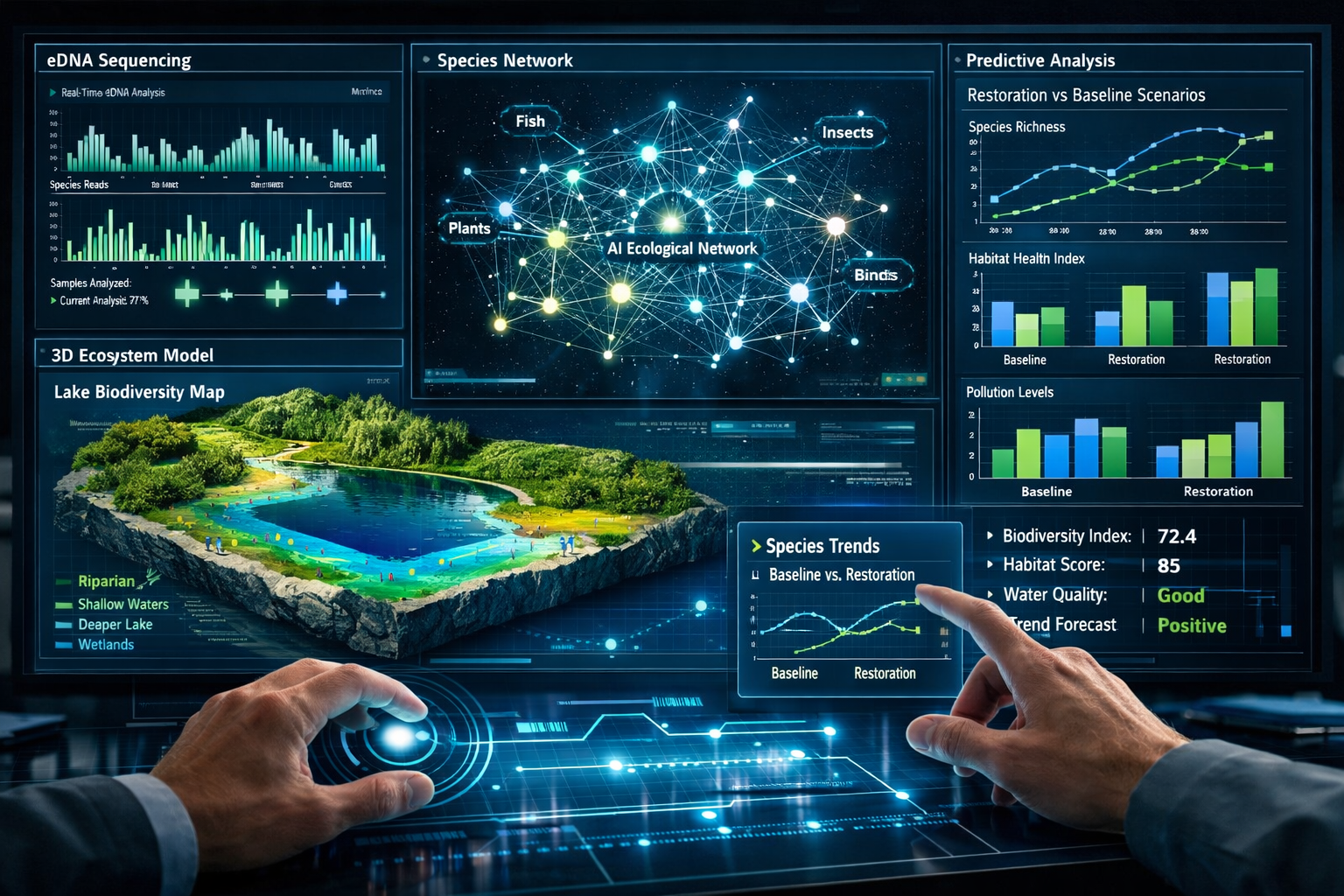
The University of Birmingham is currently developing a state-of-the-art biodiversity digital twin for freshwater lake ecosystems across England, using graph neural networks (GNNs) and temporal graph networks (TGNs) to analyze environmental DNA data from sediment cores [1]. This system tracks changes across multiple taxonomic groups simultaneously, providing a holistic view of ecosystem health rather than focusing on individual species.
Key components of biodiversity digital twins include:
- Data collection layer: Sensors, eDNA sampling, satellite imagery, and field observations
- AI processing engine: Machine learning algorithms that identify patterns and predict outcomes
- Simulation environment: 3D models that visualize ecosystem dynamics spatially and temporally
- Decision support interface: Dashboards that translate complex data into actionable insights
Why Traditional Monitoring Falls Short for Net Gain Compliance
Traditional biodiversity monitoring relies on seasonal surveys conducted at specific intervals—typically spring and summer when species are most active. This approach creates significant gaps in understanding:
❌ Temporal blind spots: Changes occurring between surveys go undetected
❌ Weather dependency: Adverse conditions can invalidate entire survey seasons
❌ Resource intensity: Manual surveys require substantial time and expertise
❌ Limited taxonomic coverage: Most surveys focus on indicator species rather than whole communities
❌ Delayed detection: Problems are identified months after they begin, when intervention is more difficult
For developers working to achieve the mandatory 10% biodiversity net gain outlined in planning requirements, these limitations create uncertainty. Without continuous monitoring, it's difficult to demonstrate that enhancement measures are working as intended or to make timely adjustments when they're not.
The Digital Twin Advantage for 2026 Ecology Projects
Digital twins address these shortcomings by providing continuous, multi-dimensional monitoring that captures ecosystem dynamics as they unfold. The Birmingham project demonstrates how digital twins can model biodiversity under multiple scenarios—"business as usual" versus restoration plans, different climate conditions, and varying pollution levels [1].
"Digital twins enable holistic, community-level ecosystem assessment rather than single-species focus, identifying main drivers of biodiversity loss through spatiotemporal data integration."
This capability is particularly valuable for Biodiversity Net Gain assessments, where demonstrating measurable improvement requires robust baseline data and verifiable progress tracking. The BioDT project has already delivered 10 prototype digital twins across grassland, forest, and agricultural ecosystems between 2022-2025, implementing FAIR principles (Findable, Accessible, Interoperable, and Reusable) that make the technology practical for widespread adoption [2].
Core Technologies Enabling Real-Time Biodiversity Tracking
Environmental DNA (eDNA) as the Foundation
Environmental DNA metabarcoding has become the cornerstone data source for biodiversity digital twins. This technique analyzes genetic material shed by organisms into their environment—water, soil, or air—to identify which species are present without requiring direct observation or capture.
The Birmingham digital twin project employs eDNA collected from freshwater ecosystems to capture community-level biodiversity, using bioinformatics and multivariate statistics to analyze high-throughput sequencing data [1]. This approach offers several advantages:
✅ Comprehensive detection: Captures rare, cryptic, and difficult-to-observe species
✅ Non-invasive sampling: Minimal ecosystem disturbance compared to traditional methods
✅ Rapid processing: Modern sequencing provides results in days rather than months
✅ Standardized protocols: Reduces observer bias and improves reproducibility
For developers conducting biodiversity impact assessments, eDNA sampling can establish robust baselines and track changes with unprecedented detail, supporting more accurate net gain calculations.
Artificial Intelligence and Machine Learning
The real power of digital twins emerges when eDNA data feeds into advanced AI algorithms that identify patterns, predict trends, and simulate outcomes:
Graph Neural Networks (GNNs): These algorithms model relationships between species, habitats, and environmental factors as interconnected networks. When a change occurs in one part of the ecosystem, GNNs predict how effects will cascade through the entire food web.
Temporal Graph Networks (TGNs): Building on GNNs, these systems add the time dimension, tracking how ecological relationships evolve across seasons and years. This enables prediction of long-term biodiversity trajectories under different management scenarios [1].
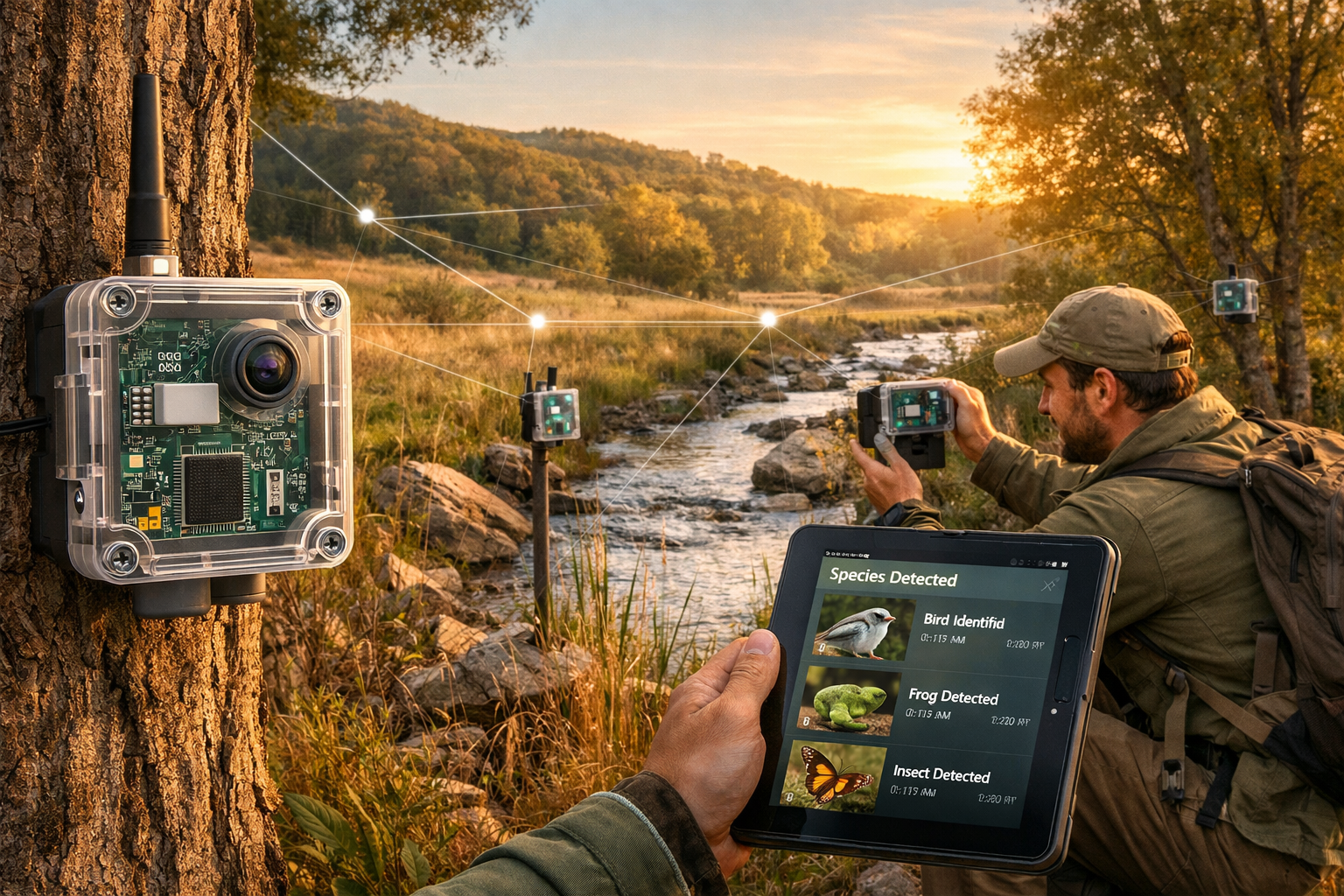
TinyML (Tiny Machine Learning): The 2026 Global Horizon Scan identifies low-power TinyML devices that don't require internet connectivity as a near-term deployment enabler for biodiversity monitoring [3]. These compact sensors can perform AI-based species identification directly in the field, transmitting only essential results rather than raw data.
Optical AI chips: Requiring minimal energy, these specialized processors enable real-time biodiversity detection in remote landscapes where traditional computing infrastructure isn't feasible [3].
Data Integration and Visualization Platforms
The Birmingham project is developing an intuitive analytical dashboard that makes digital twin tools accessible to end-users in industry and government agencies [1]. These interfaces translate complex AI outputs into visual formats that support decision-making:
- 3D ecosystem models: Spatial visualization of habitat quality and species distribution
- Predictive timelines: Projections showing biodiversity trajectories under different scenarios
- Alert systems: Automated notifications when metrics deviate from expected ranges
- Compliance reporting: Automated generation of documentation for biodiversity net gain reports
The EU's Digital Twin of the Ocean (DTO-BioFlow) project demonstrates how these platforms can integrate previously unused marine biodiversity data through AI-processed and automated data flows [4], making vast datasets actionable for conservation planning.
Deployment Strategies for 2026 Ecology Projects
Phase 1: Site Assessment and Technology Selection
Successful deployment of Digital Twins for Real-Time Biodiversity Net Gain Tracking: Deployment Strategies for 2026 Ecology Projects begins with matching technology to site characteristics:
Small development projects (under 1 hectare) may benefit from simplified digital twin approaches using commercially available eDNA services paired with cloud-based analysis platforms. These projects can leverage open-source algorithms that reduce barriers to adoption [5].
Large-scale developments with complex on-site and off-site delivery requirements need comprehensive digital twin systems with multiple sensor types:
| Site Feature | Recommended Technology | Data Collection Frequency |
|---|---|---|
| Freshwater bodies | eDNA water sampling + TinyML acoustic sensors | Weekly eDNA / Continuous audio |
| Grassland habitats | Optical AI cameras + soil eDNA | Monthly eDNA / Daily imaging |
| Woodland areas | Acoustic sensors + canopy cameras | Continuous audio / Weekly imaging |
| Wetlands | Multi-parameter water sensors + eDNA | Continuous chemistry / Bi-weekly eDNA |
Phase 2: Baseline Establishment Through Digital Twin Modeling
Creating an accurate digital twin requires establishing a comprehensive baseline that captures ecosystem complexity. This goes beyond traditional biodiversity net gain assessments by incorporating:
Multi-season data collection: Rather than single-season surveys, digital twins require data across at least one full annual cycle to capture seasonal variation in species presence and habitat use.
Community-level analysis: Instead of focusing on protected species alone, digital twins analyze entire ecological communities, identifying keystone species and critical interactions that drive ecosystem function.
Environmental context: Temperature, precipitation, water chemistry, soil nutrients, and other abiotic factors are integrated to understand what drives biodiversity patterns.
The Birmingham project demonstrates how combining spatiotemporal eDNA and environmental data enables simulation of freshwater lake biodiversity dynamics, identifying main drivers of loss and enabling holistic assessment [1].
Phase 3: Implementation and Sensor Network Deployment
Physical deployment requires strategic placement of monitoring equipment to capture representative data while minimizing maintenance requirements:
TinyML sensor networks: These low-power devices can operate for months on battery power, making them ideal for remote locations. The 2026 Horizon Scan notes that their independence from internet connectivity enables monitoring in areas where traditional IoT devices would fail [3].
Automated eDNA sampling: Emerging technologies allow scheduled water or soil collection without manual intervention, with samples preserved until laboratory pickup.
Integration with existing infrastructure: Where possible, digital twin sensors should leverage existing site infrastructure—power supplies, internet connectivity, and security systems—to reduce deployment costs.
For architects and planners solving BNG challenges, early integration of monitoring infrastructure into site designs ensures that digital twin systems can operate throughout the development lifecycle.
Phase 4: Continuous Monitoring and Adaptive Management
Once operational, digital twins enable proactive management through continuous feedback:
Real-time alerts: When biodiversity metrics decline, automated notifications enable immediate investigation and intervention, preventing minor issues from becoming major problems.
Scenario testing: Before implementing costly habitat enhancements, managers can simulate outcomes in the digital twin, testing multiple approaches to identify the most effective strategy.
Transparent reporting: Stakeholders can access live dashboards showing current biodiversity status, progress toward net gain targets, and predicted future trajectories.
This approach aligns with guidance on achieving biodiversity net gain without risk by replacing uncertainty with data-driven confidence.
Phase 5: Long-Term Verification and Compliance Documentation
Digital twins excel at generating the documentation required for regulatory compliance:
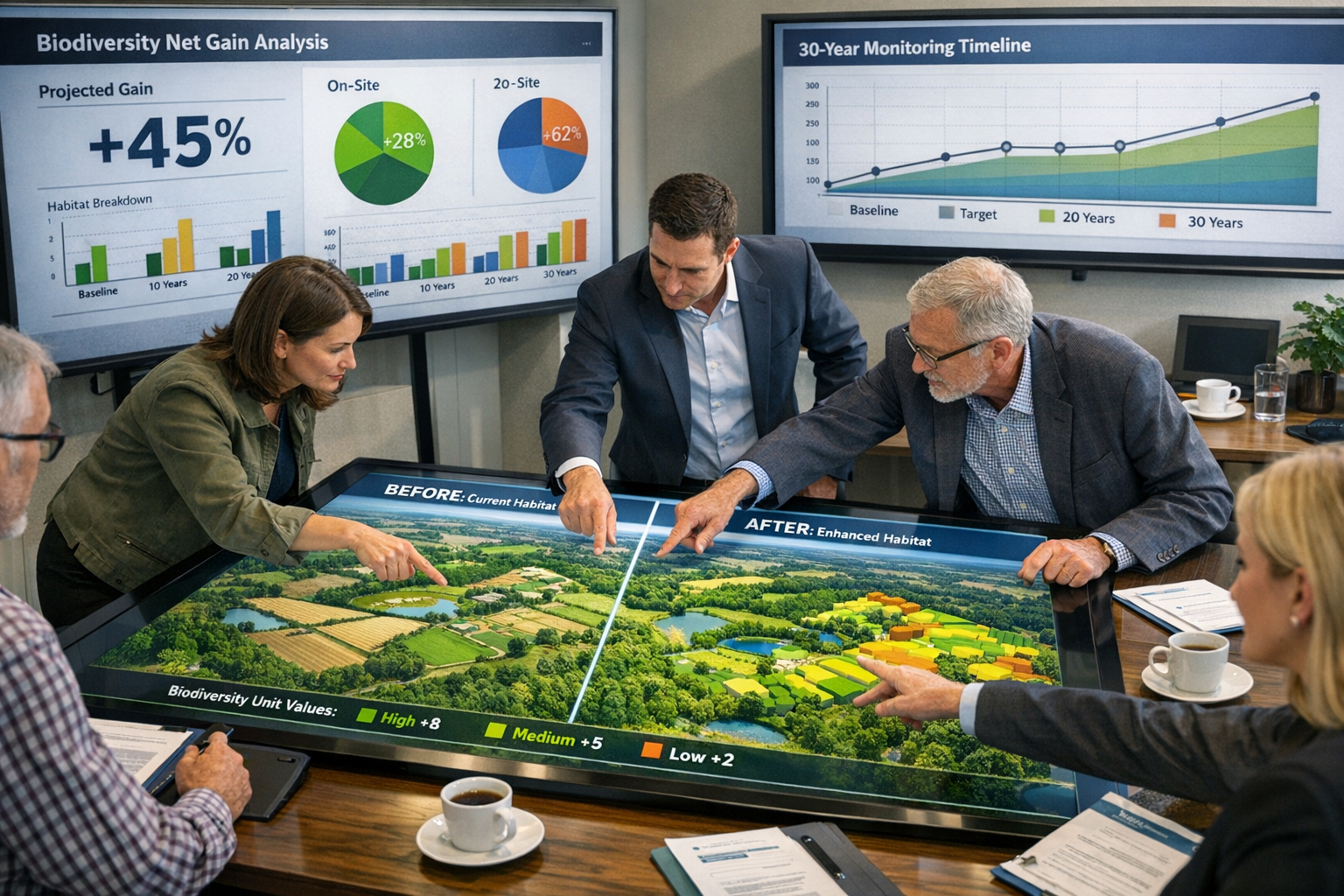
Automated metric calculation: Biodiversity unit values are continuously updated based on actual habitat condition and species presence, rather than estimated from periodic surveys.
Audit trails: Every data point, algorithm decision, and management intervention is logged, creating transparent records for regulatory review.
30-year monitoring: The long-term nature of biodiversity net gain obligations requires sustained monitoring. Digital twin infrastructure, once established, provides consistent data collection at lower long-term cost than repeated manual surveys.
Practical Considerations for Surveyors and Project Managers
Data Quality and Validation
While digital twins offer unprecedented monitoring capabilities, ensuring data quality requires careful attention:
Calibration protocols: Sensors must be regularly calibrated against manual surveys to verify accuracy. The Birmingham project emphasizes validation through traditional ecological monitoring methods [1].
Taxonomic reference databases: eDNA identification is only as good as the reference libraries used. Projects should prioritize sites where comprehensive genetic databases exist for local species.
False positives and negatives: AI algorithms require training periods to minimize errors. Initial deployment should include expert review of automated identifications.
Cost-Benefit Analysis for Different Project Scales
Digital twin technology involves upfront investment that must be weighed against long-term benefits:
Small projects (under £500,000 development value): May find simplified digital twin approaches cost-effective for demonstrating compliance, particularly where small development BNG requirements create disproportionate survey costs.
Medium projects (£500,000-£5 million): Digital twins become increasingly cost-effective, with monitoring infrastructure costs representing a smaller percentage of total project value while providing significant risk reduction.
Large projects (over £5 million): Digital twins are often essential for managing complex biodiversity credit transactions and demonstrating value to investors concerned about environmental performance.
Addressing Data Access and Transparency Concerns
The 2026 Horizon Scan raises important questions around transparency and data access for AI-driven biodiversity monitoring [3]. Project managers should consider:
Open data policies: Where possible, making biodiversity data publicly accessible strengthens stakeholder trust and contributes to broader conservation knowledge.
Proprietary algorithms: Some digital twin platforms use proprietary AI models. Projects should ensure access to underlying data even if analytical methods are commercial.
Community engagement: Digital twin dashboards can be designed for public access, allowing local communities to track biodiversity improvements in their area.
Integration with Statutory Requirements
Digital twins must align with official biodiversity net gain frameworks:
✅ Metric compatibility: Ensure digital twin outputs can be translated into statutory biodiversity unit calculations
✅ Approved methodologies: Verify that monitoring approaches meet regulatory standards for evidence
✅ Reporting formats: Configure systems to generate required documentation formats
✅ Audit readiness: Maintain records that satisfy regulatory inspection requirements
For landowners selling biodiversity units, digital twins provide compelling evidence of habitat quality that can command premium pricing in the biodiversity credits market.
Future Developments and Emerging Opportunities
Expansion Beyond Terrestrial Ecosystems
While current digital twin deployments focus on freshwater and terrestrial habitats, marine applications are advancing rapidly. The EU's DTO-BioFlow project is developing the biological component of the Digital Twin of the Ocean, facilitating access to previously unused marine biodiversity data [4]. Coastal development projects in 2026 may soon leverage these systems for intertidal and nearshore monitoring.
Integration with Climate and Carbon Monitoring
The intersection of biodiversity and net zero objectives creates opportunities for integrated digital twins that simultaneously track ecosystem carbon storage and species diversity. This dual-purpose monitoring could optimize nature-based solutions that address both climate and biodiversity crises.
Standardization and Interoperability
The BioDT project's implementation of FAIR principles [2] points toward a future where digital twins from different projects can share data and insights. Standardized protocols would enable:
- Regional biodiversity networks: Connected digital twins providing landscape-scale ecosystem understanding
- Comparative analysis: Benchmarking project performance against similar habitats elsewhere
- Predictive improvement: Machine learning models that improve as more projects contribute data
Democratization Through Open-Source Tools
Open-data frameworks and open-source algorithms are reducing barriers to digital twin adoption [5]. This democratization means that even small development projects can access sophisticated monitoring capabilities that were recently available only to large organizations with specialized expertise.
Conclusion
Digital Twins for Real-Time Biodiversity Net Gain Tracking: Deployment Strategies for 2026 Ecology Projects represent a fundamental shift from reactive to proactive biodiversity management. By creating virtual ecosystem replicas that simulate changes continuously, digital twins enable developers, landowners, and ecologists to monitor progress toward net gain targets with unprecedented accuracy, detect problems before they become critical, and optimize enhancement strategies through scenario-based planning.
The convergence of environmental DNA analysis, artificial intelligence, and low-power sensing technologies makes 2026 the pivotal year for practical digital twin deployment across UK ecology projects. From freshwater lakes monitored by graph neural networks to remote grasslands tracked by TinyML sensors, these systems are transitioning from research prototypes to operational tools that support regulatory compliance and conservation outcomes.
Actionable Next Steps
For professionals implementing biodiversity net gain projects in 2026:
- Assess your project's digital twin readiness by evaluating site characteristics, monitoring requirements, and budget constraints against available technologies
- Engage with digital twin providers early in project planning to integrate monitoring infrastructure into site designs rather than retrofitting later
- Establish robust baselines using multi-season data collection that captures ecosystem complexity before development begins
- Prioritize open-data approaches that enhance transparency and contribute to broader conservation knowledge
- Plan for long-term operation by selecting technologies with proven reliability and accessible technical support for the 30-year monitoring period
The question for 2026 ecology projects is no longer whether digital twins can improve biodiversity monitoring, but how quickly the industry can adopt these transformative tools to deliver measurable conservation outcomes alongside development. Those who embrace this technology early will gain competitive advantages through reduced compliance risk, optimized enhancement investments, and demonstrated environmental leadership.
To explore how digital twin monitoring can support your specific biodiversity net gain requirements, consider consulting with specialists who understand both the ecological science and the practical deployment challenges. The future of conservation monitoring is here—and it's running in real-time.
References
[1] 2026 B31 Biodiversity Digital Twin Leveraging Environmental Dna And Artificial Intelligence For Monitoring Biodiversity Loss – https://centa.ac.uk/studentship/2026-b31-biodiversity-digital-twin-leveraging-environmental-dna-and-artificial-intelligence-for-monitoring-biodiversity-loss/
[2] pubmed.ncbi.nlm.nih.gov – https://pubmed.ncbi.nlm.nih.gov/41629431/
[3] Whats Next For Biodiversity Conservation Insights From The 2026 Horizon Scan – https://www.unep-wcmc.org/en/news/whats-next-for-biodiversity-conservation-insights-from-the-2026-horizon-scan
[4] cordis.europa.eu – https://cordis.europa.eu/project/id/101112823
[5] journals.sagepub – https://journals.sagepub.com/doi/10.1177/03063127241236809