

The ocean's underwater forests are disappearing at an alarming rate. As 2026 unfolds, kelp forests—those towering marine ecosystems that shelter thousands of species—face unprecedented threats from warming waters, marine heatwaves, and extreme weather events. The 2026 Horizon Scan has identified projected loss of seaweed habitats as a critical concern endangering coastal biodiversity worldwide. Macroalgal Habitat Loss Surveys: Protocols for Kelp Forest Monitoring Amid 2026 Warming and Extreme Events have become essential tools for conservation professionals, marine scientists, and biodiversity surveyors working to track these vital ecosystems and implement effective restoration strategies.
This comprehensive guide explores the standardized protocols, cutting-edge technologies, and best practices that enable accurate assessment of kelp forest health in an era of rapid environmental change. Whether conducting baseline assessments or tracking restoration outcomes, understanding these monitoring frameworks is crucial for achieving biodiversity conservation goals in marine environments.
Key Takeaways
- Six core parameters form the foundation of all kelp forest monitoring: Area Extent, Kelp Density, Biodiversity, Animal Density (fish and invertebrates), and additional ecological characteristics [1]
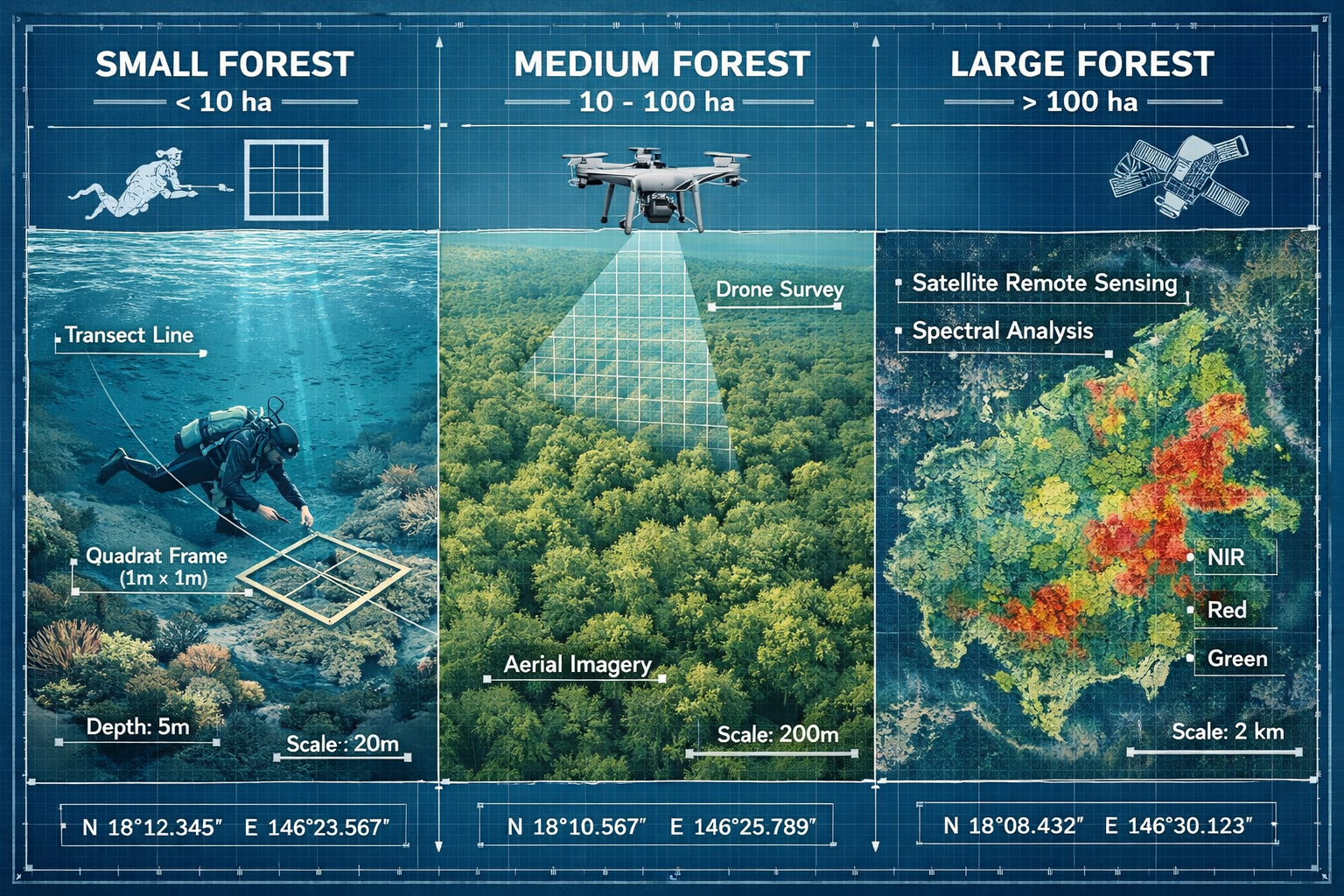
- Survey methods must match forest size: forests under 10 hectares require on-water surveys, 10-100 hectares need drone surveys, while areas over 100 hectares demand satellite imagery analysis [1]
- Seasonal timing is critical—monitoring must occur at consistent times annually to account for natural variations in kelp reproductive cycles and growth patterns [1]
- Post-intervention monitoring requires intensive sampling: 2-4 times per year in the first two years, then annually thereafter to track restoration success [1]
- Citizen science programs like Reef Check are expanding training opportunities across California, Oregon, and Washington, democratizing kelp forest conservation efforts [5]
Understanding Macroalgal Habitat Loss in 2026
The Current State of Kelp Forests 🌊
Kelp forests represent some of Earth's most productive ecosystems, rivaling tropical rainforests in biodiversity and ecological importance. These underwater giants provide critical habitat for over 1,000 species, sequester significant amounts of carbon, and support commercial fisheries worth billions of dollars annually. However, 2026 has brought intensified challenges that demand sophisticated monitoring approaches.
Climate-driven stressors affecting kelp forests include:
- Rising baseline ocean temperatures reducing kelp growth rates
- Marine heatwaves causing mass die-offs
- Increased storm intensity physically removing kelp from substrates
- Ocean acidification affecting kelp calcification processes
- Shifts in herbivore populations (particularly sea urchin outbreaks)
Why Standardized Monitoring Protocols Matter
The complexity of kelp forest ecosystems requires consistent, replicable survey methods that enable meaningful comparisons across time and geography. Without standardized protocols, data collected by different teams becomes difficult to integrate, limiting our ability to understand regional trends or evaluate conservation interventions effectively.
The Kelp Forest Alliance and Ocean Wise published comprehensive monitoring guidelines in 2024 specifically to address this challenge, creating a unified framework that researchers worldwide can adopt [3]. These protocols recognize that while remote sensing technologies offer broad coverage, trained divers can detect subtle ecosystem details—such as species composition shifts and animal behavior changes—that automated tools might miss [3].
Similar to how biodiversity impact assessments provide baseline data for terrestrial projects, kelp forest surveys establish critical reference points for marine conservation efforts.
Core Components of Macroalgal Habitat Loss Surveys: Protocols for Kelp Forest Monitoring Amid 2026 Warming and Extreme Events
The Six Essential Monitoring Parameters
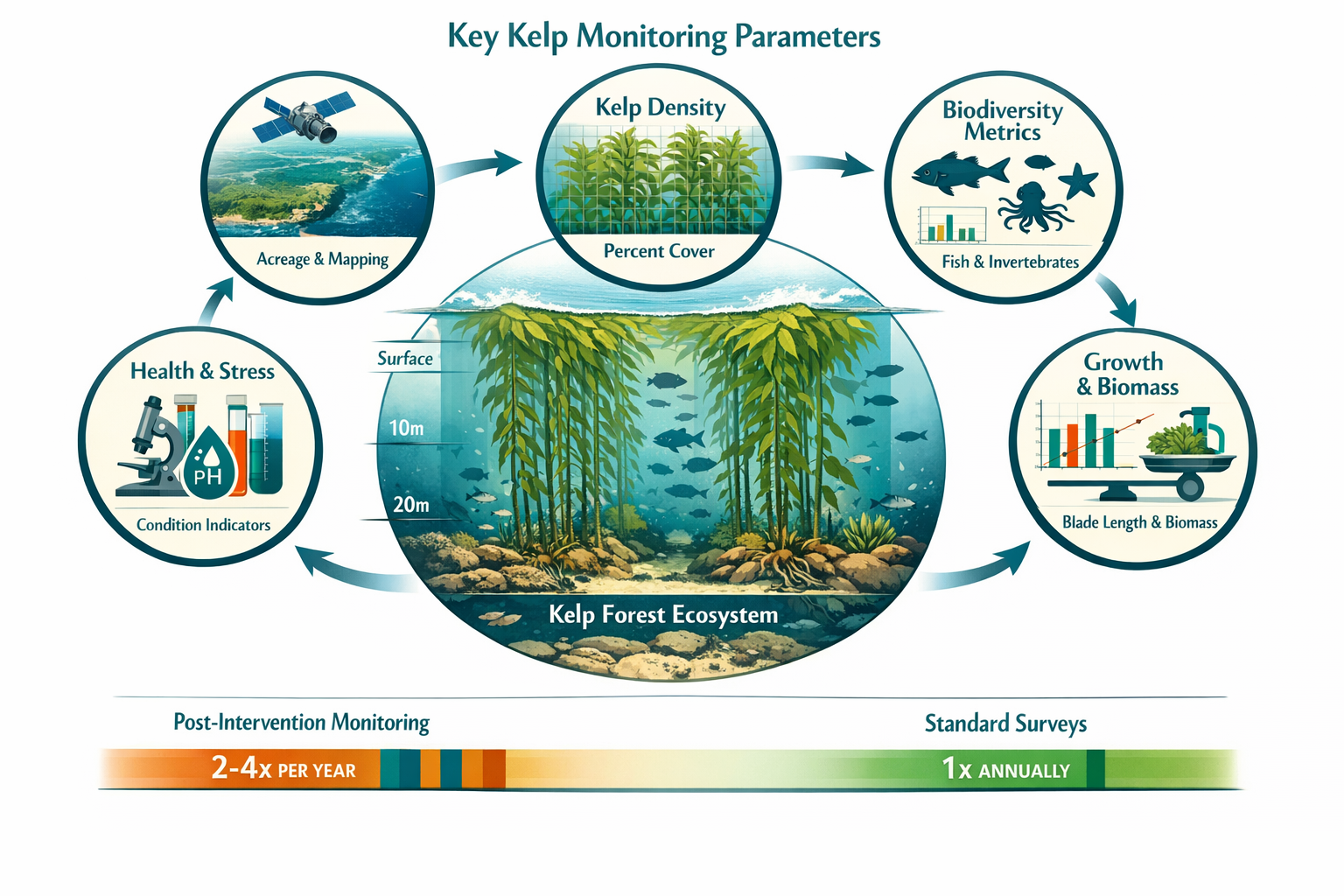
Research and field experience have identified six key parameters that should form the foundation of all kelp forest monitoring projects [1]:
-
Area Extent 📏
- Total spatial coverage of kelp forest
- Changes in forest boundaries over time
- Fragmentation patterns
- Canopy continuity assessment
-
Kelp Density 🌿
- Number of individual kelp plants per unit area
- Stipe counts within transects
- Canopy thickness measurements
- Age class distribution
-
Biodiversity Assessment 🐟
- Species richness (total number of species)
- Species composition and relative abundance
- Presence of indicator species
- Community structure analysis
-
Animal Density – Fish Populations 🐠
- Fish abundance and size distribution
- Species-specific counts
- Behavioral observations
- Trophic level representation
-
Animal Density – Invertebrates 🦞
- Herbivore populations (especially sea urchins)
- Predator abundance
- Filter feeder communities
- Substrate-dwelling organisms
-
Additional Ecological Characteristics 🔬
- Water quality parameters (temperature, salinity, turbidity)
- Substrate composition
- Light availability
- Nutrient levels
Monitoring Frequency and Seasonal Considerations
Timing is everything in kelp forest monitoring. Natural seasonal variations in kelp reproduction, growth, and survival mean that surveys conducted at different times of year cannot be directly compared [1]. Establishing a consistent annual monitoring schedule—ideally during the same month each year—ensures data accuracy and reliability.
Different metrics require different sampling frequencies:
| Metric | Recommended Frequency | Rationale |
|---|---|---|
| Canopy Cover | Monthly during growing season | Tracks rapid seasonal changes |
| Biodiversity | Quarterly | Captures seasonal species variations |
| Juvenile Kelp Survival | Weekly (first 3 months) | Critical establishment period |
| Adult Kelp Density | Annually | Stable metric with slow changes |
| Post-Restoration Monitoring | 2-4x/year (Years 1-2), then annually | Intensive early tracking [1] |
This approach mirrors the systematic monitoring required for achieving biodiversity net gain in terrestrial environments, where baseline and follow-up assessments must be carefully timed.
Survey Methodologies: Selecting the Right Approach for Your Kelp Forest
Scale-Appropriate Survey Techniques
The size and characteristics of the kelp forest being monitored determine which survey methodology will be most effective and efficient [1]:
Small Forests (< 10 hectares): On-Water Surveys 🚤
Best for: Detailed assessments, restoration sites, small MPAs
Methods include:
- Surface canopy surveys using kayaks or small boats
- GPS-tracked transect lines
- Visual density estimates
- Photographic documentation
- Direct canopy sampling
Advantages: High detail, low cost, immediate data validation
Limitations: Time-intensive, weather-dependent, limited to surface canopy
Medium Forests (10-100 hectares): Drone Surveys 🚁
Best for: Regional monitoring, canopy mapping, change detection
Methods include:
- Multispectral imaging
- High-resolution RGB photography
- Structure-from-motion photogrammetry
- Thermal imaging (for temperature mapping)
- Automated image analysis using AI
Advantages: Rapid coverage, repeatable flight paths, minimal environmental impact
Limitations: Surface canopy only, weather-sensitive, requires specialized equipment
Large Forests (> 100 hectares): Satellite Imagery 🛰️
Best for: Landscape-scale assessments, long-term trend analysis
Methods include:
- Landsat time series analysis
- Sentinel-2 multispectral data
- Planet Labs high-frequency imaging
- Spectral indices for kelp detection
- Machine learning classification algorithms
Advantages: Extensive coverage, historical data availability, cost-effective for large areas
Limitations: Lower resolution, cloud interference, surface canopy only
Benthic Biodiversity Assessment Protocols
While remote sensing captures canopy dynamics, understanding the complete kelp forest ecosystem requires underwater surveys of the benthos (seafloor). Standardized protocols recommend a minimum of 8 transects with 8 quadrats per transect for statistically robust biodiversity assessments [1].
SCUBA transect survey protocol:
- Site Selection: Establish permanent transect locations using GPS coordinates and underwater landmarks
- Transect Layout: Deploy 30-meter measuring tape along depth contour
- Quadrat Sampling: Place 1m² quadrat at predetermined intervals (every 3-4 meters)
- Species Documentation: Photograph and identify all macroalgae, invertebrates, and fish within quadrat
- Density Counts: Record abundance of key indicator species
- Environmental Data: Measure temperature, depth, visibility, and substrate type
- Quality Control: Conduct buddy verification of species identifications
California's 2024-2026 Marine Protected Area (MPA) monitoring program utilizes these SCUBA transect surveys at Tier I reference sites, following Multi-Agency Rocky Intertidal Network (MARINe) standardized protocols that have been monitoring West Coast habitats since the 1980s [2]. This long-term dataset provides invaluable context for understanding current changes.
Training and Capacity Building for 2026 Kelp Monitoring
Professional Training Opportunities
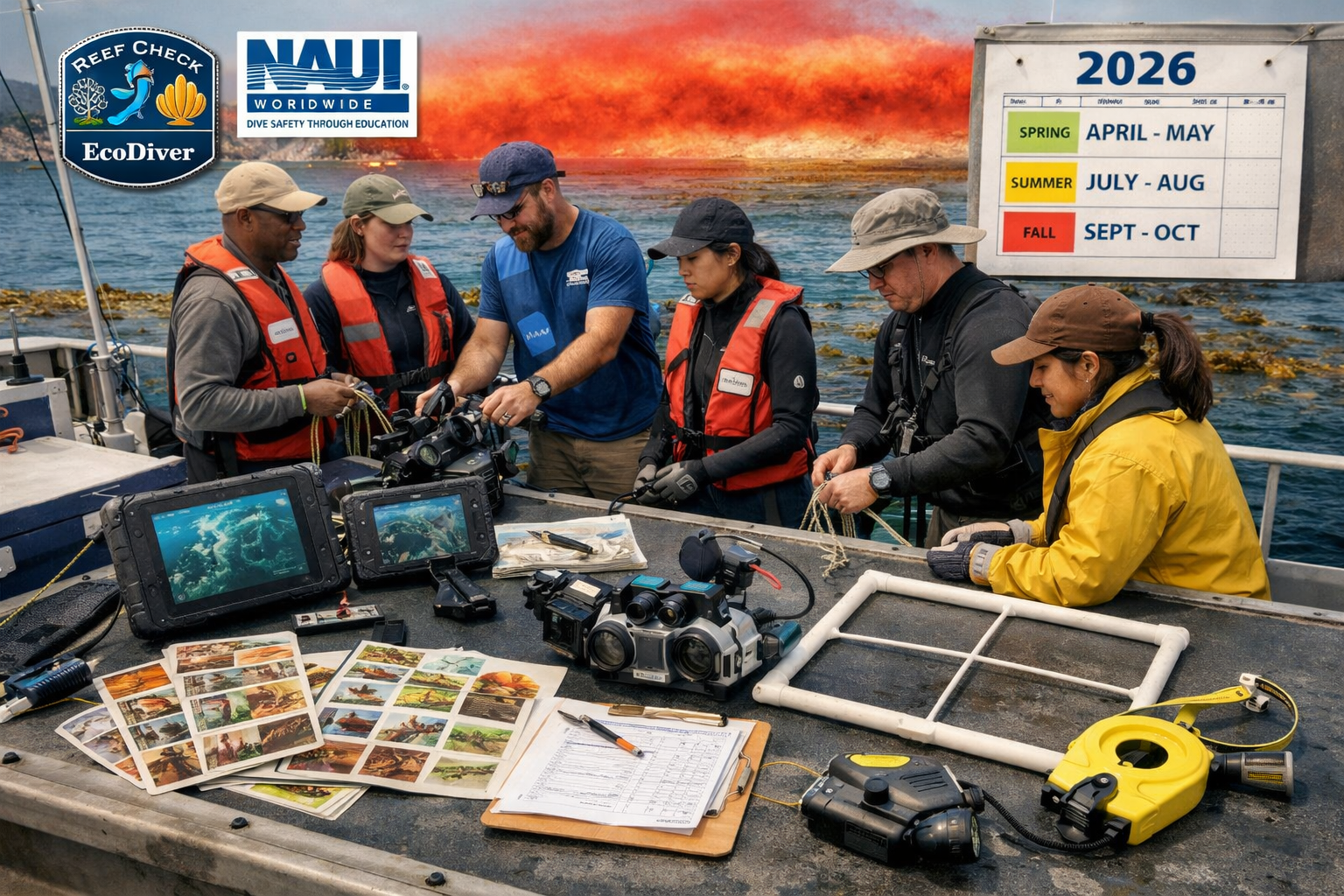
As kelp forest monitoring expands in response to accelerating habitat loss, training programs have become essential for building survey capacity. Reef Check is offering five kelp forest monitoring training opportunities throughout 2026 across California, Oregon, and Baja California for citizen scientists, with specialized NAUI certification [5].
Training programs typically cover:
- Species identification (kelp, fish, invertebrates)
- Underwater survey techniques
- Data recording protocols
- Safety procedures and dive planning
- Equipment maintenance
- Data quality assurance
- Scientific diving standards
Oregon is also hosting separate kelp restoration trainings, recognizing that monitoring and active restoration must work hand-in-hand [5]. These programs democratize marine conservation, enabling broader participation while maintaining scientific rigor.
The Role of Citizen Science 🤿
Citizen science initiatives have dramatically expanded kelp forest monitoring coverage. Reef Check expanded monitoring into Washington state in 2022, with analysis from early surveys revealing distinct regional kelp community patterns using uniform protocols [7]. This expansion demonstrates how standardized methods enable meaningful comparisons across vast geographic areas.
Benefits of citizen science monitoring:
- Increased spatial and temporal coverage
- Cost-effective data collection
- Community engagement and ocean stewardship
- Early detection of ecosystem changes
- Support for professional research programs
However, maintaining data quality requires robust training, clear protocols, and professional oversight—principles that apply equally to biodiversity surveying in terrestrial environments.
Data Management and Analysis for Climate-Era Monitoring
Digital Tools and Platforms
Modern kelp forest monitoring relies on sophisticated data management systems that integrate diverse data sources:
- Field data apps: Waterproof tablets with offline data entry
- Photo analysis software: Automated species identification using AI
- GIS platforms: Spatial analysis and mapping tools
- Statistical packages: Time series analysis and trend detection
- Cloud storage: Centralized data repositories with version control
- Visualization dashboards: Real-time monitoring status displays
Detecting Climate-Driven Changes
The 2026 monitoring protocols specifically emphasize detecting and attributing changes to climate stressors versus natural variability. This requires:
Baseline establishment: Multi-year pre-disturbance data collection
Control site comparisons: Monitoring reference sites without interventions
Environmental correlations: Linking biological changes to temperature, storm events, and other drivers
Statistical power analysis: Ensuring sample sizes can detect meaningful changes
Rapid response protocols: Triggering additional surveys after extreme events
This analytical framework parallels approaches used in biodiversity net gain assessments, where demonstrating causation requires careful experimental design.
Integrating Kelp Monitoring with Broader Conservation Strategies
From Monitoring to Management Action
Effective monitoring programs don't just collect data—they inform management decisions and conservation interventions. The feedback loop between monitoring results and adaptive management includes:
- Threshold identification: Defining ecosystem health indicators
- Trigger points: Establishing when intervention is needed
- Intervention evaluation: Assessing restoration effectiveness
- Adaptive management: Modifying strategies based on outcomes
- Stakeholder communication: Translating data into actionable insights
Connecting Marine and Terrestrial Biodiversity Goals
While kelp forests are marine ecosystems, their monitoring connects to broader biodiversity frameworks. Concepts like biodiversity net gain increasingly apply to marine environments, particularly as offshore development projects require environmental impact assessments.
Key connections include:
- Habitat banking principles: Protecting high-value kelp forests to offset impacts elsewhere
- Ecosystem services valuation: Quantifying kelp forest benefits for economic analysis
- Biodiversity offsetting: Restoring degraded kelp habitats to compensate for unavoidable losses
- Monitoring standards: Applying rigorous survey protocols across ecosystem types
Organizations working on land banking and habitat banking for terrestrial projects can apply similar frameworks to marine conservation, creating integrated approaches that address biodiversity loss across all ecosystems.
Challenges and Solutions in 2026 Kelp Forest Monitoring
Overcoming Field Logistics Barriers
Challenge: Remote locations and harsh ocean conditions limit survey access
Solutions:
- Autonomous underwater vehicles (AUVs) for inaccessible areas
- Seasonal survey windows during calm weather
- Mobile field stations and research vessels
- Partnerships with local dive operators
Addressing Data Standardization Issues
Challenge: Historical datasets used inconsistent methodologies
Solutions:
- Adoption of unified protocols (Kelp Forest Alliance guidelines) [3]
- Metadata documentation of survey methods
- Intercalibration studies comparing techniques
- Training standardization across regions
Managing Climate Uncertainty
Challenge: Rapid environmental change complicates baseline establishment
Solutions:
- Space-for-time substitution using latitudinal gradients
- Climate envelope modeling for future projections
- Increased monitoring frequency during transition periods
- Adaptive sampling designs that respond to detected changes
Funding Constraints
Challenge: Long-term monitoring requires sustained financial support
Solutions:
- Multi-agency partnerships sharing costs
- Integration with regulatory monitoring requirements
- Citizen science to reduce field costs
- Demonstrating ecosystem service values to secure funding
These challenges mirror those faced in terrestrial biodiversity planning, where long-term commitment and adequate resources determine conservation success.
Future Directions: Innovation in Kelp Forest Monitoring
Emerging Technologies 🔬
Environmental DNA (eDNA): Water sampling to detect species presence without visual surveys
Acoustic monitoring: Passive listening devices to assess fish communities
Hyperspectral imaging: Advanced spectral analysis for kelp health assessment
Artificial intelligence: Automated species identification and abundance estimation
Sensor networks: Permanent installations tracking temperature, pH, and nutrients in real-time
Predictive Modeling and Early Warning Systems
The next generation of kelp forest monitoring will integrate predictive capabilities, using machine learning to forecast habitat changes before they occur. Early warning systems could alert managers to:
- Incoming marine heatwaves threatening kelp survival
- Sea urchin population explosions requiring intervention
- Optimal timing for restoration activities
- Areas most resilient to climate change for protection prioritization
Global Coordination and Data Sharing
As kelp forests face worldwide decline, international collaboration becomes essential. Initiatives like the Kelp Forest Alliance work to coordinate monitoring efforts across countries, creating global datasets that reveal large-scale patterns and inform international conservation policy.
Conclusion
Macroalgal Habitat Loss Surveys: Protocols for Kelp Forest Monitoring Amid 2026 Warming and Extreme Events represent a critical tool in the fight to preserve ocean biodiversity. As climate change accelerates, standardized monitoring protocols enable scientists, conservation professionals, and citizen scientists to track kelp forest health, detect early warning signs of decline, and evaluate restoration interventions with scientific rigor.
The six core monitoring parameters—Area Extent, Kelp Density, Biodiversity, Fish Density, Invertebrate Density, and Ecological Characteristics—provide a comprehensive framework applicable across diverse kelp forest types and geographic regions [1]. By matching survey methods to forest size, maintaining seasonal consistency, and integrating remote sensing with in-situ assessments, monitoring programs can generate high-quality data that drives effective conservation action.
Actionable Next Steps 🎯
For conservation organizations:
- Adopt standardized Kelp Forest Alliance protocols for all monitoring projects [3]
- Establish baseline surveys before conditions deteriorate further
- Invest in staff training and equipment for long-term program sustainability
- Contact biodiversity professionals to explore integrated marine-terrestrial conservation strategies
For researchers:
- Contribute data to centralized repositories for meta-analysis
- Publish methodological comparisons to refine best practices
- Develop predictive models using existing monitoring datasets
- Collaborate across institutions to expand geographic coverage
For policymakers:
- Mandate standardized monitoring for marine protected areas
- Fund long-term monitoring programs with stable budget commitments
- Integrate kelp forest health into climate adaptation planning
- Support citizen science initiatives that expand monitoring capacity
For citizen scientists:
- Enroll in 2026 kelp forest monitoring training programs [5]
- Participate in organized survey events through Reef Check and similar organizations
- Contribute observations to community science platforms
- Advocate for kelp forest protection in your region
The underwater forests that shelter countless marine species, support coastal economies, and sequester carbon depend on our collective commitment to rigorous monitoring and evidence-based conservation. By implementing these protocols consistently and comprehensively, we can track kelp forest trajectories, identify successful interventions, and ultimately reverse the alarming trends of habitat loss that threaten these irreplaceable ecosystems.
The time to act is now—2026's warming waters and extreme events demand nothing less than our most sophisticated monitoring approaches and unwavering dedication to ocean conservation. Just as biodiversity net gain frameworks are transforming terrestrial conservation in the UK, standardized kelp forest monitoring protocols can revolutionize marine ecosystem protection worldwide.
References
[1] 2 0 Principles Of Monitoring And Reporting – https://kelpforestalliance.com/kelp-forest-ecosystem-monitoring/2-0-principles-of-monitoring-and-reporting/
[2] Item 7 Mpa Monitoring 508 – https://opc.ca.gov/wp-content/uploads/2023/12/Item-7-MPA-Monitoring-508.pdf
[3] Howe Sound Kelp – https://ocean.org/blog/howe-sound-kelp/
[5] 2026 Kelp Forest Monitoring Trainings Now Open Register Today – https://www.reefcheck.org/2026-kelp-forest-monitoring-trainings-now-open-register-today/
[7] Watch – https://www.youtube.com/watch?v=ReIA4bdOI3Y