

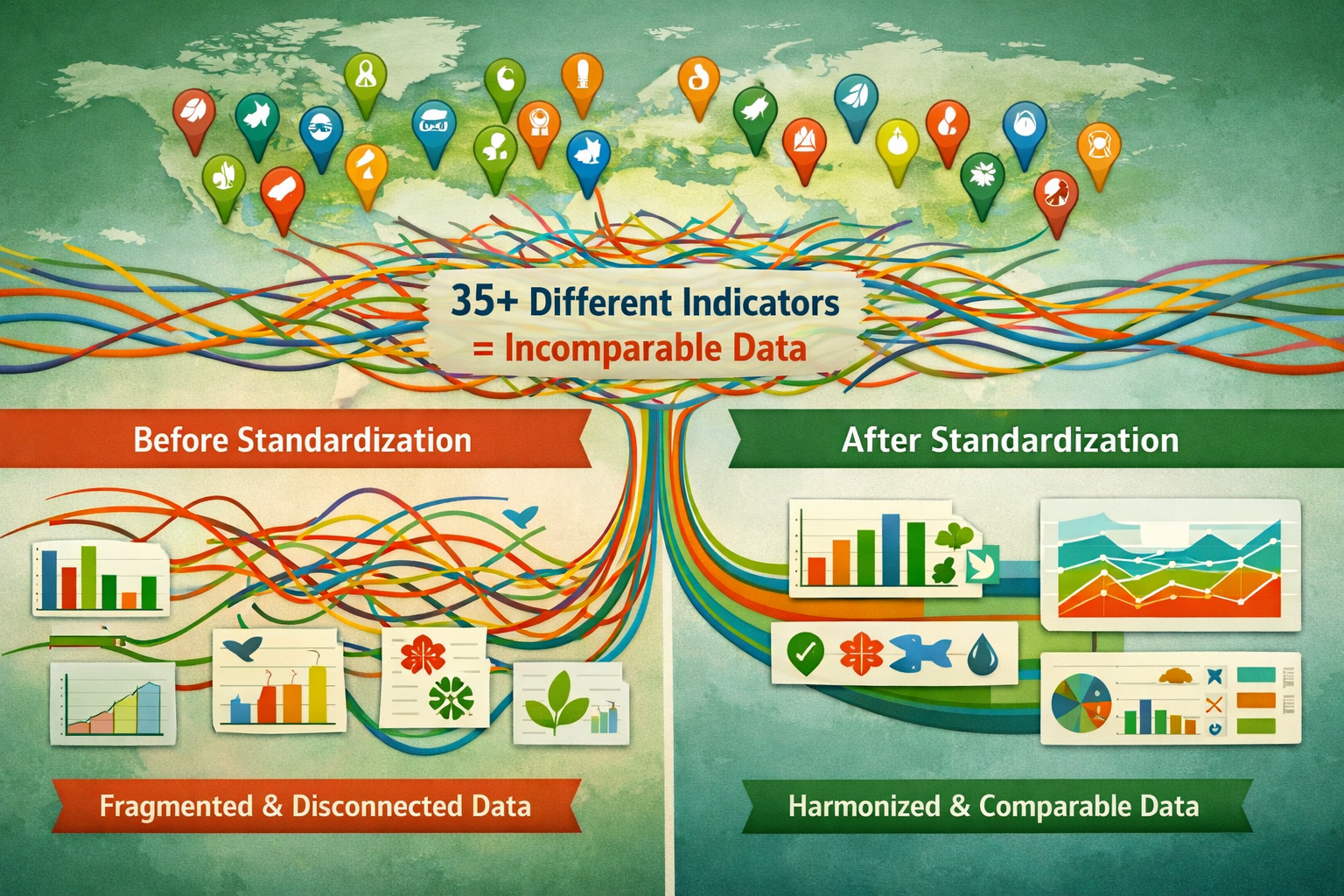
Imagine trying to solve a global puzzle where every piece comes from a different manufacturer, each using their own measurements and shapes. This is the reality facing ecologists and policymakers today. With more than 35 different biodiversity indicators currently in use across surveys worldwide, comparing data between studies has become nearly impossible. As the world races to meet ambitious conservation targets, Standardizing Biodiversity Indicators Across Surveys: Why 2026 Ecologists Must Align Reporting for Comparable Data has emerged as one of the most urgent challenges in environmental science.
The stakes have never been higher. In 2026, new mandatory reporting standards have taken effect, countries face looming biodiversity reporting deadlines, and organizations worldwide must demonstrate measurable progress toward conservation commitments. Without standardized indicators, the scientific community cannot accurately track biodiversity loss, measure restoration success, or guide evidence-based policy decisions.
Key Takeaways
- 🌍 Over 35 different biodiversity indicators are currently used across surveys, making cross-study comparison and global data synthesis virtually impossible
- 📊 GRI 101: Biodiversity 2024 became mandatory on January 1, 2026, requiring comprehensive value chain reporting and standardized disclosure of biodiversity impacts[1]
- 🗓️ Countries must submit seventh national reports to the CBD by February 28, 2026, using the Kunming-Montreal Framework's 36 headline indicators[2]
- 🔧 New global tools including the European Biodiversity Metric and Global Biodiversity Metric provide standardized assessment frameworks for different geographical contexts[3]
- ⚡ Immediate action is required from ecologists, surveyors, and organizations to align protocols and adopt standardized reporting methods to support global biodiversity commitments
The Crisis of Incomparable Biodiversity Data
Why Current Survey Methods Fail Comparison
Biodiversity surveys conducted across different regions, organizations, and time periods often produce data that cannot be meaningfully compared. This fragmentation stems from several critical issues:
Inconsistent Measurement Protocols: Different survey teams measure biodiversity using varying methodologies. One team might count species richness (total number of species), while another focuses on abundance (number of individuals per species), and yet another prioritizes functional diversity (variety of ecological roles).
Geographic and Temporal Variations: Biodiversity impacts are highly location-specific, requiring local context understanding.[1] A metric that works well for temperate forests may be inappropriate for tropical wetlands or grassland ecosystems. Similarly, seasonal variations and survey timing create additional inconsistencies.
Lack of Standardized Definitions: Even basic terms like "habitat quality" or "ecosystem condition" lack universal definitions. What one surveyor considers "good condition" might be rated differently by another, introducing subjective bias into supposedly objective data.
Technical and Capacity Barriers: Many organizations face technical barriers, lack of available data and tools, and capacity bottlenecks when implementing comprehensive monitoring frameworks.[2] Smaller conservation groups and developing nations particularly struggle with resource limitations.
The Real-World Consequences
This lack of standardization creates serious problems:
- Policy decisions based on incomplete or incomparable data lead to ineffective conservation strategies
- Corporate biodiversity commitments cannot be verified when companies use different measurement systems
- Conservation funding gets misallocated when impact assessments cannot be compared across projects
- Scientific research loses credibility when meta-analyses cannot synthesize findings from multiple studies
- Global biodiversity targets remain unmeasurable without consistent baseline and progress indicators
For organizations working on biodiversity net gain assessments, these inconsistencies create significant challenges in demonstrating compliance and measuring genuine environmental improvements.
Standardizing Biodiversity Indicators Across Surveys: The 2026 Regulatory Landscape
GRI 101: Biodiversity 2024 – A Game Changer
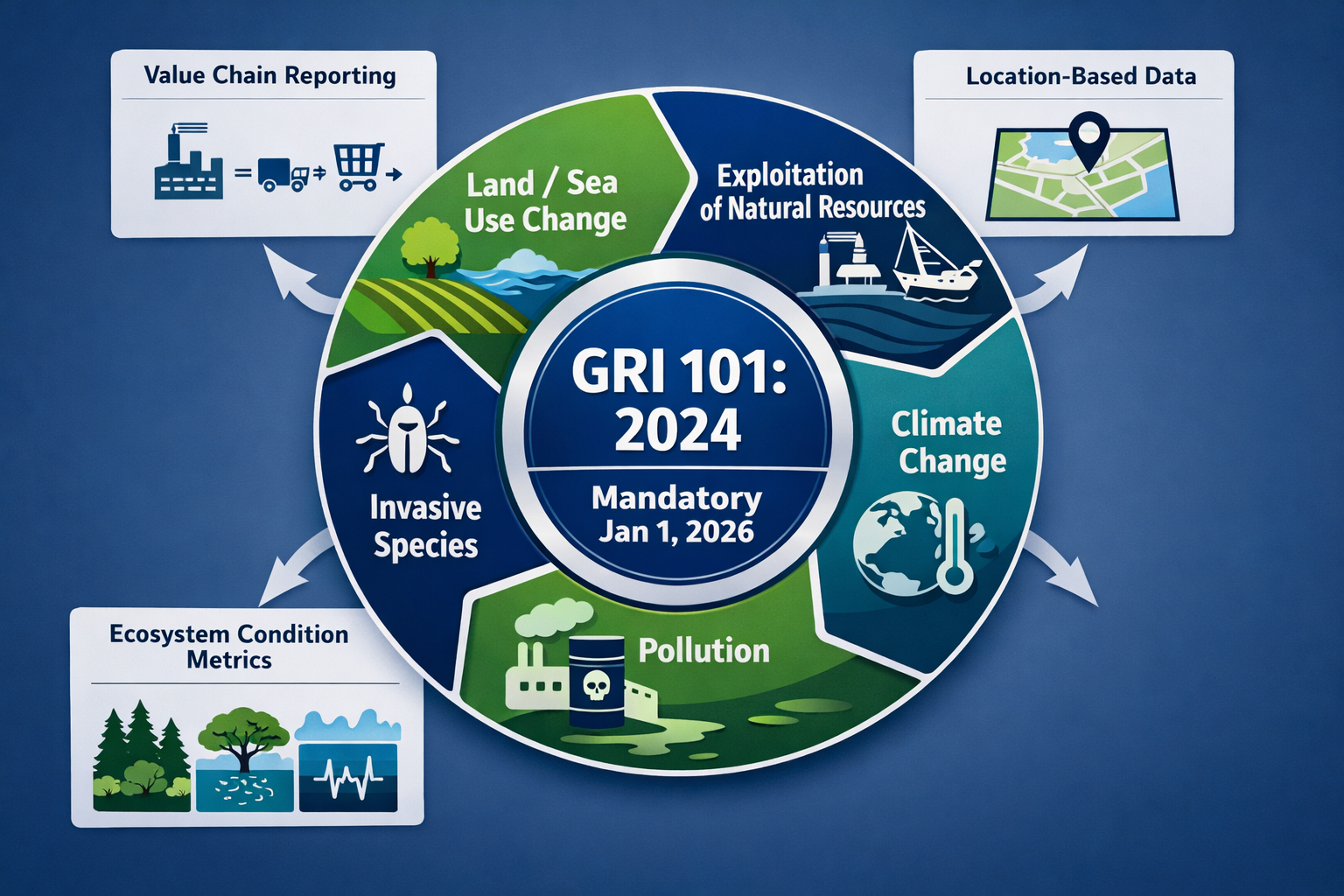
On January 1, 2026, GRI 101: Biodiversity 2024 became mandatory for all biodiversity reporting published on or after that date, replacing the previous GRI 304: Biodiversity 2016 standard.[1] This represents the most significant shift in corporate biodiversity reporting requirements in a decade.
The new standard was published on January 25, 2026, following a comprehensive revision developed through transparent multi-stakeholder engagement overseen by the Global Sustainability Standards Board.[1] It introduces several transformative requirements:
Complete Value Chain Reporting
Unlike previous standards that focused primarily on direct operations, the new standard requires complete value chain reporting. Disclosures 101-4, 101-5, and 101-6 mandate information on products and services with significant biodiversity impacts throughout the entire supply chain.[1]
This expansion recognizes that most organizations' biodiversity impacts occur upstream (raw material extraction, agriculture) or downstream (product use and disposal) rather than in their direct operations.
Material Impact Focus
To address the overwhelming challenge of measuring all biodiversity impacts across complex supply chains, only "material" or significant impacts require reporting.[1] This aligns with international regulations such as the Corporate Sustainability Reporting Directive (CSRD) and makes compliance more achievable for organizations.
Location-Based Information Requirements
Location-based information is now emphasized as essential, with Disclosure 101-5 requiring specific site locations with the most significant biodiversity impacts.[1] This acknowledges that biodiversity impacts are highly location-specific and require local context understanding.
Organizations must identify and disclose:
- Exact geographical locations of significant impact sites
- Proximity to protected areas and key biodiversity areas
- Local ecosystem types and their conservation status
- Endemic or threatened species present
The Five Direct Drivers
Five direct drivers of biodiversity loss are now required reporting elements:[1]
- Land and sea use change – habitat conversion, fragmentation, degradation
- Exploitation of natural resources – overfishing, overharvesting, unsustainable extraction
- Climate change – temperature shifts, altered precipitation, extreme weather
- Pollution – chemical, plastic, noise, light pollution
- Invasive species – introduction and spread of non-native species
This disclosure requirement helps organizations understand how they affect biodiversity and informs necessary management actions.
Changes to Biodiversity State
A new disclosure on changes to the state of biodiversity (Disclosure 101-7) replaces previous requirements and mandates reporting the type, size, and condition of ecosystems affected or potentially affected by organizations.[1]
This forward-looking approach requires organizations to assess not just current impacts but potential future changes to ecosystem health resulting from their activities.
The Kunming-Montreal Global Biodiversity Framework
The Kunming-Montreal Global Biodiversity Framework's monitoring system includes 36 headline indicators and 14 binary indicators that parties are required to report to the Convention on Biological Diversity.[2] Additionally, 52 component and 257 complementary indicators are available for voluntary use.
The seventh national reports under the CBD monitoring framework are due by February 28, 2026,[2] placing immediate pressure on countries to standardize indicator calculations and data compilation. Significant scientific and technical support is required to validate national values and ensure comparability across countries.
This tight deadline has created urgency for ecologists and national environmental agencies to align their monitoring protocols with international standards. Countries that fail to submit compliant reports risk being unable to demonstrate progress toward global biodiversity targets.
For developers and planners working on biodiversity net gain requirements, understanding these international frameworks is increasingly important as national regulations align with global standards.
Regional Standardization Efforts
The European Biodiversity Metric
The European Biodiversity Metric (EBM) launched in 2026 to support land-use planning and EU Nature Restoration Regulation compliance.[3] This metric harmonizes biodiversity assessments across continental Europe to contribute to a coherent ecological network.
The EBM provides:
- Standardized habitat classification systems
- Consistent condition assessment criteria
- Comparable biodiversity unit calculations
- Integration with existing national systems
The Global Biodiversity Metric
The Global Biodiversity Metric (GBM), launched at COP16 in 2024, enables quantification of land use impacts regardless of location or habitat type.[3] This allows comparison of biodiversity actions across geographies in relation to corporate targets and fills gaps where country-specific metrics are unavailable.
The GBM is particularly valuable for multinational corporations operating across diverse ecosystems and regulatory environments, providing a common language for biodiversity accounting.
Standardizing Biodiversity Indicators Across Surveys: Practical Implementation for 2026 Ecologists
Essential Tools for Impact Identification
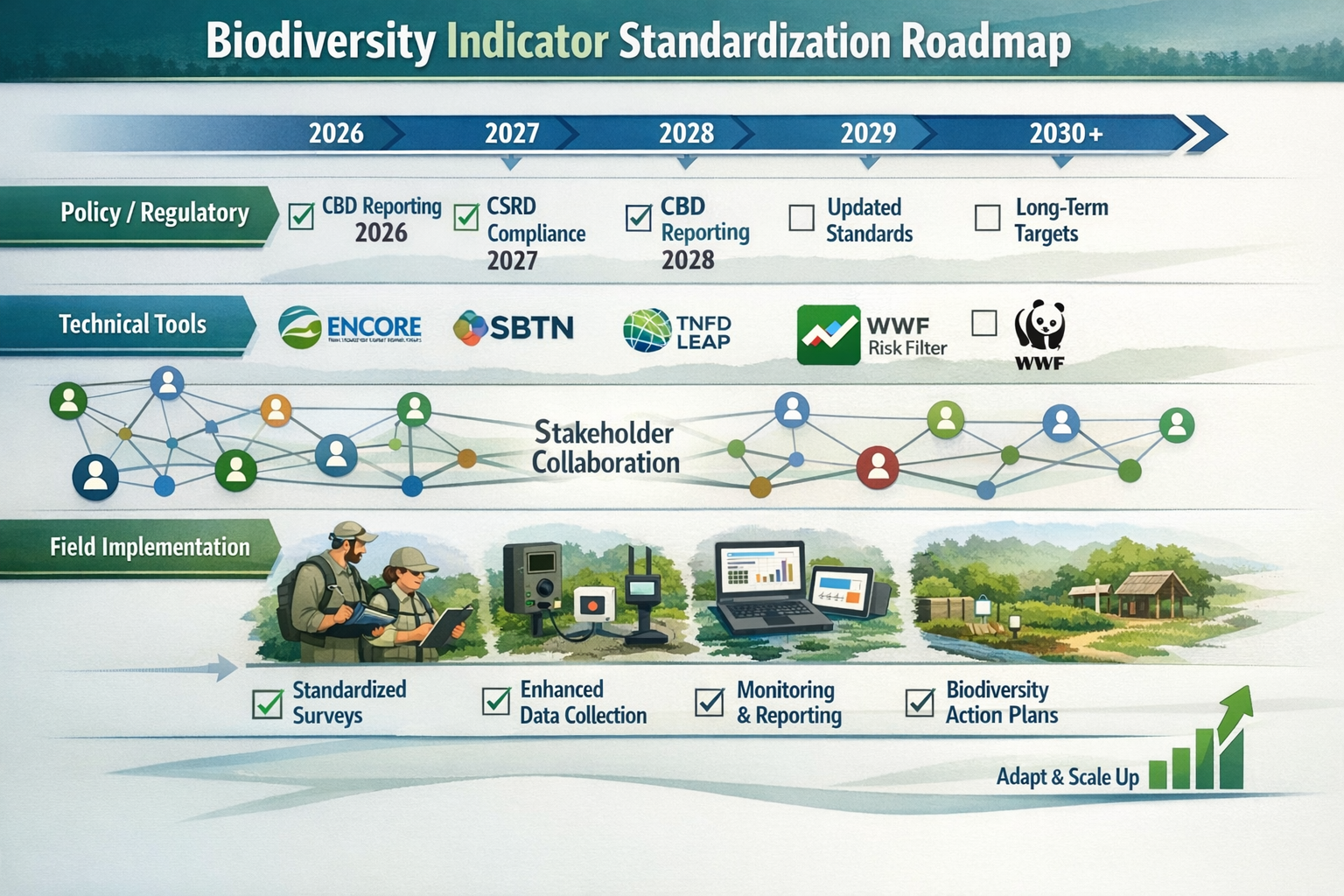
Guidance tools for identifying significant impacts include ENCORE, SBTN Materiality Screening Tool, TNFD LEAP approach, and WWF Biodiversity Risk Filter.[1] These tools help organizations navigate the complex process of impact identification across geographical locations.
ENCORE (Exploring Natural Capital Opportunities, Risks and Exposure)
ENCORE provides a comprehensive database linking economic activities to ecosystem services and natural capital dependencies. Ecologists can use ENCORE to:
- Identify which ecosystem services specific industries depend on
- Assess exposure to biodiversity-related risks
- Prioritize sectors and locations for detailed assessment
SBTN Materiality Screening Tool
The Science Based Targets Network (SBTN) tool helps organizations:
- Screen activities against biodiversity impact criteria
- Identify material impacts requiring detailed assessment
- Align targets with science-based thresholds
TNFD LEAP Approach
The Taskforce on Nature-related Financial Disclosures LEAP approach provides a four-phase process:
- Locate interface with nature
- Evaluate dependencies and impacts
- Assess material risks and opportunities
- Prepare to respond and report
WWF Biodiversity Risk Filter
This tool offers:
- Location-specific biodiversity risk assessments
- Integration with business operations data
- Scenario analysis for future risk projection
Organizations implementing biodiversity plans for development projects can leverage these tools to ensure their assessments meet standardized requirements.
Aligning Field Survey Protocols
For ecologists conducting field surveys, standardization requires adopting consistent methodologies:
Taxonomic Standards
Use internationally recognized taxonomic classifications such as:
- IUCN Red List categories for threat status
- Integrated Taxonomic Information System (ITIS) for species names
- World Register of Marine Species (WoRMS) for marine taxa
Sampling Methods
Standardize sampling approaches including:
- Plot size and placement protocols
- Survey duration and timing
- Replication requirements
- Observer training and calibration
Data Collection and Recording
Implement consistent data standards:
- Use standardized data sheets and digital forms
- Record metadata (date, time, weather, observer)
- Document deviations from protocols
- Ensure data quality control procedures
Condition Assessment
Apply standardized condition metrics such as:
- Vegetation structure indices
- Invasive species cover percentages
- Disturbance indicators
- Habitat connectivity measures
Overcoming Implementation Challenges
Ecologists face several practical challenges when adopting standardized indicators:
Resource Constraints: Comprehensive monitoring requires time, funding, and expertise. Organizations should:
- Prioritize indicators based on materiality assessment
- Leverage existing data where available
- Collaborate with partners to share monitoring costs
- Use remote sensing and technology to reduce field time
Technical Capacity: Many teams lack training in new methodologies. Solutions include:
- Participating in standardized training programs
- Accessing online resources and guidance documents
- Joining professional networks for knowledge sharing
- Engaging consultants for initial implementation support
Data Management: Handling large, complex datasets requires robust systems:
- Adopt standardized data management platforms
- Ensure interoperability with reporting frameworks
- Implement quality assurance protocols
- Maintain long-term data accessibility
For organizations seeking to achieve biodiversity net gain, standardized monitoring is essential for demonstrating measurable improvements over time.
Building Collaborative Networks
Standardizing Biodiversity Indicators Across Surveys: Why 2026 Ecologists Must Align Reporting for Comparable Data requires unprecedented collaboration:
Professional Associations: Join networks that promote standardization:
- Ecological Society of America
- British Ecological Society
- Society for Conservation Biology
- International Association for Ecology
Data Sharing Platforms: Contribute to and access shared databases:
- Global Biodiversity Information Facility (GBIF)
- Ocean Biodiversity Information System (OBIS)
- eBird and iNaturalist for citizen science
- National biodiversity data centers
Cross-Sector Partnerships: Collaborate across boundaries:
- Academic-industry partnerships for method development
- Government-NGO coordination for national reporting
- International collaboration for transboundary ecosystems
- Indigenous and local community engagement for traditional knowledge
Practical Steps for 2026
Ecologists should take these immediate actions:
✅ Review current survey protocols against GRI 101 and CBD framework requirements
✅ Conduct materiality assessment using ENCORE, SBTN, TNFD, or WWF tools
✅ Identify priority indicators aligned with organizational impacts and regulatory requirements
✅ Develop transition plan for adopting standardized methodologies
✅ Invest in training for field teams and data analysts
✅ Establish data management systems compatible with reporting frameworks
✅ Build partnerships with organizations using similar indicators
✅ Document baseline conditions using standardized metrics for future comparison
Organizations working on biodiversity impact assessments should ensure their consultants are using standardized approaches aligned with 2026 requirements.
The Future of Biodiversity Monitoring
Emerging Technologies
Technological advances are making standardized monitoring more feasible:
Remote Sensing and Satellite Imagery: Provides consistent, repeatable data across large areas for:
- Habitat extent and change detection
- Vegetation health indices
- Land use classification
- Ecosystem fragmentation analysis
Environmental DNA (eDNA): Offers standardized species detection through:
- Water and soil sampling
- Consistent laboratory protocols
- Reduced observer bias
- Detection of rare and cryptic species
Automated Acoustic Monitoring: Enables standardized surveys of:
- Bird and amphibian communities
- Bat activity patterns
- Marine mammal presence
- Ecosystem soundscape health
Machine Learning and AI: Facilitates:
- Automated species identification from images
- Pattern recognition in large datasets
- Predictive modeling of biodiversity trends
- Quality control and error detection
Integration with Climate Reporting
Biodiversity and climate reporting are increasingly integrated, recognizing their interconnection:
- Nature-based solutions provide both biodiversity and climate benefits
- Climate change is a direct driver of biodiversity loss requiring coordinated monitoring
- Reporting frameworks like TCFD and TNFD are converging
- Corporate sustainability strategies must address both simultaneously
Organizations exploring biodiversity net gain and nature restoration should consider climate co-benefits in their planning.
The Role of Policy and Regulation
Continued policy development will drive further standardization:
Mandatory Disclosure Requirements: More jurisdictions will require biodiversity reporting:
- EU Corporate Sustainability Reporting Directive (CSRD)
- UK Biodiversity Net Gain requirements
- Emerging regulations in other countries
Financial Sector Integration: Banks and investors increasingly require:
- Standardized biodiversity risk assessments
- Comparable impact metrics for portfolio screening
- Disclosure of nature-related financial risks
International Harmonization: Global coordination will continue through:
- CBD monitoring framework refinement
- GRI standard updates and guidance
- ISO standards development
- Sector-specific protocols
Conclusion
Standardizing Biodiversity Indicators Across Surveys: Why 2026 Ecologists Must Align Reporting for Comparable Data is not merely a technical challenge—it is a fundamental requirement for effective conservation in an era of unprecedented biodiversity loss. With more than 35 different indicators currently fragmenting the field, the inability to compare data across surveys undermines scientific credibility, weakens policy decisions, and prevents accurate tracking of progress toward global targets.
The regulatory landscape of 2026 has created both urgency and opportunity. The mandatory implementation of GRI 101: Biodiversity 2024, the February 28, 2026 deadline for CBD national reports, and the launch of harmonized metrics like the European Biodiversity Metric and Global Biodiversity Metric provide clear frameworks for alignment.
Ecologists, surveyors, and organizations must act now to:
🎯 Adopt standardized protocols aligned with GRI 101, CBD framework indicators, and regional metrics
🎯 Leverage available tools including ENCORE, SBTN, TNFD LEAP, and WWF Risk Filter for impact assessment
🎯 Invest in capacity building through training, technology, and collaborative networks
🎯 Implement robust data management systems compatible with reporting requirements
🎯 Build partnerships across sectors and borders to share knowledge and resources
The path forward requires commitment from all stakeholders. Professional ecologists must update field methods, organizations must allocate resources for comprehensive monitoring, policymakers must support capacity building, and the scientific community must continue developing and refining standardized approaches.
The biodiversity crisis demands comparable, reliable data to guide evidence-based decisions. By aligning reporting protocols and embracing standardization, the ecological community can provide the foundation for effective conservation action. The time for fragmented approaches has passed—2026 marks the beginning of a new era of coordinated, comparable biodiversity monitoring.
For organizations seeking guidance on implementing standardized biodiversity assessments and achieving measurable conservation outcomes, professional biodiversity surveyors can provide expert support aligned with current regulatory requirements and best practices.
The future of biodiversity depends on our ability to measure, compare, and act on reliable data. Standardization is not optional—it is essential.
References
[1] The New Gri Standard On Biodiversity – https://dfge.de/the-new-gri-standard-on-biodiversity/
[2] academic.oup – https://academic.oup.com/bioscience/advance-article/doi/10.1093/biosci/biaf189/8424339
[3] Measuring Biodiversity – https://www.ramboll.com/en-us/measuring-biodiversity
[4] 9(d) Ecosystems And Biodiversity – https://unfccc.int/sites/default/files/resource/9(d)_Ecosystems_and_biodiversity.pdf
[5] New Reports Show How Biodiversity Data Can Move Business From Commitment To Action – https://www.biodiversa.eu/2026/01/22/new-reports-show-how-biodiversity-data-can-move-business-from-commitment-to-action/
[6] New Global Biodiversity Standard Manual Released To Elevate Restoration Strategies Worldwide – https://www.ser.org/news/675219/New-Global-Biodiversity-Standard-Manual-Released-to-Elevate-Restoration-Strategies-Worldwide.htm
[7] pubmed.ncbi.nlm.nih.gov – https://pubmed.ncbi.nlm.nih.gov/41650260/
[8] Upscaling Biodiversity – https://www.lifewatch.eu/2025/05/25/upscaling-biodiversity/
[9] 2688 8319 – https://besjournals.onlinelibrary.wiley.com/doi/full/10.1002/2688-8319.70134