

{"cover":"Professional landscape format (1536×1024) hero image with bold text overlay 'Soil Microbial Diversity in BNG Baselines: eDNA Protocols for Underground Biodiversity Surveys' in extra large 72pt white sans-serif font with dark shadow effect, positioned in upper third. Background shows cross-section view of rich dark soil layers with visible root systems, microscopic bacterial colonies illustrated as glowing blue and green dots throughout soil matrix, scientist hands in nitrile gloves collecting soil sample with sterile corer in foreground. Color scheme: deep earth browns, vibrant greens, electric blues, white text. High contrast, editorial magazine quality, scientific yet accessible aesthetic, sharp focus on soil texture and microbial visualization.","content":["Landscape format (1536×1024) detailed illustration showing eDNA extraction workflow in field setting, featuring sterile soil sampling equipment laid out on white field table including soil corers, sample tubes with color-coded caps, portable cooler with ice packs, GPS device, and field notebook. Split-screen composition with left side showing surveyor in high-visibility vest collecting topsoil sample at 0-10cm depth using marked corer, right side displaying close-up of soil sample being transferred into labeled collection tube. Background shows natural grassland habitat with measurement flags. Color palette: safety orange, clinical white, natural greens and browns. Clean, instructional diagram style with annotation arrows and depth markers visible.","Landscape format (1536×1024) scientific visualization showing comparison table of DNA sequencing results from different soil depths, displayed as colorful bar charts and pie graphs on digital tablet screen held by gloved hands. Background shows laboratory bench with PCR tubes, centrifuge, and DNA extraction kit components. Main visual focus on diversity metrics comparing 0-10cm topsoil samples (showing high species richness with 200+ operational taxonomic units) versus 10-30cm deeper samples (showing reduced diversity). Data visualization includes color-coded bacterial phyla (Proteobacteria in blue, Actinobacteria in purple, Firmicutes in green) with percentage breakdowns. Professional lab environment with soft fluorescent lighting, modern scientific aesthetic.","Landscape format (1536×1024) field implementation scene showing biodiversity surveyor team conducting systematic soil sampling across development site marked with grid pattern. Aerial perspective showing sampling points marked with numbered flags across varied terrain including grassland, woodland edge, and disturbed soil areas. Foreground shows two surveyors working with sampling equipment, middle ground displays portable field lab setup with laptop running biodiversity metric software showing BNG unit calculations. Background features construction site boundary and natural habitat buffer zone. Visual elements include sampling grid overlay, habitat type boundaries marked with colored tape, and clipboard with baseline assessment forms. Natural daylight, professional survey documentation aesthetic with technical precision."]
A single teaspoon of healthy soil contains more living organisms than there are people on Earth—yet until recently, these underground ecosystems remained invisible in Biodiversity Net Gain (BNG) calculations. As England's mandatory BNG requirements reshape development planning in 2026, the hidden world of soil microbiomes has emerged as a critical frontier for accurate baseline assessments and meaningful net gain delivery.
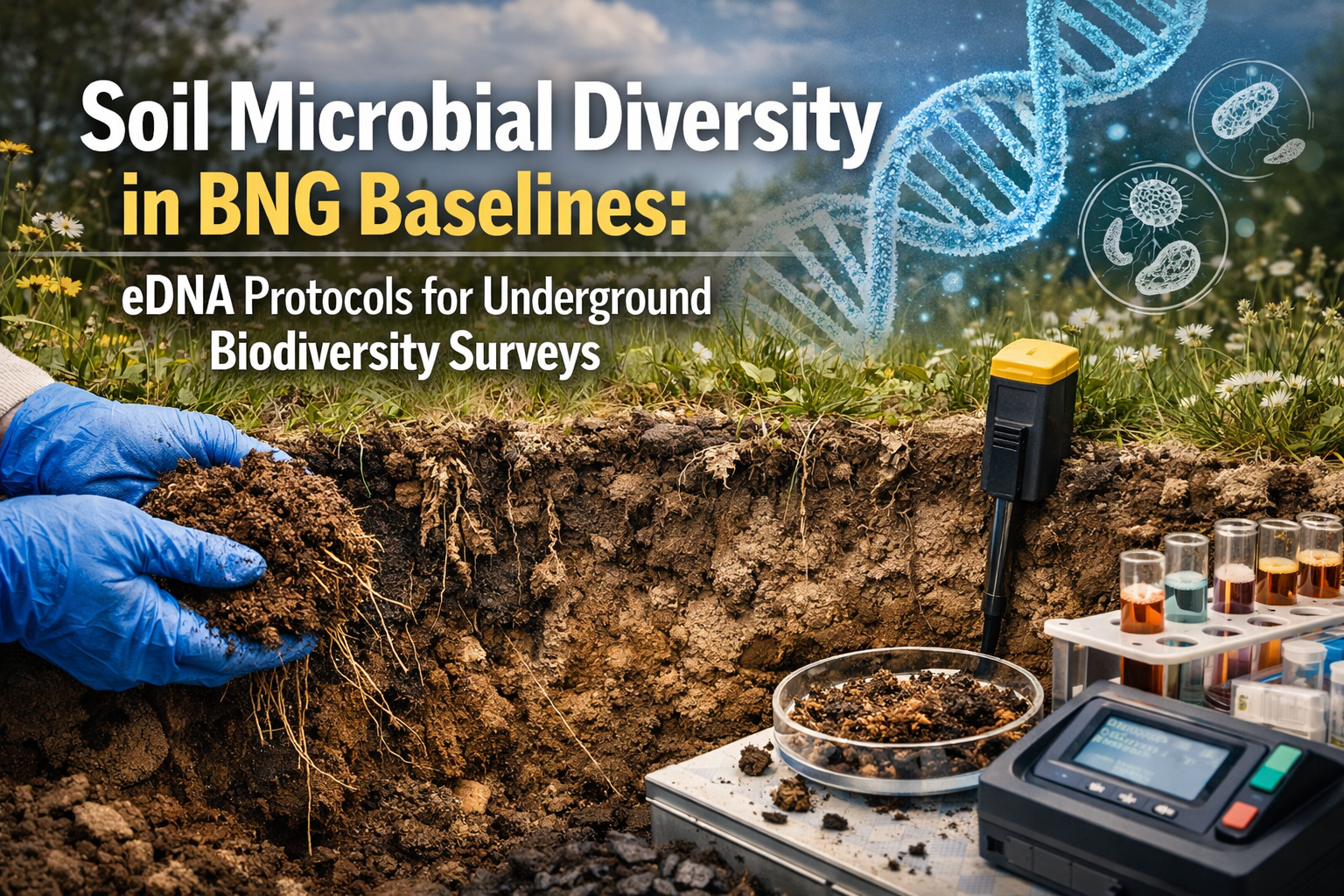
Soil Microbial Diversity in BNG Baselines: eDNA Protocols for Underground Biodiversity Surveys represents a paradigm shift in how developers, ecologists, and planners quantify biodiversity value. Traditional survey methods focus on visible flora and fauna, overlooking the bacterial, fungal, and invertebrate communities that drive ecosystem function. Environmental DNA (eDNA) sampling protocols now offer field-tested solutions for capturing this underground biodiversity, transforming how projects demonstrate compliance and measure genuine ecological improvement.
Key Takeaways
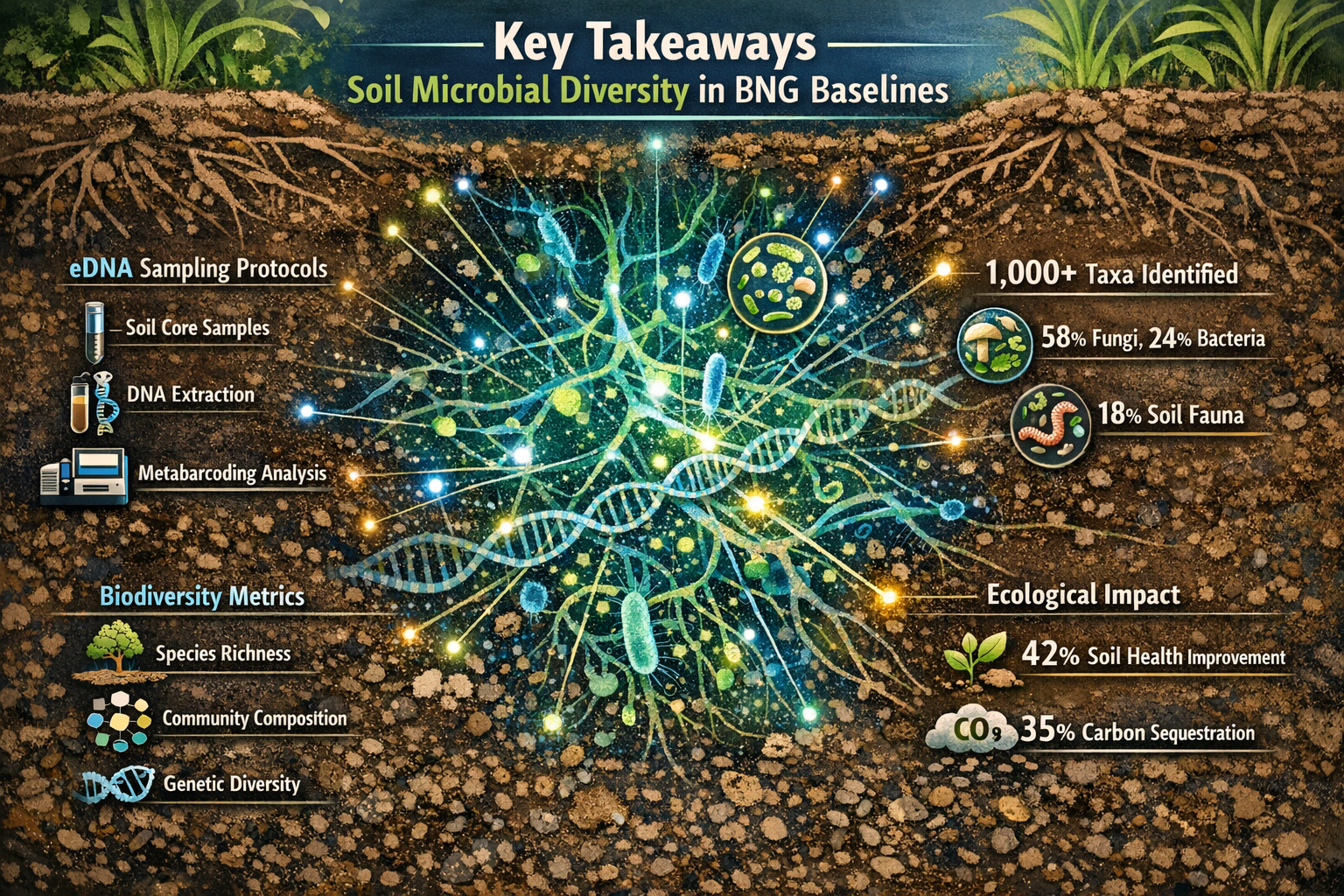
- 🔬 eDNA protocols detect 200+ microbial species from a single soil sample, revealing biodiversity invisible to traditional surveys
- 📊 Sampling depth matters: 0-10cm topsoil layers capture significantly more species than deeper samples, optimizing survey efficiency
- 🎯 16 subsamples combined with surface sampling provide the highest diversity recovery for BNG baseline assessments
- ⚠️ Universal primers have limitations: 18S rRNA primers show reduced effectiveness for key soil invertebrate groups
- ✅ USGS 2026 guidelines establish best practices for eDNA proficiency testing and validation protocols
Understanding Soil Microbial Diversity in BNG Context
The UK's Biodiversity Net Gain requirements mandate that development projects deliver at least 10% measurable improvement in biodiversity value. However, current BNG assessment frameworks primarily evaluate above-ground habitat quality and species richness, creating a significant blind spot for soil ecosystems.
Soil microbial communities perform essential ecosystem services:
- Nutrient cycling and organic matter decomposition
- Carbon sequestration and climate regulation
- Water filtration and soil structure maintenance
- Plant health support through mycorrhizal networks
- Pollutant breakdown and bioremediation
Why Soil Microbiomes Matter for BNG Compliance
When conducting a biodiversity impact assessment, developers traditionally focus on habitat types, vegetation communities, and protected species. Yet soil health directly influences habitat quality and long-term ecosystem resilience.
Soil Microbial Diversity in BNG Baselines: eDNA Protocols for Underground Biodiversity Surveys addresses three critical challenges:
- Baseline accuracy: Capturing true pre-development biodiversity value
- Monitoring effectiveness: Tracking genuine ecological improvement over 30-year management periods
- Habitat quality validation: Verifying that created or enhanced habitats support functional ecosystems
Research demonstrates that sampling protocols significantly impact species detection rates. Studies comparing standardized approaches found that sampling upper soil layers (0-10 cm topsoil and forest floor) separately detects substantially more species than sampling deeper layers (10-30 cm), which proved insufficient for capturing invertebrate diversity patterns as ecological indicators.[2]
eDNA Sampling Protocols for Soil Biodiversity Assessment
Environmental DNA (eDNA) analysis involves extracting genetic material directly from soil samples, then using DNA sequencing to identify the organisms present without physically observing them. This molecular approach revolutionizes biodiversity surveying by detecting bacteria, fungi, protists, nematodes, arthropods, and other soil-dwelling organisms simultaneously.
Field Collection Protocols for BNG Baselines
The United States Geological Survey published comprehensive best practice guidelines in January 2026, emphasizing strict adherence to established and validated methods for effective eDNA tool deployment.[6] Adapting these principles to UK BNG contexts requires careful protocol design.
Optimal Sampling Strategy:
| Parameter | Recommendation | Rationale |
|---|---|---|
| Sampling Depth | 0-10 cm topsoil | Highest species detection rate[2] |
| Number of Subsamples | 16 per sampling area | Maximizes diversity recovery[2] |
| Sample Distribution | Systematic grid pattern | Captures spatial heterogeneity |
| Sample Volume | 5-10g per subsample | Balances DNA yield with field practicality |
| Timing | Spring/autumn | Peak microbial activity periods |
| Replication | 3-5 sampling areas per habitat type | Statistical robustness |
Step-by-Step Field Collection Process
Before Sampling:
- Sterilize all equipment with 10% bleach solution
- Use new nitrile gloves for each sampling location
- Label sample tubes with unique identifiers, date, GPS coordinates
- Document habitat type, vegetation cover, soil moisture, recent disturbance
During Sampling:
- Remove surface vegetation and leaf litter (sample separately if required)
- Insert sterile soil corer to 10 cm depth
- Extract soil core maintaining vertical orientation
- Transfer soil to sterile collection tube using sterile spatula
- Repeat for all 16 subsamples within 10m² area
- Combine subsamples in single composite sample or maintain separately
- Store immediately on ice (4°C) or freeze (-20°C) within 6 hours
Quality Control Measures:
- Include field blanks (opened sterile tubes) to detect contamination
- Photograph sampling locations with reference markers
- Record environmental conditions (temperature, recent rainfall, soil pH if available)
- Maintain chain of custody documentation
When creating a biodiversity plan, developers should integrate soil eDNA sampling into Phase 1 habitat surveys to establish comprehensive baselines before construction begins.
Laboratory Analysis and Data Interpretation
Once field samples reach the laboratory, DNA extraction and sequencing reveal the microbial community composition. Understanding the analytical pipeline helps surveyors and developers interpret results within BNG frameworks.
DNA Extraction and Sequencing Methods
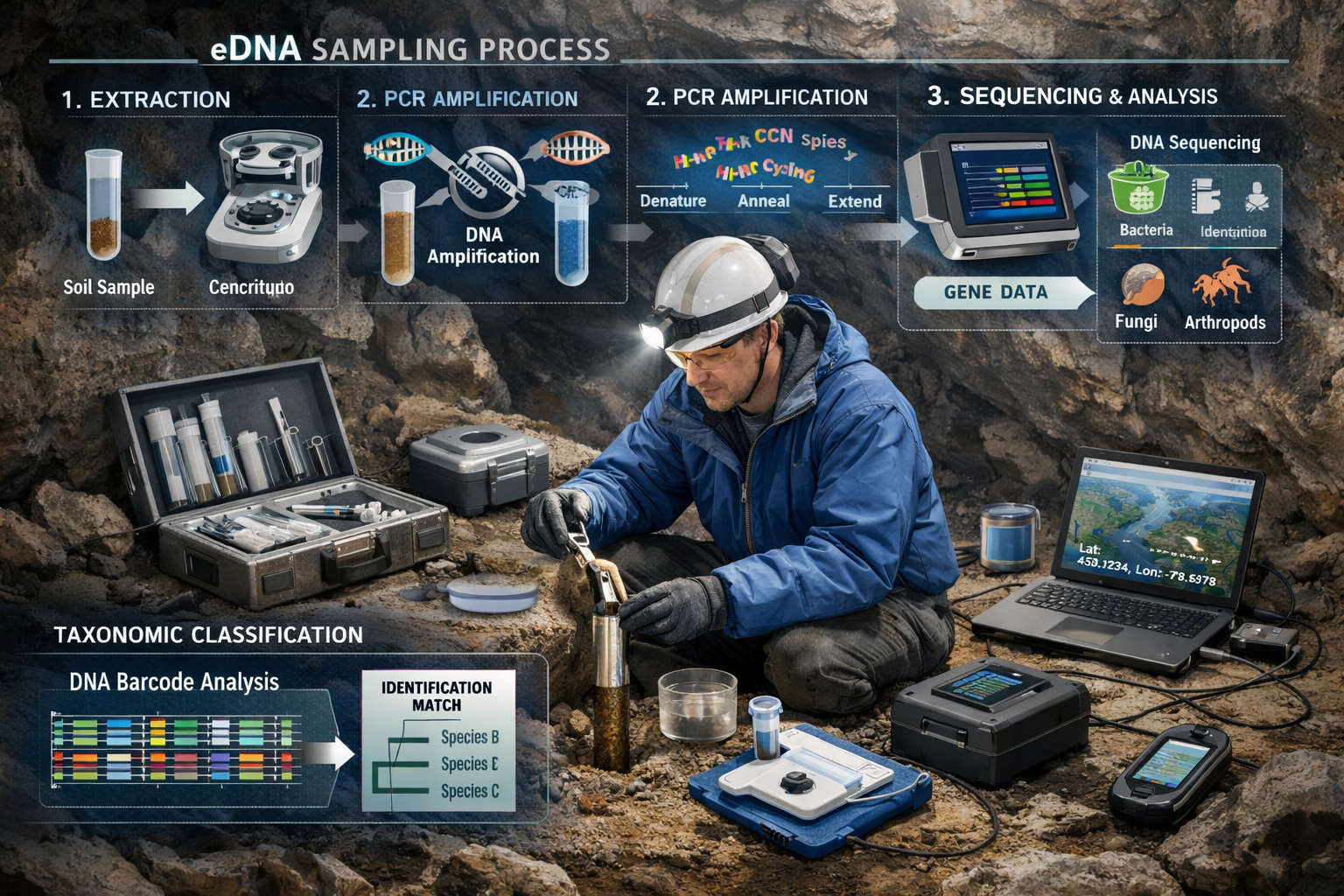
Modern eDNA analysis typically follows this workflow:
Extraction Phase:
- Mechanical and chemical lysis breaks open cells
- DNA purification removes soil particles and inhibitors
- Quality checks verify DNA concentration and purity
- Extracted DNA stored at -80°C for long-term stability
Amplification Phase:
- PCR (Polymerase Chain Reaction) amplifies target DNA regions
- Primer selection determines which organisms are detected
- Multiple primer sets may be used for comprehensive coverage
Sequencing Phase:
- High-throughput sequencing generates millions of DNA reads
- Bioinformatics pipelines process raw sequence data
- Taxonomic assignment matches sequences to reference databases
Primer Selection Challenges for Soil Biodiversity
Universal eukaryotic 18S rRNA primers provide limited resolution for certain soil invertebrate groups like Collembola and Annelida, making them less suitable as reliable response variables for monitoring ecological changes and biological soil health.[2]
Recommended Primer Targets:
- Bacteria: 16S rRNA gene (V3-V4 regions)
- Fungi: ITS (Internal Transcribed Spacer) region
- General eukaryotes: 18S rRNA gene (with limitations noted)
- Specific invertebrates: COI (Cytochrome Oxidase I) gene
- Plants: trnL or ITS2 regions
Multi-primer approaches increase detection breadth but also increase laboratory costs. Surveyors should balance comprehensiveness with budget constraints when designing biodiversity net gain assessments.
Interpreting Diversity Metrics for BNG
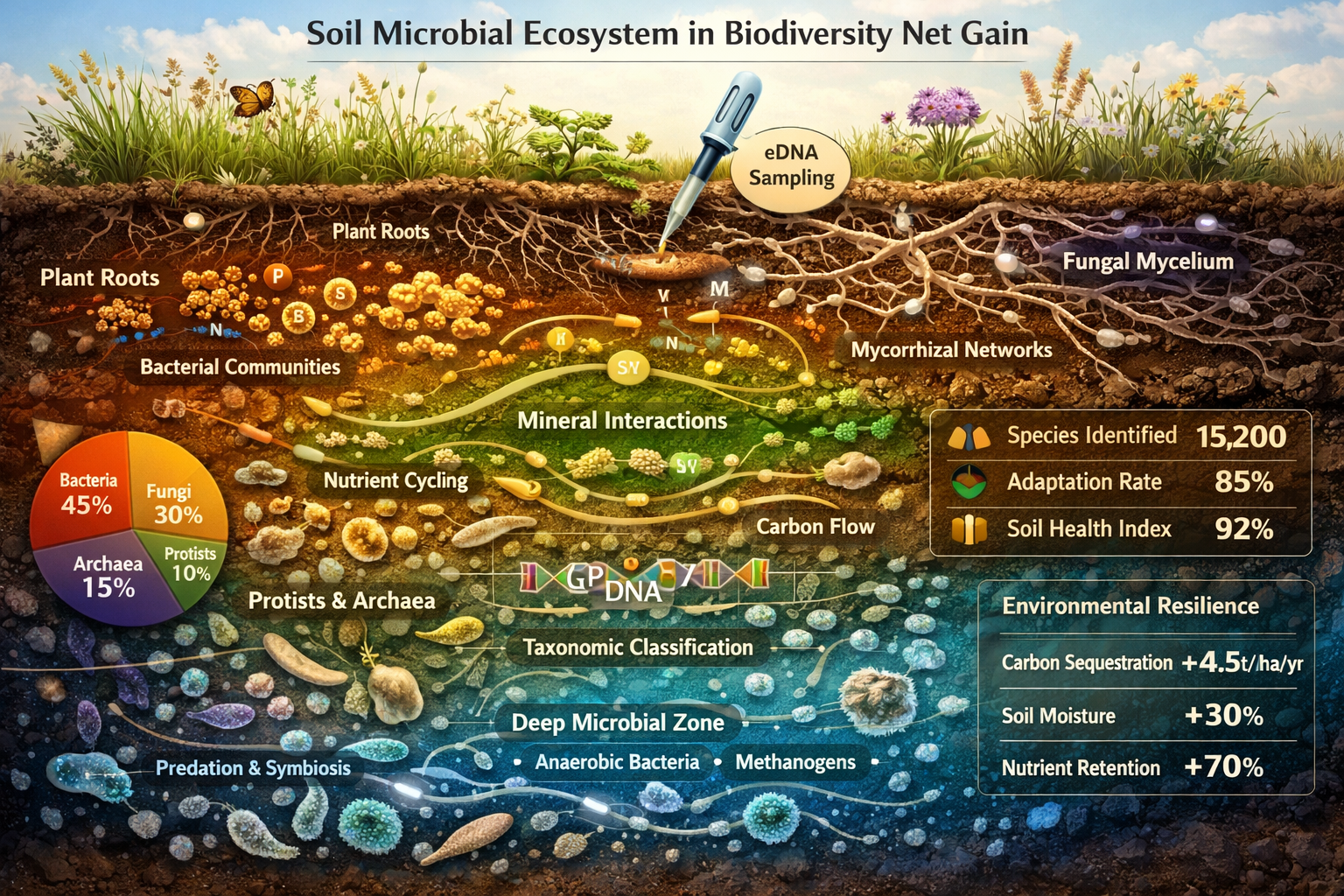
Sequencing data generates several biodiversity metrics relevant to BNG calculations:
Alpha Diversity (within-sample diversity):
- Species richness: Total number of unique taxa detected
- Shannon index: Accounts for both richness and evenness
- Simpson index: Probability two randomly selected individuals are different species
Beta Diversity (between-sample differences):
- Compares microbial communities across habitat types
- Identifies unique communities requiring protection
- Tracks community shifts during habitat creation
Functional Diversity:
- Predicts ecosystem functions from taxonomic composition
- Identifies key functional groups (decomposers, nitrogen fixers, pathogens)
- Assesses ecosystem service provision
Integrating Microbial Data into BNG Metrics
Current BNG metric calculations use the Defra Biodiversity Metric, which assigns biodiversity unit values based on habitat type, distinctiveness, condition, and strategic significance. Soil microbial data enhances these assessments:
Habitat Condition Assessment:
Microbial diversity indicators can validate habitat condition scores. High-quality grassland should support diverse bacterial and fungal communities characteristic of that habitat type. Reduced diversity or dominance by disturbance-tolerant taxa suggests degraded condition.
Post-Development Monitoring:
Comparing microbial communities before and after habitat creation verifies that created habitats support appropriate underground ecosystems. A woodland creation area should develop fungal communities dominated by mycorrhizal species over time.
Soil Health Baselines:
eDNA data provides quantitative soil health metrics that complement vegetation surveys. This becomes particularly valuable for brownfield redevelopment projects where soil quality significantly influences habitat establishment success.
Practical Implementation for Developers and Surveyors
Integrating Soil Microbial Diversity in BNG Baselines: eDNA Protocols for Underground Biodiversity Surveys into project workflows requires careful planning and coordination between ecological consultants, developers, and laboratory partners.
When to Conduct Soil eDNA Surveys
Essential Scenarios:
- ✅ Large-scale developments (>1 hectare)
- ✅ Projects impacting high-quality habitats (ancient woodland, species-rich grassland)
- ✅ Brownfield sites with unknown contamination history
- ✅ Sites where achieving 10% biodiversity net gain proves challenging
- ✅ Projects with significant soil movement or habitat translocation
Optional but Beneficial:
- Medium-scale residential developments
- Agricultural land conversions
- Linear infrastructure projects (roads, pipelines)
- Projects seeking to demonstrate environmental leadership
Cost Considerations and Budget Planning
Soil eDNA analysis represents an additional survey cost, but prices have decreased significantly as the technology matures:
Typical Cost Structure (2026 estimates):
- Field sampling (per site visit): £500-£1,200
- Laboratory analysis (per sample): £150-£400 depending on primer sets
- Bioinformatics analysis and reporting: £800-£2,000
- Total per project: £2,000-£8,000 for comprehensive assessment
These costs should be contextualized against potential benefits:
- Reduced risk of planning delays due to incomplete baseline data
- Stronger evidence for habitat condition assessments
- Improved monitoring data supporting 30-year management plans
- Potential to identify opportunities to sell biodiversity units from high-quality habitats
Selecting Laboratory Partners
Not all environmental DNA laboratories offer soil microbial analysis services. When selecting partners, surveyors should verify:
- Accreditation: ISO 17025 or equivalent quality standards
- Experience: Demonstrated track record with soil samples
- Primer validation: Published validation data for primer sets used
- Bioinformatics capacity: In-house expertise for data analysis
- Reference databases: Access to comprehensive taxonomic databases
- Turnaround time: Typically 4-8 weeks from sample receipt to report
- Data provision: Provision of raw data files for independent verification
Integrating Results into BNG Reports
Soil eDNA findings should be incorporated into standard BNG documentation:
Baseline Assessment Reports:
- Include microbial diversity metrics alongside vegetation and faunal surveys
- Use microbial data to support habitat condition scoring
- Identify unique or rare microbial communities requiring protection
Biodiversity Metric Calculations:
While current Defra Metric versions don't explicitly include soil microbial parameters, surveyors can use this data to justify habitat condition scores and distinctiveness ratings. Document the rationale clearly for planning authority review.
Monitoring and Management Plans:
Specify soil eDNA sampling as part of Year 1, Year 5, Year 10, and Year 30 monitoring protocols. Establish target microbial community compositions for created or enhanced habitats based on reference sites.
Challenges and Future Developments
Despite significant advances, Soil Microbial Diversity in BNG Baselines: eDNA Protocols for Underground Biodiversity Surveys faces several ongoing challenges that practitioners should understand.
Current Limitations
Taxonomic Resolution:
Many soil bacteria and fungi lack comprehensive reference sequences in databases. This results in identification to genus or family level rather than species, reducing precision for rare or specialized organisms.
Quantification Issues:
eDNA analysis detects presence/absence effectively but struggles with accurate abundance estimation. DNA from dead organisms may persist in soil, potentially inflating diversity estimates.
Standardization Gaps:
Unlike established survey methods for birds or bats, soil eDNA protocols lack universal standardization across the UK ecology sector. Different consultancies may use varying methods, complicating cross-project comparisons.
Regulatory Recognition:
Current BNG guidance documents don't explicitly incorporate soil microbial diversity into biodiversity unit calculations. Practitioners must make the case for its relevance on a project-by-project basis.
Emerging Solutions and Research Directions
The field continues to evolve rapidly. Recent research published through the Terrestrial Ecosystem Research Network demonstrates how soil microbiome eDNA analysis can be integrated into national biodiversity monitoring frameworks.[3] The National Ecological Observatory Network (NEON) in the United States has established standardized protocols for soil microbe marker gene sequences that provide valuable methodological templates.[4]
Promising Developments:
- Improved reference databases: Ongoing sequencing efforts expand taxonomic coverage
- Quantitative PCR methods: Better abundance estimation through targeted approaches
- Machine learning applications: AI-assisted bioinformatics improving taxonomic assignment
- Functional gene analysis: Moving beyond taxonomy to assess ecosystem function directly
- Portable sequencing: Field-deployable devices reducing laboratory turnaround time
Recommendations for Early Adopters
Developers and ecological consultants pioneering soil eDNA integration into BNG workflows should:
- Document thoroughly: Maintain detailed records of protocols, justifications, and results
- Engage early: Discuss approaches with planning authorities before submission
- Use complementary evidence: Combine eDNA data with traditional soil health indicators
- Focus on condition assessment: Use microbial data primarily to support habitat condition scoring
- Build reference datasets: Contribute to industry knowledge by publishing case studies
- Monitor regulatory developments: Track updates to BNG guidance that may incorporate soil metrics
For projects requiring biodiversity unit purchases to meet net gain obligations, soil eDNA data may help identify higher-quality offset sites with robust underground ecosystems.
Conclusion
Soil Microbial Diversity in BNG Baselines: eDNA Protocols for Underground Biodiversity Surveys represents a significant advancement in ecological assessment methodology. As BNG requirements drive more rigorous biodiversity accounting across England's development sector, the invisible world beneath our feet can no longer be ignored.
Environmental DNA protocols offer practical, field-tested solutions for quantifying soil biodiversity that traditional surveys miss entirely. By sampling topsoil layers at 0-10 cm depth using 16 subsamples per area, surveyors can detect hundreds of microbial species that drive ecosystem function and long-term habitat quality.
Key Implementation Steps
For Developers:
- Include soil eDNA sampling in project budgets for major developments
- Commission baseline surveys during initial ecological assessment phases
- Use microbial data to strengthen habitat condition justifications
- Incorporate soil monitoring into long-term management plans
For Ecological Consultants:
- Develop partnerships with accredited eDNA laboratories
- Establish standardized field protocols for consistent sampling
- Build expertise in interpreting microbial diversity metrics
- Educate clients on the value proposition for BNG compliance
For Planning Authorities:
- Recognize soil eDNA data as supporting evidence for condition assessments
- Encourage inclusion in monitoring frameworks for major projects
- Support development of regional reference datasets
- Consider soil health explicitly in net gain delivery verification
Moving Forward
The integration of soil microbial diversity into BNG frameworks remains an emerging practice in 2026, but early adoption positions projects for stronger ecological outcomes and more defensible planning applications. As reference databases expand, analytical costs decrease, and regulatory guidance evolves, soil eDNA protocols will likely become standard components of comprehensive biodiversity assessments.
The underground biodiversity that eDNA reveals isn't merely an academic curiosity—it's the foundation upon which all terrestrial ecosystems rest. By incorporating these hidden communities into baseline assessments and monitoring programs, the development sector can deliver genuine, measurable improvements in biodiversity that extend far beyond surface-level habitat creation.
For guidance on implementing comprehensive biodiversity strategies that incorporate soil health alongside traditional survey methods, explore resources on biodiversity net gain planning and achieving BNG without risk.
References
[1] Pmc12790866 – https://pmc.ncbi.nlm.nih.gov/articles/PMC12790866/
[2] zenodo – https://zenodo.org/records/15046019
[3] News Soil Microbiome Edna – https://www.tern.org.au/news/news-soil-microbiome-edna/
[4] Dp1.10109 – https://data.neonscience.org/data-products/DP1.10109.001
[5] Egu26 10962 – https://meetingorganizer.copernicus.org/EGU26/EGU26-10962.html
[6] Best Practice Guidelines Targeted Environmental Dna Based Proficiency Testing Non – https://www.usgs.gov/publications/best-practice-guidelines-targeted-environmental-dna-based-proficiency-testing-non