

Wildlife populations worldwide are collapsing faster than scientists predicted—and the reason lies not in individual threats, but in how these dangers combine and amplify each other. 🌍 New research analyzing over 3,000 vertebrate populations reveals a troubling reality: disease, invasive species, pollution, and climate change cause dramatically faster population declines when they interact, making traditional single-threat monitoring approaches dangerously inadequate in 2026.
For decades, biodiversity surveyors and conservation professionals have approached environmental threats in isolation—tracking habitat loss here, monitoring pollution there, assessing climate impacts separately. This fragmented approach, while administratively convenient, fails to capture the complex reality of how multiple stressors work together to devastate ecosystems. As development projects increasingly require comprehensive biodiversity impact assessments, understanding Interactive Threats in Biodiversity Surveys: Why Single-Threat Monitoring Fails in 2026 has become essential for effective conservation planning.
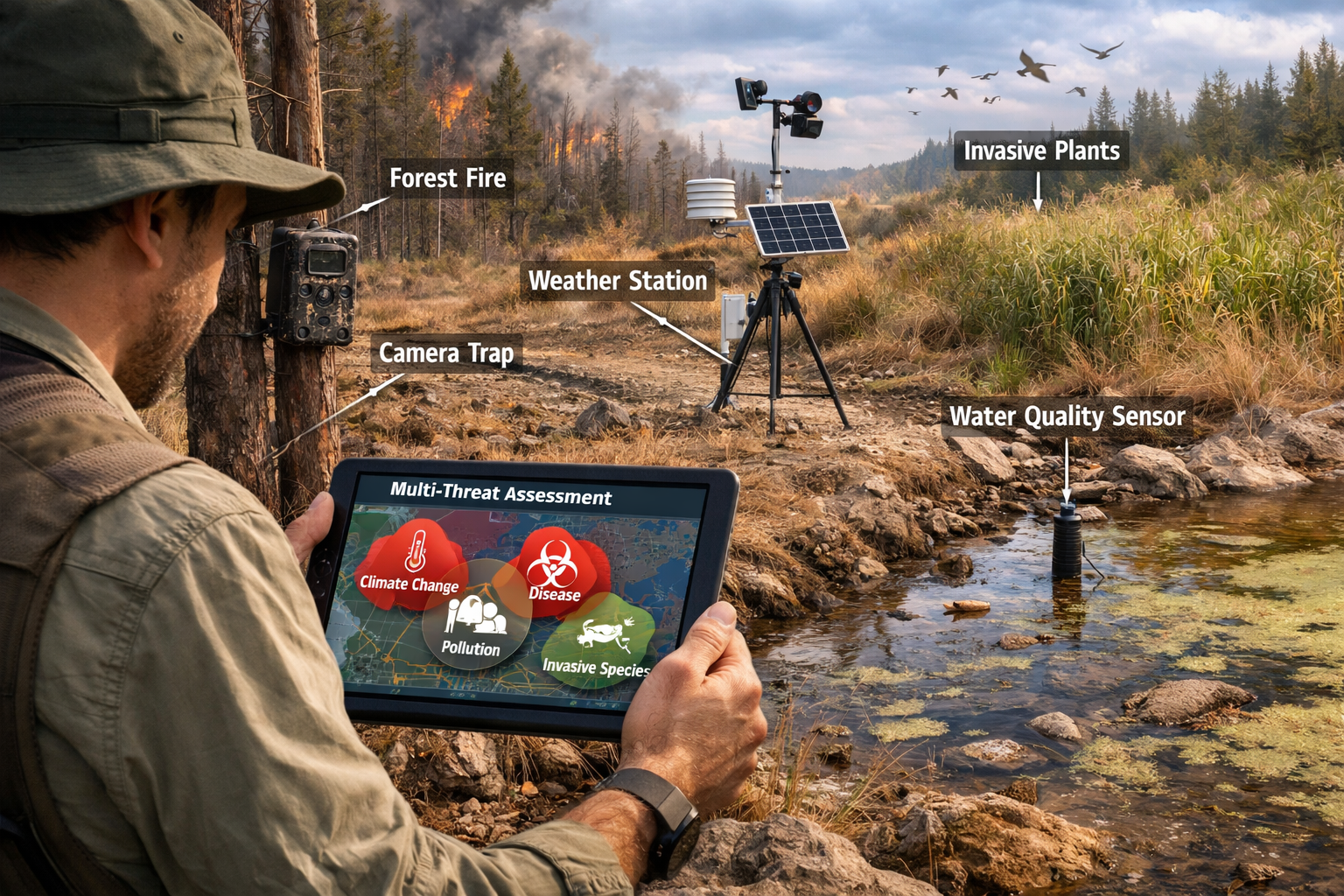
Key Takeaways
- Interactive threats cause faster declines than single threats: Populations exposed to combinations of climate change, disease, pollution, and invasive species decline significantly faster than those affected by habitat loss or exploitation alone [1][2]
- Traditional single-threat monitoring misses critical interactions: Analysis of 3,129 vertebrate populations demonstrates that threat interactions are primary drivers of biodiversity loss, not isolated pressures [1]
- Coordinated multi-stressor interventions are essential: Modeling confirms that stable or recovering populations require simultaneous mitigation across multiple threats, not sequential single-threat prioritization [2]
- Hard-to-detect species face 2.6x greater losses: Elusive species show dramatically steeper declines with land-use intensity than conventional surveys reveal, with intensive agriculture supporting only 18% of original biodiversity [4]
- Survey protocols must evolve immediately: Conservation success in 2026 demands integrated monitoring frameworks that assess threat combinations, not individual pressures in isolation
Understanding Interactive Threats in Biodiversity Surveys
What Are Interactive Threats?
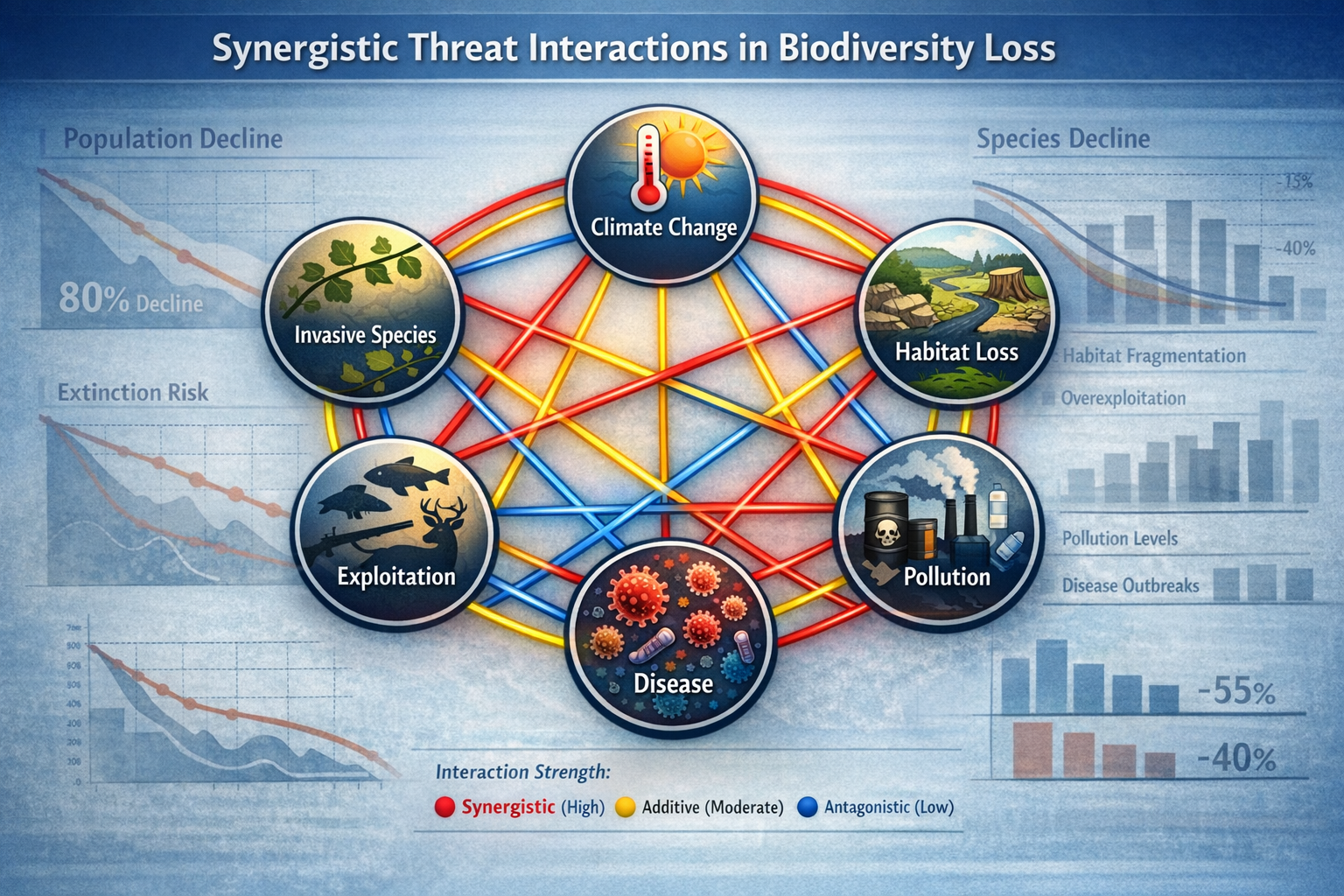
Interactive threats occur when multiple environmental stressors combine to produce effects that differ from simply adding individual threat impacts together. These interactions can be:
- Synergistic: Combined effects exceed the sum of individual threats (1 + 1 = 3)
- Antagonistic: Combined effects are less than expected from adding threats (1 + 1 = 1.5)
- Additive: Combined effects equal the sum of individual threats (1 + 1 = 2)
Research published in 2026 analyzed six major threat categories affecting wildlife populations worldwide [1]:
- 🌡️ Climate change (temperature shifts, precipitation changes, extreme weather)
- 🦠 Disease (pathogens, parasites, epidemics)
- 🏭 Pollution (chemical contamination, nutrient loading, plastics)
- 🌿 Invasive species (non-native predators, competitors, ecosystem engineers)
- 🏗️ Habitat loss and degradation (land conversion, fragmentation, quality decline)
- 🎣 Exploitation (overharvesting, hunting, fishing pressure)
These six categories create 36 unique threat combinations, each potentially producing different interaction effects on wildlife populations.
The Scale of the Problem
The groundbreaking study examined 3,129 vertebrate population time series spanning 1950 to 2020, representing species from every continent and major ecosystem type [1]. This unprecedented dataset revealed:
| Finding | Impact |
|---|---|
| Populations with multiple threats | Decline faster than single-threat populations |
| Interactive effects | Stronger than random temporal or spatial variation |
| Synergistic interactions | Most common between climate change, disease, pollution, and invasive species |
| Single-threat interventions | Insufficient to halt overall biodiversity loss trends [2] |
"Tackling threats one at a time will not be enough to halt ongoing biodiversity loss. Conservation action must be coordinated across multiple pressures." — University of Bristol research team [2]
This finding has profound implications for how biodiversity surveys must be conducted in 2026 and beyond, particularly for projects pursuing Biodiversity Net Gain requirements.
Why Single-Threat Monitoring Fails in 2026
The Limitations of Isolated Threat Assessment
Traditional biodiversity monitoring protocols developed in the late 20th century focused on identifying and ranking individual threats by frequency or perceived severity. This approach made administrative sense when conservation resources were allocated to specific threat categories—habitat protection programs, pollution control initiatives, or climate adaptation strategies operated in separate policy silos.
However, single-threat monitoring systematically underestimates actual conservation priorities for several critical reasons:
1. Synergistic Effects Remain Invisible
When surveyors assess threats in isolation, they cannot detect how stressors amplify each other. For example:
- Climate change + disease: Warming temperatures may expand pathogen ranges while simultaneously weakening host immune systems, creating declines far exceeding either threat alone
- Pollution + invasive species: Chemical contamination may preferentially harm native species while invasive competitors remain resistant, accelerating displacement
- Habitat degradation + climate change: Fragmented populations lose genetic diversity needed to adapt to rapidly changing conditions
The 2026 research confirmed that populations exposed to these interactive threat combinations declined faster than additive models predicted [1], meaning traditional risk assessments based on summing individual threats consistently underestimate actual danger.
2. Recordability Bias Masks True Declines
Recent methodological advances reveal another critical flaw in conventional monitoring: hard-to-sample species experience 2.6 times greater biodiversity loss than frequently recorded species [4].
Traditional biodiversity surveys naturally focus on conspicuous, easily detected species—common birds, large mammals, abundant plants. However, elusive species including:
- 🦎 Cryptic reptiles and amphibians
- 🦇 Nocturnal mammals
- 🐛 Specialized invertebrates
- 🌱 Rare plant species
These organisms show dramatically steeper declines with land-use intensity. Statistical corrections for this "recordability bias" reveal that intensive agriculture supports only 18% of original biodiversity compared to previous estimates of 47% that omitted poorly recorded species [4].
For biodiversity surveyors, this means single-site assessments that miss elusive species will systematically overestimate ecosystem health and underestimate threat severity—a dangerous error when planning Biodiversity Net Gain projects.
3. Climate Refugia Are Shrinking Rapidly
Assessment of 98,000+ protected areas worldwide demonstrates that climate refugia—areas projected to remain climatically suitable for most current species—shrink dramatically beyond 2°C of warming [3]. Some ecosystems may lose refugia entirely even at 1.5°C warming scenarios.
Single-threat monitoring focused only on current habitat quality or current climate conditions cannot identify which sites will maintain conservation value as conditions change. For example, Biebrza National Park in Poland—one of Europe's largest peat bog landscapes—ranks in the bottom 11% globally for projected biodiversity resilience under 4°C warming, with over 70% of species facing climate unsuitability [3].
Surveyors assessing this site for habitat quality alone would miss its extreme vulnerability to interactive climate and hydrological threats, potentially misdirecting conservation investment toward areas that cannot sustain biodiversity long-term.
4. Resource Allocation Becomes Inefficient
When conservation policy relies on ranking threat frequency to prioritize action, limited resources get misdirected [1]. The research team modeled "what-if" scenarios showing:
- If only one threat can be addressed, reducing overexploitation, habitat loss, or climate change delivers the greatest global benefits
- However, this remains insufficient for halting overall decline trends [2]
- Populations require coordinated threat mitigation across multiple pressures to stabilize or recover
For development projects, this means achieving biodiversity net gain requires integrated strategies addressing multiple stressors simultaneously, not sequential single-threat interventions that may arrive too late to prevent ecosystem collapse.
The Hidden Cost of Sequential Interventions
Traditional conservation planning often addresses threats sequentially: first secure habitat protection, then address pollution, later tackle invasive species, eventually consider climate adaptation. This phased approach seems logical but ignores the time-sensitive nature of threat interactions.
While conservationists work through their sequential checklist, synergistic interactions continue accelerating population declines. By the time multiple threats are addressed, populations may have crossed critical thresholds—losing genetic diversity, falling below minimum viable population sizes, or experiencing demographic collapse that makes recovery impossible even after threat removal.
The 2026 research makes clear: Interactive Threats in Biodiversity Surveys: Why Single-Threat Monitoring Fails in 2026 is not merely an academic observation—it represents a fundamental challenge to current conservation practice that demands immediate protocol revision.
Implementing Multi-Stressor Monitoring Protocols in 2026
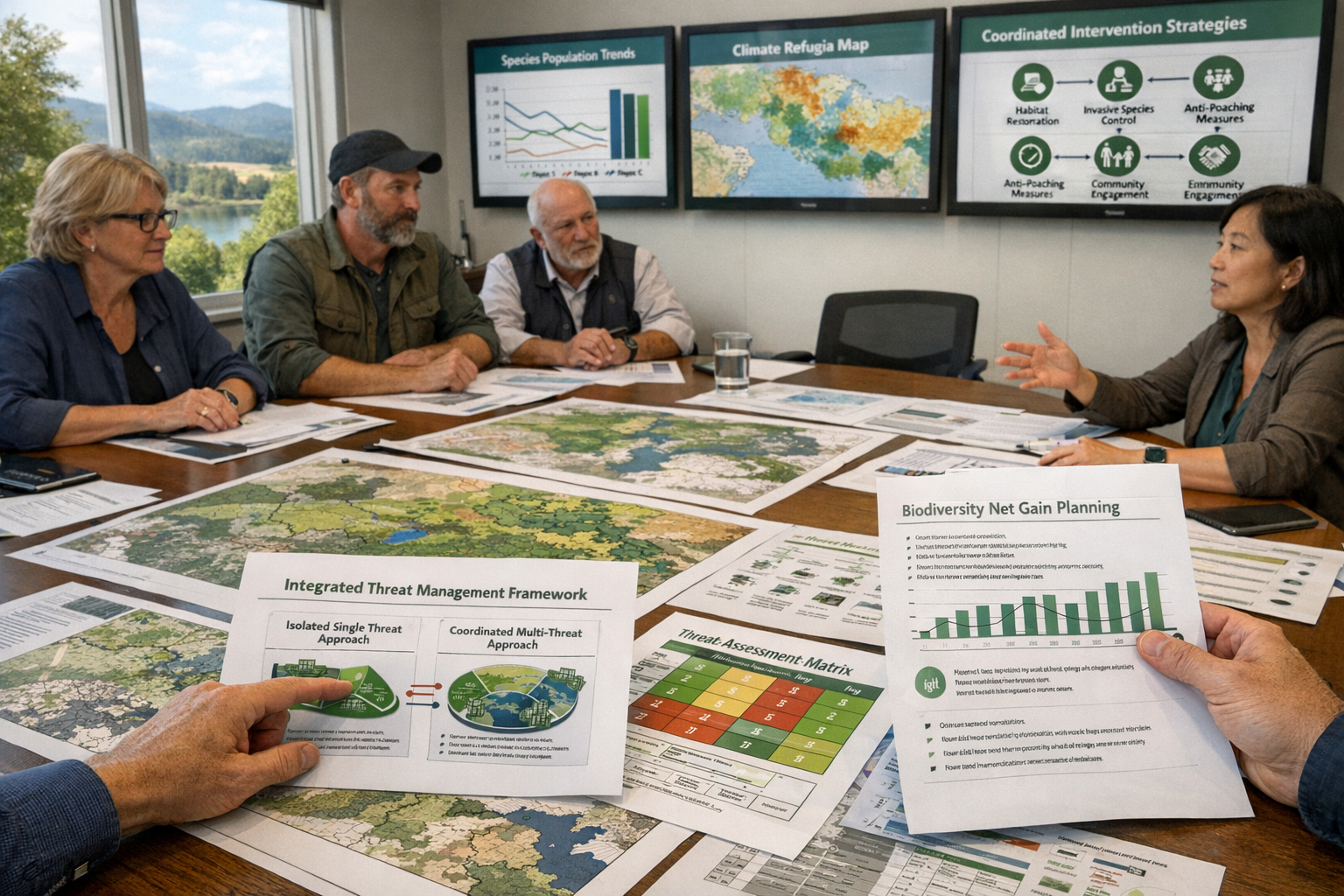
Essential Components of Integrated Threat Assessment
Effective biodiversity surveys in 2026 must evolve beyond single-threat checklists to comprehensive multi-stressor monitoring frameworks. Here are the essential components:
1. Simultaneous Multi-Threat Data Collection
Modern survey protocols should simultaneously assess all major threat categories during field visits:
Climate stressors:
- Temperature and precipitation trends
- Extreme weather frequency
- Phenological mismatches (timing of seasonal events)
- Microclimate refugia availability
Biological stressors:
- Disease prevalence and pathogen loads
- Invasive species presence and abundance
- Native species interactions and community composition
- Pollinator and seed disperser availability
Chemical stressors:
- Water and soil contamination levels
- Nutrient loading and eutrophication
- Pesticide and herbicide residues
- Atmospheric deposition
Physical stressors:
- Habitat fragmentation metrics
- Connectivity and corridor functionality
- Disturbance regimes (fire, flooding, storm damage)
- Exploitation pressure indicators
2. Technology-Enhanced Detection Methods
Addressing recordability bias requires deploying multiple detection technologies:
- 📷 Camera traps for elusive mammals and ground-dwelling birds
- 🎤 Acoustic monitoring for bats, nocturnal species, and cryptic amphibians
- 🧬 Environmental DNA (eDNA) sampling for aquatic and soil-dwelling organisms
- 🛰️ Remote sensing for landscape-scale habitat quality and change detection
- 📱 Mobile apps for standardized data collection and real-time threat mapping
These technologies dramatically improve detection of hard-to-sample species that experience the greatest threat impacts [4], ensuring surveys capture the full magnitude of biodiversity change.
3. Interaction Effect Modeling
Survey data must be analyzed using statistical frameworks that explicitly model threat interactions, not simply additive threat scores. The 2026 research employed multilevel Bayesian approaches to quantify:
- Which threat combinations produce synergistic effects
- How interaction strength varies across taxonomic groups
- Whether certain ecosystems show characteristic interaction patterns
- How threat interactions change over time
For practitioners, this means working with ecologists and statisticians who can apply appropriate analytical methods to survey data, moving beyond simple threat presence/absence checklists to quantitative interaction assessments.
4. Temporal Monitoring Programs
Single-snapshot surveys cannot detect threat interactions that emerge over time. Effective monitoring requires:
- Baseline establishment: Document conditions before major disturbances
- Regular resurveys: Annual or biennial repeat surveys to track population trends
- Event-triggered assessments: Additional surveys following extreme weather, disease outbreaks, or pollution incidents
- Long-term commitments: Multi-decade monitoring programs to detect slow-moving threats like climate change
This temporal dimension is particularly critical for Biodiversity Net Gain delivery, where 30-year management plans must account for how threat interactions will evolve over coming decades.
Practical Implementation for Development Projects
For developers, planners, and architects working on projects requiring biodiversity assessments, implementing multi-stressor monitoring involves:
Pre-Development Phase
- Comprehensive baseline surveys using multiple detection methods to capture elusive species
- Threat mapping identifying all current and projected future stressors on site and in surrounding landscape
- Interaction assessment modeling how development-related threats will combine with existing pressures
- Climate vulnerability analysis evaluating how site conditions will change over 30+ year timescales
Understanding how to achieve 10% Biodiversity Net Gain requires this comprehensive threat assessment to ensure enhancement measures address actual limiting factors, not assumed single threats.
Design Phase
- Integrated mitigation strategies that simultaneously address multiple threat categories
- Climate-adaptive design incorporating refugia, microclimates, and future-suitable habitat types
- Pollution prevention beyond regulatory minimums to reduce synergistic chemical-biological interactions
- Connectivity enhancement facilitating species movement and genetic exchange under changing conditions
Architects can solve Biodiversity Net Gain challenges by incorporating multi-threat considerations into site design from the earliest stages, not treating biodiversity as an afterthought.
Post-Development Monitoring
- Multi-stressor monitoring protocols tracking all threat categories, not just habitat area
- Adaptive management triggers specifying responses when threat interactions exceed thresholds
- Long-term stewardship funding ensuring monitoring continues throughout 30-year commitment periods
- Data sharing contributing to regional threat interaction databases that improve future assessments
Regional and Landscape-Scale Coordination
Individual site assessments, no matter how comprehensive, cannot fully address Interactive Threats in Biodiversity Surveys: Why Single-Threat Monitoring Fails in 2026. Effective conservation requires landscape-scale coordination:
- Regional threat mapping: Identifying hotspots where multiple stressors converge
- Coordinated intervention planning: Ensuring multiple landowners and projects address complementary threats
- Biodiversity credit systems: Structuring biodiversity unit markets to reward multi-threat mitigation
- Policy integration: Aligning climate, pollution, invasive species, and habitat policies
For landowners considering biodiversity unit creation, demonstrating comprehensive multi-threat management can justify premium pricing and attract developers seeking high-quality, resilient offset sites.
Policy Implications and Future Directions
Reforming Biodiversity Net Gain Requirements
Current Biodiversity Net Gain regulations in England primarily focus on habitat area and quality, with limited explicit consideration of threat interactions. The 2026 research suggests several policy reforms:
- Multi-threat assessment requirements: Mandate comprehensive threat interaction analysis in Biodiversity Net Gain assessments
- Climate resilience standards: Require demonstration that enhancement sites will maintain suitability under projected climate scenarios
- Elusive species protocols: Incorporate technology-enhanced detection methods to reduce recordability bias
- Adaptive management provisions: Build flexibility for responding to emerging threat interactions over 30-year commitment periods
International Biodiversity Agreements
The research has direct implications for international frameworks including:
- Convention on Biological Diversity: Post-2020 targets must explicitly address threat interactions, not just individual pressures
- Paris Agreement linkages: Recognizing that climate mitigation alone is insufficient without coordinated action on other threats
- Sustainable Development Goals: Integrating multi-threat approaches across SDGs related to biodiversity, climate, pollution, and sustainable land use
Business and Investment Considerations
For businesses and investors, understanding Interactive Threats in Biodiversity Surveys: Why Single-Threat Monitoring Fails in 2026 creates both risks and opportunities:
Risks:
- Projects based on single-threat assessments may fail to deliver promised biodiversity outcomes
- Inadequate threat interaction analysis may lead to regulatory non-compliance
- Underestimated threat severity may trigger unexpected costs during monitoring periods
Opportunities:
- Early adopters of multi-stressor monitoring gain competitive advantage in biodiversity markets
- Comprehensive threat management justifies premium pricing for biodiversity units
- Demonstrating climate-resilient biodiversity strategies attracts ESG-focused investors
Research Priorities for 2026 and Beyond
Key research needs identified by the 2026 studies include:
- Ecosystem-specific interaction patterns: Do threat combinations affect forests, grasslands, wetlands, and marine systems differently?
- Taxonomic variation: How do threat interactions differ for mammals, birds, reptiles, amphibians, insects, and plants?
- Threshold identification: At what point do threat interactions trigger irreversible ecosystem shifts?
- Intervention effectiveness: Which multi-threat management strategies deliver the greatest biodiversity recovery?
- Cost-benefit optimization: How can limited conservation resources be allocated most efficiently across multiple threats?
Conclusion
The evidence is unequivocal: Interactive Threats in Biodiversity Surveys: Why Single-Threat Monitoring Fails in 2026 represents one of the most critical insights in conservation science this decade. Analysis of over 3,000 vertebrate populations worldwide confirms that disease, invasive species, pollution, and climate change cause dramatically faster population declines when they combine, and that traditional single-threat monitoring approaches systematically underestimate conservation challenges [1][2].
For biodiversity surveyors, conservation professionals, developers, and policymakers, this research demands immediate protocol revision. Single-threat checklists and sequential intervention strategies that dominated 20th-century conservation practice are no longer adequate for the complex, rapidly changing ecosystems of 2026.
Actionable Next Steps
For biodiversity surveyors and consultants:
- Adopt multi-stressor monitoring protocols incorporating simultaneous assessment of all major threat categories
- Deploy technology-enhanced detection methods to reduce recordability bias and capture elusive species
- Partner with statisticians to implement interaction effect modeling in threat assessments
- Develop long-term monitoring programs that track threat interactions over time
For developers and planners:
- Commission comprehensive biodiversity impact assessments that explicitly model threat interactions
- Design integrated mitigation strategies addressing multiple stressors simultaneously
- Incorporate climate-adaptive features ensuring sites remain suitable under future conditions
- Allocate adequate resources for multi-decade monitoring and adaptive management
For policymakers:
- Reform Biodiversity Net Gain regulations to mandate multi-threat assessment
- Integrate climate resilience standards into biodiversity policy
- Support research on threat interaction patterns and intervention effectiveness
- Coordinate across policy domains to enable landscape-scale multi-threat management
For landowners and conservation organizations:
- Prioritize sites where coordinated multi-threat management can deliver greatest benefits
- Invest in comprehensive baseline surveys using multiple detection technologies
- Develop adaptive management frameworks responsive to emerging threat interactions
- Participate in regional coordination efforts addressing landscape-scale challenges
The path forward is clear: conservation success in 2026 and beyond requires moving from isolated threat assessment to integrated multi-stressor monitoring and management. Wildlife populations cannot wait for sequential, single-threat interventions. The synergistic interactions driving biodiversity loss demand coordinated, comprehensive responses that address the complex reality of how multiple pressures combine to devastate ecosystems.
By embracing this paradigm shift, the conservation community can finally align monitoring protocols with the actual mechanisms driving biodiversity change—transforming how we assess, plan, and implement conservation action for decades to come. 🌿
References
[1] Sciadv – https://www.science.org/doi/10.1126/sciadv.adx7973
[2] Wildlife Decline – https://www.bristol.ac.uk/cabot/news/2026/wildlife-decline.html
[3] New Analysis Of Climate Threats To Biodiversity Will Help Conservationists Plan For Future – https://tyndall.ac.uk/news/new-analysis-of-climate-threats-to-biodiversity-will-help-conservationists-plan-for-future/
[4] 2025 12 Elusive Species Greatest Threat Human – https://phys.org/news/2025-12-elusive-species-greatest-threat-human.html