

Australia's government recently submitted a 261-page report to the United Nations that reads "more like a fairy tale written by public relations consultants than an evidence-based report by scientists," according to the Biodiversity Council—a consortium of 11 Australian universities.[1] This stark criticism reveals a troubling disconnect between official narratives and ecological reality, offering crucial lessons for global biodiversity net gain (BNG) implementation. As nations worldwide adopt Hot Topics in Policy-Relevant Ecology Surveys: Australian Insights for Global Biodiversity Net Gain Implementation in 2026, Australia's experience demonstrates both the promise and pitfalls of translating ecological science into actionable policy.
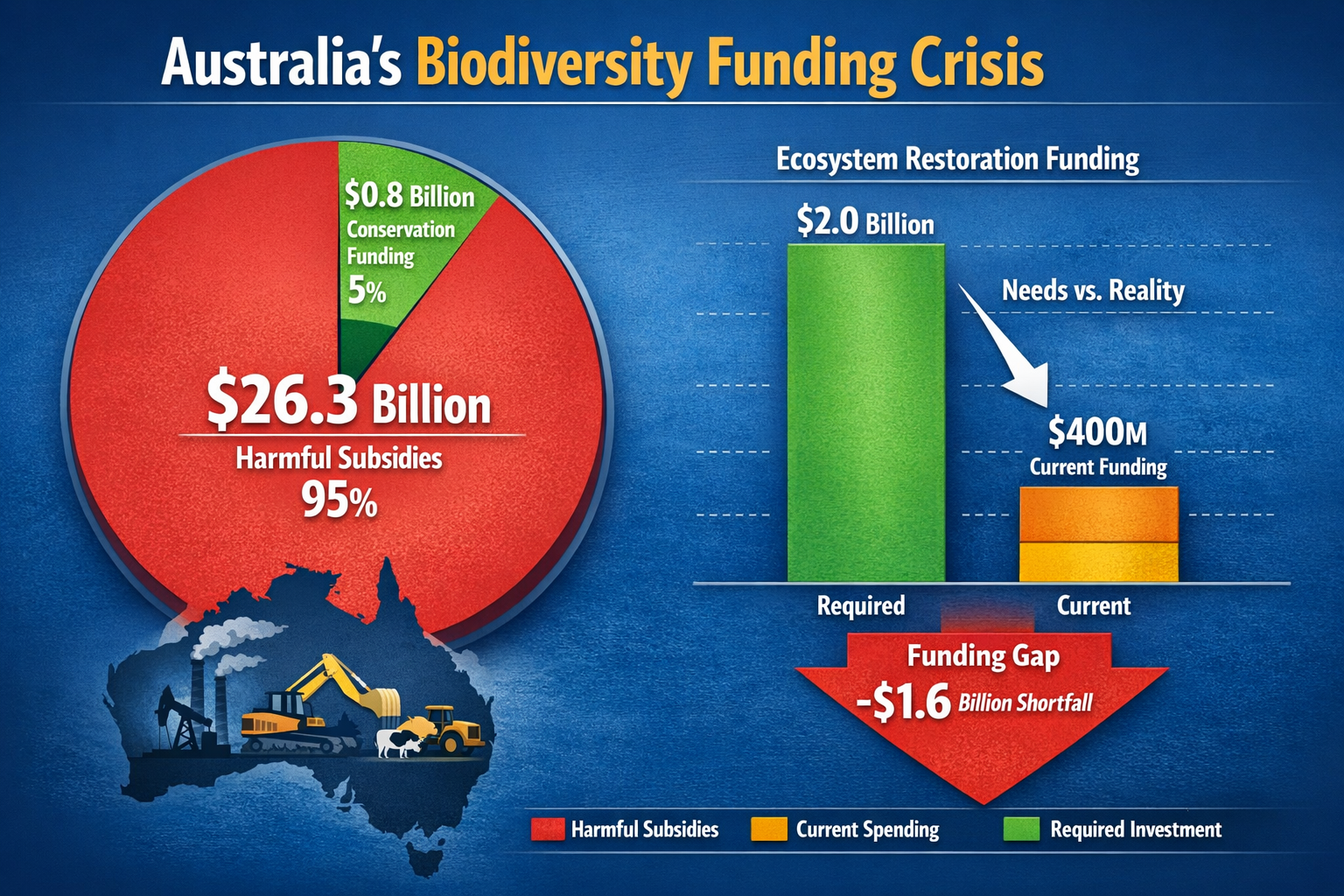
The Australian case study provides invaluable insights for international practitioners, particularly regarding evidence-based survey protocols, funding allocation, and the critical gap between policy commitments and ground-level implementation. With $26.3 billion allocated annually to biodiversity-harming subsidies—25 times the spending on nature conservation—Australia's experience serves as a cautionary tale for global BNG frameworks.[1]
Key Takeaways
- Funding Reality Check: Australia allocates $26.3 billion annually to biodiversity-harming subsidies while ecosystem restoration requires billions but receives only hundreds of millions, highlighting critical funding misalignment for BNG success
- Evidence-Based Protocols Matter: Independent scientific assessment reveals significant gaps between government reporting and ecological reality, emphasizing the need for rigorous, peer-reviewed survey methodologies
- Species-Specific Challenges: The Mount Lofty Ranges koala crisis demonstrates how localized overabundance can coexist with broader population decline, requiring nuanced survey approaches and targeted management strategies
- Global Applicability: Australian survey protocols and policy frameworks offer adaptable templates for international BNG implementation, particularly regarding habitat banking and offset calculations
- Transparency Requirements: The disconnect between official UN reporting and independent scientific assessment underscores the necessity for transparent, verifiable ecological data in BNG frameworks
The Australian Biodiversity Crisis: Critical Context for Policy-Relevant Ecology Surveys
Understanding the Funding Gap and Its Survey Implications
The Australian Government's approach to biodiversity conservation reveals a fundamental contradiction that directly impacts survey priorities and methodologies. Current government spending on degraded ecosystem restoration ranges from tens to low hundreds of millions of dollars annually, while independent research from Australian National University indicates the required investment sits in the billions of dollars.[1]
This massive funding shortfall creates several challenges for Hot Topics in Policy-Relevant Ecology Surveys: Australian Insights for Global Biodiversity Net Gain Implementation in 2026:
Key Funding Disparities:
- 💰 $26.3 billion allocated to biodiversity-harming subsidies annually (4% of federal budget)
- 🌿 $14.1 billion in fossil fuel subsidies alone, enabling resource extraction and accelerating climate change
- 📉 Conservation spending represents just 4% of harmful subsidy allocation
- 🔬 Restoration investment needs exceed current spending by multiple orders of magnitude
These financial realities shape which ecological surveys receive priority funding and how survey data gets translated into policy action. For international BNG frameworks, this demonstrates the critical importance of aligning financial incentives with conservation objectives—a lesson that applies whether implementing biodiversity net gain strategies in the UK or developing new frameworks elsewhere.
Threatened Species Status and Survey Urgency
The population abundance of threatened species in Australia has halved since 2000, with many species going extinct annually before science even recognizes them.[1] This accelerating biodiversity loss creates urgent demands for policy-relevant ecology surveys that can:
- Rapidly assess baseline conditions before further degradation occurs
- Prioritize conservation interventions based on extinction risk and ecosystem function
- Monitor population trends with sufficient frequency to detect decline before irreversible losses
- Identify critical habitats requiring immediate protection or restoration
The Australian experience demonstrates that delayed or inadequate survey efforts result in irreversible biodiversity losses, making timely, comprehensive ecological assessment a cornerstone of effective BNG implementation.
Hot Topics in Policy-Relevant Ecology Surveys: Methodological Innovations from Australian Research
Advanced Spatial Modeling for Population Management
Recent Australian research on the Mount Lofty Ranges koala population showcases cutting-edge survey methodologies applicable to global BNG frameworks. This population represents approximately 10% of Australia's total koala population and demonstrates a paradoxical conservation challenge: overabundance in one region while scarcity threatens populations elsewhere.[2]
Researchers employed advanced spatial modeling techniques to assess koala densities across the Mount Lofty Ranges, discovering that many areas exceed sustainable levels set by the South Australian government. This methodological approach offers several innovations for policy-relevant ecology surveys:
Spatial Modeling Applications:
- 🗺️ High-resolution density mapping identifying localized hotspots requiring intervention
- 📊 Predictive population modeling projecting 17-25% growth over 25 years without management
- 🎯 Targeted intervention planning identifying optimal locations for fertility control programs
- 💵 Cost-benefit analysis estimating $34 million for 25-year population stabilization through sterilizing 22% of adult females annually in high-density areas
This research, published in Ecology and Evolution, demonstrates how sophisticated survey methodologies can inform specific, costed management strategies—exactly the type of evidence-based approach needed for credible BNG implementation.[2]
Integrating Climate Adaptation into Biodiversity Surveys
The National Climate Risk Assessment identifies a major shortfall in adaptation action across Australia, directly contradicting government claims of being on track to minimize climate change impacts on biodiversity.[1] This disconnect highlights a critical gap in Hot Topics in Policy-Relevant Ecology Surveys: Australian Insights for Global Biodiversity Net Gain Implementation in 2026: the integration of climate vulnerability assessment into standard ecological survey protocols.
For international BNG frameworks, this suggests several survey enhancements:
- Climate vulnerability indexing for surveyed habitats and species
- Projected range shift modeling to identify future conservation priorities
- Resilience assessment measuring ecosystem capacity to withstand climate stressors
- Adaptive management triggers based on climate-biodiversity interaction monitoring
Understanding what you need in a biodiversity net gain report increasingly requires climate adaptation considerations, making Australian research on this integration particularly valuable for global practitioners.
Conservation Target Assessment: Lessons from Australian Protected Area Reporting
The 30×30 Target and Protection Quality Concerns
The Australian Government reported that 25% of land and 52% of Australian ocean territory are under some form of protection, positioning this as progress toward the global 30×30 conservation target (protecting 30% of land and ocean by 2030).[1] However, marine ecologist Catherine Lovelock from the University of Queensland noted this assessment requires further scrutiny regarding protection effectiveness—not merely protection designation.
This distinction between nominal protection and effective conservation represents a crucial consideration for Hot Topics in Policy-Relevant Ecology Surveys: Australian Insights for Global Biodiversity Net Gain Implementation in 2026. Survey protocols must assess:
| Protection Metric | Nominal Assessment | Effective Assessment |
|---|---|---|
| Area Coverage | Percentage of territory designated | Percentage with active management |
| Threat Reduction | Legal protection status | Actual reduction in threatening processes |
| Biodiversity Outcomes | Species presence | Population viability and trend |
| Management Resources | Budget allocation | On-ground conservation capacity |
| Connectivity | Individual reserve size | Functional landscape connectivity |
For developers and planners working on biodiversity net gain projects, this emphasizes that offset quality matters as much as offset quantity—a principle equally applicable whether considering on-site or off-site delivery options.
Harmful Subsidy Identification and Elimination
Perhaps the most significant policy gap identified in Australian reporting concerns Target 18 of the Kunming-Montreal Global Biodiversity Framework: identifying harmful subsidies by 2025 and reducing them substantially by 2030. The Australian government provided no explicit progress rating for this target, despite the Biodiversity Council documenting $26.3 billion in annual biodiversity-harming subsidies.[1]
This represents a critical blind spot in policy-relevant ecology surveys. Effective BNG implementation requires:
✅ Comprehensive subsidy auditing to identify perverse incentives
✅ Economic modeling of subsidy reform impacts on biodiversity outcomes
✅ Stakeholder engagement with subsidy-dependent industries
✅ Alternative livelihood development to enable subsidy phase-out
✅ Transparent reporting on subsidy reform progress
The Australian experience demonstrates that without addressing harmful subsidies, even well-designed BNG frameworks struggle to achieve net positive outcomes. This lesson applies globally, whether implementing biodiversity impact assessments or developing biodiversity unit markets.
Translating Australian Survey Insights to Global BNG Frameworks

Evidence-Based Protocol Development
The Ecological Society of Australia has developed evidence-based syntheses that guide surveyors on policy-aligned protocols, offering a template for international BNG frameworks. These protocols emphasize:
Core Protocol Elements:
- Standardized baseline assessment using repeatable, quantitative methods
- Peer-reviewed methodologies ensuring scientific rigor and defensibility
- Multi-scale spatial analysis from site-level to landscape-level assessment
- Temporal monitoring frameworks enabling trend detection and adaptive management
- Transparent data management supporting independent verification and meta-analysis
For practitioners implementing BNG requirements, these Australian-developed protocols offer adaptable frameworks that balance scientific rigor with practical feasibility. Whether conducting biodiversity impact assessments or planning biodiversity strategies, evidence-based protocols reduce uncertainty and improve conservation outcomes.
Habitat Banking and Offset Market Development
Australian experience with habitat banking provides valuable insights for global BNG implementation, particularly regarding:
- Quality assurance mechanisms ensuring offset sites deliver promised biodiversity gains
- Long-term management requirements maintaining offset values over 30+ year timeframes
- Market transparency enabling price discovery and preventing speculation
- Additionality verification ensuring offsets represent genuine conservation gains beyond business-as-usual
The distinction between land banking and habitat banking becomes particularly important when considering Australian lessons. Effective habitat banking requires robust survey protocols to establish baseline conditions, monitor progress toward biodiversity targets, and verify long-term conservation outcomes.
For developers evaluating biodiversity unit costs or landowners considering selling biodiversity units, understanding these quality assurance mechanisms helps ensure investments deliver genuine conservation value.
Adaptive Management and Policy Feedback Loops
The disconnect between Australian government reporting and independent scientific assessment highlights the critical importance of adaptive management and policy feedback loops in Hot Topics in Policy-Relevant Ecology Surveys: Australian Insights for Global Biodiversity Net Gain Implementation in 2026. Effective BNG frameworks require:
🔄 Regular independent review of policy effectiveness by scientific bodies
🔄 Transparent reporting mechanisms enabling public scrutiny of conservation claims
🔄 Rapid response protocols when monitoring reveals declining biodiversity trends
🔄 Stakeholder engagement incorporating diverse perspectives into policy refinement
🔄 International benchmarking comparing national performance against global standards
These feedback mechanisms ensure that survey data actually influences policy decisions rather than simply documenting ongoing biodiversity decline. For architects and developers working to solve biodiversity net gain challenges, understanding these policy feedback loops helps anticipate regulatory evolution and future-proof project designs.
Practical Implementation Strategies for International BNG Practitioners
Survey Timing and Seasonal Considerations
Australian ecological research emphasizes the importance of survey timing aligned with species life cycles and seasonal patterns. This principle applies globally but requires local adaptation based on:
- Breeding seasons when species detectability peaks
- Migration patterns affecting species presence and abundance
- Phenological events influencing habitat quality assessment
- Weather patterns impacting survey feasibility and data quality
For practitioners managing small development projects with BNG requirements, understanding optimal survey timing can significantly impact baseline assessments and subsequent offset requirements.
Multi-Stakeholder Engagement Models
The Australian experience demonstrates that effective BNG implementation requires engagement across multiple stakeholder groups:
Key Stakeholder Categories:
- 🏛️ Government agencies setting policy frameworks and enforcement standards
- 🔬 Scientific institutions providing evidence-based protocols and independent review
- 🏗️ Development sector implementing on-ground BNG requirements
- 🌾 Landowners managing offset sites and conservation areas
- 🌍 Community organizations advocating for biodiversity protection
- 🏢 Financial institutions funding conservation and offset markets
Successful engagement models balance these diverse interests while maintaining scientific rigor and conservation effectiveness. Understanding how to achieve 10% biodiversity net gain requires navigating these stakeholder relationships effectively.
Technology Integration in Modern Ecology Surveys
Australian research increasingly incorporates advanced technologies into policy-relevant ecology surveys:
- Drone-based aerial surveys enabling rapid, cost-effective habitat assessment
- Environmental DNA (eDNA) sampling detecting cryptic or rare species presence
- Acoustic monitoring assessing bird and bat populations through automated recording
- Satellite imagery analysis tracking landscape-scale habitat change over time
- Machine learning algorithms processing large datasets for pattern detection
These technological advances make comprehensive ecological assessment more feasible and affordable, supporting achieving biodiversity net gain without the risk of inadequate baseline data.
Addressing Common Implementation Challenges
Data Quality and Verification Standards
The criticism of Australia's UN report as reading "like a fairy tale" rather than evidence-based assessment highlights fundamental challenges in data quality and verification.[1] International BNG frameworks must establish:
✓ Independent peer review of survey data and methodologies
✓ Standardized quality control protocols across survey providers
✓ Public data repositories enabling transparency and meta-analysis
✓ Accreditation systems for qualified ecology surveyors
✓ Audit mechanisms verifying claimed biodiversity outcomes
These verification standards protect against both intentional misrepresentation and unintentional methodological errors that could undermine BNG credibility.
Scaling Challenges: From Pilot Projects to Nationwide Implementation
Australian experience reveals significant challenges in scaling BNG frameworks from pilot projects to nationwide implementation:
Common Scaling Challenges:
| Challenge | Description | Potential Solutions |
|---|---|---|
| Surveyor Capacity | Insufficient qualified professionals | Training programs, technology adoption |
| Regional Variation | Diverse ecosystems requiring different protocols | Flexible frameworks with regional adaptation |
| Market Liquidity | Limited offset supply in high-demand areas | Strategic habitat creation, banking incentives |
| Monitoring Costs | Long-term verification expenses | Streamlined protocols, remote sensing |
| Policy Consistency | Changing regulations creating uncertainty | Stable long-term policy frameworks |
For planners addressing top questions about biodiversity net gain, understanding these scaling challenges helps set realistic expectations and develop robust implementation strategies.
Financial Sustainability of Conservation Outcomes
The Australian funding gap—billions needed versus hundreds of millions allocated—demonstrates that BNG frameworks must address long-term financial sustainability.[1] Effective approaches include:
- Endowment models generating perpetual management funding
- Payment for ecosystem services creating ongoing revenue streams
- Conservation finance innovation attracting private capital to biodiversity outcomes
- Subsidy reform redirecting harmful subsidies toward conservation
- Market-based mechanisms enabling price discovery and efficient resource allocation
Understanding the cost of biodiversity units and statutory credits within these broader financial sustainability frameworks helps ensure conservation investments deliver lasting outcomes.
Future Directions for Policy-Relevant Ecology Surveys
Integration with Climate Change Mitigation
As climate change increasingly drives biodiversity loss, Hot Topics in Policy-Relevant Ecology Surveys: Australian Insights for Global Biodiversity Net Gain Implementation in 2026 must integrate climate mitigation co-benefits. This includes:
- Carbon sequestration assessment in habitat restoration projects
- Climate refugia identification prioritizing areas with climate resilience
- Nature-based solutions delivering both biodiversity and climate benefits
- Adaptation pathway modeling anticipating future conservation priorities
The connection between biodiversity and net zero targets creates opportunities for integrated policy frameworks that address both crises simultaneously.
Emerging Technologies and Survey Innovation
Technological innovation continues transforming ecology survey capabilities:
🚁 Autonomous monitoring systems reducing ongoing survey costs
🧬 Genomic techniques enabling species identification and population genetics analysis
📱 Citizen science platforms expanding data collection capacity
🤖 Artificial intelligence automating image and sound analysis
🛰️ Remote sensing advances improving habitat classification and change detection
These innovations make comprehensive, long-term monitoring increasingly feasible, supporting adaptive management and policy refinement.
Global Knowledge Exchange and Capacity Building
Australian insights for global BNG implementation depend on effective knowledge exchange mechanisms:
- International working groups sharing methodological innovations
- Capacity building programs training ecology surveyors in developing nations
- Open-access databases enabling comparative analysis across jurisdictions
- Policy learning networks facilitating rapid adoption of successful approaches
- South-South cooperation adapting frameworks to diverse governance contexts
These knowledge exchange mechanisms accelerate global BNG implementation while avoiding repetition of mistakes made in early-adopter jurisdictions like Australia.
Conclusion
The Australian experience with policy-relevant ecology surveys offers both cautionary lessons and promising innovations for global biodiversity net gain implementation in 2026. The stark disconnect between government reporting and independent scientific assessment—with Australia's UN report characterized as reading "like a fairy tale"—demonstrates the critical importance of evidence-based protocols, transparent verification, and independent peer review.[1]
Key lessons from Hot Topics in Policy-Relevant Ecology Surveys: Australian Insights for Global Biodiversity Net Gain Implementation in 2026 include:
Critical Success Factors:
- Align financial incentives by eliminating the $26.3 billion in biodiversity-harming subsidies while scaling conservation investment from hundreds of millions to the billions required[1]
- Implement rigorous survey protocols using advanced spatial modeling and technology integration, as demonstrated by Mount Lofty Ranges koala research[2]
- Ensure protection quality rather than merely protection quantity, recognizing that 25% land protection means little without effective management[1]
- Establish transparent verification through independent scientific review preventing the disconnect between official claims and ecological reality
- Integrate climate adaptation into standard survey protocols, addressing the major shortfall in adaptation action identified by national risk assessments[1]
For international practitioners implementing BNG frameworks, Australian insights provide adaptable templates for survey methodologies, habitat banking systems, and policy feedback loops. Whether you're a developer creating biodiversity plans, a planner navigating BNG requirements, or a landowner considering conservation opportunities, understanding these Australian lessons helps avoid costly mistakes while accelerating effective implementation.
Next Steps for Practitioners
To apply Australian insights to your BNG implementation:
✅ Review current survey protocols against evidence-based standards from the Ecological Society of Australia
✅ Assess funding alignment identifying any harmful subsidies undermining conservation objectives
✅ Establish verification mechanisms ensuring independent scientific review of biodiversity claims
✅ Integrate climate considerations into baseline assessments and long-term monitoring
✅ Engage multiple stakeholders balancing development needs with conservation effectiveness
✅ Adopt emerging technologies improving survey efficiency and data quality
✅ Plan for long-term sustainability ensuring adequate funding for 30+ year management commitments
The urgency is clear: threatened species populations have halved since 2000, with many species going extinct before science recognizes them.[1] Effective policy-relevant ecology surveys, informed by Australian experience and adapted to local contexts, represent our best opportunity to reverse biodiversity decline while enabling sustainable development.
For personalized guidance on implementing biodiversity net gain requirements for your specific project, contact experienced ecology surveyors who can translate these global insights into practical, site-specific solutions.
References
[1] Optimistic Spin Hides Worsening Nature Crisis In Government Report To Un – https://biodiversitycouncil.org.au/news/optimistic-spin-hides-worsening-nature-crisis-in-government-report-to-un
[2] The Conservation Crisis Facing South Australias Koalas – https://www.uow.edu.au/the-stand/2026/the-conservation-crisis-facing-south-australias-koalas.php