

Landscape fragmentation now affects over 70% of remaining forests worldwide, creating isolated habitat patches that threaten long-term population viability for countless species. As urbanization accelerates across England in 2026, Genetic Connectivity in Fragmented Landscapes: Survey Protocols for BNG Corridor Assessments have emerged as essential tools for ecologists designing wildlife corridors that genuinely enhance biodiversity rather than simply creating green spaces that look good on paper.
The challenge facing conservation practitioners is clear: traditional habitat assessments measure physical connectivity but fail to capture whether wildlife populations can maintain genetic diversity across fragmented landscapes. Recent research reveals that classical genetic distance assumptions break down in real-world fragmented habitats, requiring updated survey protocols that combine molecular genetics with movement modeling[1]. This integration becomes particularly critical for Biodiversity Net Gain (BNG) projects where corridor effectiveness determines whether developments genuinely deliver the mandated 10% biodiversity improvement.

Key Takeaways
- Network-based genetic monitoring provides early warning signals that detect population fragmentation effects before irreversible genetic losses occur
- DNA markers and movement modeling together assess whether proposed corridors will maintain viable gene flow between isolated populations
- Environmental predictors including precipitation, temperature, and elevation reliably forecast genetic connectivity patterns across landscapes
- Equivalent Connected Area (ECA) metrics standardize corridor effectiveness measurements across different species and habitat types
- BNG corridor assessments require integrated protocols combining field genetics, spatial modeling, and long-term monitoring frameworks
Understanding Genetic Connectivity in Fragmented Landscapes
What Makes Genetic Connectivity Different from Physical Connectivity
Physical habitat corridors may appear continuous on maps yet fail to facilitate actual gene flow between populations. Genetic connectivity measures whether individuals successfully move between habitat patches and reproduce, thereby transferring genetic material across the landscape. This distinction matters enormously for conducting biodiversity impact assessments because corridors that animals traverse without breeding provide minimal conservation value.
Recent advances in landscape genetics reveal three critical factors determining corridor effectiveness:
🧬 Dispersal behavior – Species-specific movement patterns that determine which landscape features facilitate or impede gene flow
🌡️ Environmental gradients – Temperature, precipitation, and elevation patterns that predict where genetic exchange naturally occurs[2]
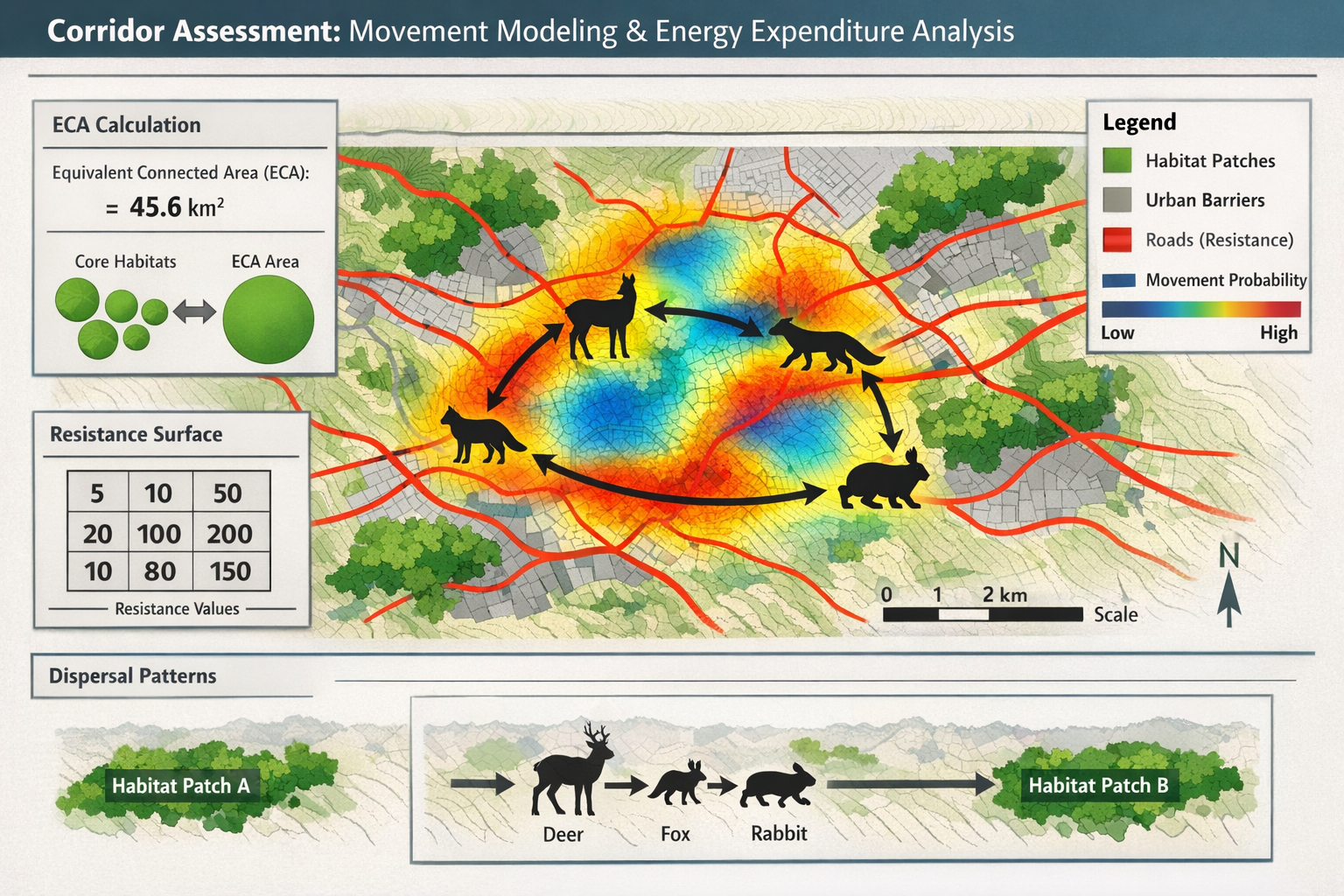
🚧 Resistance surfaces – Human-modified features like roads and urban areas that create barriers requiring significantly more energy expenditure for animal movement[4]
Research from 2026 demonstrates that environmental variables reliably predict genetic connectivity across fragmented landscapes, with precipitation and temperature serving as particularly strong indicators for plant species[2]. This predictive capacity enables ecologists to identify optimal corridor placement before expensive habitat restoration begins.
The Network Theory Revolution in Genetic Monitoring
Traditional population genetics assumed simplified spatial models that don't capture real-world connectivity patterns. A groundbreaking framework published in February 2026 integrates network theory with mathematical population genetics to study fragmentation effects more accurately[1]. This network-based approach treats habitat patches as nodes and movement corridors as edges, creating mathematical models that predict genetic consequences of landscape changes.
The framework identifies detectable early warning signals in genetic monitoring data that precede rapid transitional phases in population genetics[3]. These signals function like canaries in coal mines, alerting conservation managers to connectivity problems before populations crash. For BNG projects, this means corridor assessments can incorporate predictive monitoring rather than waiting years to discover whether interventions succeeded.
Key advantages of network-based genetic monitoring include:
- Detection of fragmentation effects before population declines become visible
- Quantification of corridor effectiveness using standardized genetic metrics
- Identification of critical habitat patches that disproportionately maintain landscape connectivity
- Prediction of how proposed developments will alter existing gene flow patterns
Survey Protocols for BNG Corridor Assessments
Phase 1: Baseline Genetic Characterization
Effective corridor assessments begin with comprehensive baseline genetic surveys of target species populations. This foundational work establishes current connectivity levels against which BNG improvements can be measured.
DNA Marker Selection
Modern landscape genetics studies employ two primary marker types[6]:
| Marker Type | Best Applications | Advantages | Limitations |
|---|---|---|---|
| mtDNA | Maternal lineage tracking, historical connectivity | Cost-effective, well-established protocols | Lower resolution, maternal inheritance only |
| SNPs | Fine-scale population structure, recent gene flow | High resolution, genome-wide coverage | Higher cost, requires reference genomes |
For most BNG corridor assessments, Single Nucleotide Polymorphism (SNP) markers provide superior resolution for detecting contemporary gene flow patterns. However, budget constraints may necessitate mtDNA approaches for initial surveys, with targeted SNP analysis for critical populations.
Sampling Design Considerations
Proper sampling design determines whether genetic data accurately reflects landscape connectivity:
- Sample 20-30 individuals per habitat patch to capture population-level genetic diversity
- Include patches on both sides of proposed corridors to establish baseline connectivity metrics
- Collect samples across multiple seasons for species with temporal movement patterns
- Document precise GPS coordinates for spatial analysis integration
- Preserve tissue samples properly (typically 95% ethanol or silica gel) to maintain DNA quality
Phase 2: Connectivity Modeling and Resistance Surface Development
While genetic data reveals current connectivity, predictive modeling forecasts how proposed corridors will alter gene flow patterns. This phase integrates spatial analysis with species biology to create resistance surfaces that quantify landscape permeability.
Energy Expenditure Models
The Equivalent Connected Area (ECA) approach measures connectivity by calculating the energy animals require to move between habitat patches[4]. Roads, urban development, and unsuitable habitat types create high-resistance barriers that effectively reduce landscape connectivity even when physical gaps remain small.
Resistance values typically range from 1 (optimal habitat requiring minimal energy) to 1000+ (nearly impassable barriers). For example:
- Mature woodland for forest specialists: Resistance = 1
- Hedgerows and scrub: Resistance = 5-10
- Agricultural grassland: Resistance = 50-100
- Minor roads: Resistance = 200-500
- Major roads and urban areas: Resistance = 1000+
These values require calibration for specific species through movement ecology studies or expert consultation. The BNG assessment process should document resistance value justifications with reference to published literature or empirical movement data.
Hybrid Zone Analysis for Plant Corridors
Recent research reveals that plant hybrids create functional connectivity corridors across fragmented landscapes, maintaining genetic diversity and potentially expanding species distributions[2]. For BNG projects involving botanical corridors, identifying potential hybrid zones using environmental predictors (precipitation, temperature, elevation) enables strategic corridor placement that leverages natural hybridization processes.
Phase 3: Integrated Genetic Connectivity Assessment
This critical phase combines baseline genetic data with connectivity models to evaluate whether proposed corridors will maintain viable populations.
Isolation-by-Distance Analysis
Classical population genetics predicts that genetic differentiation increases with geographic distance—a pattern called isolation-by-distance (IBD). However, fragmentation causes deviations from expected IBD patterns[1]. Comparing observed genetic distances against geographic distances reveals whether landscape features disrupt gene flow.
"Fragmentation causes deviations from expected isolation-by-distance patterns and predictions between genetic diversity and connectivity, requiring updated theoretical interpretations for real landscapes." – Network-based genetic monitoring research[1]
Gene Flow Estimation
Modern population genetics software calculates effective migration rates between habitat patches using genetic data. For BNG corridors, target thresholds typically aim for:
- Minimum 1-2 effective migrants per generation to prevent inbreeding depression
- 5-10 effective migrants per generation for long-term adaptive potential
- Higher rates for species with naturally high dispersal capabilities
Phase 4: Early Warning Signal Detection
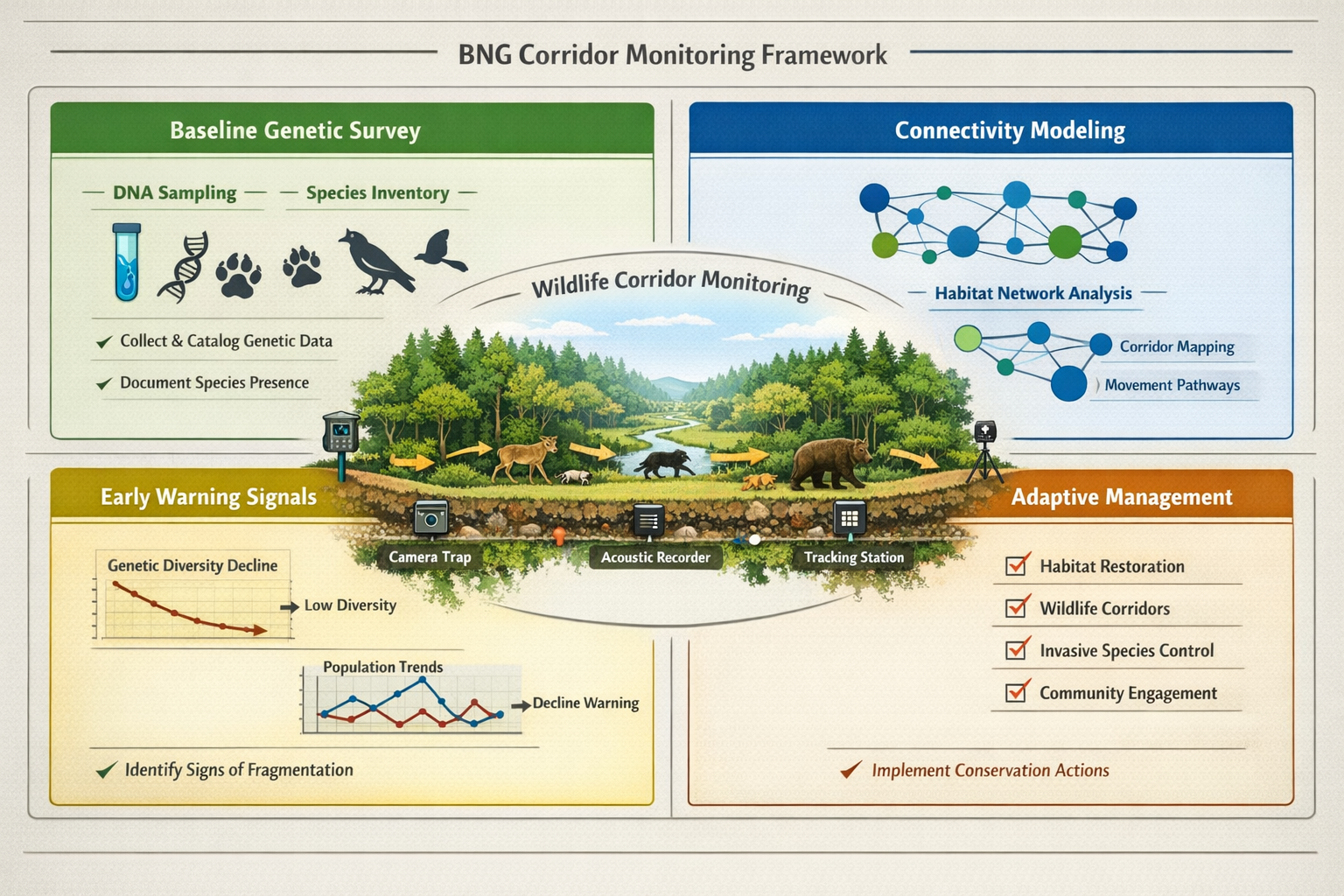
The 2026 network-based monitoring framework provides practical tools for detecting genetic warning signals before population crashes occur[3]. These signals include:
📊 Declining heterozygosity – Reduction in genetic variation within populations indicating restricted gene flow
📉 Increasing genetic differentiation – Growing genetic distances between patches suggesting corridor failure
⚠️ Allelic richness loss – Disappearance of rare genetic variants that provide adaptive potential
Establishing monitoring protocols during initial corridor design enables adaptive management responses when early warning signals appear. Creating comprehensive biodiversity plans should incorporate genetic monitoring schedules aligned with species generation times.
Implementing Genetic Connectivity Protocols in BNG Projects
Practical Considerations for Developers and Ecologists
Integrating genetic connectivity assessments into BNG workflows requires balancing scientific rigor with project timelines and budgets. The following framework provides practical guidance for implementation.
When Genetic Surveys Are Essential
Not all BNG projects require comprehensive genetic assessments. Prioritize genetic connectivity protocols when:
✅ Projects impact designated wildlife corridors or strategic connectivity networks
✅ Developments fragment large continuous habitat blocks into isolated patches
✅ Target species have limited dispersal capabilities or specific corridor requirements
✅ Off-site BNG delivery involves habitat creation distant from source populations
✅ Long-term monitoring commitments extend beyond typical BNG timeframes
For small development projects with minimal landscape-scale impacts, simplified connectivity assessments using existing genetic data or surrogate species modeling may suffice.
Cost-Benefit Analysis
Genetic connectivity assessments represent additional upfront investment but reduce long-term risks of BNG failure. Typical costs include:
- Field sampling and DNA extraction: £50-150 per sample
- SNP genotyping: £100-300 per sample depending on marker density
- Bioinformatics analysis: £2,000-5,000 per species
- Connectivity modeling: £3,000-8,000 depending on landscape complexity
These costs should be weighed against potential expenses of failed corridor implementations, which may require purchasing additional biodiversity units or statutory credits if monitoring reveals inadequate connectivity.
Collaboration with Specialized Consultants
Genetic connectivity assessments require specialized expertise beyond traditional ecological survey skills. Successful BNG projects typically involve collaboration between:
🔬 Molecular ecologists – Design sampling protocols, conduct laboratory analyses, interpret genetic data
🗺️ Landscape ecologists – Develop resistance surfaces, conduct spatial modeling, integrate GIS data
🦋 Species specialists – Provide natural history expertise, validate movement assumptions, identify critical habitats
📊 Population geneticists – Analyze genetic structure, calculate gene flow metrics, detect warning signals
Professional biodiversity surveyors increasingly partner with university research groups or specialized genetics laboratories to deliver comprehensive corridor assessments that meet BNG requirements.
Integration with Statutory BNG Requirements
Genetic connectivity protocols complement rather than replace standard BNG assessment procedures. The UK's statutory BNG framework requires 10% biodiversity gain measured using the biodiversity metric, which primarily assesses habitat quality and extent.
Genetic connectivity assessments enhance BNG delivery by:
- Validating corridor functionality beyond simple habitat creation
- Identifying optimal corridor placement using species-specific movement data
- Establishing monitoring frameworks that detect problems early
- Supporting adaptive management through evidence-based intervention triggers
- Demonstrating genuine ecological improvement beyond metric compliance
Documentation of genetic connectivity assessments strengthens planning applications by demonstrating thorough consideration of long-term biodiversity outcomes.
Case Study Applications and Emerging Best Practices
Multi-Species Corridor Design
Research demonstrates that different species exhibit vastly different connectivity patterns across identical landscapes[6]. Effective BNG corridors must therefore accommodate multiple species with varying dispersal capabilities and habitat requirements.
Umbrella Species Approach
Selecting focal species with demanding connectivity requirements ensures corridors benefit broader ecological communities. Ideal umbrella species for genetic connectivity assessments possess:
- Moderate dispersal capabilities (neither extremely mobile nor sedentary)
- Conservation concern or protected status
- Feasible sampling and genetic analysis
- Ecological relationships with other priority species
For woodland corridors, species like dormice or woodland butterflies often serve as effective umbrellas. For grassland systems, small mammals or invertebrates with limited flight capacity provide useful indicators.
Adaptive Management Triggers
The early warning signal framework enables proactive corridor management rather than reactive crisis response. Establishing clear intervention triggers ensures timely action when genetic monitoring reveals problems.
Example trigger framework:
| Warning Signal | Monitoring Frequency | Intervention Threshold | Management Response |
|---|---|---|---|
| Heterozygosity decline | Every 5 years | >10% reduction | Assess corridor barriers, enhance habitat quality |
| Genetic differentiation increase | Every 5 years | FST increase >0.05 | Investigate movement barriers, consider translocation |
| Effective migrants | Every 5 years | <1 per generation | Corridor redesign, habitat expansion |
| Allelic richness | Every 10 years | Loss of rare alleles | Genetic rescue consideration |
These thresholds require calibration for specific species and landscape contexts, but provide starting points for developing monitoring protocols.
Leveraging Environmental Predictors
The discovery that environmental variables reliably predict genetic connectivity[2] enables cost-effective preliminary corridor assessments before expensive genetic sampling begins. Ecologists can use publicly available climate and topographic data to:
- Identify landscape sections with high connectivity probability
- Prioritize sampling locations for genetic verification
- Predict how climate change may alter future connectivity patterns
- Design corridors that align with environmental gradients facilitating natural gene flow
This approach proves particularly valuable for land banking and habitat banking schemes where corridor placement decisions occur years before development impacts materialize.
Future Directions and Technological Advances
Emerging Technologies in Genetic Monitoring
Rapid technological advancement continues expanding genetic connectivity assessment capabilities while reducing costs:
Environmental DNA (eDNA) – Non-invasive sampling from water, soil, or air samples that detect species presence without capturing individuals. While currently limited for population genetics, advancing eDNA methods may enable genetic connectivity assessment from environmental samples.
Genomic selection panels – Targeted SNP sets optimized for specific conservation questions, reducing sequencing costs while maintaining analytical power for connectivity assessment.
Machine learning integration – Artificial intelligence algorithms that identify complex connectivity patterns in genetic and landscape data, potentially revealing non-obvious corridor design principles.
Real-time genetic monitoring – Portable sequencing devices enabling field-based genetic analysis, accelerating data collection and reducing laboratory bottlenecks.
Policy Development and Standardization
As genetic connectivity assessments become more common in BNG practice, standardized protocols and guidance documents will emerge. Expected developments include:
- Species-specific survey guidelines detailing appropriate genetic markers and sampling intensities
- Standardized resistance value libraries for common landscape features and species groups
- Genetic monitoring reporting templates ensuring consistent documentation across projects
- Quality assurance frameworks for laboratory procedures and bioinformatics analyses
Ecologists implementing genetic connectivity protocols in 2026 contribute to this emerging best practice foundation, with early adopters shaping future standards.
Conclusion
Genetic Connectivity in Fragmented Landscapes: Survey Protocols for BNG Corridor Assessments represent the next evolution in biodiversity conservation, moving beyond simple habitat creation toward evidence-based corridor design that genuinely enhances population viability. The integration of network-based genetic monitoring, movement modeling, and early warning signal detection provides practitioners with powerful tools for ensuring BNG investments deliver lasting ecological benefits.
For developers, ecologists, and planners navigating England's BNG requirements in 2026, genetic connectivity assessments offer multiple advantages: reduced risk of corridor failure, stronger planning applications, and demonstrated commitment to genuine biodiversity improvement. While these protocols require additional expertise and investment, the alternative—creating corridors that fail to maintain viable populations—ultimately proves far more costly.
Actionable Next Steps
🎯 For developers: Engage with professional biodiversity surveyors early in project planning to determine whether genetic connectivity assessments would strengthen your BNG strategy.
🎯 For ecologists: Build relationships with molecular ecology laboratories and landscape modeling specialists to expand service offerings in this emerging field.
🎯 For landowners: Consider how genetic connectivity enhancement might increase the value of biodiversity units for sale by demonstrating corridor functionality.
🎯 For all stakeholders: Stay informed about emerging best practices and technological advances that continue improving genetic connectivity assessment capabilities.
The fragmented landscapes of 2026 demand sophisticated conservation approaches that recognize connectivity as more than lines on maps. By embracing genetic connectivity protocols, the BNG framework can deliver its full potential—creating functional ecological networks that sustain wildlife populations for generations to come.
References
[1] Network-based genetic monitoring of landscape fragmentation – https://pubmed.ncbi.nlm.nih.gov/41706903/
[2] Fragmented Landscapes – https://www.unr.edu/nevada-today/news/2026/fragmented-landscapes
[3] Pnas – https://www.pnas.org/doi/10.1073/pnas.2515033123
[4] Looking At The Connectivity Of Natural Landscapes – https://natcapresearch.com/insights/blog/looking-at-the-connectivity-of-natural-landscapes
[5] Magazine – https://www.frontiersin.org/research-topics/8992/fragmentation-and-connectivity-in-forest-landscapes/magazine
[6] Ece3 – https://onlinelibrary.wiley.com/doi/10.1002/ece3.71084