

The future of biodiversity conservation is being written in the world's most remote corners—places where cellular towers don't reach, power grids don't exist, and traditional monitoring technology simply cannot function. Yet these are precisely the ecosystems that need protection most urgently. In 2026, a revolutionary technology called TinyML (Tiny Machine Learning) promises to democratize biodiversity monitoring by bringing artificial intelligence to off-grid field sites. However, the digital divide threatens to leave behind the very communities and regions that stand at the frontlines of conservation. Understanding Equitable TinyML Access in Global Biodiversity Surveys: Overcoming Infrastructure Barriers for 2026 Fieldwork is essential for ensuring that technological advances benefit everyone, not just well-resourced institutions.
Key Takeaways
- 🌍 TinyML technology has been identified as a major emerging issue for biodiversity conservation in the 2026 Global Horizon Scan, offering unprecedented opportunities for remote monitoring
- ⚡ Low-power edge computing enables AI-powered species identification and environmental monitoring in locations without internet connectivity or electrical infrastructure
- 🤝 Equity challenges remain central concerns, as ensuring TinyML works for communities with limited digital infrastructure will determine how fairly its benefits are distributed
- 📊 Real-world applications demonstrate 90%+ accuracy in wildlife detection and environmental monitoring using affordable, solar-powered devices
- 🔧 Strategic deployment approaches including open-source platforms, local capacity building, and offline-first architectures can overcome infrastructure barriers for inclusive fieldwork
What is TinyML and Why Does It Matter for Biodiversity Surveys?
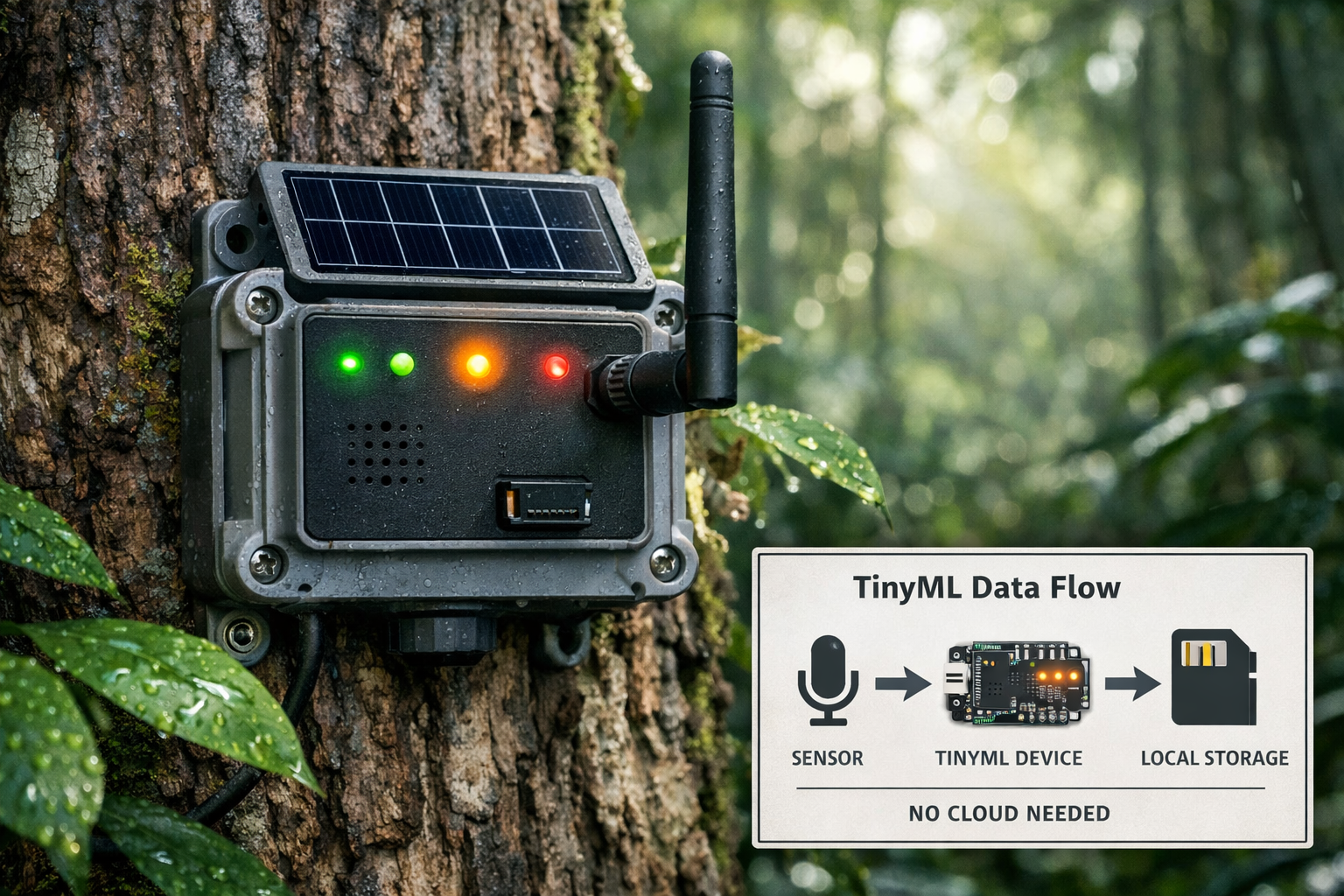
TinyML represents a fundamental shift in how artificial intelligence can be deployed for conservation purposes. Unlike traditional machine learning that requires powerful computers and constant internet connectivity, TinyML runs sophisticated AI models on microcontrollers smaller than a coin and consuming less power than a hearing aid battery.
The Technology Behind TinyML
TinyML devices combine three critical components:
- Microcontrollers with processing capabilities measured in milliwatts
- Machine learning models optimized to run on minimal memory (often under 250KB)
- Sensors for audio, visual, or environmental data collection
These components work together to perform real-time analysis directly on the device—a process called edge computing. Instead of sending raw data to distant servers for processing, the device makes intelligent decisions locally and only transmits results when necessary.
Revolutionary Applications in Field Surveys
The practical implications for biodiversity work are transformative. In Malaysia, researchers successfully deployed TinyML devices that identify hornbill calls with high accuracy, enabling continuous monitoring of endangered species without the need for constant data transmission to centralized servers [1]. This approach dramatically reduces both data volume and energy costs while providing real-time conservation insights.
"TinyML operates effectively in off-grid conditions where network access and electrical infrastructure are absent, making it suitable for remote ecological landscapes." [1]
Similar applications include:
- 🦜 Automated species identification through acoustic monitoring
- 📸 Camera trap analysis that filters thousands of images on-device
- 🌡️ Environmental parameter tracking for temperature, humidity, and soil conditions
- 🚨 Real-time threat detection identifying chainsaw sounds or unauthorized vehicle movement
The 17th annual horizon scan of conservation issues for 2026 highlighted these technology innovations, including low-power optical AI chips and TinyML models, as potentially revolutionary for biodiversity monitoring [5]. This recognition by leading conservation scientists underscores the technology's significance for the field.
Understanding Infrastructure Barriers in Global Biodiversity Fieldwork
While TinyML offers remarkable capabilities, significant obstacles prevent its equitable deployment across the world's most biodiverse regions. These barriers disproportionately affect communities and conservation projects in the Global South, where biodiversity is often richest but infrastructure is most limited.
The Digital Divide in Conservation Technology
The 2026 Global Horizon Scan explicitly identified equity and accessibility as central unresolved questions, noting that ensuring TinyML technologies "work for a wide range of users — including communities with limited digital infrastructure — will be central to how equitably their benefits are shared" [2]. This concern encompasses multiple dimensions:
Connectivity Challenges:
- Limited or absent cellular network coverage in remote field sites
- Lack of reliable internet for downloading model updates or accessing training resources
- High costs for satellite communication alternatives
Power Infrastructure Gaps:
- Absence of electrical grids in many critical biodiversity hotspots
- Limited access to reliable solar equipment or maintenance support
- Battery disposal and replacement logistics in remote locations
Technical Capacity Constraints:
- Shortage of trained personnel who can deploy and maintain TinyML systems
- Language barriers in technical documentation and training materials
- Limited access to educational resources for local communities
Economic Barriers:
- High upfront costs for devices and deployment equipment
- Lack of funding specifically allocated for technology infrastructure
- Currency exchange challenges affecting purchasing power
Regional Disparities in Technology Access
Different regions face distinct infrastructure challenges that affect TinyML deployment:
| Region | Primary Barriers | Specific Challenges |
|---|---|---|
| Sub-Saharan Africa | Power access, technical training | Limited solar infrastructure, few local TinyML experts |
| Southeast Asia | Connectivity, device costs | Remote island ecosystems, import tariffs on technology |
| Latin America | Funding, maintenance support | Long supply chains, limited repair facilities |
| Pacific Islands | Shipping logistics, isolation | High transport costs, small-scale deployments economically challenging |
These disparities mean that without intentional intervention, TinyML adoption will follow existing patterns of technological inequality, concentrating benefits in well-resourced institutions while bypassing community-led conservation efforts.
Equitable TinyML Access in Global Biodiversity Surveys: Strategies for 2026 Fieldwork Success
Overcoming infrastructure barriers requires comprehensive strategies that address technical, social, and economic dimensions simultaneously. The following approaches have demonstrated effectiveness in pilot projects and offer scalable pathways for equitable deployment.
Open-Source Hardware and Software Solutions
Open-source platforms reduce costs and enable local adaptation:
- Arduino-based TinyML kits available for under $50 per unit
- Edge Impulse and TensorFlow Lite providing free model training tools
- Community-developed models shared through conservation networks
- Modular designs allowing repair with locally available components
These platforms enable conservation organizations to build capacity without vendor lock-in or proprietary restrictions. Local technicians can modify designs to suit specific field conditions and species monitoring needs.
Solar-Powered and Energy-Efficient Deployment
Addressing power challenges through innovative energy solutions:
✅ Integrated solar panels providing 5+ years of autonomous operation
✅ Ultra-low-power sleep modes consuming microwatts between detection events
✅ Energy harvesting from temperature differentials or mechanical vibration
✅ Standardized battery systems using widely available rechargeable cells
Precision irrigation studies using TinyML demonstrated highly accurate predictions of resource requirements in off-grid agricultural settings [1], proving that sustainable operation without grid connectivity is achievable across multiple environmental applications.
Capacity Building and Local Training Programs
Human infrastructure is as critical as technical infrastructure:
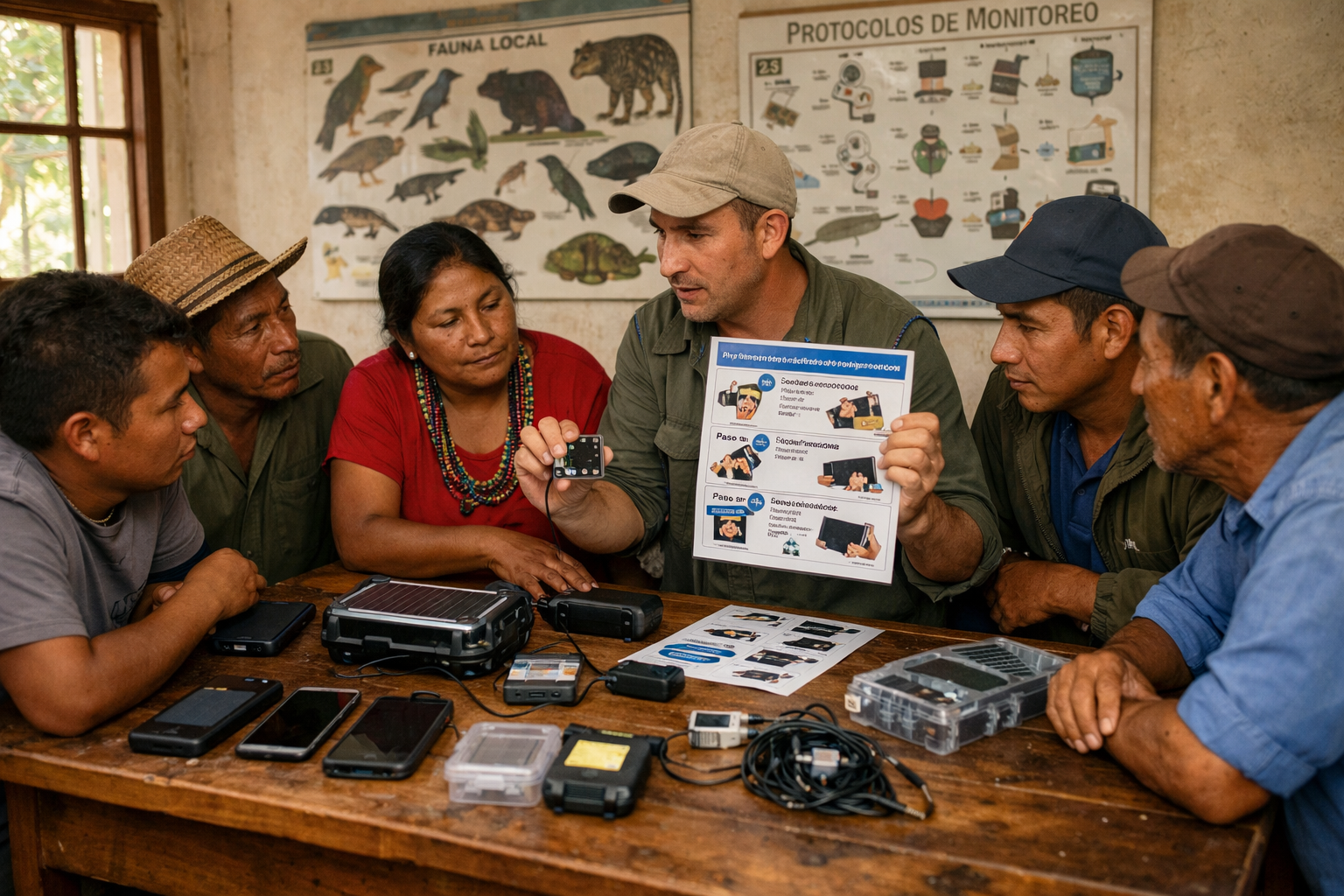
- Train-the-trainer programs creating regional expertise hubs
- Visual field guides reducing language barriers in device setup
- Remote mentorship networks connecting experienced practitioners with newcomers
- Certification pathways recognizing local technical expertise
- Community ownership models ensuring long-term sustainability
These programs transform TinyML from an external technology imposed on communities into a tool that local stakeholders control and customize for their conservation priorities.
Offline-First Data Architecture
Designing systems that function without constant connectivity:
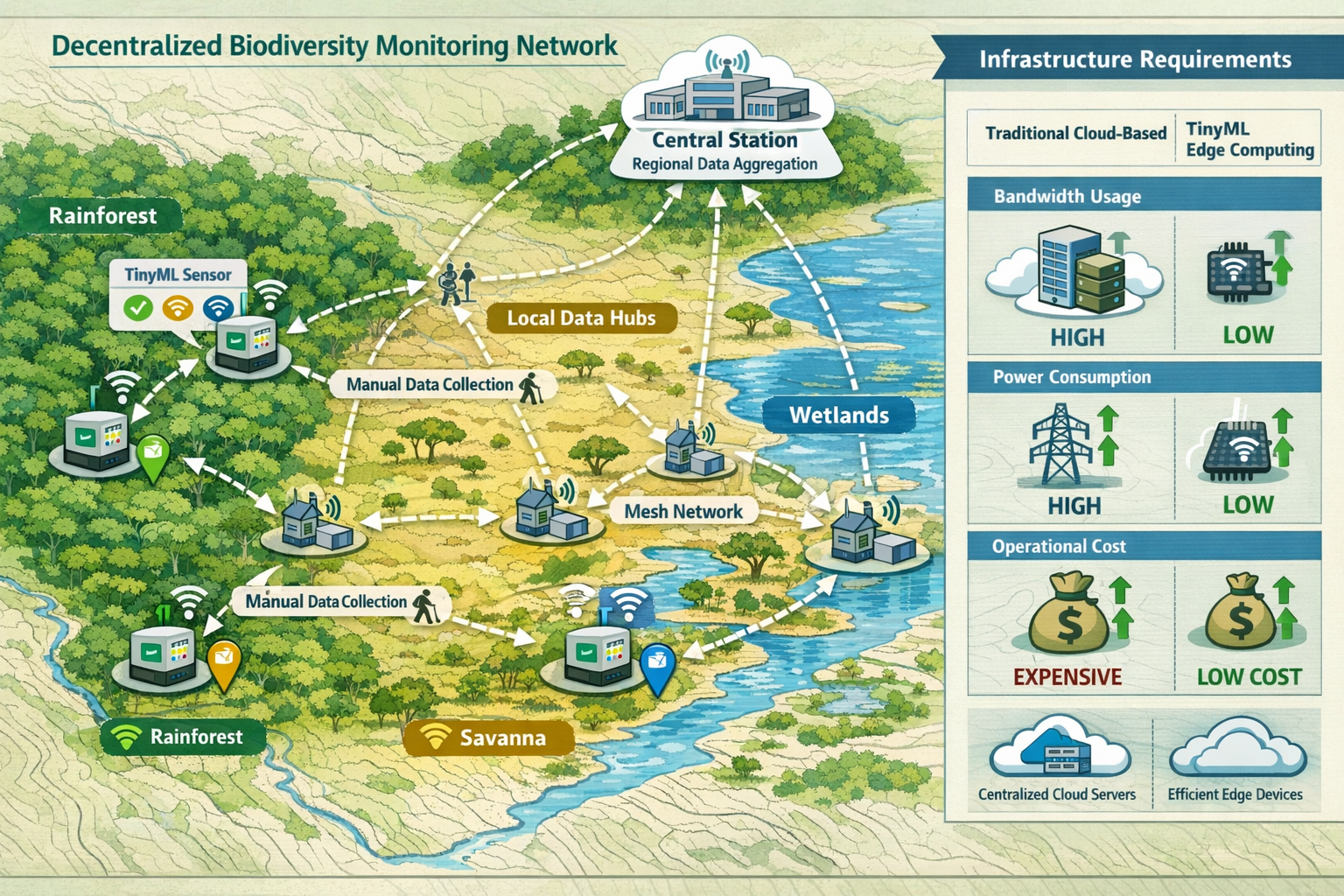
- Local data storage with periodic manual collection
- Mesh networking between nearby devices for data aggregation
- Opportunistic synchronization when connectivity becomes available
- Edge analytics providing immediate insights without cloud processing
This approach recognizes that TinyML operates effectively in off-grid conditions [1] and designs entire monitoring systems around this capability rather than treating connectivity as a requirement.
Collaborative Funding and Resource Sharing
Financial mechanisms that distribute costs equitably:
💰 Equipment lending libraries operated by regional conservation networks
💰 Bulk purchasing cooperatives reducing per-unit costs
💰 Technology transfer partnerships between well-resourced and under-resourced institutions
💰 Grant programs specifically targeting infrastructure development in high-biodiversity, low-infrastructure regions
These approaches acknowledge that individual projects or communities may lack resources for full deployment while collective action can overcome financial barriers.
Culturally Appropriate Implementation
Ensuring technology serves local values and priorities:
- Indigenous knowledge integration in species identification models
- Data sovereignty frameworks giving communities control over collected information
- Benefit-sharing agreements ensuring conservation outcomes serve local interests
- Participatory design processes involving end-users in system development
The effectiveness of biodiversity monitoring ultimately depends on community engagement and support. Technology that respects local autonomy and incorporates traditional ecological knowledge achieves better conservation outcomes than externally imposed solutions.
Real-World Success Stories: TinyML Overcoming Infrastructure Barriers
Practical examples demonstrate how strategic approaches enable equitable TinyML deployment despite infrastructure limitations.
Malaysian Hornbill Conservation
Researchers deployed acoustic monitoring devices in remote Malaysian forests where cellular coverage and electrical infrastructure were absent. The TinyML-powered sensors successfully identified hornbill calls with high accuracy [1], providing continuous data on endangered species movements without requiring data scientists in the field or constant connectivity to cloud servers.
Key success factors:
- Solar-powered autonomous operation for 6+ months
- On-device species identification reducing data transmission needs
- Local community members trained in device maintenance
- Open-source model allowing adaptation to regional hornbill dialects
Forest Protection Through Sound Detection
Conservation projects implemented real-time detection of unauthorized activities using TinyML-enabled sound sensors that recognize chainsaw noise or unauthorized vehicle movement [1]. By triggering alerts only when specific patterns occur, these systems reduce false positives and battery drain while operating entirely off-grid.
Infrastructure solutions employed:
- Ultra-low-power wake-on-sound architecture
- Local mesh networks for alert propagation
- Solar charging with multi-week battery backup
- Simple SMS alerts requiring only basic cellular coverage
Agricultural Water Management
While not strictly biodiversity monitoring, precision irrigation studies using TinyML demonstrated principles directly applicable to conservation fieldwork. These systems achieved highly accurate predictions of water requirements in off-grid settings [1], proving that sophisticated AI analysis can function reliably without cloud connectivity or electrical infrastructure.
Transferable lessons:
- Edge computing reduces infrastructure dependencies
- Local processing enables real-time decision-making
- Solar power provides sustainable long-term operation
- Simple user interfaces enable operation by non-technical users
These examples illustrate that Equitable TinyML Access in Global Biodiversity Surveys: Overcoming Infrastructure Barriers for 2026 Fieldwork is not merely aspirational—it is achievable with appropriate strategies and commitment to inclusive deployment.
Policy and Institutional Support for Equitable Technology Access
Individual projects cannot overcome systemic infrastructure barriers alone. Institutional and policy-level interventions are essential for achieving equitable TinyML access across global biodiversity surveys.
International Conservation Frameworks
Major conservation initiatives should explicitly address technology equity:
- Convention on Biological Diversity technology transfer mechanisms
- Global Biodiversity Framework monitoring protocols incorporating TinyML
- International funding specifically allocated for infrastructure development
- South-South cooperation programs facilitating knowledge exchange
Organizations working on biodiversity net gain initiatives can integrate TinyML deployment into their monitoring and verification protocols, creating demand for equitable technology access.
National Policy Interventions
Governments can reduce barriers through targeted policies:
- Tax exemptions for conservation technology imports
- Spectrum allocation for conservation monitoring networks
- Technical education programs incorporating TinyML training
- Research funding prioritizing low-infrastructure solutions
- Data sovereignty protections ensuring community control
Institutional Commitments
Universities, NGOs, and research institutions should adopt equity principles:
- Open data policies making training datasets freely available
- Hardware donation programs redistributing functional equipment
- Collaborative research models ensuring equitable authorship and credit
- Capacity building investments in partner institutions
Professional organizations conducting biodiversity impact assessments can advocate for TinyML integration in standard methodologies while ensuring equitable access to necessary tools.
Integrating TinyML into Existing Biodiversity Monitoring Frameworks
For maximum impact, TinyML deployment should complement rather than replace existing monitoring approaches. Integration with established frameworks ensures continuity and leverages existing expertise.
Compatibility with Biodiversity Net Gain Requirements
Developers and planners implementing biodiversity net gain strategies can utilize TinyML for:
- Baseline surveys establishing pre-development biodiversity values
- Long-term monitoring verifying habitat creation success
- Automated reporting reducing manual survey costs
- Continuous verification for biodiversity units sold or purchased
Enhancing Traditional Survey Methods
TinyML augments rather than replaces field ecologists:
| Traditional Method | TinyML Enhancement | Combined Benefit |
|---|---|---|
| Periodic site visits | Continuous automated monitoring | Detect rare events between surveys |
| Manual species counts | Automated detection and counting | Increase sample size and frequency |
| Expert identification | AI-assisted preliminary sorting | Focus expert time on difficult cases |
| Point sampling | Distributed sensor networks | Capture spatial variation comprehensively |
This complementary approach ensures that biodiversity assessments remain scientifically robust while gaining efficiency through technology.
Data Standards and Interoperability
Equitable access requires standardized data formats enabling:
- Cross-platform compatibility between different TinyML systems
- Integration with existing databases and monitoring protocols
- Quality assurance frameworks ensuring data reliability
- Metadata standards documenting collection methods and limitations
Organizations developing biodiversity plans should specify data standards that accommodate both traditional and TinyML-generated information.
Addressing Concerns and Limitations
While TinyML offers significant opportunities, realistic assessment of limitations ensures appropriate deployment and manages expectations.
Technical Limitations
Model accuracy constraints:
- TinyML models typically achieve 85-95% accuracy compared to 95-99% for cloud-based systems
- Performance degrades with species not included in training data
- Environmental conditions (rain, wind) can affect sensor performance
Hardware constraints:
- Limited battery life in extreme temperatures
- Vulnerability to physical damage from wildlife or weather
- Sensor degradation over time requiring replacement
Data Quality Considerations
TinyML-generated data requires validation:
- False positive rates necessitate expert verification of unusual detections
- Sampling bias from fixed sensor locations
- Temporal gaps during maintenance or battery failures
- Species misidentification particularly for rare or similar species
Professional biodiversity surveyors should establish protocols for integrating TinyML data with traditional survey methods to ensure overall data quality.
Ethical and Social Considerations
Deployment must address potential concerns:
⚠️ Surveillance implications of audio and visual monitoring
⚠️ Data ownership and access rights
⚠️ Employment impacts on traditional field survey roles
⚠️ Dependency risks on external technology providers
Transparent governance frameworks and community consultation processes help navigate these challenges while maximizing benefits.
Future Directions: Equitable TinyML Access in Global Biodiversity Surveys Beyond 2026
The trajectory of TinyML technology and its application to biodiversity conservation will continue evolving rapidly. Anticipating future developments helps stakeholders prepare for emerging opportunities and challenges.
Technological Advances on the Horizon
Expected improvements in coming years:
- Smaller, more powerful processors enabling more sophisticated models
- Improved energy harvesting extending autonomous operation periods
- Multi-modal sensors combining audio, visual, and environmental data
- Federated learning allowing models to improve while preserving data privacy
Scaling Equitable Deployment
Moving from pilot projects to global implementation requires:
- Manufacturing partnerships producing devices at conservation-appropriate price points
- Regional distribution networks reducing shipping costs and delays
- Standardized training curricula enabling rapid capacity building
- Quality assurance systems ensuring device reliability across manufacturers
Integration with Global Monitoring Systems
TinyML will increasingly connect to broader conservation infrastructure:
- Essential Biodiversity Variables standardized reporting
- Protected area management systems for real-time threat detection
- Global biodiversity databases aggregating distributed monitoring data
- Early warning systems for ecosystem changes
Organizations involved in biodiversity credits and biodiversity unit trading may increasingly rely on TinyML-generated verification data, creating market incentives for equitable technology deployment.
Conclusion
Equitable TinyML Access in Global Biodiversity Surveys: Overcoming Infrastructure Barriers for 2026 Fieldwork represents both a technical challenge and a moral imperative. The technology's identification as a major emerging issue in the 2026 Global Horizon Scan [2] reflects its transformative potential for conservation. However, realizing this potential equitably requires deliberate strategies addressing the digital divide that threatens to exclude communities and regions with limited infrastructure.
The path forward combines technical innovation with social commitment:
Technical Solutions:
- Open-source hardware and software reducing costs
- Solar-powered systems enabling off-grid operation
- Offline-first architectures eliminating connectivity requirements
- Edge computing bringing AI capabilities to remote locations
Social and Institutional Solutions:
- Capacity building programs creating local expertise
- Collaborative funding mechanisms distributing costs
- Policy interventions reducing import and deployment barriers
- Culturally appropriate implementation respecting local values
Practical Integration:
- Complementing traditional survey methods rather than replacing them
- Supporting biodiversity net gain requirements with continuous monitoring
- Establishing data standards ensuring interoperability
- Developing validation protocols maintaining scientific rigor
Actionable Next Steps
For conservation practitioners, policymakers, and technology developers committed to equitable biodiversity monitoring:
- Assess current infrastructure in your target regions and identify specific barriers
- Pilot TinyML deployments using open-source platforms and local partnerships
- Invest in capacity building prioritizing train-the-trainer models
- Advocate for policy support including funding and regulatory frameworks
- Share knowledge openly contributing to collective learning and improvement
- Establish governance frameworks ensuring community data sovereignty
- Monitor equity outcomes tracking who benefits from technology deployment
The promise of TinyML for biodiversity conservation is immense—continuous, automated monitoring of the world's most threatened ecosystems using affordable, sustainable technology. Whether this promise is realized equitably or perpetuates existing inequalities depends on choices made today. By prioritizing infrastructure development, capacity building, and inclusive deployment strategies, the conservation community can ensure that TinyML's benefits reach those working at the frontlines of biodiversity protection, regardless of their access to traditional digital infrastructure.
The decade ahead will determine whether emerging conservation technologies bridge or widen the gap between well-resourced and under-resourced conservation efforts. With intentional commitment to equity, TinyML can become a tool for democratizing biodiversity monitoring, empowering local communities, and generating the comprehensive data needed to address the global biodiversity crisis effectively.
For organizations seeking to implement cutting-edge monitoring approaches while ensuring equitable access, contact biodiversity professionals who understand both technical requirements and social dimensions of conservation technology deployment.
References
[1] Tiny Machine Learning Tinyml In The Wild Offline Environmental Ai – https://www.ignitec.com/insights/tiny-machine-learning-tinyml-in-the-wild-offline-environmental-ai/
[2] Whats Next For Biodiversity Conservation Insights From The 2026 Horizon Scan – https://www.unep-wcmc.org/en/news/whats-next-for-biodiversity-conservation-insights-from-the-2026-horizon-scan
[5] A Horizon Scan Of Biological Conservation Issues For 2026 – https://www.bas.ac.uk/data/our-data/publication/a-horizon-scan-of-biological-conservation-issues-for-2026/