

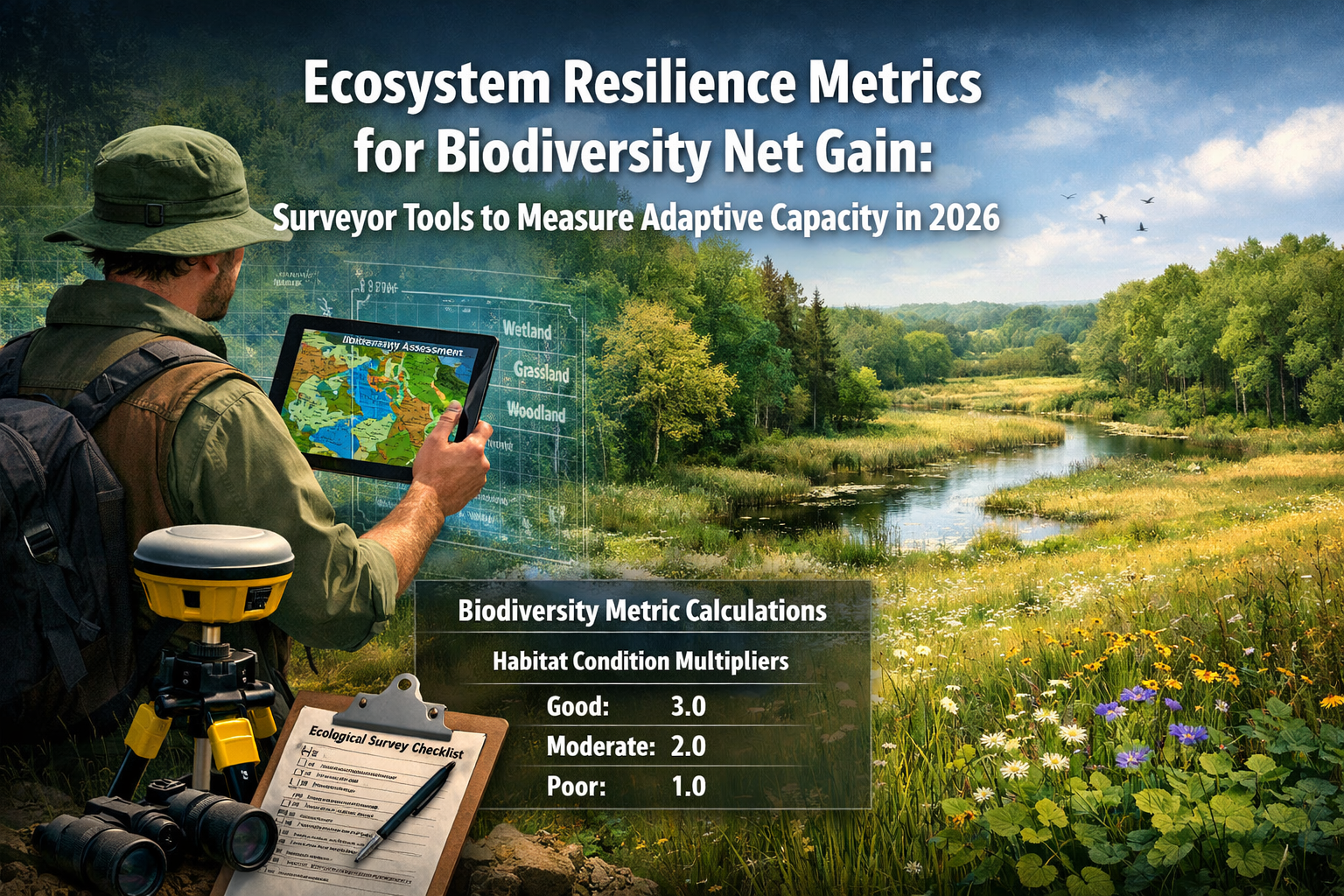
Recent research from the Smithsonian Institution reveals that ecosystem resilience fundamentally depends on land-sea interactions, a finding that transforms how ecologists approach Biodiversity Net Gain (BNG) assessments. As development projects across the UK navigate increasingly complex environmental requirements, surveyors now integrate functional diversity indices to score site adaptability—moving beyond simple species counts to measure how ecosystems actually respond to stress. This shift represents a fundamental evolution in how professionals evaluate and document ecological resilience within BNG frameworks.
Understanding Ecosystem Resilience Metrics for Biodiversity Net Gain: Surveyor Tools to Measure Adaptive Capacity in 2026 requires familiarity with both established methodologies and emerging assessment techniques. The current landscape combines DEFRA Metric 4.1 calculations with sophisticated resilience indicators that evaluate nutrient cycles, structural diversity, and connectivity patterns. For surveyors, planners, and developers, these tools provide the evidence base needed to demonstrate genuine, long-term ecological improvement.
Key Takeaways
- DEFRA Metric 4.1 remains the authoritative standard for calculating biodiversity units in 2026, incorporating four key factors: habitat size, condition, distinctiveness, and connectivity [7]
- Functional diversity indices now complement traditional species counts, allowing surveyors to measure adaptive capacity through ecosystem response to stressors like nutrient disruption and climate variability
- 30-year monitoring requirements mandate long-term verification of resilience gains, with evidence-heavy documentation standards that mirror supply-chain traceability [1]
- Connectivity assessments have become central to resilience evaluation, recognizing that fragmentation limits species movement and reduces ecosystem adaptation potential [2]
- Field checklists for stressor assessment provide practical frameworks for evaluating nutrient cycles, structural diversity, and physical extent during site surveys
Understanding Ecosystem Resilience Within BNG Frameworks
Ecosystem resilience refers to the capacity of natural systems to absorb disturbances, reorganize, and maintain essential functions despite environmental pressures. Within Biodiversity Net Gain contexts, measuring resilience extends far beyond counting species or calculating habitat area. It requires assessing whether created or enhanced habitats can withstand climate fluctuations, disease pressures, invasive species, and human-induced stressors over the mandatory 30-year monitoring period [1].
The Four Pillars of BNG Measurement
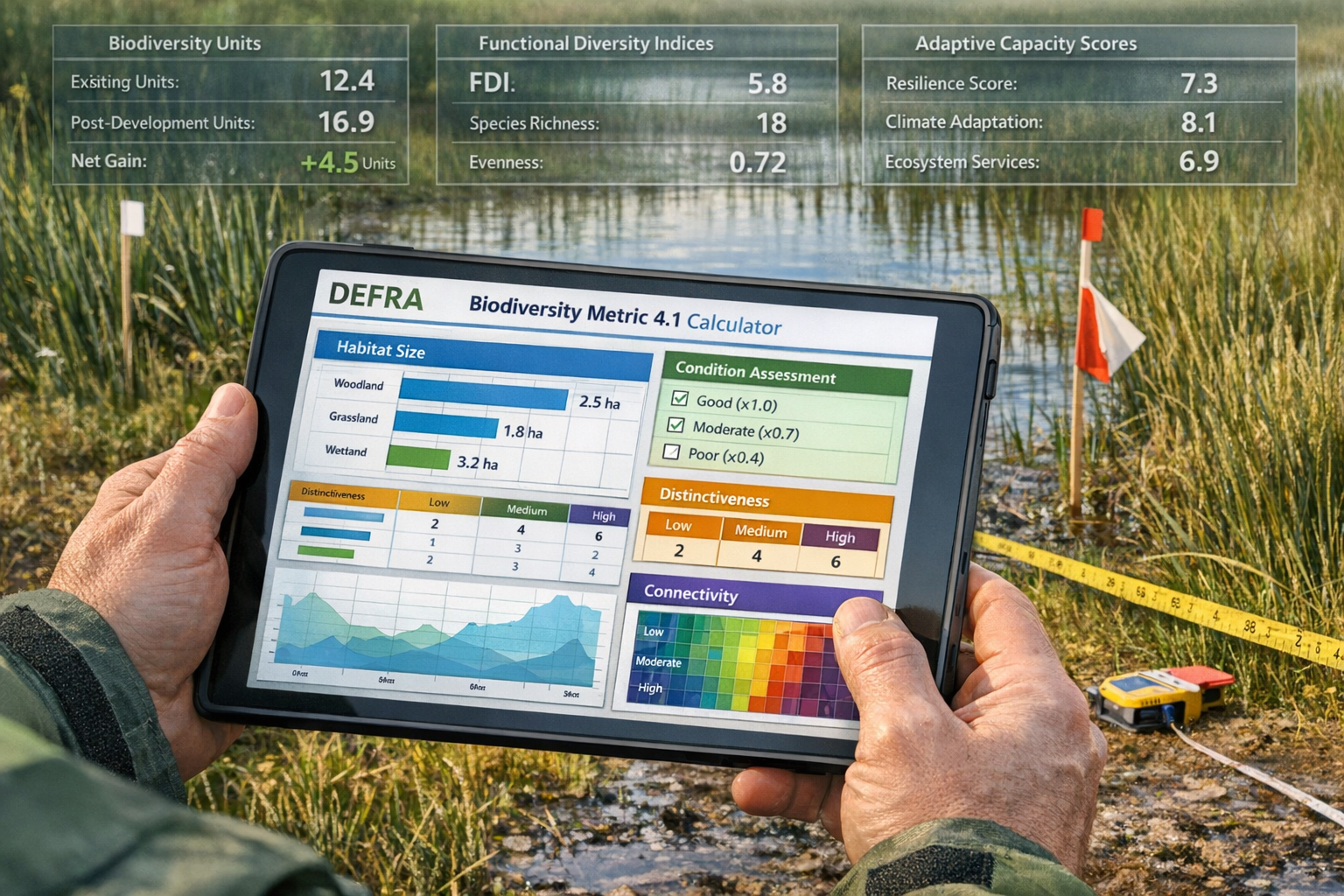
The DEFRA Metric 4.1 quantifies biodiversity using four interconnected factors that collectively determine unit values [3]:
- Habitat Size – The physical area measured in hectares or linear kilometers
- Habitat Condition – Assessed through standardized criteria reflecting ecological functionality
- Habitat Distinctiveness – Rarity and irreplaceability scores based on habitat type
- Strategic Significance – Location value including connectivity to existing habitats
Each factor receives multipliers that reflect local ecological contexts, with habitat condition assessments now incorporating resilience indicators such as structural diversity, age-class distribution, and native species composition [7].
Why Resilience Metrics Matter for Long-Term Success
Traditional biodiversity assessments capture ecological value at a single point in time. Resilience metrics, however, predict whether those values will persist under future conditions. Consider two hypothetical wetland creation schemes that both achieve identical biodiversity unit scores:
- Site A: Monoculture reed bed with uniform age structure, isolated from other wetlands
- Site B: Diverse wetland mosaic with varied vegetation zones, connected to river corridor
While both sites might initially score similarly under basic habitat metrics, Site B demonstrates superior resilience through structural diversity and connectivity. When drought conditions arrive, Site B's varied water depth zones provide refugia for species, while its corridor connections allow population replenishment from upstream habitats. These adaptive capacities don't always appear in standard unit calculations but prove critical for achieving Biodiversity Net Gain without risk.
Integrating Land-Sea Interactions
The Smithsonian research on land-sea interaction resilience holds particular relevance for coastal and estuarine BNG projects. Ecosystems at terrestrial-aquatic interfaces exhibit unique resilience characteristics driven by:
- Nutrient flux patterns between marine and terrestrial systems
- Salinity gradients that create specialized habitat niches
- Tidal dynamics influencing vegetation zonation and species distribution
- Sediment transport affecting habitat stability and succession pathways
Surveyors assessing coastal habitats must evaluate these interaction zones as integrated systems rather than separate terrestrial and aquatic units. Field checklists should document tidal range impacts, saltwater intrusion patterns, and sediment deposition rates—factors that determine whether coastal habitats can adapt to sea-level rise and storm intensification.
Surveyor Tools to Measure Adaptive Capacity in 2026
Professional ecologists now deploy a sophisticated toolkit combining traditional field survey methods with digital assessment platforms and analytical frameworks. Understanding Ecosystem Resilience Metrics for Biodiversity Net Gain: Surveyor Tools to Measure Adaptive Capacity in 2026 requires familiarity with both hardware instruments and conceptual assessment frameworks.
Field Assessment Instruments and Technologies
Modern BNG surveys integrate multiple data collection tools:
📱 Digital Survey Platforms
- Tablet-based applications with offline functionality for remote sites
- GPS-enabled habitat mapping with sub-meter accuracy
- Integrated photo-point documentation with metadata tagging
- Real-time biodiversity unit calculations using DEFRA Metric 4.1 algorithms
🔬 Environmental Monitoring Equipment
- Soil testing kits for nutrient cycle assessment (nitrogen, phosphorus, pH)
- Moisture meters for hydrological condition evaluation
- Canopy densometers for structural diversity measurement
- Drone systems for aerial habitat extent and fragmentation analysis
📊 Connectivity Assessment Tools
- GIS software for landscape-scale corridor identification
- Habitat network modeling platforms
- Species dispersal distance databases
- Fragmentation index calculators
These instruments provide the quantitative data foundation for resilience assessment, but their effective use requires understanding what indicators actually predict adaptive capacity.
Functional Diversity Indices: Beyond Species Counts
Traditional biodiversity metrics often emphasize species richness—the total number of species present. While valuable, species counts don't necessarily indicate resilience. A site might host numerous species yet lack functional redundancy if all species occupy similar ecological niches.
Functional diversity indices measure the range of ecological roles (functions) that species perform within an ecosystem. Key functional traits relevant to resilience include:
| Functional Trait Category | Resilience Relevance | Survey Assessment Method |
|---|---|---|
| Growth form diversity | Multiple structural layers provide habitat heterogeneity | Vegetation stratification surveys |
| Reproductive strategy range | Mix of seed banking, vegetative spread ensures regeneration | Life history trait documentation |
| Nutrient acquisition methods | Diverse nitrogen fixers, mycorrhizal associations buffer nutrient stress | Root system and soil microbiome sampling |
| Disturbance tolerance spectrum | Range from pioneers to climax species enables succession | Species trait database matching |
| Dispersal mechanism variety | Multiple dispersal vectors maintain connectivity | Seed dispersal observation and trait analysis |
Surveyors can calculate functional diversity using established indices such as:
- Functional Richness (FRic): Volume of trait space occupied by species assemblage
- Functional Evenness (FEve): Distribution of abundance across trait space
- Functional Divergence (FDiv): Degree of niche differentiation among species
These calculations require trait databases and specialized software, but provide quantitative resilience scores that complement traditional biodiversity unit calculations. For practical implementation, many surveyors use simplified functional group approaches, categorizing species into ecological guilds (e.g., nitrogen-fixers, deep-rooted perennials, early successional colonizers) and ensuring adequate representation across groups.
Stressor Assessment Checklists
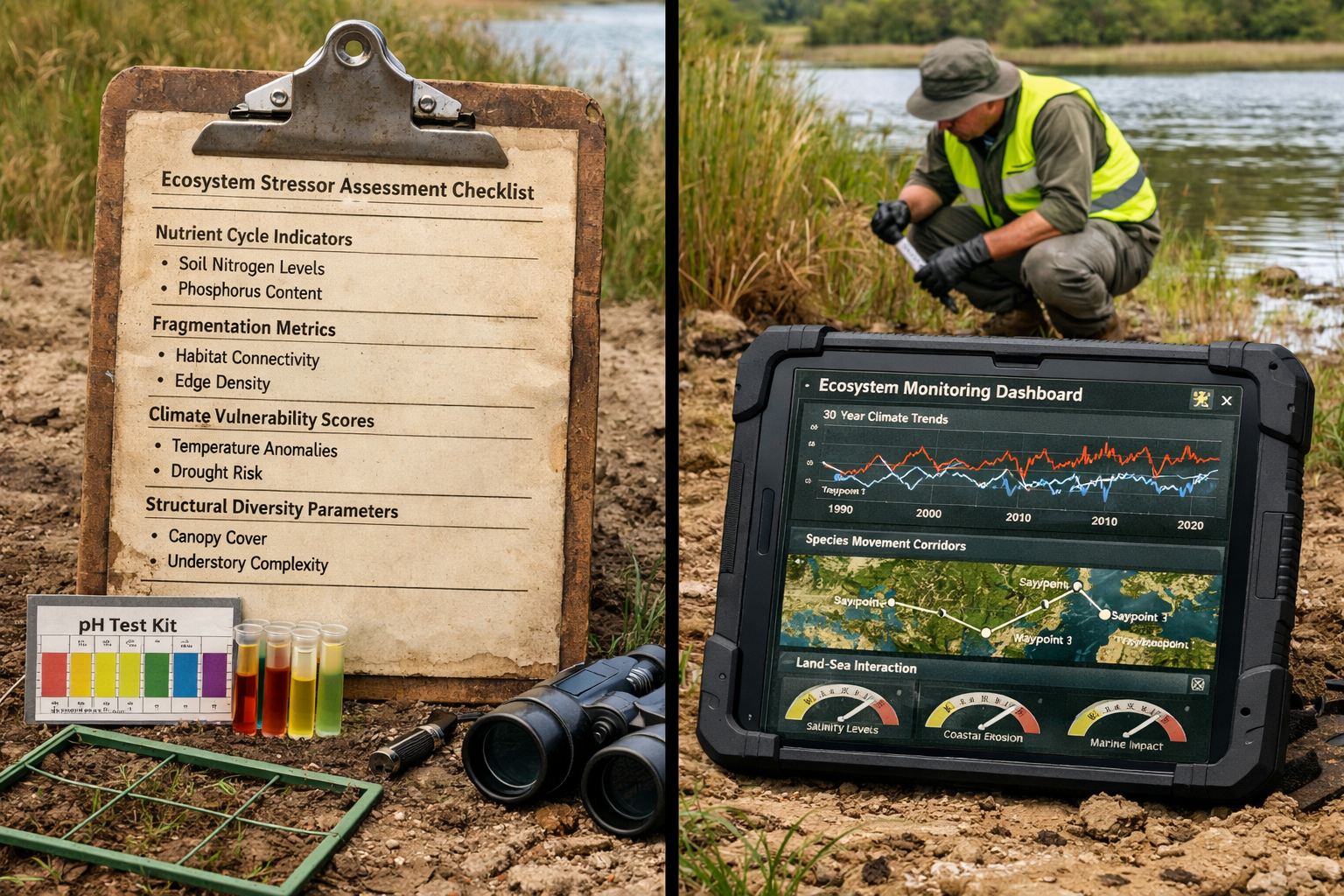
Adaptive capacity fundamentally represents an ecosystem's ability to withstand specific stressors. Comprehensive resilience assessment requires systematic evaluation of vulnerability to predictable pressures. Field checklists should address:
🌡️ Climate Stress Indicators
- Temperature extremes tolerance (species heat/cold sensitivity)
- Drought resilience features (water storage capacity, deep-rooted species)
- Flood adaptation characteristics (water-tolerant vegetation, sediment stability)
- Phenological flexibility (species with variable flowering/breeding timing)
💧 Nutrient Cycle Integrity
- Soil organic matter content and stability
- Nitrogen fixation capacity (legume presence, soil bacteria)
- Phosphorus availability and cycling rates
- Decomposition functionality (invertebrate diversity, fungal networks)
🔗 Connectivity and Fragmentation
- Distance to nearest similar habitat patches
- Corridor quality and continuity
- Barrier identification (roads, development, unsuitable habitat)
- Stepping-stone habitat availability
🏗️ Structural Complexity
- Vegetation layer diversity (ground, shrub, canopy)
- Age-class distribution (avoiding uniform-age monocultures)
- Microhabitat features (deadwood, rock piles, water bodies)
- Edge-to-interior ratios and ecotone development
For Biodiversity Net Gain assessments, these checklists translate into condition assessment criteria that influence habitat quality multipliers. Sites demonstrating strong performance across stressor categories receive higher condition scores, which directly increase biodiversity unit calculations.
Connectivity Mapping Protocols
The integration of connectivity assessments as a core BNG factor represents one of the most significant methodological advances in recent years [2]. Ecosystems without fragmentation facilitate species movement, genetic exchange, and spatial adaptation—particularly critical as climate change forces species range shifts.
Surveyors measure connectivity through:
-
Structural Connectivity: Physical habitat continuity
- Measure gaps between habitat patches
- Identify barrier types and permeability
- Map corridor dimensions and quality
-
Functional Connectivity: Species-specific movement potential
- Calculate dispersal distances for target species groups
- Model movement resistance across landscape matrix
- Identify critical linkage zones for priority species
-
Strategic Location Assessment: Position within broader habitat networks
- Proximity to designated nature conservation sites
- Alignment with Local Nature Recovery Strategies
- Contribution to regional ecological networks
Digital tools such as Circuitscape, Linkage Mapper, and FRAGSTATS enable quantitative connectivity analysis at landscape scales. For individual site assessments, simplified approaches include measuring distances to nearest similar habitats and evaluating corridor quality using standardized criteria.
Many developers now recognize that on-site versus off-site delivery decisions should consider connectivity implications. Off-site habitat creation in strategically connected locations may deliver greater resilience benefits than isolated on-site patches, even if both achieve equivalent biodiversity unit scores.
Implementing Resilience Metrics in BNG Projects
Translating theoretical resilience concepts into practical survey protocols requires systematic integration with existing BNG workflows. Understanding Ecosystem Resilience Metrics for Biodiversity Net Gain: Surveyor Tools to Measure Adaptive Capacity in 2026 means knowing how to embed resilience assessment into standard project timelines and deliverables.
Baseline Assessment Integration
Resilience evaluation begins during baseline ecological surveys. Traditional baseline work documents existing habitat types, species assemblages, and biodiversity unit values. Enhanced baseline assessments now incorporate:
Phase 1: Initial Site Visit
- Standard habitat mapping using UKHab classification
- Photographic documentation of structural features
- Preliminary connectivity desktop assessment using GIS
- Initial stressor vulnerability screening
Phase 2: Detailed Survey
- Species inventories with functional trait documentation
- Habitat condition assessment including resilience indicators
- Soil sampling for nutrient cycle analysis
- Detailed connectivity field verification
Phase 3: Resilience Scoring
- Functional diversity index calculation
- Stressor vulnerability matrix completion
- Connectivity value quantification
- Adaptive capacity rating assignment
This phased approach ensures resilience metrics complement rather than complicate standard biodiversity impact assessment procedures. The additional data collection typically adds 15-20% to survey time but provides substantial value for demonstrating long-term viability.
Design Phase Application
Resilience metrics prove most valuable during habitat creation design, where they inform decisions that determine long-term success. Architects and planners can use resilience frameworks to:
Optimize Habitat Configuration
- Design habitat mosaics that maximize functional diversity
- Position created habitats to enhance connectivity
- Incorporate microhabitat features that buffer climate stress
- Plan age-class diversity through phased planting schedules
Select Resilient Species Assemblages
- Choose species mixes with complementary functional traits
- Include climate-adapted genotypes and provenances
- Ensure reproductive strategy diversity
- Incorporate stress-tolerant foundation species
Build Adaptive Management Capacity
- Design flexible systems that accommodate succession
- Create redundancy in critical ecological functions
- Plan intervention triggers based on resilience indicators
- Establish monitoring protocols for early warning signals
For projects pursuing 10% Biodiversity Net Gain targets, resilience-informed design reduces the risk of habitat failure during the 30-year monitoring period. While initial biodiversity unit calculations might be similar between resilient and non-resilient designs, long-term outcomes diverge significantly.
Monitoring and Verification Protocols
The 30-year monitoring requirement mandates that BNG projects demonstrate sustained ecological gains [1]. Resilience metrics provide the framework for meaningful monitoring that detects problems early and guides adaptive management.
Year 1-5: Establishment Monitoring
- Vegetation establishment success rates
- Colonization by target functional groups
- Soil development indicators (organic matter accumulation)
- Initial connectivity usage (species movement evidence)
Year 6-15: Development Monitoring
- Structural diversity progression
- Functional diversity trajectory
- Stressor response observations (drought, flood, heat events)
- Habitat condition score trends
Year 16-30: Maturity Monitoring
- Ecosystem self-regulation capacity
- Resilience to disturbance events
- Maintenance of target condition scores
- Adaptive capacity under changing conditions
Modern verification standards emphasize evidence-heavy documentation with clear justification and habitat traceability [1]. This means monitoring reports must demonstrate not just that habitats persist, but that they maintain the functional characteristics and adaptive capacity that justified their biodiversity unit values.
Addressing the 600+ Metrics Challenge
A significant challenge facing the BNG sector is the proliferation of environmental metrics. Over 600 different sets of environmental metrics currently exist globally, with ongoing efforts to achieve consensus on credible, practical measurement approaches [4]. This fragmentation creates confusion for practitioners trying to select appropriate resilience indicators.
The solution lies in hierarchical metric frameworks that:
- Use DEFRA Metric 4.1 as the primary calculation tool for regulatory compliance [7]
- Supplement with targeted resilience indicators relevant to specific habitat types and site contexts
- Align with emerging standards such as Science-Based Targets for Nature
- Maintain consistency with Local Nature Recovery Strategies and regional priorities
Surveyors should resist the temptation to measure everything measurable. Instead, select 5-8 key resilience indicators that:
- ✅ Directly relate to identified site-specific stressors
- ✅ Can be measured reliably and repeatedly
- ✅ Provide early warning of declining adaptive capacity
- ✅ Inform actionable management interventions
- ✅ Align with client understanding and project objectives
This focused approach delivers meaningful resilience assessment without overwhelming projects with excessive data collection requirements.
Policy Context: May 2026 Infrastructure Rollout
The anticipated May 2026 rollout of BNG requirements for major infrastructure projects represents a significant expansion of the regulatory framework [1]. Large-scale linear infrastructure (roads, railways, pipelines) presents unique resilience challenges:
Infrastructure-Specific Resilience Considerations
- Habitat fragmentation effects from linear barriers
- Edge effects along extended corridor boundaries
- Hydrological disruption impacts
- Connectivity severance and mitigation requirements
Surveyors working on infrastructure projects must evaluate resilience at landscape scales, considering how projects affect regional habitat networks rather than just local biodiversity values. This requires:
- Multi-site connectivity modeling
- Cumulative impact assessment across project phases
- Strategic compensation site selection based on network value
- Long-term monitoring of barrier effects on species movement
The infrastructure rollout also emphasizes the importance of understanding BNG requirements for planners and developers early in project conception, when resilience-informed design can avoid costly late-stage modifications.
Practical Guidance for Surveyors and Developers
Implementing ecosystem resilience metrics requires practical workflows that integrate with existing project management structures. The following guidance helps professionals incorporate resilience assessment without disrupting established BNG processes.
Essential Surveyor Toolkit for 2026
Core Equipment 💼
- Tablet with BNG calculation software (DEFRA Metric 4.1 compliant)
- GPS unit with sub-meter accuracy
- Digital camera with geotagging capability
- Soil testing kit (pH, NPK, organic matter)
- Vegetation sampling equipment (quadrats, tape measures)
Resilience-Specific Additions 🔧
- Functional trait reference guides or database access
- Connectivity assessment templates
- Stressor vulnerability checklists
- Habitat condition scoring sheets with resilience criteria
- Species dispersal distance references
Digital Resources 💻
- GIS software for connectivity mapping
- Functional diversity calculation tools
- Habitat network modeling platforms
- Photo-point monitoring applications
- Data management systems with 30-year retention capacity
Step-by-Step Resilience Assessment Protocol
Step 1: Desktop Preparation
- Review Local Nature Recovery Strategy priorities
- Identify designated sites within 2km radius
- Map potential connectivity corridors using aerial imagery
- Research climate projections for project area
- Compile relevant species trait databases
Step 2: Field Survey
- Conduct standard habitat and species surveys
- Document structural diversity features
- Collect soil samples for nutrient analysis
- Photograph representative areas and key features
- Record connectivity barriers and potential corridors
- Complete stressor vulnerability checklist
Step 3: Laboratory and Office Analysis
- Process soil samples for nutrient parameters
- Calculate biodiversity units using DEFRA Metric 4.1
- Compute functional diversity indices
- Analyze connectivity using GIS tools
- Complete resilience scoring matrix
Step 4: Reporting and Recommendations
- Present standard BNG calculations
- Supplement with resilience assessment findings
- Identify enhancement opportunities for adaptive capacity
- Provide design recommendations based on stressor analysis
- Outline monitoring protocols for resilience indicators
This protocol typically requires 1-2 additional field days and 2-3 additional office days compared to standard BNG assessments, representing a reasonable investment for significantly improved outcome confidence.
Common Pitfalls and How to Avoid Them
❌ Pitfall 1: Overcomplicating Assessment
✅ Solution: Focus on 5-8 key indicators relevant to site-specific stressors rather than attempting comprehensive resilience evaluation across all possible metrics.
❌ Pitfall 2: Ignoring Temporal Dynamics
✅ Solution: Design monitoring protocols that capture ecosystem development trajectories, not just snapshot conditions. Resilience emerges over time.
❌ Pitfall 3: Treating Resilience as Separate from BNG
✅ Solution: Integrate resilience indicators into habitat condition assessments where they directly influence biodiversity unit calculations.
❌ Pitfall 4: Neglecting Connectivity at Design Stage
✅ Solution: Evaluate connectivity implications during site selection and layout planning, when design modifications are still feasible and cost-effective.
❌ Pitfall 5: Inadequate Baseline Documentation
✅ Solution: Invest in thorough baseline resilience assessment to establish clear improvement targets and monitoring benchmarks.
Cost-Benefit Considerations
Developers frequently question whether enhanced resilience assessment justifies additional costs. The business case rests on risk reduction:
Financial Risks of Poor Resilience 📉
- Habitat failure requiring expensive remediation
- Regulatory non-compliance penalties
- Delayed project completion due to ecological issues
- Reputational damage from visible habitat degradation
- Increased monitoring and management costs
Benefits of Resilience-Informed Approach 📈
- Reduced habitat failure probability
- Lower long-term management costs
- Enhanced regulatory confidence and approval speed
- Improved corporate environmental credentials
- Greater certainty of achieving biodiversity net gain targets
For most projects, resilience assessment adds 10-15% to ecological survey costs but can reduce long-term management costs by 30-40% through better-designed, more stable habitats. The return on investment becomes particularly compelling for large developments with substantial BNG obligations.
Working with Biodiversity Credit Markets
As biodiversity credit markets mature, resilience metrics increasingly influence credit pricing and marketability. Credits generated from resilient habitat creation command premium prices because they carry lower delivery risk.
For Credit Buyers (Developers):
- Evaluate credit provider's resilience assessment methodology
- Request evidence of connectivity planning
- Review monitoring protocols for resilience indicators
- Assess long-term management plans for adaptive capacity
- Compare costs of biodiversity units against delivery risk
For Credit Sellers (Landowners):
- Invest in resilience-informed habitat design to increase credit value
- Document functional diversity and connectivity benefits
- Implement monitoring that demonstrates adaptive capacity
- Consider land banking versus habitat banking strategies based on resilience potential
The credit market increasingly recognizes that not all biodiversity units carry equivalent long-term value. Units backed by rigorous resilience assessment provide greater certainty of 30-year persistence, justifying price differentiation.
Conclusion
Ecosystem resilience metrics represent the evolution of Biodiversity Net Gain from simple habitat accounting to sophisticated ecological outcome prediction. As the UK's BNG framework matures in 2026, surveyors equipped with functional diversity assessment tools, stressor evaluation checklists, and connectivity mapping protocols deliver superior value to clients while advancing genuine nature recovery.
The integration of Ecosystem Resilience Metrics for Biodiversity Net Gain: Surveyor Tools to Measure Adaptive Capacity in 2026 into standard practice requires modest additional investment in survey time and analytical capacity but yields substantial returns through reduced habitat failure risk and enhanced long-term ecological outcomes. The Smithsonian research on land-sea interactions reminds practitioners that resilience emerges from system-level properties—connectivity, functional redundancy, structural diversity—that transcend simple species inventories.
Actionable Next Steps
For Surveyors:
- Update field protocols to include resilience indicator checklists
- Acquire functional trait databases and diversity calculation tools
- Develop connectivity assessment capabilities using GIS platforms
- Integrate resilience scoring into habitat condition assessments
- Establish 30-year monitoring frameworks that track adaptive capacity
For Developers and Planners:
- Commission baseline assessments that include resilience evaluation
- Incorporate connectivity considerations into site layout design
- Specify resilience criteria in habitat creation specifications
- Select biodiversity credit providers based on resilience methodology
- Establish adaptive management protocols triggered by resilience indicators
For Landowners:
- Assess existing land holdings for strategic connectivity value
- Design habitat creation schemes with functional diversity targets
- Implement soil management practices that support nutrient cycling
- Consider selling biodiversity units from resilience-optimized sites
- Engage with Local Nature Recovery Strategies for alignment opportunities
The path forward requires collaboration between ecologists, developers, regulators, and landowners—all working within frameworks that recognize ecosystem resilience as fundamental to achieving meaningful, lasting biodiversity net gain. As major infrastructure projects come within BNG scope in May 2026, the sector's capacity to assess and deliver resilient ecological outcomes will determine whether the policy achieves its transformative potential for nature recovery.
For comprehensive support with biodiversity assessments incorporating resilience metrics, contact professional biodiversity surveyors who can guide projects through the evolving regulatory landscape while maximizing ecological outcomes.
References
[1] Biodiversity Net Gain Nature – https://www.intelligentliving.co/biodiversity-net-gain-nature/
[2] Biodiversity Enhancement Approaches – https://cieem.net/i-am/biodiversity-enhancement-approaches/
[3] The Ultimate Guide To Biodiversity Net Gain A 2025 Perspective – https://www.bng.ai/blog/the-ultimate-guide-to-biodiversity-net-gain-a-2025-perspective/
[4] Metrics – https://www.naturepositive.org/metrics/
[7] The State Of Biodiversity Net Gain In 2026 Key Policy Updates – https://biodiversity-netgain.co.uk/the-state-of-biodiversity-net-gain-in-2026-key-policy-updates/