

More than 40% of species present in typical ecological surveys go undetected during standard field assessments. This staggering reality means that conservation decisions, biodiversity baselines, and environmental impact assessments often rest on incomplete data. Cryptic Species and Occupancy Modeling: Advanced Statistical Methods for Detecting Hard-to-Find Biodiversity offers a powerful solution to this challenge by distinguishing true species absence from simple failure to detect.
For developers, ecologists, and conservation planners working within frameworks like Biodiversity Net Gain, understanding these advanced statistical approaches has become essential in 2026. Occupancy modeling provides the mathematical rigor needed to account for imperfect detection—the reality that even when species are present, observers may miss them due to behavior, weather, timing, or observer skill.
This comprehensive guide explores how cryptic species detection, combined with sophisticated occupancy-detection frameworks, transforms biodiversity assessment from guesswork into statistically robust science.
Key Takeaways
- Occupancy modeling explicitly accounts for imperfect detection, preventing systematic underestimation of species presence in biodiversity assessments
- Dynamic occupancy models track three distinct processes—initial occupancy, colonization, and extinction—providing complete population dynamics understanding beyond simple presence/absence data
- Passive acoustic monitoring combined with occupancy statistics enables scalable, cost-effective detection of cryptic species across landscape-level spatial scales
- Bayesian computational frameworks allow sophisticated statistical inference for hard-to-find species while quantifying uncertainty in conservation decisions
- Hierarchical sampling designs with repeat surveys separate detection probability from true occupancy, improving baseline accuracy for biodiversity impact assessments
Understanding the Detection Problem in Biodiversity Surveys
Why Traditional Surveys Miss Cryptic Species
Traditional biodiversity surveys operate on a flawed assumption: that failure to observe a species means it's absent. This assumption breaks down completely for cryptic species—organisms that are present but difficult to detect due to:
🦉 Nocturnal or crepuscular activity patterns
🌿 Camouflage and cryptic coloration
🔇 Infrequent vocalization or low detectability
📍 Restricted microhabitat use
⏰ Seasonal variation in activity
When developers conduct biodiversity assessments without accounting for detection probability, they systematically underestimate species richness. This creates two critical problems:
- Undervalued baseline biodiversity leading to insufficient mitigation measures
- Legal and regulatory risks when undetected protected species are later discovered
Occupancy modeling provides the statistical framework to address these challenges head-on[3].
The Occupancy-Detection Framework Explained
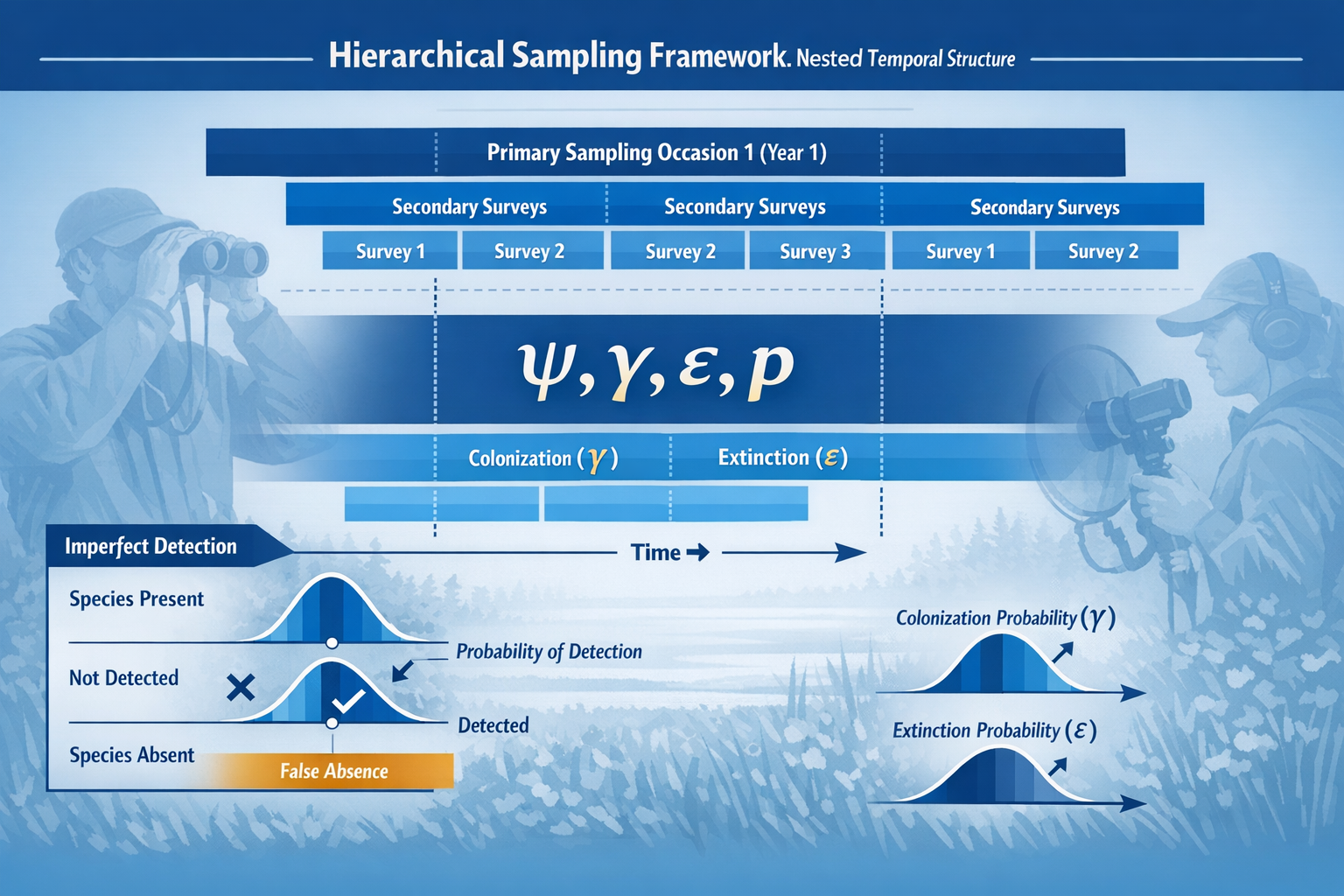
At its core, occupancy modeling separates two fundamental questions:
Question 1: Is the species truly present at this site? (Occupancy: ψ)
Question 2: Given the species is present, what's the probability we detect it? (Detection: p)
This separation requires a specific hierarchical sampling design with:
- Primary sampling occasions (seasons, years, or distinct time periods)
- Secondary sampling occasions (repeat surveys within each primary period)
By conducting multiple surveys at the same location within a timeframe where the population is assumed "closed" (no immigration or emigration), researchers can mathematically estimate both occupancy probability and detection probability[2].
"Occupancy modeling is now widely adopted as the rigorous standard for analyzing species surveys because it explicitly accounts for imperfect detection within sites, preventing underestimation of species presence."[3]
Cryptic Species and Occupancy Modeling: Advanced Statistical Methods in Practice
Passive Acoustic Monitoring as a Game-Changer
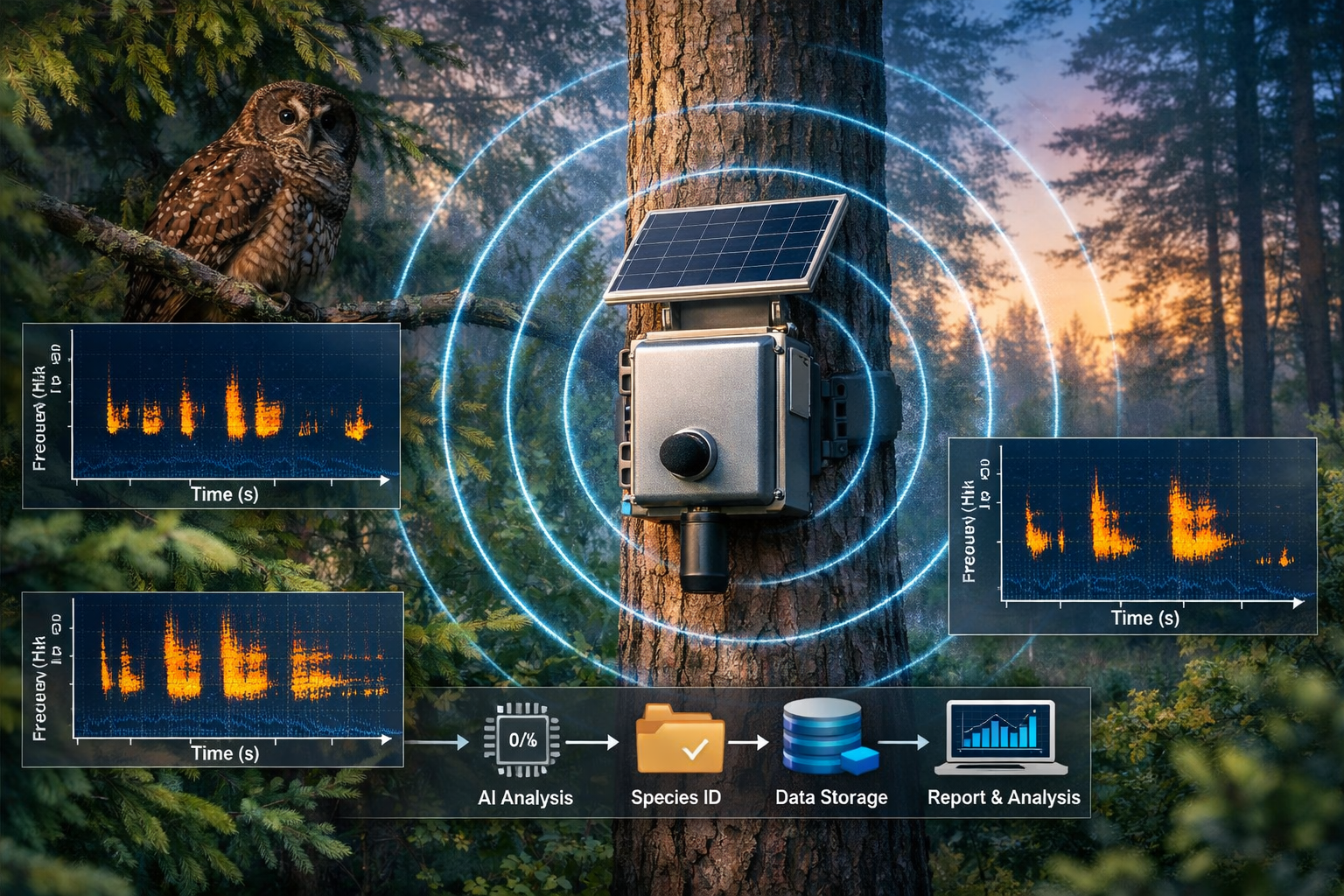
One of the most significant advances in Cryptic Species and Occupancy Modeling: Advanced Statistical Methods for Detecting Hard-to-Find Biodiversity involves integrating passive acoustic monitoring (PAM) with occupancy frameworks.
PAM technology enables:
✅ Continuous soundscape capture without human presence
✅ Detection of cryptic or elusive species through vocalizations
✅ Temporal data on species activity patterns throughout seasons
✅ Reduced field effort while increasing survey coverage
✅ Permanent acoustic records for verification and reanalysis
A landmark 4-year study of California spotted owls demonstrated that occupancy dynamics and annual population trends could be reliably estimated using only PAM data analyzed with dynamic occupancy models[2]. This validation represents a paradigm shift for conservation monitoring, particularly for nocturnal and cryptic species that are challenging to survey using traditional methods.
Automated Classification and Scalability
The integration of semiautomated species classification techniques with PAM surveys enables landscape-scale data collection that would be prohibitively expensive using traditional field methods[2].
Modern workflows combine:
- Acoustic recorders deployed across study areas
- Automated detection algorithms that flag potential species vocalizations
- Machine learning classifiers trained on verified recordings
- Human verification of uncertain detections
- Occupancy model analysis accounting for both detection errors and classification errors
This approach dramatically reduces the manual analysis burden while maintaining statistical rigor—essential for projects requiring biodiversity baseline assessments across large development sites.
Three-Component Dynamic Occupancy Models
Standard occupancy models estimate presence/absence at a single point in time. Dynamic occupancy models extend this framework to estimate three distinct ecological processes[2]:
| Process | Parameter | Ecological Meaning |
|---|---|---|
| Initial Occupancy | ψ₁ | Probability a site is occupied at the start of the study |
| Colonization | γ | Probability an unoccupied site becomes occupied between periods |
| Extinction | ε | Probability an occupied site becomes unoccupied between periods |
| Detection | p | Probability of detecting the species when present |
This framework provides mechanistic understanding of population dynamics rather than just snapshots of presence. For developers working on biodiversity net gain strategies, understanding colonization and extinction rates helps predict how species will respond to habitat creation or restoration efforts.
Advanced Statistical Implementation for Cryptic Species Detection
Bayesian Computational Approaches
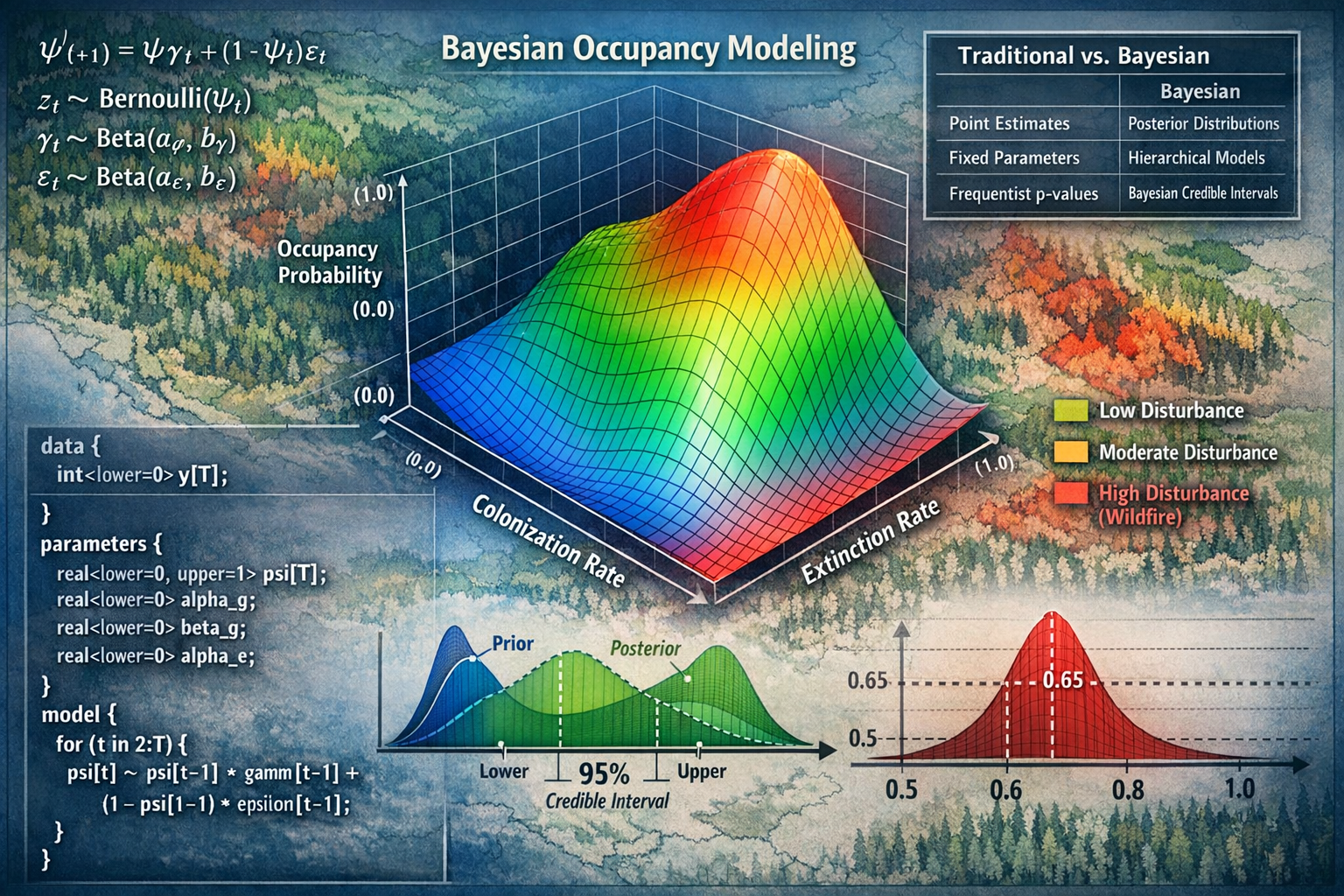
Recent implementations of Cryptic Species and Occupancy Modeling: Advanced Statistical Methods for Detecting Hard-to-Find Biodiversity increasingly use Bayesian frameworks for statistical inference[2].
The Bayesian approach offers several advantages:
🎯 Explicit uncertainty quantification through posterior distributions
🔗 Natural incorporation of prior knowledge from previous studies
📊 Flexible model structures accommodating complex ecological relationships
🔄 Hierarchical modeling of multiple species or sites simultaneously
💻 Modern computational tools like Stan probabilistic programming language
The ubms package in R provides an accessible interface to Stan for occupancy modeling, enabling ecologists to fit sophisticated models without deep programming expertise[2]. This democratization of advanced methods means that even smaller ecological consultancies can apply cutting-edge techniques to biodiversity assessments.
Multi-Scale Inference Capabilities
A powerful feature of modern occupancy frameworks is the ability to derive simultaneous estimates at multiple spatial scales[2]:
- Regional bioregion level for conservation planning
- Individual forest or reserve level for management decisions
- Site-specific level for development impact assessment
- Annual resolution for monitoring temporal trends
This multi-scale capability proves particularly valuable for Biodiversity Net Gain planning, where developers need to understand both site-specific impacts and contributions to landscape-level conservation goals.
Disturbance Response Quantification
Occupancy modeling excels at detecting ecological responses to disturbances. The California spotted owl study found that high-severity fire impacts were detectable across all three occupancy processes—initial occupancy, colonization, and extinction[2].
This capability enables:
- Quantitative assessment of development impacts on cryptic species
- Before-after-control-impact (BACI) designs with statistical rigor
- Adaptive management based on monitored occupancy changes
- Evidence-based mitigation targeting specific demographic processes
For projects requiring biodiversity credits, demonstrating measurable improvements in occupancy parameters provides concrete evidence of conservation success.
Practical Applications in Biodiversity Net Gain Assessments
Improving Baseline Accuracy
The most immediate application of Cryptic Species and Occupancy Modeling: Advanced Statistical Methods for Detecting Hard-to-Find Biodiversity is improving baseline assessments for development projects.
Traditional surveys might conclude a species is absent after 2-3 visits. Occupancy modeling with repeat surveys can:
- Estimate detection probability (often 0.3-0.7 for cryptic species)
- Calculate confidence intervals around occupancy estimates
- Determine optimal survey effort needed for desired confidence levels
- Identify covariates affecting detection (weather, time of day, observer experience)
This statistical rigor reduces the risk that protected species are overlooked, preventing costly delays when species are discovered during construction.
Spatially-Nested Hierarchical Distribution Models
Advanced implementations use spatially-nested hierarchical species distribution models to estimate both current and projected future distributions of cryptic species[1]. These models integrate:
- Occupancy data from field surveys
- Environmental covariates (habitat, climate, disturbance)
- Spatial autocorrelation structures
- Climate change projections for future scenarios
This approach helps developers and planners understand not just where species currently occur, but where suitable habitat will exist under future conditions—critical for long-term biodiversity strategies.
Validation Against Traditional Methods
Skeptics might question whether PAM and occupancy modeling can truly replace traditional field surveys. The California spotted owl research directly compared PAM-based occupancy estimates to traditional demographic field studies, with results supporting the reliability of PAM for informing conservation decisions[2].
This validation provides confidence that these advanced methods meet regulatory standards while offering significant advantages in:
- Cost-effectiveness through reduced field time
- Temporal coverage with continuous monitoring
- Spatial extent through scalable deployment
- Repeatability with permanent acoustic records
Implementing Occupancy Modeling in Your Biodiversity Projects
Design Requirements for Robust Analysis
To successfully apply Cryptic Species and Occupancy Modeling: Advanced Statistical Methods for Detecting Hard-to-Find Biodiversity, projects need:
Spatial Design:
- Minimum 20-30 survey sites for simple models
- 50+ sites for covariate modeling
- Stratified sampling across habitat types
- Consideration of spatial independence
Temporal Design:
- 3-5 repeat surveys within closure period
- Primary periods matching ecological dynamics
- Consistent survey protocols across visits
- Documentation of survey conditions
Data Requirements:
- Binary detection/non-detection data
- Site-level covariates (habitat characteristics)
- Survey-level covariates (weather, time, observer)
- Spatial coordinates for all sites
Software and Analytical Tools
Several software packages enable occupancy analysis:
| Platform | Package/Program | Best For |
|---|---|---|
| R | unmarked | Standard occupancy models |
| R | ubms | Bayesian occupancy models |
| R | camtrapR | Camera trap data processing |
| Python | pyoccupancy | Integration with ML pipelines |
| Standalone | PRESENCE | User-friendly interface for beginners |
For most biodiversity assessment projects, working with experienced ecological consultants who understand both the statistical methods and regulatory requirements provides the most efficient path to compliance.
Integration with BNG Metric Calculations
Occupancy modeling results enhance Biodiversity Net Gain assessments by:
- Providing defensible species inventories with quantified uncertainty
- Identifying high-value habitats based on occupancy probabilities
- Supporting condition assessments through detection of rare species
- Monitoring effectiveness of habitat creation or restoration
- Demonstrating additionality for off-site biodiversity units
The statistical rigor of occupancy approaches strengthens the evidence base for biodiversity unit calculations, reducing uncertainty and potential disputes.
Future Directions and Emerging Technologies
Multi-Species Occupancy Models
The next frontier involves simultaneously modeling multiple species to understand:
- Community-level patterns across species assemblages
- Species interactions affecting occupancy and detection
- Functional diversity beyond simple species counts
- Indicator species for habitat quality assessment
These community models provide richer ecological insights relevant to biodiversity planning.
Integration with eDNA Methods
Environmental DNA (eDNA) sampling combined with occupancy modeling offers another powerful approach for cryptic species detection. Water, soil, or air samples can detect species presence through genetic traces, with occupancy models accounting for:
- Sample contamination probability
- DNA degradation affecting detection
- Species-specific detection probabilities
- Spatial patterns in eDNA distribution
Machine Learning and AI Enhancement
Artificial intelligence is revolutionizing species classification from acoustic and camera trap data. Deep learning models can:
- Classify species from audio recordings with >95% accuracy
- Detect rare vocalizations in massive datasets
- Identify individual animals for capture-recapture studies
- Predict occupancy from remote sensing data
These technologies make Cryptic Species and Occupancy Modeling: Advanced Statistical Methods for Detecting Hard-to-Find Biodiversity increasingly accessible and cost-effective for routine application in development projects.
Conclusion
Cryptic Species and Occupancy Modeling: Advanced Statistical Methods for Detecting Hard-to-Find Biodiversity represents a fundamental shift from assumption-based surveys to statistically rigorous detection frameworks. By explicitly accounting for imperfect detection, these methods prevent the systematic underestimation of species presence that has plagued traditional biodiversity assessments.
For developers, planners, and conservation professionals working within Biodiversity Net Gain frameworks in 2026, occupancy modeling offers:
✅ Defensible baseline assessments with quantified uncertainty
✅ Cost-effective monitoring through PAM and automated classification
✅ Mechanistic understanding of population dynamics
✅ Multi-scale inference supporting adaptive management
✅ Regulatory confidence through validated methodologies
Actionable Next Steps
For Developers:
- Engage ecological consultants experienced in occupancy modeling early in project planning
- Consider PAM surveys for projects in areas with protected nocturnal or cryptic species
- Request occupancy-based analyses in biodiversity impact assessments
- Use occupancy estimates to optimize survey effort and reduce assessment timelines
For Ecologists:
- Invest in training on modern occupancy modeling software and Bayesian approaches
- Develop protocols integrating PAM with traditional survey methods
- Build reference libraries of verified species recordings for automated classification
- Collaborate with statisticians to implement cutting-edge analytical frameworks
For Planners:
- Recognize occupancy modeling as best practice for cryptic species assessment
- Update guidance documents to encourage detection-probability frameworks
- Accept occupancy-based evidence in Biodiversity Net Gain submissions
- Support monitoring programs using these methods for long-term adaptive management
The future of biodiversity conservation depends on knowing what species are truly present—not just what we happen to observe. Advanced statistical methods for detecting hard-to-find biodiversity provide the scientific foundation for making informed, defensible decisions that protect species while enabling sustainable development.
References
[1] 1365 2656 – https://besjournals.onlinelibrary.wiley.com/doi/abs/10.1111/1365-2656.70248
[2] Pmc12808558 – https://pmc.ncbi.nlm.nih.gov/articles/PMC12808558/
[3] 2026 Neapms Conference Program Ver 18 Final – https://www.neapms.org/s/2026-NEAPMS-Conference-Program-ver-18-FINAL.pdf
[4] 1362693 Acoustic Bird Community Composition But Not Richness Responds To Natural Coverages In A Tropical Agro Cultural Landscape – https://www.authorea.com/users/1002249/articles/1362693-acoustic-bird-community-composition-but-not-richness-responds-to-natural-coverages-in-a-tropical-agro-cultural-landscape