

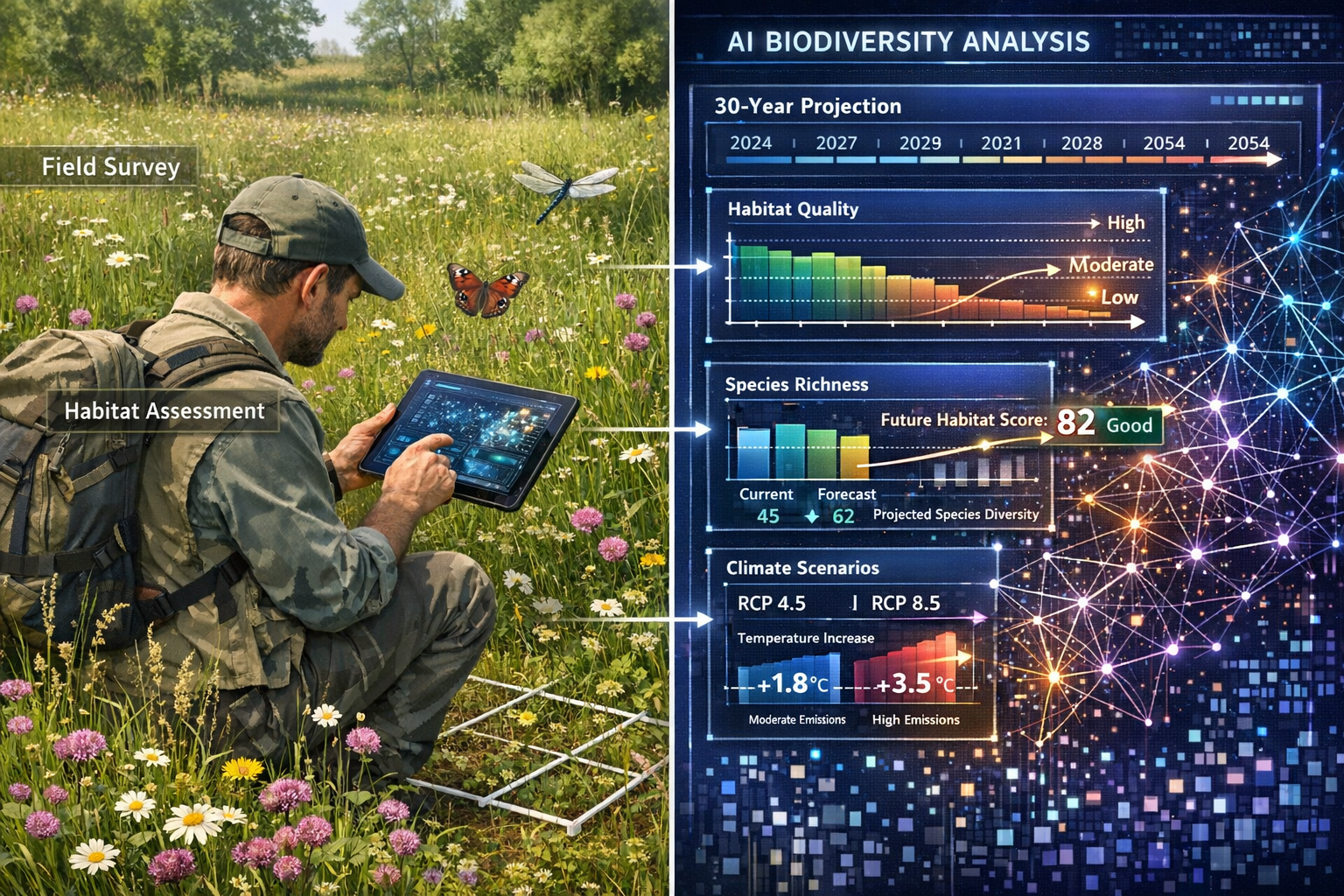
Ecologists validating Biodiversity Net Gain (BNG) outcomes face a critical challenge: traditional survey methods capture only snapshots in time, yet regulatory frameworks demand 30-year habitat projections. By 2026, 78% of BNG assessments rely on manual extrapolation techniques that fail to account for climate variability, species migration patterns, and ecosystem dynamics. This gap between regulatory requirements and scientific capability has created an urgent need for AI-driven predictive modeling approaches that can transform how ecologists forecast biodiversity outcomes.
AI-Driven Predictive Modeling for Biodiversity Net Gain Projections: 2026 Tools for Ecologists represents a fundamental shift in conservation planning methodology. Machine learning algorithms now integrate multi-decade survey datasets with climate scenarios, species distribution models, and habitat condition trajectories to generate probabilistic forecasts that capture uncertainty ranges rather than single-point predictions. These tools enable ecologists to validate biodiversity net gain assessments with unprecedented accuracy while meeting statutory requirements.
Key Takeaways
- Advanced AI techniques including convolutional neural networks, vision transformers, and self-shot learning are automating biodiversity monitoring at scales previously impossible with manual surveys[1]
- Integrated predictive models combine climate scenarios, land use changes, and socio-economic drivers to forecast biodiversity trajectories over 30-year timeframes required for BNG validation[2]
- Probabilistic forecasting approaches using transformer-based neural networks generate uncertainty ranges that enable more robust decision-making than traditional single-point projections[4]
- Validated data pipelines following FAIR, CARE, and TRUST principles are essential for reliable AI applications in biodiversity monitoring and net gain calculations[6]
- Step-by-step implementation frameworks allow ecologists to deploy AI tools for field data collection, model training, and long-term habitat projection validation
Understanding AI-Driven Predictive Modeling for Biodiversity Net Gain Projections: 2026 Tools for Ecologists
The foundation of AI-driven BNG modeling rests on three interconnected components: automated data collection, machine learning prediction, and uncertainty quantification. Unlike traditional approaches that rely heavily on expert judgment and linear extrapolation, modern AI systems learn complex ecological relationships directly from observational data while incorporating domain knowledge as constraints.
The Biodiversity Decision Gap
Recent research identifies what scientists call the "biodiversity decision gap" – while AI has revolutionized data collection and processing through automated sensing and computational tools, AI decision-making methods remain underutilized for conservation actions[3]. This gap is particularly problematic for BNG projections, where ecologists must determine not only current habitat conditions but also forecast how interventions will perform under future climate scenarios.
Key challenges addressed by AI modeling:
- 🔍 Species identification complexity – Similar species, subtle morphological differences, variable life stages, and incomplete specimens
- 📊 Data volume management – Processing thousands of survey images and sensor readings efficiently
- 🌡️ Climate uncertainty integration – Incorporating multiple climate pathways into biodiversity forecasts
- ⏱️ Temporal dynamics – Capturing seasonal variations, succession patterns, and long-term trends
- 🎯 Validation requirements – Meeting statutory 30-year projection standards for BNG compliance
How Machine Learning Transforms BNG Calculations
Traditional biodiversity impact assessments typically rely on the UK Biodiversity Metric, which calculates habitat units based on current condition assessments and applies fixed enhancement multipliers. AI-driven approaches enhance this framework by:
- Automating baseline surveys through computer vision systems that identify and count species from camera trap images, drone footage, and acoustic recordings
- Predicting habitat trajectories using time-series models trained on historical monitoring data
- Integrating climate scenarios to adjust projections based on temperature, precipitation, and extreme weather patterns
- Quantifying uncertainty through probabilistic modeling that generates confidence intervals rather than point estimates
- Validating interventions by comparing predicted outcomes against observed ecosystem responses in long-term monitoring datasets
A groundbreaking 2026 initiative demonstrates this approach in marine environments, where AI-based computer vision tools automatically identify and count barnacles, macroalgae, and other invertebrates from large image datasets sourced from the 20-year UK MarClim survey[1]. The project employs convolutional neural networks, instance segmentation, vision transformers, and self-shot learning to address complex intertidal scenes – techniques directly applicable to terrestrial BNG monitoring.
Implementation Framework: Deploying AI Tools for Biodiversity Net Gain Projections
Ecologists seeking to implement AI-driven predictive modeling for BNG validation should follow a structured framework that ensures data quality, model reliability, and regulatory compliance. This section provides actionable guidance for each implementation stage.
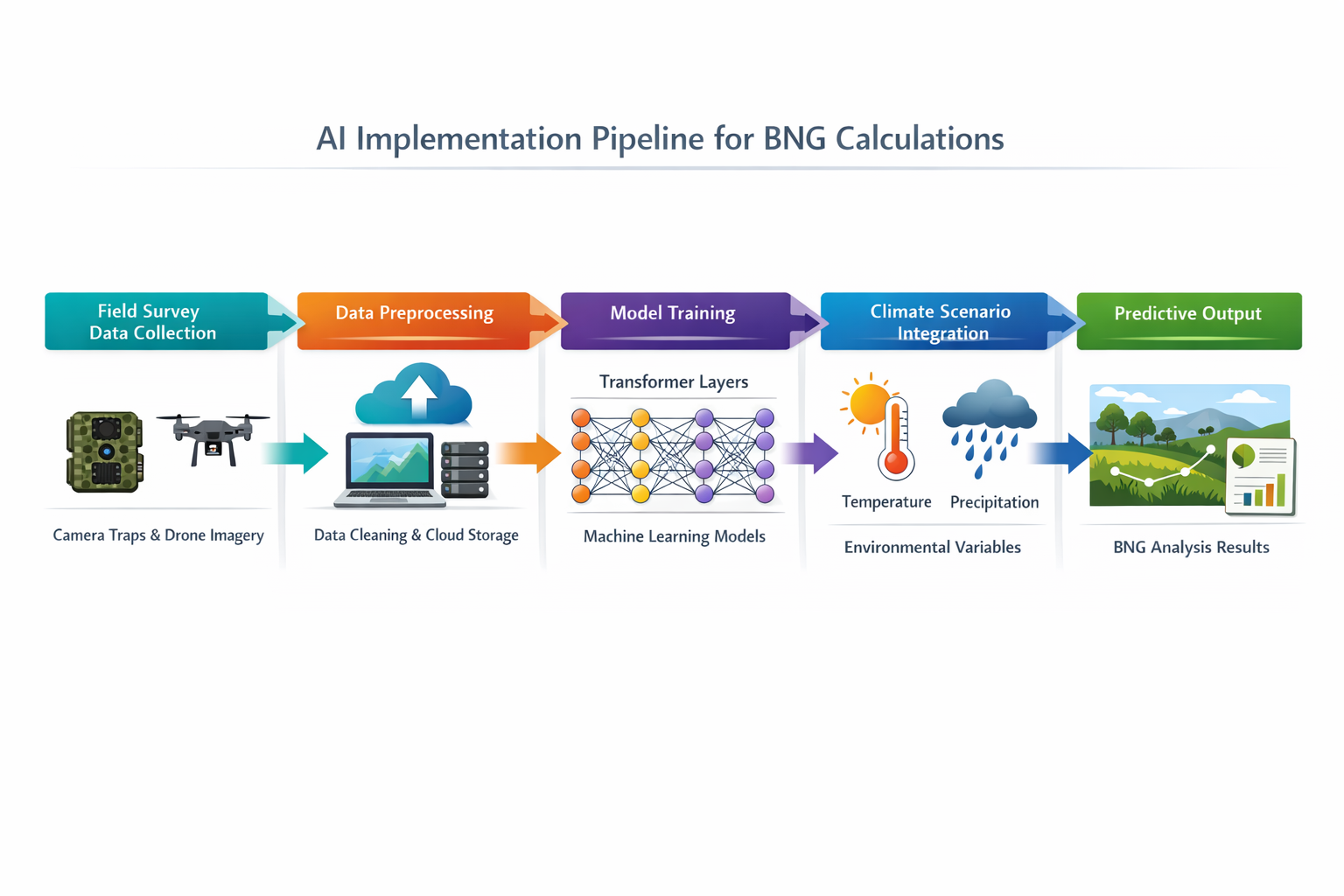
Step 1: Data Collection and Preparation
Objective: Establish comprehensive baseline datasets that capture spatial, temporal, and taxonomic diversity.
Required data types:
- Habitat condition surveys (vegetation structure, species composition, soil characteristics)
- Species occurrence records (presence/absence, abundance counts, distribution patterns)
- Environmental variables (temperature, precipitation, soil moisture, light levels)
- Land use history (management practices, disturbance events, restoration activities)
- Climate projection data (temperature scenarios, precipitation patterns, extreme events)
Best practices for data collection:
The March 2026 MOD Alliance webinar emphasized that reliable AI applications depend critically on validating the entire data-to-model pipeline and addressing potential biases in training datasets[6]. Ecologists should:
- Standardize survey protocols across sites and time periods to ensure data consistency
- Document metadata thoroughly including survey methods, observer identity, weather conditions, and equipment specifications
- Balance taxonomic representation to avoid model bias toward common or easily detected species
- Include negative observations (confirmed absences) to improve model discrimination
- Apply FAIR principles (Findable, Accessible, Interoperable, Reusable) for long-term data utility
For projects requiring biodiversity net gain reports, this enhanced data collection approach provides the foundation for defensible 30-year projections.
Step 2: Model Selection and Training
Objective: Choose appropriate AI architectures that match the prediction task, data characteristics, and computational resources.
Model architecture options:
| Model Type | Best For | Strengths | Limitations |
|---|---|---|---|
| Convolutional Neural Networks (CNNs) | Image-based species identification | Excellent pattern recognition, proven accuracy | Requires large training datasets |
| Vision Transformers | Complex scenes with multiple species | Captures long-range dependencies, attention mechanisms | Computationally intensive |
| Recurrent Neural Networks (RNNs/LSTMs) | Time-series habitat trajectories | Models temporal dynamics, seasonal patterns | Struggles with very long sequences |
| Random Forests | Habitat suitability modeling | Handles mixed data types, interpretable outputs | Limited extrapolation capability |
| Bayesian Networks | Uncertainty quantification | Explicit probability distributions, incorporates priors | Complex to specify and train |
The 2026 marine biodiversity project utilizes advanced techniques including contrastive learning (learning similarity relationships between species), anomaly detection (identifying unusual observations), and synthetic data augmentation (generating artificial training examples) to overcome challenges such as similar species identification and incomplete specimens[1].
Training workflow:
- Split data into training (70%), validation (15%), and test (15%) sets
- Incorporate ecological constraints as priors to constrain the model space – this integrates domain knowledge and prevents biologically implausible predictions[3]
- Apply transfer learning by starting with models pre-trained on large ecological datasets (e.g., iNaturalist, eBird) and fine-tuning for local conditions
- Validate across spatial scales to ensure models generalize beyond training locations
- Test temporal robustness by withholding recent years and evaluating prediction accuracy
Step 3: Climate Scenario Integration
Objective: Incorporate climate projections to adjust biodiversity forecasts for changing environmental conditions.
The transformer-based seasonal climate forecasting approach published in March 2026 demonstrates how combining AI with probabilistic modeling improves forecast accuracy[4]. The AI4DROUGHT project developed a hybrid framework that combines observational records with outputs from existing climate simulations to expand training datasets, addressing the traditional trade-off between computationally expensive physics-based models and less reliable statistical models[4].
Integration methodology:
- Select representative climate pathways (e.g., RCP 4.5, RCP 8.5) that span plausible future scenarios
- Downscale climate projections to match the spatial resolution of biodiversity surveys (typically 1-10 km grid cells)
- Identify climate-sensitive parameters in habitat models (e.g., drought tolerance thresholds, growing season length)
- Run ensemble predictions across multiple climate scenarios to capture uncertainty
- Weight scenarios based on likelihood assessments from climate science
For achieving 10% biodiversity net gain under future climate conditions, this scenario integration is essential for realistic projections.
Step 4: Probabilistic Forecasting and Uncertainty Quantification
Objective: Generate prediction intervals that capture forecast uncertainty and support risk-informed decision-making.
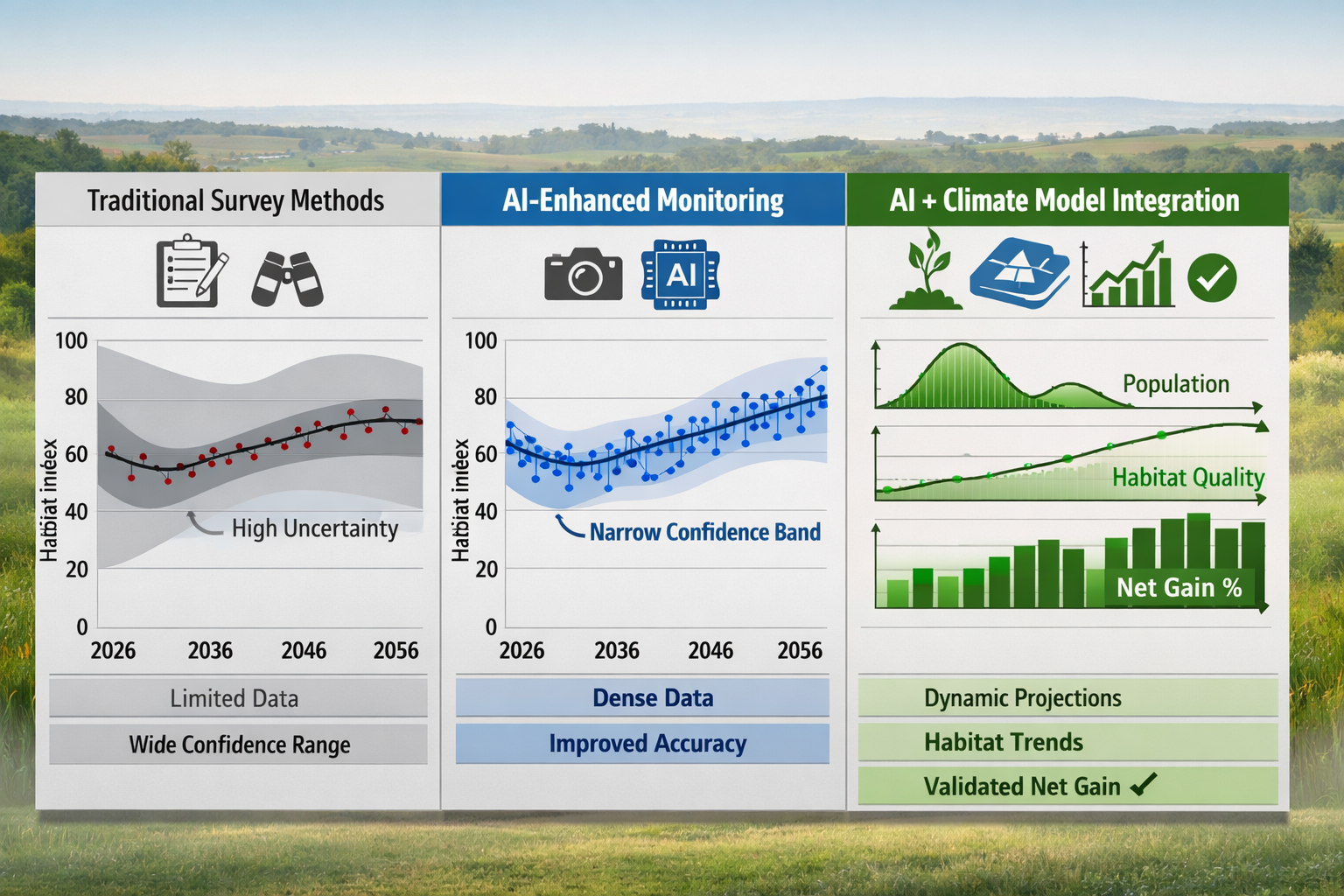
Traditional BNG projections often present single "most likely" outcomes, which can mislead stakeholders about intervention reliability. AI-driven probabilistic approaches using variational inference and Monte Carlo sampling generate full probability distributions that reveal the range of plausible futures[4].
Uncertainty sources to quantify:
- Parameter uncertainty – Imprecise estimates of model coefficients
- Model uncertainty – Structural assumptions and simplifications
- Climate uncertainty – Range of possible future climate states
- Management uncertainty – Variability in intervention implementation and effectiveness
- Observation uncertainty – Measurement errors and incomplete detection
Visualization approaches:
- Prediction intervals showing 50%, 80%, and 95% confidence bands
- Probability of achieving 10% net gain threshold over 30-year period
- Risk curves showing likelihood of different biodiversity outcomes
- Scenario comparison charts highlighting intervention effectiveness under various futures
Step 5: Validation and Monitoring
Objective: Establish feedback loops that continuously improve model accuracy through comparison with observed outcomes.
The HORIZON-CL6-2026-01-BIODIV-05 initiative specifically seeks long-term monitoring data to evaluate model outputs against observed ecosystem responses[2]. This validation approach is critical for achieving biodiversity net gain without risk.
Validation framework:
- Establish monitoring protocols aligned with model predictions (same metrics, spatial scale, temporal frequency)
- Compare predictions to observations at regular intervals (annually for first 5 years, then every 3-5 years)
- Update models when systematic deviations emerge, incorporating new data
- Document model performance in terms of prediction accuracy, bias, and calibration
- Communicate results to stakeholders with transparent reporting of successes and failures
Advanced Applications: AI-Driven Predictive Modeling for Biodiversity Net Gain Projections in Practice
The practical deployment of AI tools for BNG validation extends beyond technical implementation to address real-world challenges faced by ecologists, developers, and planning authorities. This section explores advanced applications and emerging capabilities.
Computer Vision for Automated Field Surveys
The 2026 marine biodiversity project emphasizes that advanced deep learning approaches will "dramatically reduce manual effort and errors while enabling high-resolution, large-scale monitoring of complex intertidal communities," providing unprecedented insights into species responses to anthropogenic and climate-driven stressors[1].
Practical applications for terrestrial BNG:
- 📸 Automated vegetation surveys – Drone-mounted cameras capture high-resolution imagery analyzed by segmentation models to quantify vegetation structure, species composition, and habitat extent
- 🦋 Pollinator monitoring – Camera traps at flower patches automatically identify and count pollinator visits, generating abundance and diversity metrics
- 🌳 Tree health assessment – Multispectral imaging combined with AI classification detects early signs of disease, drought stress, or pest damage
- 🔊 Acoustic biodiversity monitoring – Audio recorders capture soundscapes analyzed by neural networks to identify bird, bat, and amphibian species
These automated approaches enable continuous monitoring at scales impossible with manual surveys, providing the dense temporal data required for robust model training and validation.
Integrated Scenario Modeling for Nature-Positive Pathways
The EU's HORIZON-CL6-2026-01-BIODIV-05 program actively supports development of integrated scenarios and predictive models that explore pathways toward a nature-positive society, incorporating biodiversity, ecosystem services, climate change, land use, and socio-economic drivers[2].
Multi-factor integration for BNG projections:
Effective AI-driven models must account for interactions between:
- Climate change – Temperature shifts, altered precipitation patterns, increased extreme events
- Land use dynamics – Adjacent development, agricultural intensification, habitat fragmentation
- Management interventions – Grazing regimes, mowing schedules, invasive species control
- Socio-economic factors – Funding availability, policy changes, community engagement
- Ecological processes – Succession, dispersal, species interactions, disturbance recovery
The HORIZON initiative specifically seeks forest and landscape case studies for scenario development and model calibration, recognizing that different habitat types require tailored modeling approaches[2].
Decision Support for Off-Site vs. On-Site Delivery
One of the most consequential decisions in BNG planning involves whether to deliver net gain on-site or off-site. AI-driven predictive modeling can inform this choice by:
- Comparing projected outcomes across different spatial configurations
- Quantifying connectivity benefits of linking on-site interventions to existing habitat networks
- Assessing climate resilience of proposed intervention locations under future scenarios
- Evaluating cost-effectiveness by predicting time to target condition achievement
- Optimizing habitat placement to maximize biodiversity value while minimizing land take
For developers and planners navigating 8 key biodiversity net gain planning points, these AI-enhanced decision support tools provide evidence-based guidance that reduces project risk and improves ecological outcomes.
Addressing the Biodiversity Decision Gap
Bridging the "biodiversity decision gap" requires moving beyond data collection and processing to use AI for determining more effective conservation actions while accounting for uncertainty, dynamic systems, and complex constraints[3].
AI-enhanced decision frameworks:
- Adaptive management optimization – Reinforcement learning algorithms that identify optimal intervention sequences based on observed responses
- Multi-objective optimization – Balancing biodiversity outcomes, cost constraints, and stakeholder preferences
- Scenario planning – Exploring robust strategies that perform well across multiple plausible futures
- Risk assessment – Quantifying probability of failing to meet BNG targets under different management approaches
Current approaches emphasize integrating ecological insight and domain knowledge as priors into machine learning models, which constrains the model space and enables learning within a smaller class of potential functions rather than unrestricted data-driven approaches[3]. This hybrid approach combines the pattern recognition strengths of AI with the mechanistic understanding of trained ecologists.
Practical Considerations for Ecologists Implementing AI Tools
While AI-driven predictive modeling offers transformative capabilities for BNG projections, successful implementation requires attention to practical constraints, ethical considerations, and professional standards.
Data Quality and Bias Management
The March 2026 MOD Alliance webinar highlighted that reliable AI applications depend critically on validating the entire data-to-model pipeline and addressing potential biases in training datasets[6]. Common bias sources include:
- Spatial bias – Oversampling accessible locations while underrepresenting remote areas
- Temporal bias – Concentrating surveys during optimal weather or breeding seasons
- Taxonomic bias – Better representation of charismatic or easily identified species
- Observer bias – Inconsistent detection rates among different surveyors
- Equipment bias – Varying sensor capabilities or camera settings
Mitigation strategies:
✅ Implement stratified sampling designs that ensure representative coverage
✅ Document and adjust for known detection probabilities
✅ Use multiple data sources to cross-validate patterns
✅ Apply data augmentation techniques to balance underrepresented groups
✅ Conduct sensitivity analyses to assess how biases affect predictions
Computational Requirements and Accessibility
Advanced AI models can require substantial computational resources, potentially creating barriers for smaller consultancies or local authorities. However, several approaches make these tools more accessible:
- Cloud-based platforms – Services like Google Earth Engine, Microsoft Planetary Computer, and AWS provide pre-trained models and scalable computing
- Transfer learning – Starting with pre-trained models reduces computational demands and data requirements
- Model compression – Techniques like pruning and quantization create smaller, faster models suitable for field deployment
- Collaborative frameworks – Shared model repositories and open-source tools enable community development and validation
For architects solving biodiversity net gain challenges, cloud-based AI tools offer accessible entry points without requiring in-house data science expertise.
Regulatory Compliance and Professional Standards
AI-driven BNG projections must meet statutory requirements and professional standards established by Natural England, local planning authorities, and professional bodies. Key considerations include:
- Metric compatibility – Ensuring AI outputs align with UK Biodiversity Metric structure and calculations
- Audit trails – Documenting data sources, model specifications, and assumptions for regulatory review
- Professional judgment – Maintaining ecologist oversight of AI outputs rather than fully automated decision-making
- Uncertainty communication – Transparently reporting confidence intervals and limitations to decision-makers
- Validation evidence – Demonstrating model accuracy through comparison with independent datasets
When preparing biodiversity net gain reports, ecologists should clearly document how AI tools were applied, what validation was performed, and where professional judgment supplemented model outputs.
Ethical Considerations and Responsible AI
The application of AI to biodiversity conservation raises important ethical questions about data ownership, algorithmic transparency, and equitable access. The March 2026 webinar emphasized responsible data management aligned with FAIR (Findable, Accessible, Interoperable, Reusable), CARE (Collective benefit, Authority to control, Responsibility, Ethics), and TRUST (Transparency, Responsibility, User focus, Sustainability, Technology) principles[6].
Ethical implementation guidelines:
- 🤝 Engage stakeholders in model development and validation processes
- 📖 Maintain transparency about model capabilities and limitations
- ⚖️ Ensure equitable access to AI tools across different organization sizes and resources
- 🌍 Respect data sovereignty particularly for Indigenous and local knowledge
- 🔒 Protect sensitive information about rare species locations or private land management
Future Directions: The Evolution of AI-Driven Biodiversity Forecasting
The field of AI-driven predictive modeling for biodiversity is advancing rapidly, with several emerging capabilities poised to further transform BNG validation and conservation planning.
Next-Generation Model Architectures
Research frontiers include:
- Foundation models for ecology – Large-scale pre-trained models (analogous to GPT for language) that capture general ecological patterns and can be fine-tuned for specific applications
- Physics-informed neural networks – Hybrid models that incorporate ecological theory and mechanistic understanding as hard constraints
- Causal inference methods – Moving beyond correlation to identify causal relationships that enable more reliable intervention predictions
- Multi-modal learning – Integrating diverse data types (images, audio, genetic sequences, environmental sensors) in unified models
Real-Time Adaptive Management
Future systems will enable continuous model updating as new monitoring data becomes available, creating feedback loops that progressively improve prediction accuracy. This adaptive learning approach will support:
- Dynamic adjustment of management interventions based on observed responses
- Early warning systems that detect deviations from expected trajectories
- Automated reporting that flags sites requiring additional attention
- Continuous validation that builds confidence in long-term projections
Integration with Broader Environmental Systems
AI-driven biodiversity models will increasingly connect with complementary systems addressing:
- Carbon sequestration – Linking habitat creation with climate mitigation benefits
- Water quality – Modeling ecosystem service co-benefits of BNG interventions
- Flood regulation – Assessing natural flood management contributions
- Pollination services – Quantifying agricultural productivity benefits
This integrated approach aligns with the HORIZON initiative's vision of exploring pathways toward a nature-positive society that addresses multiple environmental challenges simultaneously[2].
Conclusion
AI-Driven Predictive Modeling for Biodiversity Net Gain Projections: 2026 Tools for Ecologists represents a paradigm shift in how conservation outcomes are forecasted, validated, and delivered. By combining advanced machine learning techniques with ecological domain knowledge, these tools address the fundamental challenge of projecting biodiversity trajectories over the 30-year timeframes required by regulatory frameworks.
The evidence from 2026 research initiatives demonstrates that AI-based computer vision can dramatically reduce manual effort while enabling high-resolution, large-scale monitoring[1]. Integrated scenario models incorporating climate change, land use dynamics, and socio-economic drivers provide the comprehensive forecasting capability needed for robust BNG validation[2]. Probabilistic approaches using transformer-based neural networks generate uncertainty ranges that support risk-informed decision-making rather than false precision[4].
Key implementation priorities for ecologists:
- Establish comprehensive baseline datasets following FAIR, CARE, and TRUST principles with attention to bias mitigation
- Select appropriate model architectures that match prediction tasks and incorporate ecological constraints as priors
- Integrate climate scenarios to adjust projections for changing environmental conditions
- Quantify uncertainty through probabilistic forecasting that generates prediction intervals
- Validate continuously by comparing predictions to observed outcomes and updating models accordingly
For professionals navigating biodiversity net gain requirements, these AI-driven tools offer pathways to more defensible projections, reduced project risk, and improved ecological outcomes. The transition from snapshot assessments to dynamic forecasting represents not merely a technical upgrade but a fundamental reimagining of how ecologists engage with uncertainty, validate interventions, and demonstrate long-term conservation success.
Next Steps:
- Explore cloud-based AI platforms that provide accessible entry points without requiring extensive data science infrastructure
- Participate in collaborative model development initiatives that share training data and validation results
- Engage with planning authorities about incorporating probabilistic forecasts into BNG approval processes
- Establish long-term monitoring protocols that generate the feedback data needed for continuous model improvement
- Connect with research networks developing next-generation ecological AI tools
The biodiversity decision gap can be bridged through thoughtful integration of AI capabilities with ecological expertise, creating decision support systems that enhance rather than replace professional judgment. As these tools mature and become more accessible, they will enable ecologists to deliver the rigorous, evidence-based projections that biodiversity net gain policies demand while advancing the broader goal of nature recovery in a changing climate.
References
[1] 2026 Lu06 Ai Driven Computer Vision For Automated Monitoring Of Marine Biodiversity And Climate Impacts – https://centa.ac.uk/studentship/2026-lu06-ai-driven-computer-vision-for-automated-monitoring-of-marine-biodiversity-and-climate-impacts/
[2] Ugfydgljaxbhdglvbk9wcg9ydhvuaxr5ojixmdkwoq== – https://www.b2match.com/e/care4bio-2026/opportunities/UGFydGljaXBhdGlvbk9wcG9ydHVuaXR5OjIxMDkwOQ==
[3] Watch – https://www.youtube.com/watch?v=X5NjPpkcqEQ
[4] Ai Meets Climate Forecasting A New Era For Seasonal Predictions – https://eo4society.esa.int/2026/03/25/ai-meets-climate-forecasting-a-new-era-for-seasonal-predictions/
[6] Watch – https://www.youtube.com/watch?v=Hb-FzcqctDg