

Last updated: May 21, 2026
Quick Answer: From 2 November 2026, Nationally Significant Infrastructure Projects (NSIPs) — including roads, rail, and energy networks — will be legally required to deliver a minimum 10% biodiversity net gain where development consent applications are submitted on or after that date. Separately, the government expects to introduce new rules for small sites by the end of July 2026 (subject to parliamentary scheduling), including a new 0.2ha area-based exemption, removal of the self-build exemption, and equal status for off-site delivery on minor residential schemes. Until secondary legislation is passed, the current BNG regime remains fully in force.
Key Takeaways
- NSIPs face a hard deadline: Development consent applications submitted on or after 2 November 2026 must meet the 10% BNG duty.
- Small site rules are changing: A new 0.2ha area-based exemption is expected by end of July 2026, replacing some existing exemptions.
- Self-build exemption to be removed: The current exemption for small self-build and custom-build homes is proposed for removal.
- Off-site delivery gets a boost: For minor residential schemes (≤9 dwellings, ≤1ha), off-site biodiversity delivery would gain equal footing with on-site delivery.
- Spatial risk multiplier reform: The multiplier will shift from LPA/NCA boundaries to ~48 Local Nature Recovery Strategy (LNRS) areas, expanding the pool of usable off-site units.
- Brownfield consultation live: A consultation on a potential brownfield residential exemption closed 10 June 2026 — watch for the government's response.
- Nothing changes yet without legislation: All proposed changes require secondary legislation before they take effect.
- Ecology demand is rising: Each of these changes increases the need for BNG metric calculations, habitat surveys, and strategic ecology advice.
Table of Contents
- What Is Biodiversity Net Gain and How Does It Work?
- What Are the Key 2026 Changes to BNG for NSIP Infrastructure and Small Sites?
- Which Development Sites Are Exempt from the 2026 BNG Rules?
- Large vs Small Infrastructure Projects: What's Different Under the New Rules?
- How Do You Calculate Biodiversity Net Gain for Your Site?
- What Happens If You Can't Achieve 10% BNG On-Site?
- Can You Buy Biodiversity Credits Instead of Creating Habitat?
- What Ecological Assessments Do You Need for a Small Infrastructure Site?
- Who Enforces BNG for NSIPs — and What Are the Penalties?
- Common Mistakes Developers Make with BNG
- How Will These Changes Impact Small Construction Businesses?
- FAQ
- Conclusion
What Is Biodiversity Net Gain and How Does It Work? {#what-is-bng}
Biodiversity net gain (BNG) is a planning requirement in England that means development must leave the natural environment measurably better than it was before. The legal minimum is a 10% net gain in biodiversity value, calculated using Natural England's Biodiversity Metric tool.
The metric assigns a unit value to habitats based on their type, condition, and size. Developers compare the pre-development baseline against the post-development habitat provision. If the gain falls short of 10%, the shortfall must be made up through off-site habitat creation or, as a last resort, statutory biodiversity credits purchased from the government.
For a fuller breakdown of what this process involves in practice, see what's included in a biodiversity net gain assessment.
BNG became mandatory for most major developments in England in February 2024 and for small sites in April 2024, under Schedule 7A of the Environment Act 2021. NSIPs — the large nationally significant schemes — were always intended to follow, and 2026 is when that obligation arrives.
What Are the Key 2026 Changes to BNG for NSIP Infrastructure and Small Sites? {#key-2026-changes}
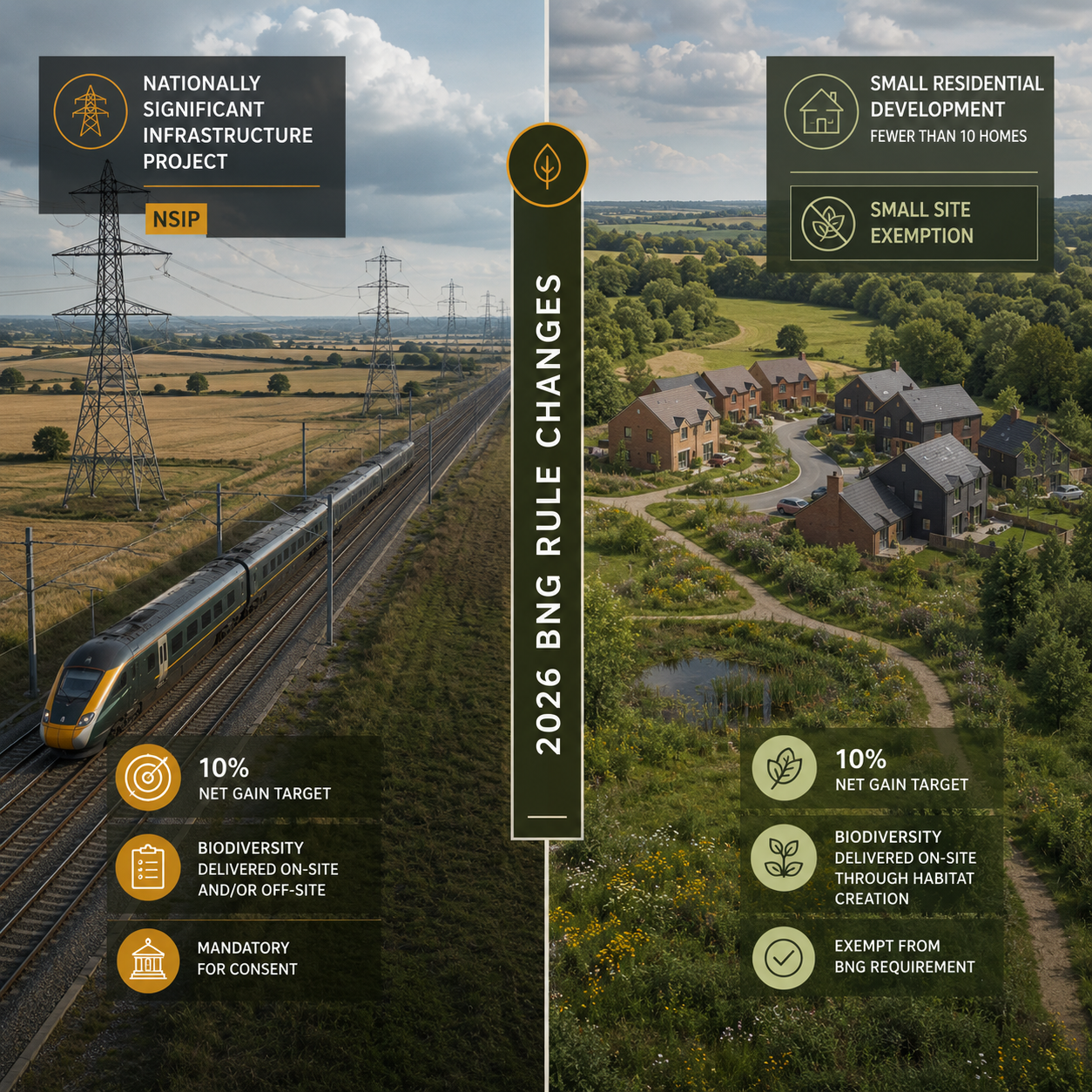
The biodiversity net gain 2026 changes for NSIP infrastructure and small sites fall into four distinct areas, each with different timelines and implications for developers and ecology professionals.
1. NSIPs: The 2 November 2026 Trigger Date
From 2 November 2026, any application for a Development Consent Order (DCO) submitted to the Planning Inspectorate must include a commitment to deliver at least 10% BNG. This covers roads, railways, airports, energy generation and transmission infrastructure, and other nationally significant schemes defined under the Planning Act 2008.
The duty applies at the point of application submission, not consent. Schemes already in the DCO pipeline before that date are not caught by the new requirement — but developers close to that boundary should take legal advice on their specific timeline.
2. New 0.2ha Area-Based Exemption (Expected by End of July 2026)
The government expects to introduce a new exemption for development affecting less than 0.2 hectares of habitat. This is a simpler, area-based test intended to reduce the administrative burden on very small schemes. It replaces some of the complexity in the current exemption framework.
3. Removal of the Self-Build/Custom-Build Exemption
Currently, small self-build and custom-build homes benefit from a specific BNG exemption. The government proposes to remove this exemption, bringing these projects within the standard BNG framework. Developers and individuals planning self-build schemes should factor BNG costs and assessments into their budgets now.
4. Equal Status for Off-Site Delivery on Minor Residential Schemes
For residential schemes of 9 or fewer dwellings on sites of 1 hectare or less, the proposed rules would give off-site biodiversity delivery equal status with on-site delivery. Under the current gain hierarchy, developers must demonstrate they've exhausted on-site options before going off-site. Loosening this hierarchy for minor schemes gives smaller developers more flexibility and may reduce on-site design constraints. For more on this distinction, see biodiversity net gain: off-site or on-site delivery?
5. Spatial Risk Multiplier Reform: LNRS Areas Replace LPA Boundaries
One of the more technical but commercially significant changes is the shift in how the spatial risk multiplier is assessed. Currently, the multiplier is tied to Local Planning Authority (LPA) or National Character Area (NCA) boundaries — around 337 LPAs across England. The proposed change would align the multiplier with Local Nature Recovery Strategy (LNRS) areas, of which there are approximately 48.
This consolidation means off-site habitat units created in one LNRS area could satisfy demand from a much wider geographic catchment, expanding the market for habitat bank operators and making it easier for developers to source off-site units.
Which Development Sites Are Exempt from the 2026 BNG Rules? {#exemptions}
Several categories of development are exempt from BNG requirements, though the 2026 changes will adjust this list. The current exemptions include householder applications, development with a de minimis impact on biodiversity, and certain temporary developments. See the full picture at exempt projects.
Under the proposed 2026 changes:
| Exemption | Current Position | Proposed 2026 Change |
|---|---|---|
| Small self-build/custom-build | Exempt | Exemption to be removed |
| Development affecting <0.2ha of habitat | No specific area-based exemption | New 0.2ha exemption proposed |
| Brownfield residential development | No specific exemption | Consultation closed 10 June 2026; outcome pending |
| Householder applications | Exempt | No change proposed |
| De minimis impact (no net loss of habitat) | Exempt | No change proposed |
⚠️ Important: None of these proposed changes are in force yet. They require secondary legislation. Until that legislation passes, the existing exemption framework applies in full.
Large vs Small Infrastructure Projects: What's Different Under the New Rules? {#large-vs-small}
The biodiversity net gain 2026 changes treat NSIP infrastructure and small sites very differently, reflecting the different planning regimes they sit within.
NSIPs are consented through the DCO process via the Planning Inspectorate, not through local planning authorities. The 10% BNG duty for NSIPs will be set out in secondary legislation and will apply as a condition of consent. Given the scale of NSIP schemes — often spanning multiple LPA areas and LNRS zones — the spatial risk multiplier reform is particularly relevant here, as it simplifies the geographic matching of off-site units.
Small sites (minor residential schemes of ≤9 dwellings on ≤1ha) go through the standard local planning process. The key change for them is the loosening of the gain hierarchy: off-site delivery becomes an equal option rather than a fallback. This is a practical acknowledgement that small sites often lack the physical space to achieve 10% BNG entirely on-site.
For guidance tailored to smaller schemes, BNG for small development projects covers the specific challenges these developers face.
How Do You Calculate Biodiversity Net Gain for Your Site? {#how-to-calculate}
BNG is calculated using Natural England's statutory Biodiversity Metric (currently version 4.0). The metric produces a score in biodiversity units for each habitat parcel on the site, based on:
- Area (hectares)
- Habitat type (e.g., neutral grassland, hedgerow, woodland)
- Condition (assessed against Natural England condition criteria)
- Strategic significance (using the spatial risk multiplier)
- Temporal risk (accounting for the time lag before new habitat reaches target condition)
The pre-development baseline score is compared against the post-development score. If the post-development score is at least 10% higher, the site meets the BNG requirement.
For a step-by-step walkthrough, see how to achieve 10% biodiversity net gain.
Common calculation mistake: Using an inaccurate baseline. If the habitat condition assessment is too generous at baseline, the 10% target becomes harder to hit. Conversely, undervaluing the baseline can make the target appear easier but may be challenged by the LPA or Planning Inspectorate.
What Happens If You Can't Achieve 10% BNG On-Site? {#off-site-credits}
If on-site habitat provision falls short of the 10% target, developers have two further options: off-site habitat units and statutory biodiversity credits.
Off-site units are purchased from habitat bank operators who have registered habitat enhancement or creation on land outside the development site. These units are recorded on the Natural England biodiversity gain sites register. The LNRS spatial reform proposed for 2026 will make sourcing these units more straightforward for many schemes.
Statutory biodiversity credits are a government backstop — they're more expensive than market-rate off-site units and are intended to be a last resort. For a cost comparison, see cost of biodiversity units and statutory credits.
The gain hierarchy (on-site first, then off-site, then credits) currently applies to all developments except, under the proposed rules, minor residential schemes where off-site would be given equal status.
Can You Buy Biodiversity Credits Instead of Creating Habitat? {#buying-credits}
Yes, but statutory biodiversity credits are designed as a last resort, not a first choice. They are purchased directly from the government and are priced to incentivise genuine habitat creation over financial offsets.
Developers who want to explore the off-site market — which is generally more cost-effective — can buy biodiversity units through registered habitat bank providers. Landowners with suitable land can also sell biodiversity units by registering a habitat management agreement.
For a practical guide to the credit system, see the guide to biodiversity credits for developers.
What Ecological Assessments Do You Need for a Small Infrastructure Site? {#ecological-assessments}
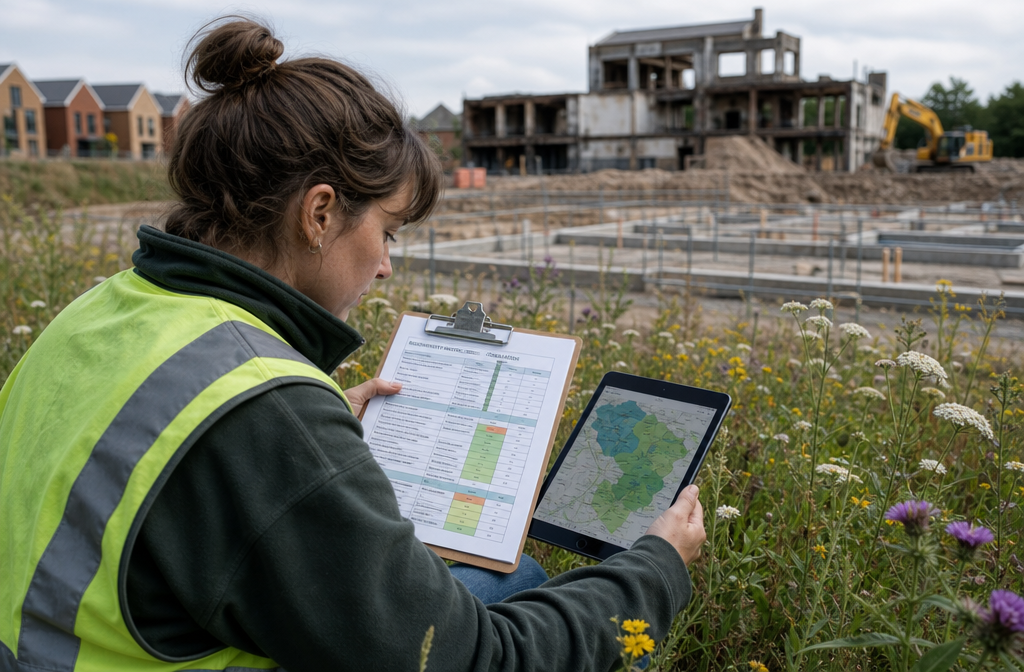
For most sites subject to BNG, the minimum requirement is a Preliminary Ecological Appraisal (PEA) to establish the habitat baseline, followed by completion of the statutory Biodiversity Metric. Depending on the site, additional surveys may be required — for example, protected species surveys for bats, great crested newts, or dormice.
For NSIP schemes, the ecology workload is substantially greater. DCO applications typically require an Environmental Statement with detailed ecological chapters, a Habitat Management and Monitoring Plan (HMMP), and a BNG assessment covering the full project footprint, which may span dozens of kilometres.
For a clear overview of what's involved, how to conduct a biodiversity impact assessment is a useful starting point.
Choose a full ecology survey package if: your site has any semi-natural habitat, watercourses, mature trees, or is adjacent to designated land. The cost of a missed protected species survey far exceeds the cost of doing it upfront.
Who Enforces BNG for NSIPs — and What Are the Penalties? {#enforcement-penalties}
For standard planning applications, BNG compliance is enforced by the Local Planning Authority as a condition of planning permission. Failure to deliver the required habitat within the agreed timeframe is a breach of planning condition, which can result in enforcement action including stop notices and retrospective requirements.
For NSIPs, enforcement will sit with the Planning Inspectorate and, ultimately, the Secretary of State. BNG obligations will be embedded in the DCO itself, making them legally binding conditions of the consent. Non-compliance with a DCO condition is a serious matter that can trigger legal proceedings.
There are no fixed financial penalty figures published for BNG non-compliance in isolation — enforcement is through planning law rather than a standalone BNG penalty regime. However, the reputational and commercial consequences of enforcement action on a major infrastructure project are significant.
Common Mistakes Developers Make with BNG {#common-mistakes}
Getting BNG wrong at the planning stage creates delays and cost overruns. The most frequent errors are:
- Starting the metric too late: BNG should inform site layout design, not be retrofitted after planning drawings are complete.
- Underestimating baseline habitat quality: A robust PEA is essential. Guessing habitat condition leads to metric errors that LPAs will challenge.
- Assuming exemptions apply: With the 2026 changes, the self-build exemption is going. Developers who assume they're exempt without checking current legislation risk submitting non-compliant applications.
- Ignoring the gain hierarchy: Developers on small sites sometimes go straight to off-site without documenting why on-site delivery isn't feasible — even where the hierarchy applies, the reasoning must be evidenced.
- Not registering off-site units early enough: The habitat gain sites register process takes time. Leaving off-site sourcing until after planning approval creates programme risk.
For more on avoiding these pitfalls, see achieving biodiversity net gain without the risk.
How Will These Changes Impact Small Construction and Development Businesses? {#impact-on-small-businesses}
The biodiversity net gain 2026 changes to NSIP infrastructure and small sites create both new obligations and new opportunities for smaller developers and construction businesses.
New obligations:
- Self-build and custom-build developers who previously relied on the exemption will need to budget for BNG metric work and potentially off-site unit purchases.
- Any scheme affecting 0.2ha or more of habitat that doesn't qualify for another exemption must deliver 10% BNG.
New opportunities:
- The equal status for off-site delivery on minor residential schemes removes a design constraint. Smaller developers can now plan simpler sites and meet BNG through the off-site market without needing to justify why on-site delivery isn't possible.
- The LNRS spatial reform expands the geographic catchment for off-site units, which should improve unit availability and potentially reduce prices in areas where supply was previously thin.
Bottom line for small developers: Budget for a PEA and metric calculation on every scheme that isn't clearly exempt. The cost of getting this wrong — delays, redesigns, enforcement — is far greater than the cost of early ecology advice.
FAQ {#faq}
Q: When exactly does BNG become mandatory for NSIPs?
A: The duty applies to Development Consent Order applications submitted on or after 2 November 2026. Applications submitted before that date are not caught by the new requirement.
Q: Is the 0.2ha area-based exemption in force now?
A: No. It is a proposed change expected to be introduced via secondary legislation by the end of July 2026, subject to parliamentary scheduling. The current exemption framework applies until that legislation is enacted.
Q: Does the brownfield residential exemption exist yet?
A: Not yet. A government consultation on a potential brownfield residential BNG exemption closed on 10 June 2026. The government's response and any resulting legislation are still pending.
Q: What is the spatial risk multiplier and why does the LNRS change matter?
A: The spatial risk multiplier adjusts the value of off-site biodiversity units based on their geographic location relative to the development. Shifting from ~337 LPA boundaries to ~48 LNRS areas means units created in one LNRS zone can serve a much wider area, increasing the supply of usable off-site units for developers.
Q: Can a minor residential developer go straight to off-site BNG delivery under the proposed rules?
A: Under the proposed changes, yes — for schemes of 9 or fewer dwellings on 1 hectare or less, off-site delivery would have equal status with on-site. This removes the current requirement to demonstrate that on-site options have been exhausted first.
Q: Who pays for BNG on an NSIP scheme?
A: The applicant (typically the infrastructure promoter or developer) is responsible for funding and delivering BNG as part of the DCO consent conditions. Costs will vary significantly depending on the scheme's footprint, existing habitat quality, and whether off-site units or statutory credits are needed.
Conclusion {#conclusion}
The biodiversity net gain 2026 changes for NSIP infrastructure and small sites represent the most significant evolution of England's BNG regime since mandatory requirements came into force in 2024. For NSIP promoters, the 2 November 2026 application deadline is a hard trigger that should already be shaping DCO programme planning and ecology budgets. For smaller developers, the removal of the self-build exemption and the introduction of a 0.2ha area-based test will change which schemes need BNG assessments — and the loosening of the gain hierarchy for minor residential schemes gives genuine design flexibility.
None of these changes are in force yet. Until secondary legislation is passed, the existing BNG framework governs every application. That means there's a window now to prepare: commission baseline surveys, run the metric, and explore off-site options before the rules shift.
Actionable next steps:
- Check your application timeline against the 2 November 2026 NSIP trigger date if you're involved in any DCO scheme.
- Commission a PEA and BNG metric on any small site that may lose its current exemption — don't wait for legislation.
- Monitor the brownfield consultation outcome if you develop residential schemes on brownfield land.
- Engage an ecology consultant early — BNG should inform design, not follow it.
- Explore the off-site unit market now, particularly if the LNRS spatial reform will expand your sourcing options.
For tailored advice on any of these steps, contact Biodiversity Surveyors or explore the guidance for developers section for further resources.
References
- Department for Environment, Food and Rural Affairs (Defra). Biodiversity Net Gain: Consultation on Changes to the Regime. UK Government, 2025.
- Environment Act 2021, Schedule 7A. UK Parliament, 2021.
- Planning Act 2008. UK Parliament, 2008.
- Natural England. Biodiversity Metric 4.0 User Guide. Natural England, 2023.
- Planning Inspectorate. Nationally Significant Infrastructure Projects: Guidance. UK Government, 2024.
- Defra. Local Nature Recovery Strategies: Guidance for Responsible Authorities. UK Government, 2023.