

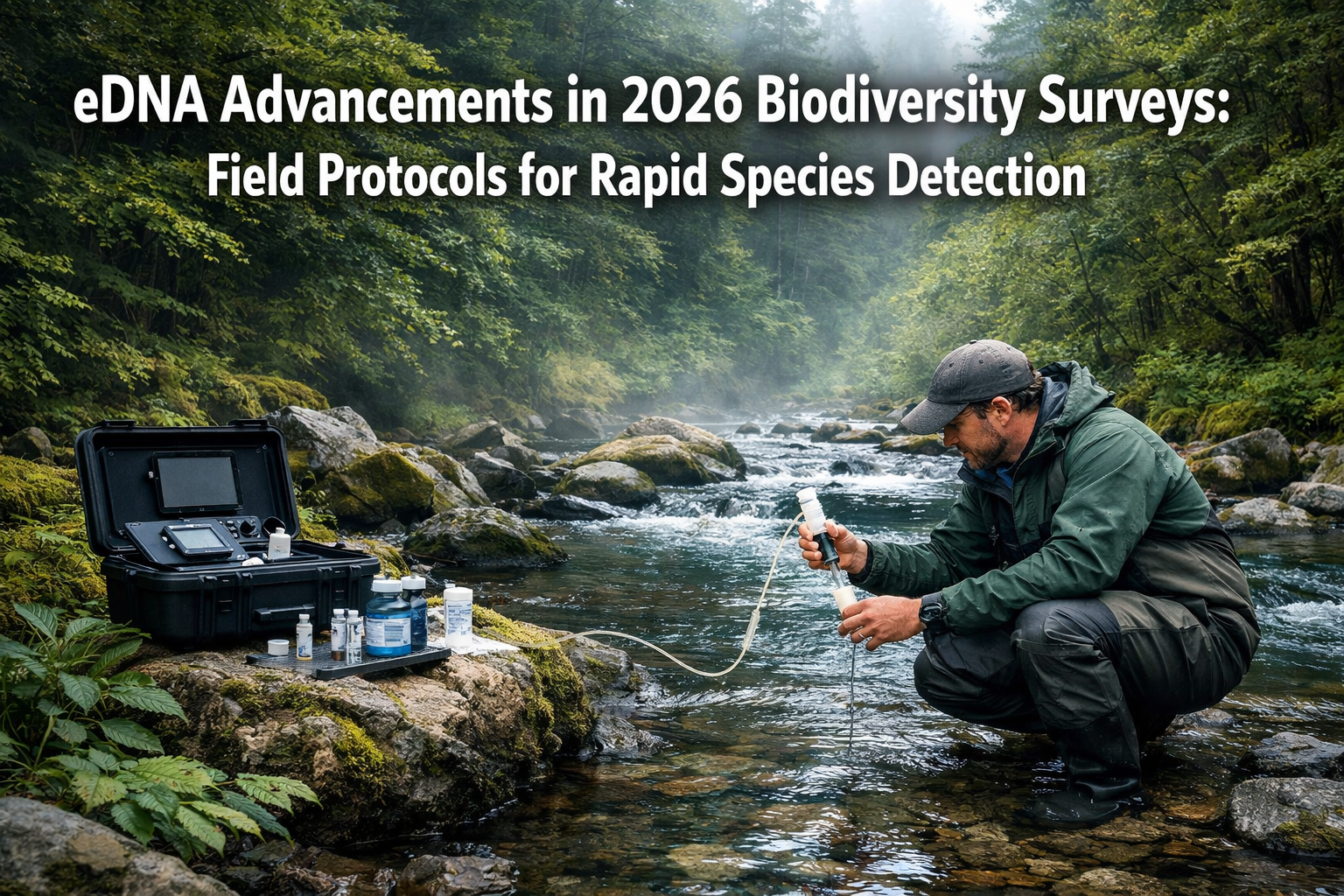
Between 2024 and 2026, standardized field protocols became widely referenced, citizen access to eDNA testing expanded rapidly, and legal acceptance of environmental DNA as "probable cause" increased dramatically—transforming biodiversity detection from a university-only capability into an accessible tool for landowners, ecologists, and developers [3]. This revolution in eDNA advancements in 2026 biodiversity surveys: field protocols for rapid species detection now enables non-invasive species monitoring that delivers results in days rather than months, fundamentally changing how projects achieve biodiversity net gain validation.
The shift is measurable: a comprehensive 15-year synthesis published in January 2026 systematized standardized guidelines across aquatic, terrestrial, and atmospheric ecosystems, while global initiatives like eDNA Expeditions established biomolecular sampling networks across 25 marine sites [4][1]. For developers, planners, and ecologists working under tight timelines, these advancements mean faster baseline assessments, more accurate species inventories, and scientifically defensible data for regulatory compliance.
Key Takeaways
- Standardized protocols now enable non-experts to collect scientifically valid eDNA samples following step-by-step guidance, with filtration specifications (0.22–0.45 μm for aquatic systems) systematized across environments [4]
- Rapid detection timelines deliver species identification results in 48-72 hours compared to traditional survey methods requiring weeks or months of field observation
- Cross-domain detection capabilities identify biodiversity from microbes to megafauna in single samples, supporting comprehensive biodiversity net gain assessments
- Integrated monitoring workflows combine eDNA flagging with camera confirmation and follow-up verification, creating reliable evidence chains for regulatory compliance [3]
- Contamination control remains the critical success factor, with strict field protocols preventing false positives that undermine survey credibility
Understanding eDNA Technology and Its Role in Modern Biodiversity Surveys
Environmental DNA (eDNA) refers to genetic material organisms shed into their surroundings—skin cells, scales, mucus, feces, urine, or gametes that persist in water, soil, or air. Modern eDNA surveys collect these microscopic traces and use molecular analysis to identify which species occupy an area without ever seeing or capturing the organisms themselves.
How eDNA Detection Works
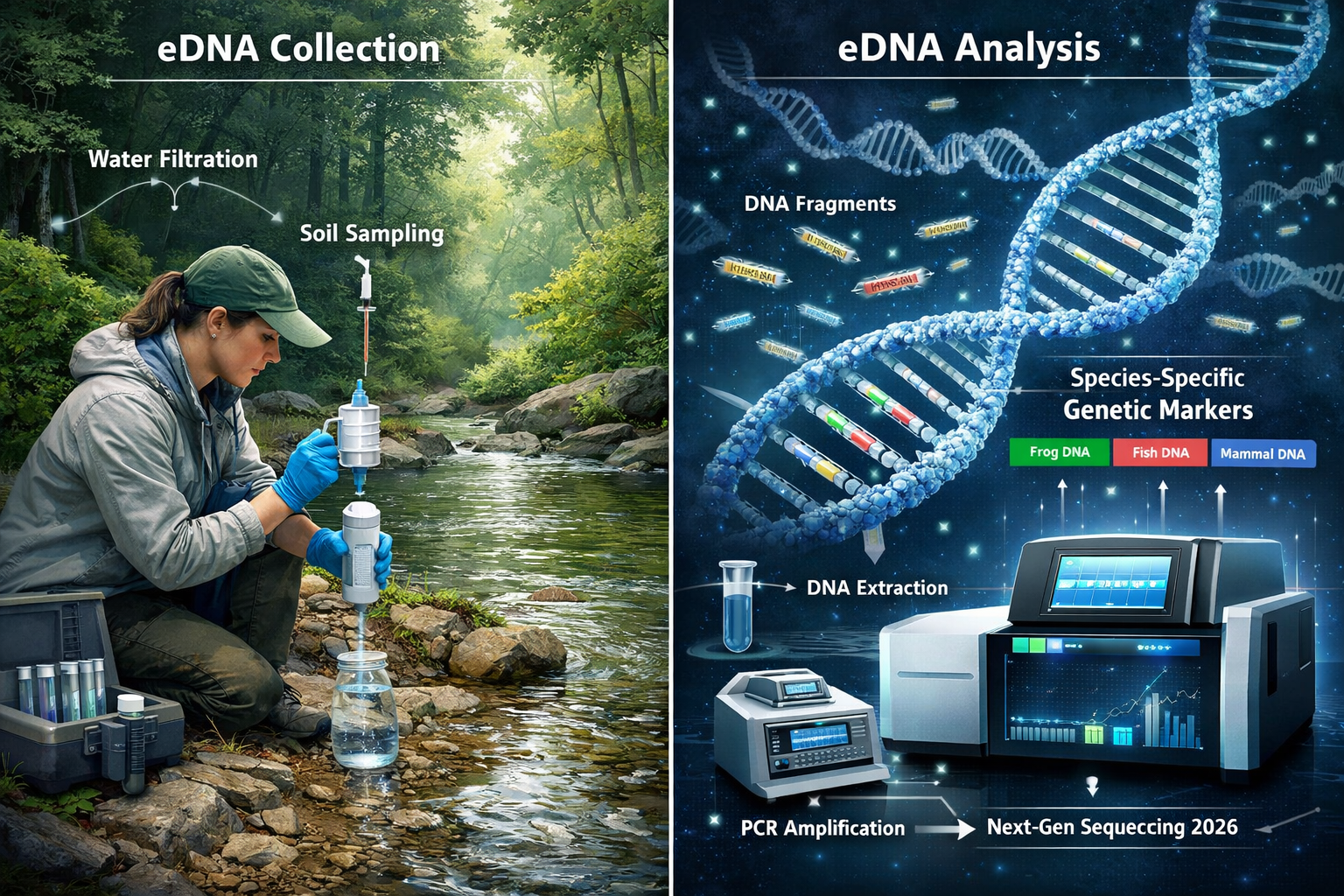
The process follows a straightforward workflow:
- Sample Collection: Field teams filter water, collect soil cores, or capture air samples using standardized equipment
- DNA Extraction: Laboratory technicians isolate genetic material from collected samples
- Amplification & Sequencing: Targeted PCR or metabarcoding techniques identify species-specific DNA sequences
- Bioinformatic Analysis: Software compares sequences against reference databases to confirm species presence
- Reporting: Results generate species lists with detection confidence levels
A January 2026 peer-reviewed synthesis in Ecology and Evolution documented over 15 years of technological refinement, establishing that properly executed eDNA protocols now match or exceed traditional survey accuracy while dramatically reducing field time [4][5].
Why eDNA Matters for Biodiversity Net Gain
For projects requiring biodiversity net gain compliance, eDNA offers distinct advantages:
- ⚡ Speed: Baseline surveys complete in days instead of seasonal monitoring cycles
- 💰 Cost-effectiveness: Reduced field hours lower labor costs substantially
- 🎯 Sensitivity: Detects rare or cryptic species missed by visual observation
- 📊 Standardization: Reproducible protocols create defensible regulatory documentation
- 🌍 Accessibility: Teams can survey remote or hazardous locations safely
The eDNA Expeditions initiative demonstrates this scalability—establishing a global marine biodiversity observatory across 25 sites with data collection protocols that enable consistent monitoring from tropical reefs to polar waters [1].
eDNA Advancements in 2026 Biodiversity Surveys: Standardized Field Protocols
The most significant advancement in 2026 is the systematization of field protocols that ensure data quality regardless of who collects samples. Research teams at Swedish University of Agricultural Sciences are developing standardized protocols specifically for forest biodiversity assessment, with applications extending to conservation area identification [2].
Aquatic Environment Sampling Protocols
Water sampling remains the most mature eDNA application, with protocols refined through thousands of surveys:
Equipment Requirements
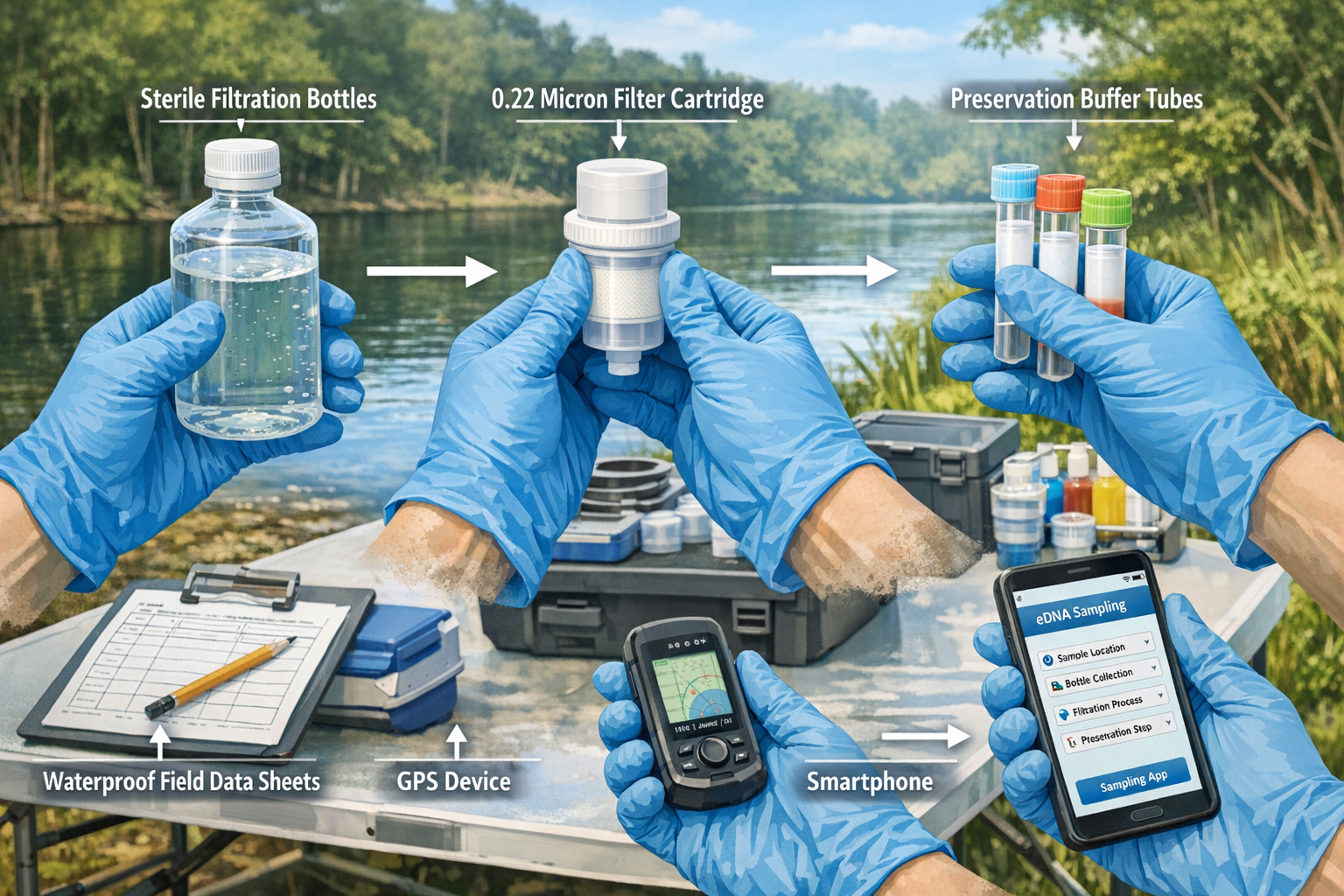
- Sterile filtration bottles (1-2 liters capacity)
- 0.22–0.45 μm pore size filter cartridges (standardized specification) [4]
- Preservation buffer or ethanol (95%+)
- Nitrile gloves (powder-free)
- Waterproof field data sheets
- GPS device for precise location recording
Step-by-Step Collection Process
- Pre-sampling preparation: Don clean gloves, label bottles with site ID, date, and time
- Site selection: Choose representative locations avoiding obvious contamination sources
- Collection technique: Collect water from mid-depth (avoid surface film and bottom sediment)
- Filtration: Pass water through filter using hand pump or vacuum system
- Preservation: Transfer filter to preservation buffer immediately
- Storage: Keep samples cool (4°C) until laboratory delivery
- Documentation: Record GPS coordinates, water temperature, pH, and environmental conditions
The eDNA Expeditions network provides full technical support and online training that guides participants step-by-step, enabling anyone from experts to non-scientists to collect scientifically valid samples [1].
Terrestrial Environment Sampling Protocols
Soil eDNA collection follows parallel standardization, with PCI/DNeasy methods established as best practice [4]:
| Parameter | Specification | Purpose |
|---|---|---|
| Sample depth | 0-10 cm | Captures recent organism activity |
| Sample volume | 25-50 grams | Sufficient DNA yield |
| Spatial replication | 3-5 subsamples per site | Accounts for heterogeneity |
| Preservation | -20°C freezing or silica desiccation | Prevents DNA degradation |
| Contamination control | Sterile tools between samples | Eliminates cross-contamination |
Atmospheric eDNA Sampling
Air sampling represents the newest frontier, with MD8 samplers now standardized for capturing airborne genetic material [4]. Applications include:
- Pollen and plant diversity monitoring
- Insect population assessment
- Pathogen detection in agricultural settings
- Urban biodiversity surveys in built environments
Critical Contamination Prevention Measures
Contamination is identified as the most common source of false positives in eDNA surveys [3]. Field protocols must include:
✅ Equipment sterilization between sites using 10% bleach solution
✅ Negative control samples (sterile water processed identically to field samples)
✅ Upstream-to-downstream sampling to prevent cross-contamination
✅ Dedicated equipment sets for invasive species detection
✅ Detailed chain-of-custody documentation for regulatory applications
Rapid Species Detection: From Field to Results in 2026
The promise of eDNA advancements in 2026 biodiversity surveys: field protocols for rapid species detection materializes in dramatically compressed timelines. Where traditional surveys require multiple seasonal visits spanning 6-12 months, modern eDNA workflows deliver actionable results within a week.
Timeline Comparison: Traditional vs. eDNA Surveys
Traditional Biodiversity Survey
- Week 1-4: Initial site reconnaissance and habitat mapping
- Month 2-6: Seasonal field visits for different species groups
- Month 7-8: Data compilation and species identification
- Month 9-10: Report writing and quality review
- Total: 9-10 months
Modern eDNA Survey
- Day 1: Field sampling (2-4 hours per site)
- Day 2: Sample delivery to laboratory
- Day 3-5: DNA extraction, amplification, and sequencing
- Day 6-7: Bioinformatic analysis and species identification
- Total: 7-10 days
Laboratory Processing Advancements
Modern biomolecular laboratories processing eDNA samples employ standardized workflows that maximize throughput while maintaining quality:
- Automated extraction platforms: Robotic systems process 96 samples simultaneously
- Metabarcoding panels: Multiplex PCR targets multiple taxonomic groups in single reactions
- Next-generation sequencing: High-throughput platforms generate millions of sequence reads
- AI-powered bioinformatics: Machine learning algorithms accelerate species identification
The eDNA Expeditions network uses "tree-of-life" workflow analyses capable of detecting biodiversity across all domains—from microbes to megafauna—with site-specific curated species lists generated from samples processed at specialized facilities [1].
Integrated Monitoring Workflows for Regulatory Compliance
Best practice in 2026 combines multiple detection methods rather than relying exclusively on eDNA [3]:
Phase 1: eDNA Screening
- Rapid species detection flags concern zones
- Identifies areas requiring focused attention
- Generates preliminary species inventories
Phase 2: Confirmation Monitoring
- Camera trap deployment at eDNA-positive locations
- Visual surveys targeting detected species
- Physical evidence collection where appropriate
Phase 3: Management Response
- Targeted interventions based on confirmed presence
- Habitat enhancement for protected species
- Invasive species removal where detected
Phase 4: Verification
- Follow-up eDNA testing confirms intervention success
- Repeat sampling validates species persistence
- Documentation supports biodiversity net gain reporting
This integrated loop creates defensible evidence chains that satisfy regulatory requirements while accelerating project timelines.
Three Primary Applications for Rapid Detection
eDNA testing in 2026 focuses on three standardized applications [3]:
1. Early Detection 🔍
Identifying invasive species at densities too low for nets or visual surveys. This capability proves invaluable for developers conducting baseline assessments before construction begins, ensuring no protected species are overlooked.
2. Surveillance of High-Risk Locations 🎯
Monitoring farm ponds, reservoirs, boat ramps, irrigation canals, and tributaries where species introductions are likely. Regular eDNA surveillance creates early warning systems that prevent establishment.
3. Post-Removal Verification ✅
Confirming eradication success after invasive species removal or validating habitat enhancement effectiveness. Follow-up eDNA testing provides objective evidence that interventions achieved intended outcomes.
Field Deployment Guides for Challenging Terrains
eDNA advancements in 2026 biodiversity surveys: field protocols for rapid species detection extend beyond standardized methods to include terrain-specific guidance that maintains protocol integrity in difficult conditions.
Remote and Mountainous Environments
Indigenous and university scientists are advancing protocols specifically designed for remote wildlife monitoring, combining traditional ecological knowledge with modern molecular techniques [6]. Key adaptations include:
- Lightweight filtration systems: Portable hand-pump filters weighing under 1 kg
- Solar-powered refrigeration: Maintaining sample integrity without grid electricity
- Satellite communication: Uploading field data from locations without cellular coverage
- Multi-day sampling campaigns: Protocols for extended field work in backcountry settings
A collaborative project documented in March 2026 demonstrates how proper training enables community-based monitoring in challenging mountain stream locations, expanding survey capacity while respecting indigenous knowledge systems [6].
Urban and Developed Landscapes
Built environments present unique contamination risks requiring modified protocols:
Urban Water Bodies
- Sample upstream of stormwater outfalls
- Increase negative control frequency
- Document potential contamination sources
- Consider seasonal variation in urban runoff
Brownfield and Remediation Sites
- Account for chemical inhibitors in soil samples
- Use increased sample volumes to overcome inhibition
- Conduct preliminary soil chemistry analysis
- Validate DNA extraction efficiency with spiked controls
Agricultural and Working Lands
For projects involving sustainable farming initiatives or agricultural biodiversity assessments:
- Timing considerations: Avoid sampling immediately after pesticide application
- Spatial design: Grid sampling captures field-scale heterogeneity
- Pollinator detection: Air sampling complements traditional insect surveys
- Soil health indicators: Microbial eDNA reveals ecosystem function
Wetlands and Transitional Habitats
Wetland sampling requires specialized approaches:
- Water depth variation: Collect samples from multiple depths in stratified water columns
- Sediment eDNA: Core sampling captures historical species presence
- Seasonal dynamics: Protocol timing accounts for wet/dry cycles
- Vegetation interference: Clear sampling areas without disturbing substrate
Practical Implementation for Biodiversity Net Gain Projects
Developers and ecologists implementing biodiversity net gain strategies can integrate eDNA surveys into project workflows:
Pre-Development Baseline Assessment
Objective: Document existing biodiversity before site disturbance
eDNA Protocol:
- Conduct sampling during optimal detection season (typically spring/summer)
- Target multiple habitat types (aquatic, terrestrial, edge zones)
- Include reference samples from adjacent undisturbed areas
- Generate comprehensive species inventories for metric calculation
Timeline: 2-3 weeks from sampling to final report
Output: Species lists supporting biodiversity impact assessments and baseline metric calculations
Post-Enhancement Monitoring
Objective: Verify habitat creation/enhancement achieves target biodiversity
eDNA Protocol:
- Repeat baseline sampling locations for direct comparison
- Add new sampling points in enhanced habitats
- Conduct seasonal monitoring to track colonization
- Compare results against target species lists
Timeline: Quarterly sampling over 2-3 years
Output: Quantitative evidence of biodiversity gain for regulatory reporting
Invasive Species Screening
Objective: Detect invasive species before they become established
eDNA Protocol:
- Target high-risk introduction points (water features, material delivery areas)
- Use species-specific assays for known regional invaders
- Implement rapid response protocols when detections occur
- Conduct post-treatment verification sampling
Timeline: 1 week per sampling event
Output: Early warning system preventing costly infestations
Cost Considerations and Accessibility
The democratization of eDNA testing between 2024 and 2026 dramatically reduced barriers to entry [3]:
Typical Cost Structure (2026)
| Service Component | Cost Range | Notes |
|---|---|---|
| Field sampling kit | £50-150 | Reusable equipment reduces per-sample costs |
| Laboratory analysis (single species) | £100-250 per sample | PCR-based detection |
| Metabarcoding (multi-species) | £300-600 per sample | Comprehensive biodiversity assessment |
| Bioinformatic analysis | £150-400 | Species identification and reporting |
| Consultation and interpretation | £500-1,500 | Expert review of results |
DIY vs. Professional Services
Self-Collection with Professional Analysis
- Developers purchase standardized kits
- Field teams collect samples following online protocols
- Samples ship to accredited laboratories
- Savings: 30-50% compared to full-service surveys
Full-Service Professional Surveys
- Experienced ecologists conduct sampling
- Quality assurance protocols ensure data defensibility
- Integrated reporting for regulatory compliance
- Advantage: Reduced risk of protocol errors
For projects requiring biodiversity net gain compliance, professional services typically provide better value by ensuring results satisfy regulatory scrutiny.
Quality Assurance and Data Validation
Reliable eDNA surveys require rigorous quality control:
Laboratory Accreditation
Choose laboratories with:
- ISO 17025 accreditation for molecular analysis
- Published validation studies for target species
- Participation in proficiency testing programs
- Transparent reporting of detection limits and error rates
Data Interpretation Guidelines
Positive Detection: Species DNA present in sample
- Interpretation: Species likely present in sampled area within recent timeframe
- Confidence level: High when multiple samples positive
- Action: Proceed to confirmation monitoring
Negative Detection: Species DNA absent from sample
- Interpretation: Species absent, present below detection limit, or sampling missed occupied areas
- Confidence level: Moderate; absence of evidence ≠ evidence of absence
- Action: Consider additional sampling or alternative methods
Ambiguous Results: Weak signals or contamination indicators
- Interpretation: Uncertain; requires repeat sampling
- Confidence level: Low
- Action: Resample with enhanced contamination controls
Regulatory Acceptance
Legal acceptance of eDNA as "probable cause" is increasing but remains geographically uneven [3]. Best practice includes:
- Supplementing eDNA with traditional methods for critical decisions
- Documenting chain of custody meticulously
- Using accredited laboratories with established track records
- Engaging early with regulatory authorities on protocol acceptance
Future Directions and Emerging Technologies
While 2026 represents a milestone in eDNA standardization, ongoing developments promise further advances:
Real-Time Field Analysis
Portable sequencing devices are transitioning from research tools to field-ready equipment:
- Handheld sequencers: Species identification in hours rather than days
- Smartphone integration: AI-powered apps guide sampling and preliminary analysis
- Cloud connectivity: Instant data sharing with project teams and regulators
Quantitative eDNA
Moving beyond presence/absence to abundance estimation:
- Correlating DNA concentration with population size
- Tracking population trends over time
- Supporting adaptive management decisions
Multi-Omics Integration
Combining eDNA with complementary molecular approaches:
- RNA analysis: Detecting metabolically active organisms
- Isotope analysis: Understanding food web relationships
- Microbiome profiling: Assessing ecosystem health
Conclusion
The eDNA advancements in 2026 biodiversity surveys: field protocols for rapid species detection represent a fundamental shift in how projects approach biodiversity assessment. Standardized protocols now enable rapid, cost-effective species detection that accelerates biodiversity net gain validation while maintaining scientific rigor.
For developers, planners, and ecologists, the practical implications are clear:
✅ Baseline assessments complete in weeks instead of months
✅ Comprehensive species inventories from single sampling events
✅ Early detection of invasive species prevents costly management
✅ Objective monitoring validates habitat enhancement success
✅ Defensible documentation supports regulatory compliance
Actionable Next Steps
For Developers Planning Projects:
- Integrate eDNA surveys into early-stage biodiversity planning
- Budget for baseline eDNA assessment alongside traditional surveys
- Engage accredited laboratories early to discuss protocol design
- Plan post-enhancement monitoring using repeat eDNA sampling
For Ecologists Conducting Surveys:
- Pursue training in standardized eDNA protocols through recognized programs
- Establish relationships with accredited molecular laboratories
- Develop integrated monitoring workflows combining eDNA with traditional methods
- Document protocols meticulously for regulatory review
For Landowners and Conservation Managers:
- Consider eDNA surveillance for early invasive species detection
- Explore citizen science opportunities through initiatives like eDNA Expeditions
- Use eDNA monitoring to track habitat restoration success
- Investigate biodiversity unit opportunities on managed lands
The convergence of standardized protocols, accessible technology, and regulatory acceptance positions eDNA as an essential tool in the modern biodiversity surveyor's toolkit. Projects that embrace these advancements gain competitive advantages through faster timelines, reduced costs, and more comprehensive species detection—ultimately supporting better conservation outcomes and more successful biodiversity net gain delivery.
References
[1] eDNA Expeditions – https://ednaexpeditions.org
[2] Establishing Standardized Protocols For Using Environmental Dna To Assess Biodiversity Of Forests – https://www.slu.se/en/research/research-catalogue/projekt/e/establishing-standardized-protocols-for-using-environmental-dna-to-assess-biodiversity-of-forests/
[3] Edna Testing For Invasive Species – https://landwildlifereport.com/2026/01/20/edna-testing-for-invasive-species/
[4] pubmed.ncbi.nlm.nih.gov – https://pubmed.ncbi.nlm.nih.gov/41522225/
[5] Ece3 – https://onlinelibrary.wiley.com/doi/10.1002/ece3.72891
[6] Indigenous And University Scientists Advance Protocols For Edna Wildlife Monitoring – https://envirobites.org/2026/03/26/indigenous-and-university-scientists-advance-protocols-for-edna-wildlife-monitoring/