

Nine days. That is all the time left for developers, planners and landowners to respond before Natural England closes the consultation on the first Environmental Delivery Plan (EDP) ever published under the Planning and Infrastructure Act 2025. The Norfolk Environmental Delivery Plan nature restoration levy is not a theoretical reform sitting in a white paper, it is a live, priced mechanism that could determine whether thousands of homes across six Norfolk council areas get built this decade.
Published on 17 September 2026 and confirmed by a Defra written ministerial statement on 12 October 2026 (HLWS363), the draft Norfolk EDP sets a flat charge of £2,675 per dwelling for developers who want to discharge nutrient neutrality obligations through a single pooled payment rather than bespoke mitigation. The consultation window closes at 9.29am on 27 October 2026, a precise, almost clinical deadline that leaves little room for late submissions.
This article sets out what the plan covers, who can use it, how the levy compares with existing nutrient mitigation routes, and what ecologists and developers should be doing right now.
Key Takeaways
- The Norfolk Environmental Delivery Plan nature restoration levy is set at £2,675 per dwelling (flat rate), before RICS CIL indexation and VAT, under draft rules open for consultation until 27 October 2026.
- The plan could unlock up to 15,780 homes across South Norfolk, Broadland, Norwich, Breckland, North Norfolk, King's Lynn and West Norfolk, and the Broads Authority area, but only for sites outside a 50-metre buffer around the Wensum, Bure and Yare protected sites.
- Participation is voluntary; developers can still pursue bespoke nutrient neutrality credits or on-site solutions instead.
- The levy funds 109 hectares of fen wetland restoration, 1km of River Wensum works, and species-specific measures secured for at least 100 years, but mandatory Biodiversity Net Gain obligations remain entirely separate and unaffected.
- Ecologists should be preparing baseline surveys, Habitats Regulations screening and BNG assessments now, regardless of whether a site ultimately uses the EDP.
What Is the Norfolk Environmental Delivery Plan Nature Restoration Levy?
The EDP is Natural England's response to a long-running problem: nutrient pollution from new housing harming the Broads Special Area of Conservation, the Broadland Ramsar site and the River Wensum SAC. Instead of every developer negotiating bespoke phosphorus or nitrogen mitigation, the Norfolk Environmental Delivery Plan nature restoration levy lets eligible schemes pay a single standardised charge and hand responsibility for offsetting their nutrient impact to Natural England.
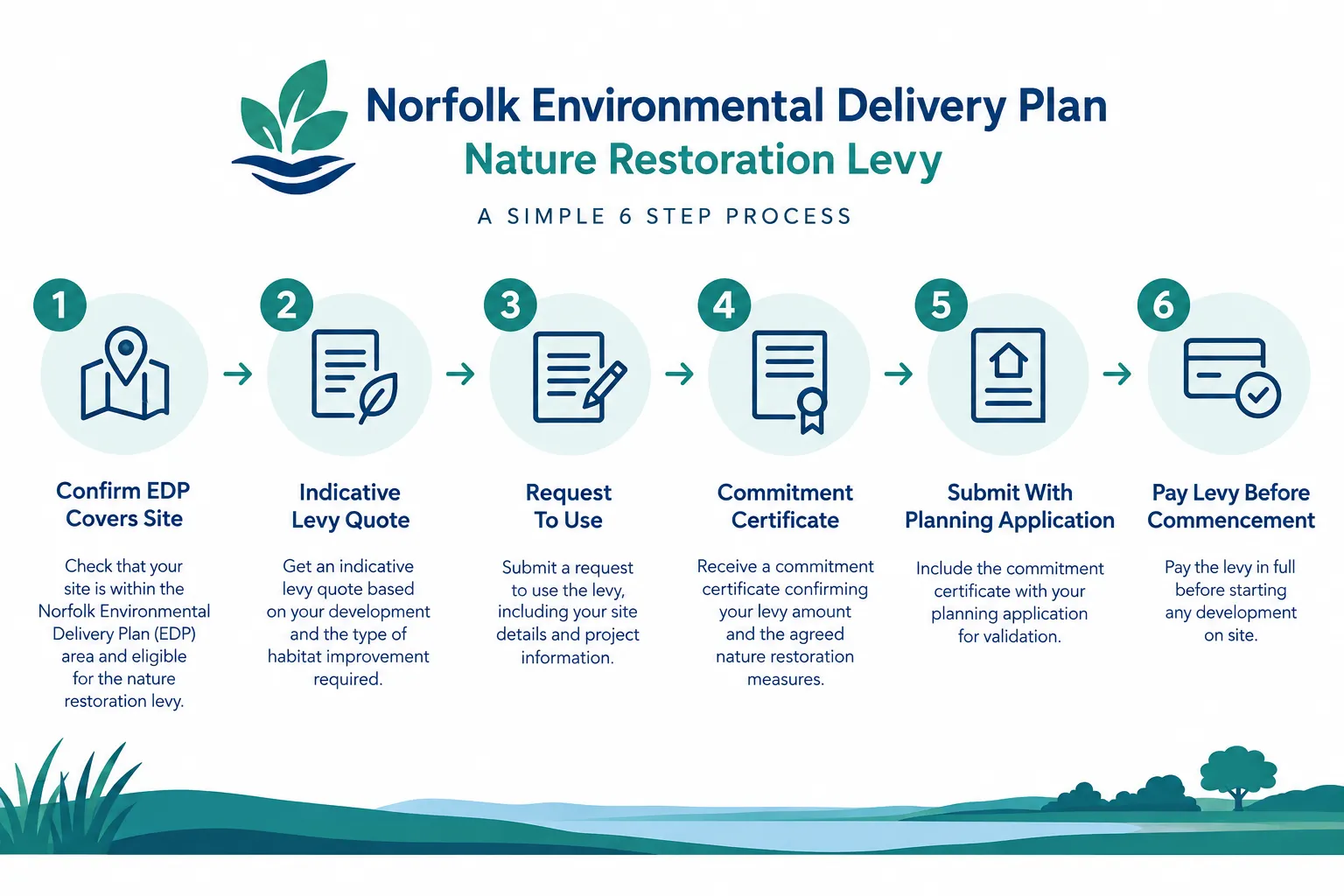
The charge is £2,675 per house or flat, applied flatly regardless of dwelling size, before annual indexation to the RICS CIL index and before VAT (the draft states 20% VAT applies, though applicants should verify final charging documents). For a 10-home scheme, that works out at £26,750 before indexation or VAT is added. The legal foundation is the Nature Restoration Levy Regulations 2026 (SI 2026/1020), made on 10 September 2026 and in force from 11 September.
Natural England has modelled capacity for up to 15,780 homes, assuming 75% delivery and 80% take-up of the scheme. That figure featured in earlier Biodiversity Surveyors coverage of the draft Norfolk plan's £2,675 levy and 15,780-home capacity, and it remains the headline number nine months, or rather weeks, from the consultation deadline.
Levy vs Bespoke Nutrient Credits: A Cost Comparison Framing
For years, developers in nutrient-sensitive catchments have negotiated individual mitigation packages, often through off-site nutrient credit purchases priced on a scheme-by-scheme basis. The EDP's flat £2,675 figure offers something those bespoke markets rarely do: price certainty before planning submission.
That said, flat pricing cuts both ways. Campaigners quoted by Jones Day in October 2026 commentary argue the levy is too low to reflect the true cost of restoring degraded habitats, while Natural England counters that pooling contributions from many small schemes allows landscape-scale restoration, such as the 109 hectares of fen wetland work, that individual developers could never deliver alone. Developers weighing the EDP against bespoke credits should treat the levy as one option among several, not an automatic default, particularly where a site's own habitat strategy could deliver comparable or better outcomes through on-site biodiversity net gain delivery.
Which Norfolk Sites Can and Cannot Use the Plan
Eligibility is geographically precise. The EDP covers nutrient pollution from housing in the River Wensum (phosphorus), Bure Broads and Marshes (phosphorus and nitrogen), and Yare Broads and Marshes (phosphorus and nitrogen) catchments, within South Norfolk, Broadland, Norwich, Breckland, North Norfolk, King's Lynn and West Norfolk, and the Broads Authority area.
Three catchments are explicitly excluded: Ant Broads and Marshes, Trinity Broads, and Upper Thurne Broads and Marshes. More significantly, any site wholly or partly within 50 metres of the Bure or Yare Broads and Marshes sites, or the River Wensum SAC, cannot use the plan at all, regardless of which council area it sits in. Developers near these boundaries will need bespoke Habitats Regulations Assessment and nutrient neutrality routes outside the EDP, a point echoed in guidance on building a biodiversity plan for English development projects.
Sites relying on non-mains drainage face an additional condition: package treatment plants must be installed and operating before occupation, meeting discharge limits of 5 mg/l total phosphorus and 27 mg/l total nitrogen.
How to Respond to the Consultation Before 27 October
With the window closing at 9.29am on 27 October 2026, time for formal representations is short. Developers and landowners with sites in the affected catchments should:
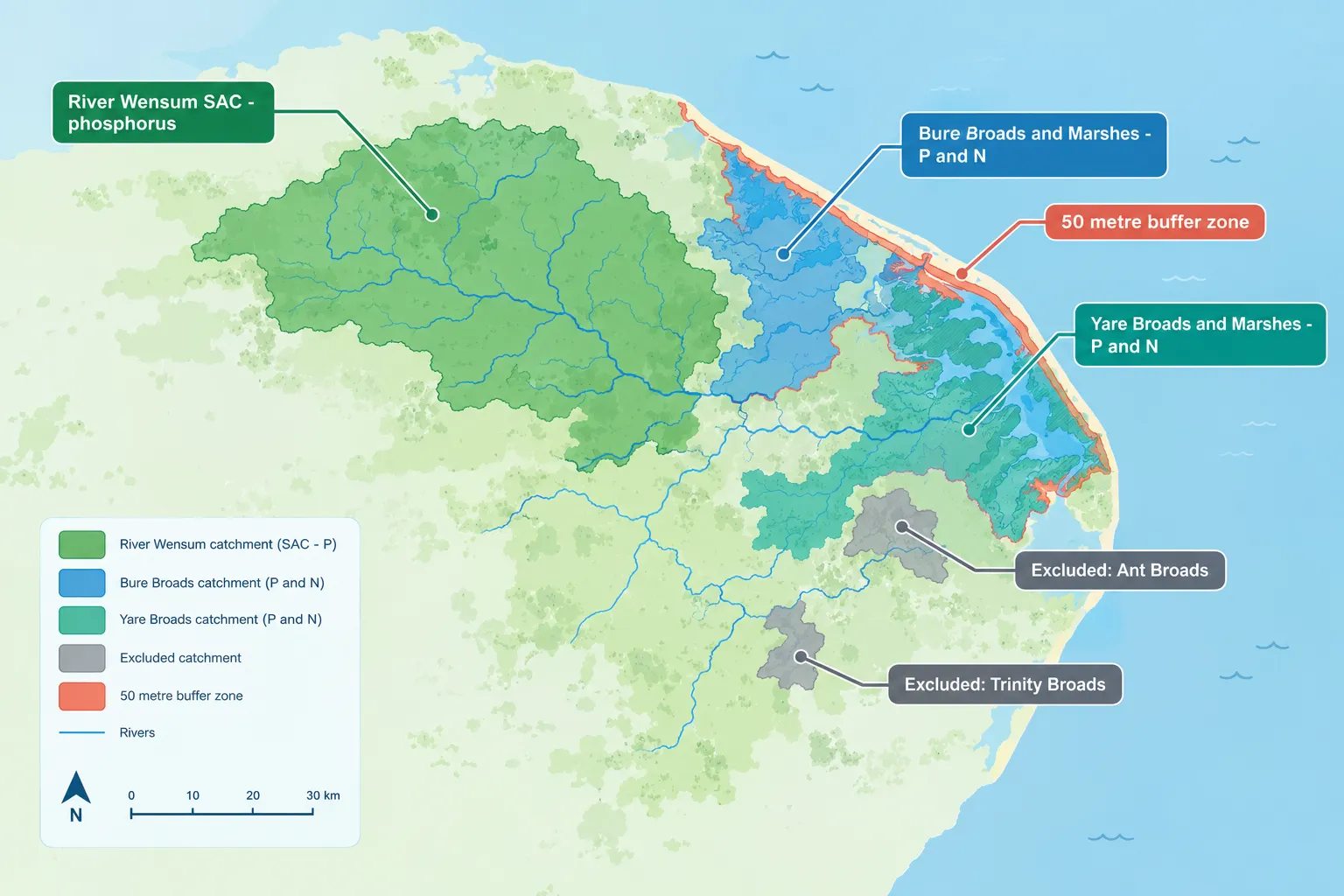
- Check whether their site falls inside the eligible catchments and outside the 50-metre exclusion buffer.
- Review the conservation programme detail, the fen wetland creation, Wensum river structure works, and Desmoulin's whorl snail habitat measures, to assess whether the "overall improvement test" claims are credible for their locality.
- Submit comments on the levy rate, the six-year cut-off for new levy requests within the ten-year plan period, and the adequacy of 100-year legal securing of measures.
- Flag concerns about voluntary-versus-mandatory status, since a mandatory EDP would require Secretary of State approval and change how reliably developers can plan around it.
What Ecologists and Developers Should Prepare Now
Whether or not a scheme ultimately uses the levy, the EDP process does not remove any existing ecological obligations. Biodiversity Net Gain remains mandatory and sits entirely outside Part 3 of the Act, the off-site BNG unit market continues unchanged, as explored in guidance on translating biodiversity survey results into long-term BNG management plans.
Practical preparation should include:
- Baseline ecological surveys, completed early enough to support both BNG metric calculations and any EDP eligibility check.
- Habitats Regulations Assessment screening for impacts falling outside the EDP's defined scope, particularly for sites near the 50-metre exclusion zones.
- Early engagement with Local Nature Recovery Strategy priorities, since EDP-funded habitat creation may intersect with wider strategic nature recovery mapping.
- Drainage strategy work for any non-mains sites, given the fixed phosphorus and nitrogen discharge limits attached to package treatment plants.
Criticism and What Natural England Says
The EDP has not escaped scrutiny. Reporting from Jones Day in October 2026 captured campaigner concerns that the model amounts to a "pay-to-pollute" approach: nutrient pollution happens now, while restoration measures, fen creation, river structure removal, deer management, may take years to deliver tangible nutrient reduction. Critics also question whether deer management genuinely reduces nutrient loading, and argue £2,675 undervalues the true restoration cost.
Natural England's counterargument is pragmatic: pooled funding across many developments can finance landscape-scale restoration that scattered, scheme-by-scheme mitigation cannot achieve, while giving builders upfront cost certainty that bespoke negotiations rarely offer.
What to Watch Next
Three things will shape how this plays out. First, whether the Secretary of State approves a mandatory version of the EDP, which would remove the voluntary opt-in currently in place. Second, how Natural England responds to consultation feedback before finalising charging documents, including the VAT treatment. Third, whether further EDPs emerge in other nutrient-sensitive catchments nationally, using Norfolk as the template, a trend worth tracking alongside broader BNG reform activity, including NSIP-related BNG deadline changes.
Frequently Asked Questions
Is the Norfolk Environmental Delivery Plan nature restoration levy mandatory?
No. Participation is voluntary by default. A mandatory EDP would require separate Secretary of State approval.
Does paying the levy replace Biodiversity Net Gain requirements?
No. BNG sits outside Part 3 of the Planning and Infrastructure Act 2025 and remains a separate, mandatory obligation alongside any EDP levy payment.
How much does the levy cost per home?
£2,675 per dwelling, flat rate, before RICS CIL indexation and VAT. Ten homes would cost £26,750 before indexation and VAT.
Can every Norfolk developer use the plan?
No. Sites must sit within specific catchments and council areas, and cannot be within 50 metres of the Bure or Yare Broads and Marshes sites or the River Wensum SAC.
What happens if I get a commitment certificate but delay my planning application?
The commitment certificate expires after six months if no planning application has been submitted.
When does the consultation close?
At 9.29am on 27 October 2026.
Conclusion
The Norfolk Environmental Delivery Plan nature restoration levy represents the first real test of how England's Nature Restoration Fund model will work in practice, pooled money, flat pricing, and landscape-scale conservation promises set against genuine questions about pace and proof of outcome. For developers and landowners in the affected catchments, the immediate priority is simple: check eligibility against the catchment map and 50-metre exclusion zones, read the conservation programme detail, and submit consultation comments before 9.29am on 27 October 2026. Ecologists should press ahead with baseline surveys, HRA screening and BNG assessments regardless of the EDP's outcome, since those obligations do not disappear. Firms such as Biodiversity Surveyors continue to track how this first EDP evolves, and further EDPs are likely to follow its template in other nutrient-sensitive catchments across England.
References
- Natural England, draft Norfolk Environmental Delivery Plan consultation, published 17 September 2026
- Defra, Written Ministerial Statement HLWS363, 12 October 2026
- Nature Restoration Levy Regulations 2026 (SI 2026/1020), made 10 September 2026, in force 11 September 2026
- Jones Day, commentary on Norfolk EDP criticism, October 2026