

The way we measure biodiversity is undergoing a radical shift. In 2026, field surveyors face an exciting yet challenging landscape where traditional observation methods meet cutting-edge technologies like environmental DNA (eDNA) sampling and acoustic monitoring. Recent research published in PNAS outlines nine fundamental changes needed to transform biodiversity measurement [2], providing a roadmap for ecologists working to implement these innovations in compliance with modern conservation requirements. Understanding these Nine Transformations in Biodiversity Measurement: Field Protocols for Surveyors Adopting eDNA and Acoustics in 2026 is essential for professionals conducting surveys that meet regulatory standards while leveraging technological advances.
Key Takeaways
- 🧬 Technology integration is essential: eDNA, acoustic monitoring, and AI must work together with traditional methods to create comprehensive biodiversity assessments
- 📊 Standardized protocols are critical for ensuring data quality and comparability across different survey projects and geographic regions
- 🌍 Data validation against existing baselines ensures emerging technologies produce reliable results for regulatory compliance
- 🤝 Collaborative frameworks that value data generation efforts and incorporate diverse knowledge sources strengthen biodiversity measurement systems
- ✅ Conservation effectiveness can finally be quantified when modern measurement systems are properly implemented in field surveys
Understanding the Transformation in Biodiversity Measurement
Biodiversity measurement has traditionally relied on visual surveys, manual species identification, and time-intensive field observations. While these methods remain valuable, they often miss cryptic species, nocturnal animals, and organisms that are difficult to detect through conventional means. The Nine Transformations in Biodiversity Measurement: Field Protocols for Surveyors Adopting eDNA and Acoustics in 2026 represent a fundamental shift toward more comprehensive, technology-enabled assessment methods [1].
These transformations are particularly relevant for surveyors working on development projects requiring biodiversity net gain assessments, where accurate baseline data determines project requirements and success metrics.
Why Traditional Methods Need Enhancement
Traditional biodiversity surveys face several limitations:
- Limited detection: Visual surveys miss species that are rare, nocturnal, or cryptic
- Observer bias: Different surveyors may record different results in the same location
- Time constraints: Comprehensive manual surveys require extensive field time
- Seasonal limitations: Many species can only be detected during specific periods
- Taxonomic expertise: Identifying species requires specialized knowledge that may not always be available
Modern technologies address these gaps by detecting species through DNA traces in environmental samples and recording vocalizations continuously over extended periods.
Transformation 1: Capitalizing on Technology Integration
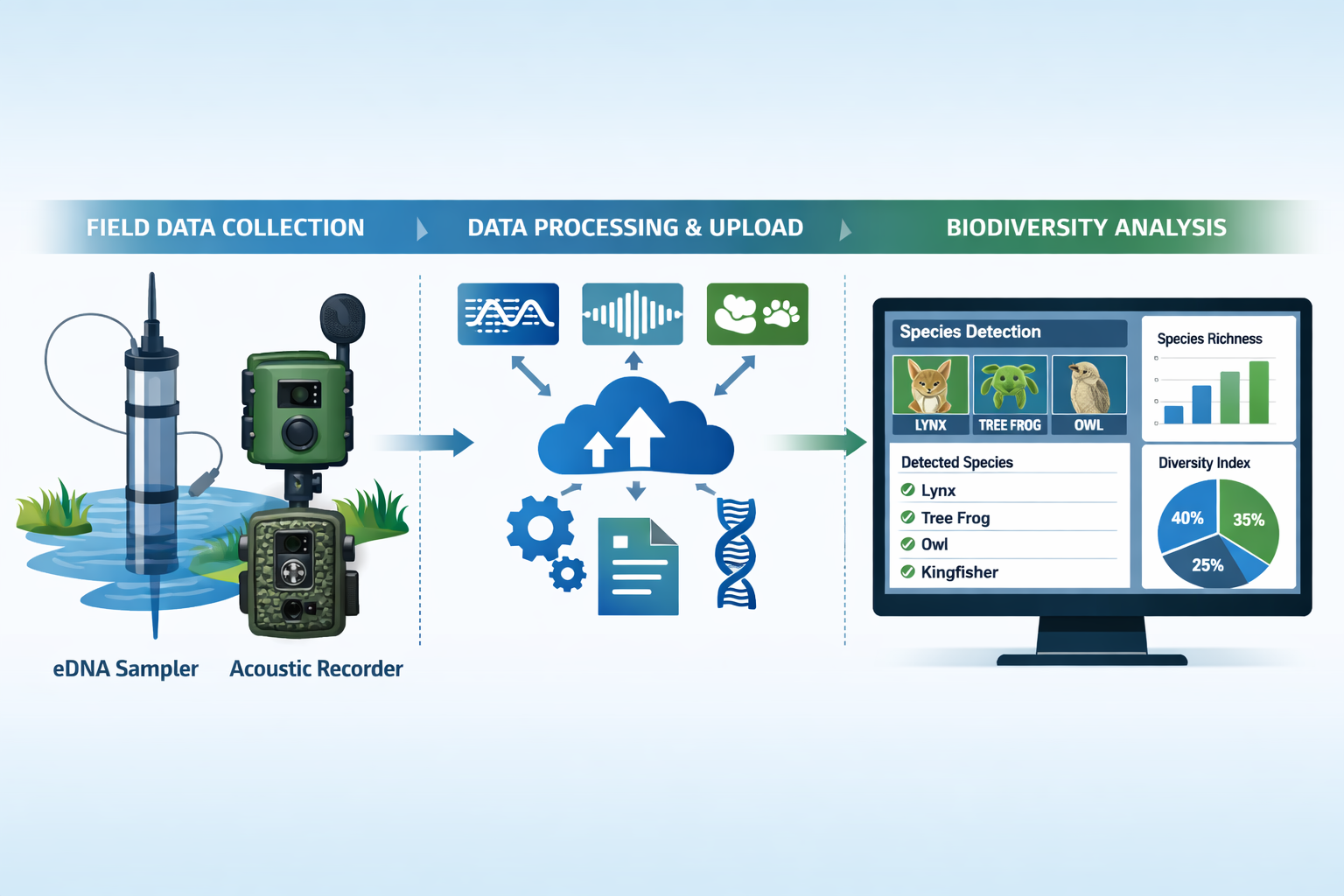
The first transformation involves integrating multiple data sources to create comprehensive biodiversity assessments [2]. Rather than viewing eDNA, acoustic monitoring, camera traps, and traditional surveys as competing methods, surveyors must learn to combine them strategically.
Implementing Multi-Method Field Protocols
For field surveyors in 2026, this means developing protocols that:
Combine complementary technologies:
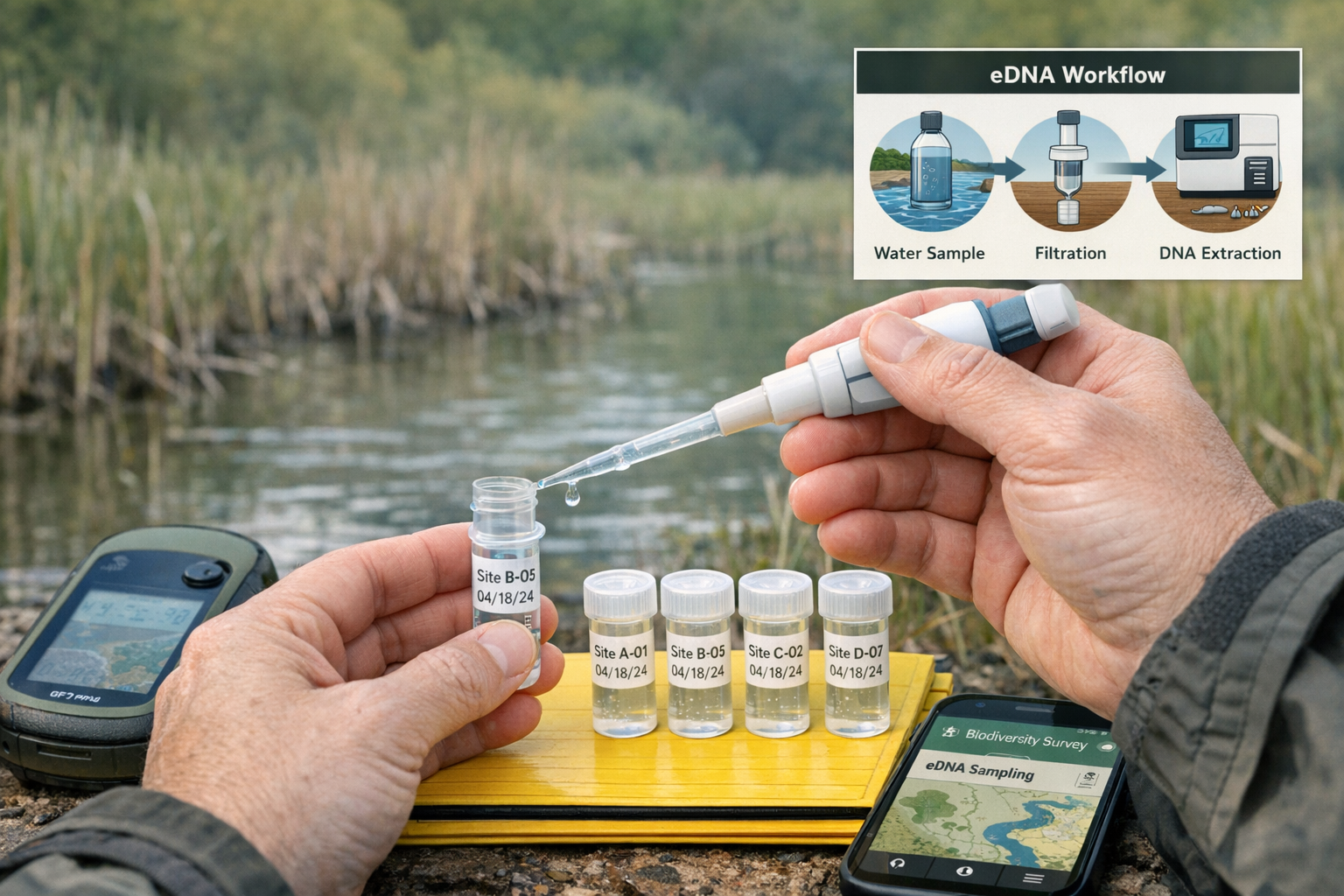
- Use eDNA sampling to detect aquatic species and terrestrial animals near water sources
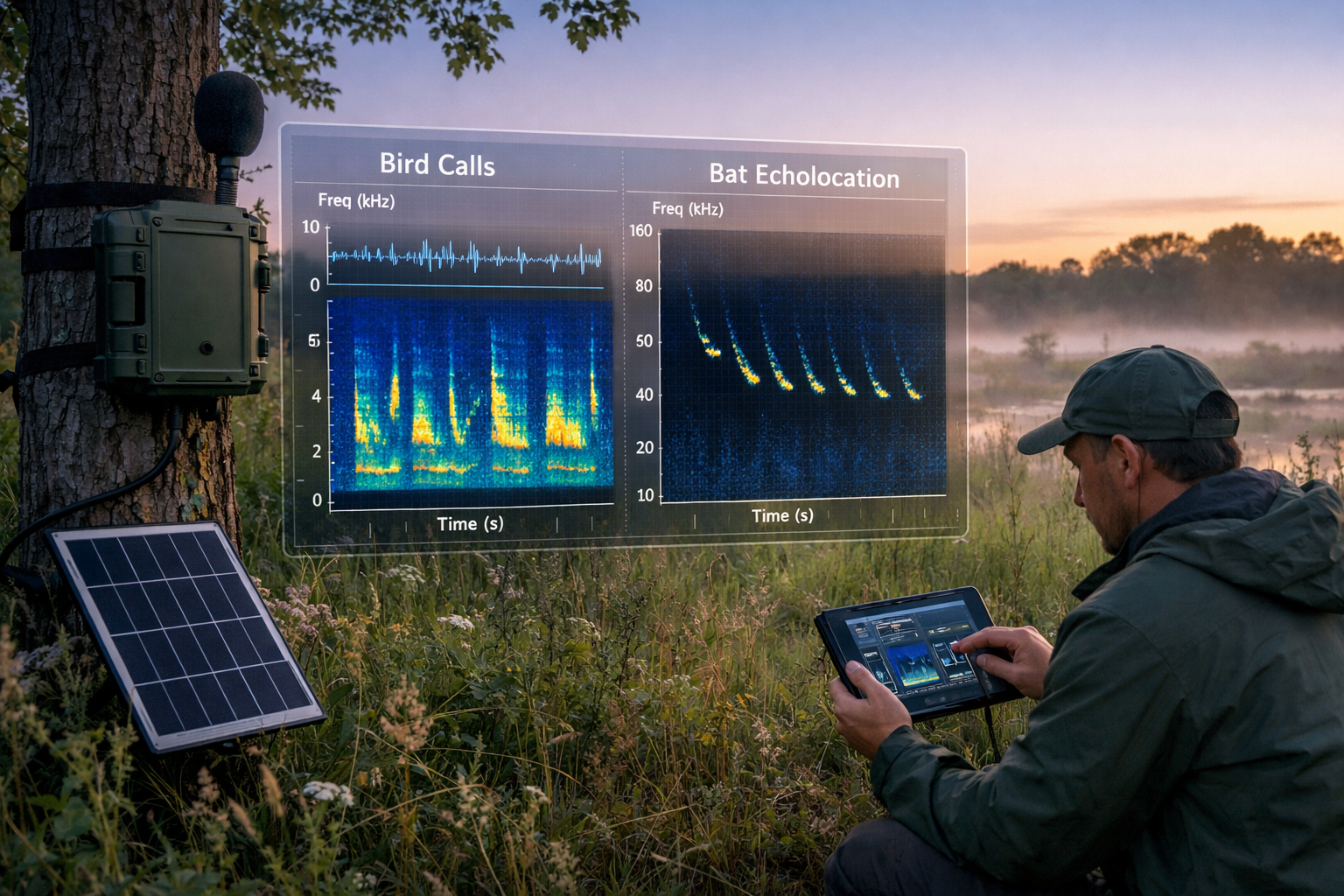
- Deploy acoustic recorders to monitor birds, bats, amphibians, and insects
- Conduct visual surveys to provide context and validate technological detections
- Install camera traps for mammal detection in strategic locations
Create integrated sampling schedules:
- Coordinate eDNA collection with acoustic deployment timing
- Align traditional survey windows with technology-based monitoring periods
- Schedule laboratory analysis to provide timely results for project timelines
Develop data fusion strategies:
- Create unified species lists from all detection methods
- Cross-reference detections across different technologies
- Resolve taxonomic discrepancies between methods
- Generate comprehensive biodiversity metrics that reflect all data sources
This integrated approach is essential for developers working to achieve biodiversity net gain targets, as it provides more complete baseline assessments.
Emerging Technologies on the Horizon
Beyond eDNA and acoustics, surveyors should prepare for additional innovations:
- TinyML devices: Low-power machine learning devices that can identify species in real-time without internet connectivity [4]
- Optical AI chips: Energy-efficient processors enabling broader deployment of automated monitoring
- Advanced genomics: Metabarcoding techniques that identify entire communities from single samples
- Remote sensing integration: Satellite and drone imagery combined with ground-based biological data
Transformation 2: Standardizing Data Collection Methods
The second transformation addresses the critical need for standardized protocols across biodiversity monitoring activities [1]. Without agreed-upon standards, data from different projects cannot be compared or aggregated, limiting their value for conservation planning and policy development.
Developing Standard eDNA Protocols
For eDNA sampling, standardization must address:
Sample collection procedures:
- Water volume collected (typically 1-2 liters for aquatic surveys)
- Number of replicate samples per location (minimum 3 replicates recommended)
- Filtration methods and filter pore sizes (0.45-0.7 μm most common)
- Preservation techniques (ethanol, preservation buffer, or freezing)
- Negative controls to detect contamination
Sampling design:
- Spatial distribution of sampling points
- Temporal frequency of collection
- Environmental conditions documentation
- Chain of custody procedures
Laboratory analysis standards:
- DNA extraction protocols
- PCR amplification parameters
- Primer selection for target taxa
- Sequencing depth and quality thresholds
- Bioinformatics pipelines for species identification
Standardizing Acoustic Monitoring
Acoustic surveys require standardization in:
Equipment specifications:
- Recording frequency range (minimum 20 kHz for birds, 200+ kHz for bats)
- Sampling rate and bit depth
- Microphone sensitivity and directionality
- Weather protection standards
Deployment protocols:
- Recorder placement height and orientation
- Distance from habitat edges
- Recording schedule (continuous vs. programmed intervals)
- Deployment duration (minimum 7 days recommended)
Analysis methods:
- Automated detection algorithms
- Manual validation procedures
- Species identification confidence thresholds
- Reporting formats and metrics
Standardized approaches ensure that biodiversity impact assessments produce consistent, defensible results across different surveyors and geographic locations.
Transformation 3: Calibrating New Technologies with Existing Data
The third transformation emphasizes validation of emerging technologies against established baseline data to ensure consistency and reliability [3]. This calibration process is essential for regulatory acceptance and scientific credibility.
Validation Strategies for Field Surveyors
Effective calibration involves:
Parallel sampling campaigns:
- Conduct traditional surveys alongside eDNA and acoustic monitoring
- Compare species detection rates between methods
- Identify which species are reliably detected by each technology
- Document false positives and false negatives
Reference database development:
- Build local reference libraries of DNA sequences for target species
- Create acoustic reference libraries of regional species vocalizations
- Validate automated identification algorithms against expert identifications
- Update databases as taxonomic knowledge improves
Detection probability modeling:
- Calculate detection probabilities for different species and methods
- Account for environmental factors affecting detection (water flow, temperature, background noise)
- Develop correction factors for comparing results across methods
- Establish confidence intervals for biodiversity metrics
Addressing Methodological Limitations
Each technology has inherent limitations that must be understood:
eDNA challenges:
- DNA degradation rates vary by environment
- Transport of DNA from upstream or adjacent habitats
- Difficulty distinguishing live organisms from dead material
- Taxonomic resolution limitations for closely related species
Acoustic monitoring challenges:
- Background noise interference (wind, rain, human activity)
- Species with similar vocalizations
- Silent species or life stages
- Seasonal variation in vocal activity
Understanding these limitations helps surveyors design protocols that maximize reliability while acknowledging uncertainty—critical for projects requiring biodiversity net gain compliance.
Transformation 4: Closing Tropical and Data-Poor Region Gaps
The fourth transformation prioritizes increased capacity and technology deployment in tropical regions and other data-poor areas where biodiversity measurement is currently insufficient [1]. While this transformation has global implications, it also affects surveyors working in any under-studied region.
Practical Applications for Regional Surveyors
Even in well-studied countries, many habitats lack adequate baseline data:
- Urban and peri-urban areas: Often overlooked despite high conservation value
- Private lands: Limited historical survey effort compared to protected areas
- Freshwater systems: Rivers, streams, and ponds frequently under-surveyed
- Nocturnal communities: Bats, moths, and other night-active species poorly documented
eDNA and acoustic technologies are particularly valuable for rapidly establishing baseline data in these contexts, supporting biodiversity planning for development projects.
Transformation 5: Creating Safeguarded Databases
The fifth transformation addresses the need for living databases of trusted information to reduce risks from AI hallucinations and false data that could contaminate biodiversity assessments [2]. As artificial intelligence becomes more prevalent in species identification and data analysis, protecting data integrity becomes critical.
Data Management Best Practices for Surveyors
Field surveyors must implement robust data management:
Quality control procedures:
- Document all data collection methods thoroughly
- Maintain detailed metadata for every sample and recording
- Implement multiple levels of validation before data publication
- Track data provenance from field collection through final analysis
Secure data storage:
- Use reputable biodiversity databases with version control
- Maintain backup copies in multiple secure locations
- Implement access controls and audit trails
- Participate in established data-sharing networks
AI contamination prevention:
- Verify AI-generated species identifications manually
- Flag uncertain identifications for expert review
- Document confidence levels for all automated detections
- Maintain human oversight of critical determinations
These practices ensure that data used for biodiversity net gain reporting remains trustworthy and defensible.
Transformation 6: Valuing Data Generation Efforts
The sixth transformation recognizes and incentivizes the labor and expertise involved in collecting biodiversity data [3]. High-quality biodiversity surveys require significant skill, time, and resources that must be appropriately valued.
Professional Standards for Technology-Enhanced Surveys
As surveyors adopt new technologies, professional competencies must expand:
Required skills for 2026 surveyors:
- Traditional field identification abilities
- eDNA sampling and handling techniques
- Acoustic equipment deployment and maintenance
- Data management and bioinformatics basics
- Quality assurance and validation procedures
- Technology troubleshooting in field conditions
Training and certification:
- Formal training programs in emerging technologies
- Competency assessments for new methods
- Continuing education requirements
- Professional accreditation for technology-based surveys
Appropriate compensation:
- Recognition of increased technical expertise
- Adequate project budgets for technology deployment
- Fair payment for data collection, analysis, and validation
- Long-term funding for monitoring programs
Properly valuing these efforts ensures that biodiversity surveyors can maintain high professional standards while adopting new technologies.
Transformation 7: Incorporating Indigenous and Local Knowledge
The seventh transformation ensures that traditional ecological knowledge is integrated into modern biodiversity measurement systems with appropriate recognition and governance [1]. This transformation acknowledges that Indigenous peoples and local communities often possess detailed understanding of species, habitats, and ecological processes.
Respectful Integration in Field Surveys
For surveyors working in areas with Indigenous or local communities:
Engagement protocols:
- Consult with communities before beginning surveys
- Seek free, prior, and informed consent for research activities
- Incorporate local ecological knowledge into survey design
- Recognize community members as co-researchers when appropriate
Knowledge integration:
- Document traditional species names and classifications
- Learn about seasonal patterns and ecological relationships from local experts
- Validate technology-based detections against local knowledge
- Share results with communities in accessible formats
Benefit sharing:
- Ensure communities benefit from research conducted on their lands
- Provide training opportunities in new technologies
- Support community-led monitoring initiatives
- Acknowledge contributions in reports and publications
This approach enriches biodiversity assessments while respecting the rights and knowledge of local peoples.
Transformation 8: Quantifying Conservation Effectiveness
The eighth transformation enables rigorous assessment of whether conservation actions achieve intended outcomes [2]. For surveyors, this means designing monitoring programs that can detect changes in biodiversity over time and attribute those changes to specific interventions.
Monitoring Protocols for Conservation Outcomes
Effective outcome monitoring requires:
Baseline establishment:
- Comprehensive pre-intervention surveys using multiple methods
- Documentation of species composition, abundance, and diversity
- Characterization of habitat conditions and threats
- Establishment of reference sites for comparison
Repeated sampling:
- Consistent methodology across time periods
- Appropriate sampling frequency to detect changes
- Long-term commitment to monitoring (minimum 5-10 years)
- Adaptive protocols that respond to emerging issues
Impact evaluation:
- Statistical analysis of before-after comparisons
- Comparison with reference sites or control areas
- Attribution of changes to specific conservation actions
- Transparent reporting of successes and failures
This transformation is particularly relevant for landowners creating biodiversity units, as it provides evidence that habitat creation and enhancement delivers measurable conservation benefits.
Transformation 9: Building Resilient Global Datasets
The ninth transformation focuses on increasing resilience of biodiversity information systems to technical failures and societal disruptions [3]. As biodiversity data becomes increasingly digital and interconnected, protecting against data loss becomes critical.
Resilience Strategies for Field Data
Surveyors contribute to system resilience through:
Distributed data storage:
- Submit data to multiple repositories
- Maintain local copies of all raw data
- Use standardized formats that remain accessible long-term
- Participate in international data-sharing networks
Documentation completeness:
- Record all methods in sufficient detail for replication
- Document equipment specifications and settings
- Maintain field notes and contextual information
- Archive reference materials (photos, recordings, specimens)
Interoperability:
- Use common data standards and vocabularies
- Ensure compatibility with major biodiversity databases
- Provide sufficient metadata for data discovery and reuse
- Support open-access principles while respecting sensitive information
These practices ensure that valuable biodiversity data remains accessible for future research and conservation planning.
Implementing the Nine Transformations: Practical Field Protocols for 2026
Translating these transformations into practical field protocols requires systematic planning and execution. Here's how surveyors can implement technology-enhanced biodiversity measurement in 2026:
Pre-Survey Planning
1. Define survey objectives clearly:
- Identify target taxa and habitats
- Determine required detection sensitivity
- Establish sampling intensity based on site size and complexity
- Align protocols with regulatory requirements
2. Select appropriate technology combinations:
- Choose methods suited to target species and habitats
- Consider budget constraints and available expertise
- Plan for technology validation through parallel traditional surveys
- Ensure equipment availability and functionality
3. Develop integrated sampling design:
- Map sampling locations for eDNA, acoustic, and visual surveys
- Create sampling schedule accounting for seasonal patterns
- Plan logistics for equipment deployment and retrieval
- Arrange laboratory analysis and data processing
Field Implementation
4. Deploy eDNA sampling protocols:
- Collect water samples using sterile techniques
- Filter samples in field or preserve for laboratory processing
- Include field blanks and negative controls
- Document environmental conditions (temperature, pH, turbidity)
- Store samples appropriately until analysis
5. Install acoustic monitoring equipment:
- Mount recorders at appropriate heights and orientations
- Program recording schedules based on target taxa
- Protect equipment from weather and tampering
- Test functionality before leaving site
- Record deployment metadata (GPS coordinates, habitat description)
6. Conduct complementary traditional surveys:
- Perform visual surveys during optimal conditions
- Record all species observations with confidence levels
- Document habitat characteristics and potential threats
- Photograph representative species and habitats
- Note any unusual observations or conditions
Post-Survey Analysis and Reporting
7. Process and analyze data:
- Submit eDNA samples for laboratory analysis
- Download and backup acoustic recordings
- Run automated detection algorithms on acoustic data
- Validate automated identifications manually
- Compile species lists from all methods
8. Integrate and validate results:
- Cross-reference detections across methods
- Resolve taxonomic discrepancies
- Calculate biodiversity metrics (species richness, diversity indices)
- Assess detection confidence for each species
- Identify data gaps and limitations
9. Report findings comprehensively:
- Present results from all survey methods
- Discuss concordance and discordance between methods
- Acknowledge limitations and uncertainties
- Provide recommendations for conservation or management
- Archive data in appropriate repositories
These protocols support robust biodiversity assessments for developers and other stakeholders requiring reliable baseline data.
Overcoming Implementation Challenges
Adopting the Nine Transformations in Biodiversity Measurement: Field Protocols for Surveyors Adopting eDNA and Acoustics in 2026 presents several challenges that surveyors must address:
Technical Challenges
Equipment costs: eDNA analysis and acoustic recorders represent significant investments
- Solution: Share equipment among projects, seek grant funding, demonstrate cost-effectiveness through improved detection
Expertise gaps: Many surveyors lack training in molecular and acoustic methods
- Solution: Pursue professional development, collaborate with specialists, participate in training workshops
Data management complexity: Technology-enhanced surveys generate large datasets requiring specialized handling
- Solution: Invest in data management systems, use standardized formats, seek bioinformatics support
Regulatory and Acceptance Challenges
Method acceptance: Regulatory bodies may be unfamiliar with new technologies
- Solution: Provide validation data, demonstrate compliance with standards, educate decision-makers
Protocol standardization: Lack of agreed-upon methods creates uncertainty
- Solution: Follow published guidelines, participate in standards development, document methods thoroughly
Quality assurance: Ensuring data quality with new methods requires new approaches
- Solution: Implement rigorous QA/QC procedures, maintain human oversight, document validation processes
Practical Field Challenges
Logistical complexity: Deploying multiple technologies increases field time and coordination
- Solution: Plan thoroughly, develop efficient workflows, train field teams comprehensively
Environmental conditions: Weather, access, and site conditions affect technology performance
- Solution: Plan for contingencies, protect equipment appropriately, document conditions affecting results
Sample processing: eDNA samples require timely laboratory analysis
- Solution: Establish relationships with analytical laboratories, plan sampling schedules around processing capacity
The Future of Biodiversity Measurement Beyond 2026
While the Nine Transformations in Biodiversity Measurement: Field Protocols for Surveyors Adopting eDNA and Acoustics in 2026 provide a roadmap for current practice, biodiversity measurement will continue evolving. Surveyors should prepare for:
Continued technological advancement:
- Real-time species identification in the field using portable DNA sequencers
- Artificial intelligence that reliably identifies species from images and sounds
- Drone-based sampling and monitoring at landscape scales
- Integration of biodiversity data with climate and land-use information
Increased automation:
- Autonomous monitoring stations requiring minimal human intervention
- Automated data processing and quality control
- AI-assisted report generation and interpretation
- Continuous monitoring replacing periodic surveys
Enhanced connectivity:
- Real-time data sharing among surveyors and researchers
- Global biodiversity monitoring networks
- Citizen science integration with professional surveys
- Open-access databases supporting conservation decision-making
Regulatory evolution:
- Formal acceptance of technology-based survey methods
- Updated standards incorporating emerging technologies
- Performance-based rather than method-based requirements
- Greater emphasis on long-term monitoring and adaptive management
Staying current with these developments ensures that biodiversity surveyors remain effective contributors to conservation and sustainable development.
Conclusion
The Nine Transformations in Biodiversity Measurement: Field Protocols for Surveyors Adopting eDNA and Acoustics in 2026 represent a fundamental shift in how we assess and monitor biodiversity. By integrating emerging technologies like environmental DNA sampling and acoustic monitoring with traditional survey methods, surveyors can provide more comprehensive, accurate, and defensible biodiversity assessments.
Successful implementation requires commitment to standardized protocols, rigorous validation, appropriate data management, and recognition of the expertise required for high-quality surveys. Surveyors must also embrace collaborative approaches that value diverse knowledge sources and ensure that conservation actions are effectively evaluated.
For professionals working on development projects, these transformations offer opportunities to conduct more robust biodiversity assessments that better inform conservation planning and regulatory compliance. The enhanced detection capabilities of modern technologies support more accurate baseline assessments, improving the foundation for biodiversity net gain calculations and habitat management decisions.
Actionable Next Steps
For individual surveyors:
- Pursue training in eDNA sampling and acoustic monitoring techniques
- Begin incorporating new technologies alongside traditional methods
- Participate in method validation studies to build expertise
- Join professional networks focused on technology-enhanced biodiversity monitoring
- Stay informed about emerging standards and best practices
For survey organizations:
- Invest in eDNA and acoustic monitoring equipment and training
- Develop standardized protocols that integrate multiple survey methods
- Establish partnerships with analytical laboratories and technology specialists
- Implement robust data management systems
- Contribute to standards development and method validation efforts
For project developers and planners:
- Request technology-enhanced surveys for comprehensive baseline assessments
- Budget appropriately for integrated survey approaches
- Plan project timelines accounting for new methodologies
- Support long-term monitoring to evaluate conservation outcomes
- Engage with experienced biodiversity surveyors who can implement modern protocols effectively
The transformation of biodiversity measurement is underway. By adopting these nine fundamental changes, surveyors can provide the high-quality data needed to support effective conservation in an era of unprecedented environmental change. The integration of eDNA, acoustics, and other emerging technologies with traditional ecological expertise represents not just an evolution in methods, but a revolution in our capacity to understand and protect the natural world.
References
[1] Nine Changes Needed Deliver Radical Transformation Biodiversity Measurement – https://www.bto.org/our-work/science/publications/papers/nine-changes-needed-deliver-radical-transformation-biodiversity-measurement
[2] Pnas – https://www.pnas.org/doi/10.1073/pnas.2519345123
[3] Nine Changes Needed To Deliver A Radical Transformation In Biodiv – https://research.bangor.ac.uk/en/publications/nine-changes-needed-to-deliver-a-radical-transformation-in-biodiv/
[4] Whats Next For Biodiversity Conservation Insights From The 2026 Horizon Scan – https://www.unep-wcmc.org/en/news/whats-next-for-biodiversity-conservation-insights-from-the-2026-horizon-scan