

Four exemptions vanished or appeared overnight, one rule was scrapped entirely, and a whole category of national infrastructure just got pulled into the biodiversity net gain system. That is not a slow policy drift. That is a hard reset for anyone building in England right now.
The Biodiversity Net Gain rule changes August 2026 NSIP November 2026 mark the most significant shift to England's nature-recovery planning rules since BNG became mandatory in 2024. On 6 August 2026, four separate amendments reshaped who is exempt, who is not, and how strictly the biodiversity gain hierarchy applies to smaller schemes. Then, from 2 November 2026, Nationally Significant Infrastructure Projects (NSIPs) join the mandatory BNG regime for the first time, bringing motorways, energy schemes, and major transport corridors under the same 10% gain requirement that has applied to housing developers for two years.
This article breaks down exactly what changed, who is affected, and what developers, ecologists, and landowners should do before the next compliance deadline lands.
Key Takeaways
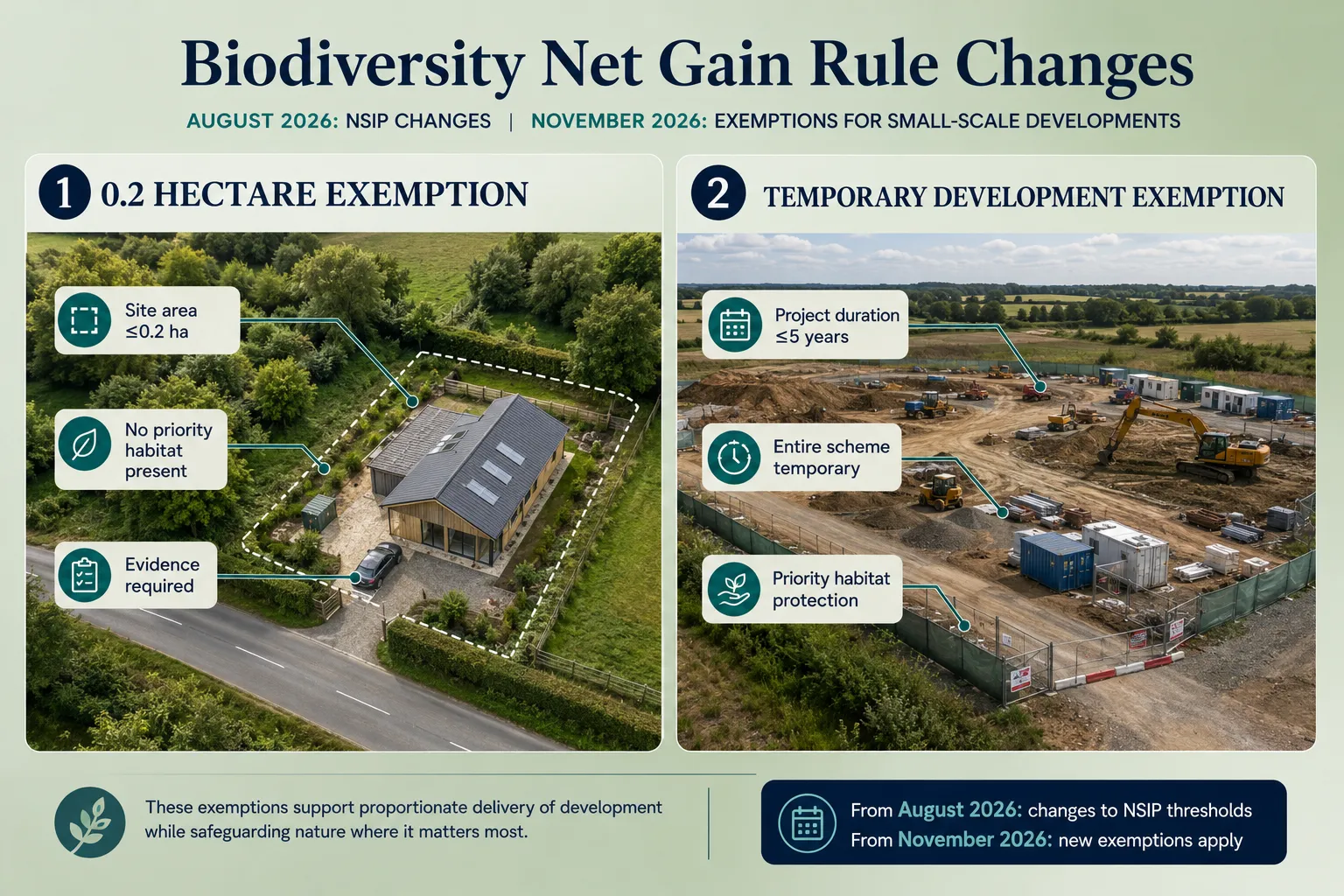
- From 6 August 2026, developments of 0.2 hectares or less are exempt from BNG, but only where no priority habitat is affected.
- A new temporary development exemption covers schemes lasting five years or less, provided the whole project is temporary and no priority habitat is impacted.
- The biodiversity gain hierarchy has been eased for minor development, giving smaller schemes more flexibility on where and how gains are delivered.
- The self and custom build exemption has been removed, meaning these projects must now deliver biodiversity net gain like any other development.
- NSIPs become subject to mandatory BNG from 2 November 2026, under a front-loaded regime requiring an approved biodiversity gain plan before consent.
The Four Biodiversity Net Gain Rule Changes That Took Effect on 6 August 2026
The government has been quietly recalibrating BNG since its 2024 launch, responding to complaints that the rules were disproportionately burdensome for small sites. The 6 August 2026 amendments are the clearest evidence yet that ministers are willing to trim the edges of the policy while keeping its core intact.
1. The 0.2-Hectare Small Site Exemption
Developments covering 0.2 hectares or less are now exempt from the mandatory biodiversity net gain requirement, but only where the site does not affect a priority habitat. This is a meaningful concession for small infill plots, single-dwelling extensions on tight urban sites, and minor commercial units that previously had to commission a full metric assessment for a fraction of a hectare.
Landowners and small-scale developers should not assume automatic exemption, however. Local planning authorities will still expect evidence that no priority habitat is present. A short desk-based habitat check, or a walkover survey where doubt exists, remains sensible due diligence even under the exemption.
2. The Temporary Development Exemption
A second exemption now applies to genuinely temporary schemes. To qualify, three conditions must all be met:
- The whole development is temporary in nature.
- Planning permission is granted for five years or less.
- The development does not impact an onsite priority habitat.
This covers things like temporary site compounds, short-term construction access roads, and pop-up commercial uses. It does not cover phased permanent development dressed up as "temporary" to dodge the metric, planning authorities are alert to this and will scrutinise permission wording closely.
3. Easing of the Biodiversity Gain Hierarchy for Minor Development
Under the original BNG framework, developers had to follow a strict hierarchy: on-site habitat creation first, off-site delivery second, and statutory biodiversity credits only as an absolute last resort. From 6 August 2026, that hierarchy has been relaxed specifically for minor development, giving smaller schemes more practical routes to compliance without forcing disproportionate on-site habitat works onto sites that simply cannot accommodate them.
This is arguably the most consequential of the four changes for everyday developers, because it acknowledges what ecologists have argued for years: a 0.3-hectare infill site cannot always deliver 10% gain on-site without absurd design compromises. For a deeper look at how developers weigh on-site versus off-site delivery, see this guide to biodiversity net gain off-site or on-site delivery.
4. Removal of the Self and Custom Build Exemption
The most notable rollback is the removal of the self and custom build exemption. Previously, individuals building their own homes were exempt from BNG obligations. That exemption is gone. Self-builders and custom-build developers must now comply with the same 10% net gain requirement, metric assessment, and habitat management planning as commercial housebuilders.
This closes a loophole that some argued was being exploited by larger developers structuring schemes to qualify as "self-build" in name only. For genuine self-builders, though, it means budgeting for ecological survey and habitat delivery costs that were not previously required. Anyone in this position should read up on what is in a biodiversity net gain assessment before submitting a planning application.
| Change | Effective Date | Who It Affects |
|---|---|---|
| 0.2 hectare exemption | 6 August 2026 | Small sites with no priority habitat |
| Temporary development exemption | 6 August 2026 | Schemes with permission of 5 years or less |
| Eased hierarchy for minor development | 6 August 2026 | Small and minor development applications |
| Self and custom build exemption removed | 6 August 2026 | Individual self-builders and custom-build projects |
| Mandatory BNG for NSIPs | 2 November 2026 | Major infrastructure promoters |
NSIP Mandatory BNG from November 2026: A Front-Loaded Regime
While the August changes eased pressure on smaller projects, the opposite is happening at the top end of the development scale. From 2 November 2026, Nationally Significant Infrastructure Projects become subject to mandatory biodiversity net gain for the first time. This brings major energy, transport, water, and waste infrastructure schemes under the same statutory framework that housebuilders have operated under since 2024.
The government has now published full NSIP BNG guidance and a completed policy framework, and biodiversity gain statements have effectively been given the same status as National Policy Statements, a signal of how seriously this is being treated within the planning system. As of September 2026, developers preparing NSIP applications are already being advised to build gain planning into their earliest project timelines, because the regime is deliberately front-loaded.
What NSIP Promoters Must Do
The core obligations mirror the standard BNG framework but apply at a much larger scale and complexity:
- Achieve at least a 10% biodiversity net gain, measured using the statutory biodiversity metric.
- Prepare and secure an approved biodiversity gain plan before development can proceed.
- Prioritise on-site and off-site habitat creation and enhancement, treating statutory biodiversity credits as a genuine last resort, not a convenient shortcut.
Because NSIPs typically involve multi-year consenting processes, examinations, and huge land footprints, the "front-loaded" nature of the regime means ecological baseline work, metric calculations, and habitat strategy need to be locked in far earlier than developers might be used to on smaller schemes. Waiting until post-consent to think about biodiversity delivery is no longer viable. For infrastructure promoters new to this framework, biodiversity net gain explained is a useful primer on the underlying mechanics before diving into NSIP-specific guidance.
Why This Matters for Landowners and Ecologists
Large infrastructure schemes will need substantial off-site habitat parcels to meet their 10% target, since on-site creation alone is rarely feasible along a rail corridor or transmission line. This creates real opportunity for landowners with suitable land to sell biodiversity units into a market that is about to see a wave of new institutional-scale demand. Ecologists, meanwhile, should expect NSIP promoters to commission far more detailed, longer-duration baseline surveys than typical residential schemes require, given the scrutiny biodiversity gain statements will face at examination stage.
Practical Steps for Developers Right Now
Whether a project sits at the small end of the scale or is a multi-year infrastructure consent, the same discipline applies: get the metric assessment right, document the habitat baseline properly, and do not assume an exemption applies without checking the detail. Developers should:
- Confirm site area and priority habitat status before relying on the 0.2-hectare or temporary exemptions.
- Reassess self-build or custom-build projects that assumed exemption before 6 August 2026.
- Review minor development applications against the eased hierarchy to see if off-site or credit-based routes are now more efficient.
- NSIP promoters should begin biodiversity gain plan preparation immediately, given the front-loaded nature of the November 2026 regime.
For a broader view of common pitfalls, 8 things you need to know about biodiversity net gain as a planner remains a solid reference point even after these amendments.
FAQ: Biodiversity Net Gain Rule Changes August 2026 NSIP November 2026
Does the 0.2-hectare exemption apply automatically?
No. It only applies where no priority habitat is present on the site. Evidence of habitat status is still advisable.
Are self-builders now treated the same as commercial developers?
Yes. The self and custom build exemption was removed on 6 August 2026, so individual self-builders must now meet the same 10% gain requirement.
What counts as a "temporary development" under the new exemption?
A scheme where the whole development is temporary, permission is granted for five years or less, and no onsite priority habitat is affected.
When exactly does mandatory BNG apply to NSIPs?
From 2 November 2026, all qualifying Nationally Significant Infrastructure Projects must comply with the mandatory biodiversity net gain framework.
Can NSIP promoters rely heavily on biodiversity credits?
No. Credits are intended as a last resort after on-site and off-site habitat options have been genuinely exhausted.
Has the core 10% gain requirement changed?
No. The August 2026 amendments adjust exemptions and hierarchy flexibility, but the underlying 10% metric-based target remains unchanged for non-exempt developments.
Conclusion
The Biodiversity Net Gain rule changes August 2026 NSIP November 2026 represent a two-speed reform: relief for small and minor schemes, and a significant new obligation for major infrastructure. Developers relying on old exemption assumptions, particularly self-builders, need to revisit their planning strategy immediately. Infrastructure promoters, meanwhile, have a narrow window before 2 November 2026 to build biodiversity gain planning into project timelines that are already front-loaded with consenting complexity.
The safest next step for any affected party is a proper habitat baseline check and metric assessment before assuming an exemption applies or a deadline is comfortably distant. For hands-on support navigating these changes, explore achieving biodiversity net gain without the risk or speak to a specialist before your next planning submission.
biodiversity net gain, BNG rule changes, NSIP biodiversity net gain, biodiversity gain plan, statutory biodiversity metric, small site exemption, self build exemption, planning permission UK, habitat creation, biodiversity credits, UK infrastructure planning, nature recovery policy