

A single hectare of land can now trigger three entirely different sets of legal obligations depending on whether it sits inside a housing estate, a self-build plot, or the corridor of a new offshore transmission line. That is the reality facing England's development sector in September 2026, following the most significant restructuring of biodiversity rules since Biodiversity Net Gain (BNG) became mandatory in February 2024. The Biodiversity Net Gain changes September 2026 NSIP rollout marks a genuine turning point: smaller sites have gained welcome flexibility, while the country's largest infrastructure projects are now locked into a fixed statutory deadline of 2 November 2026 for mandatory 10% net gain.
For developers, SME housebuilders, planning consultants, and biodiversity surveyors, this is not a minor technical update. It changes who must comply, when metric calculations are required, and how baseline ecological surveys should be scoped from this point forward.
Key Takeaways
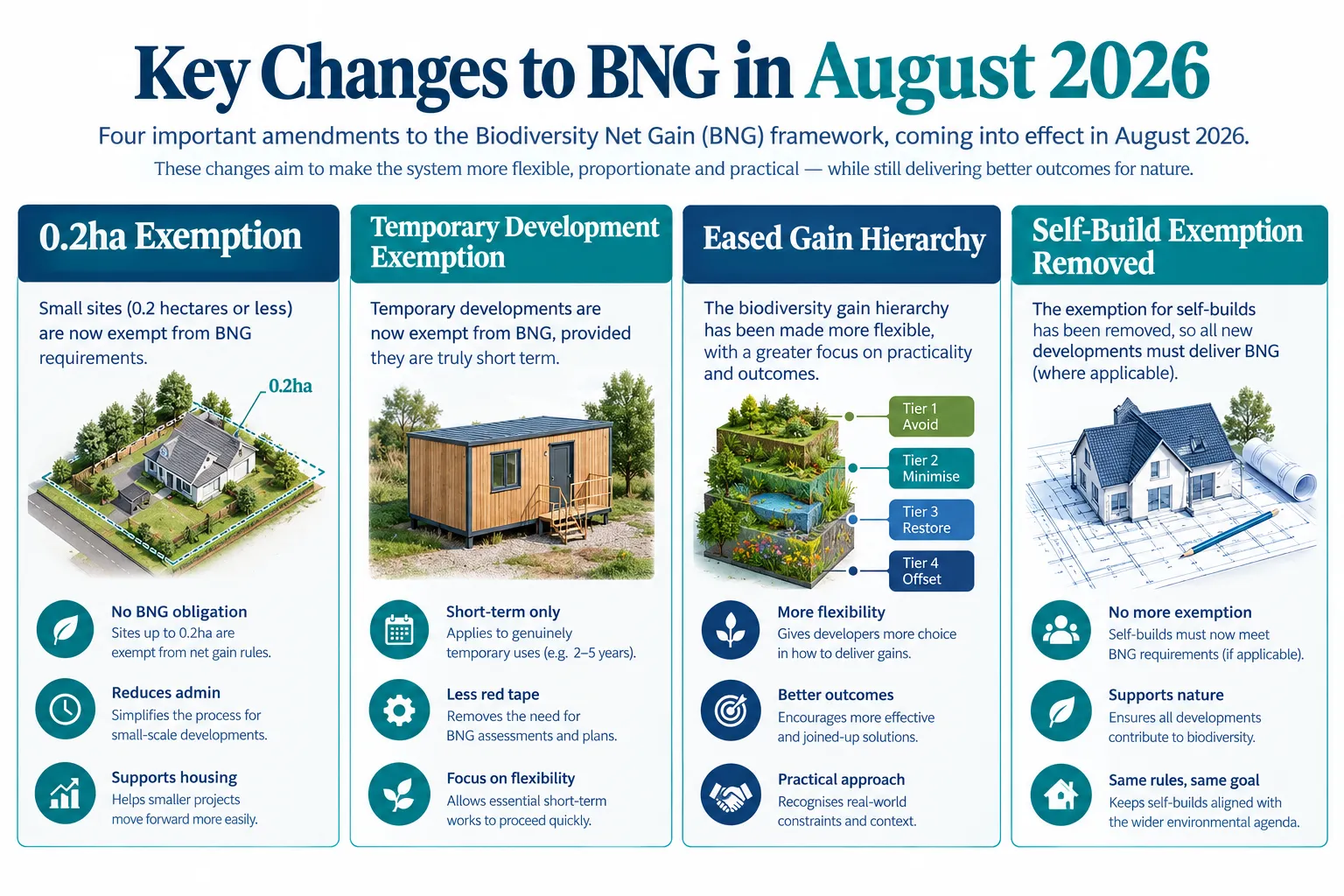
- On 6 August 2026, amendments introduced a 0.2-hectare exemption threshold, a temporary development exemption where priority habitat is unaffected, an eased gain hierarchy for minor development, and removal of the self/custom-build exemption.
- Mandatory BNG for Nationally Significant Infrastructure Projects (NSIPs) takes effect from 2 November 2026, requiring at least 10% biodiversity net gain on all Development Consent Order (DCO) applications submitted on or after that date.[2][6][10]
- NSIP BNG applies only in England, down to the mean low-water mark, and does not cover offshore marine areas or projects consented via Hybrid Bills.[2][10][13][14]
- Sector biodiversity gain statements for energy and national networks now carry the same legal weight as National Policy Statements, meaning inspectors must apply them when determining DCO applications.[6][7][11]
- Ecologists and biodiversity surveyors face a dual challenge: adapting baseline assessments for smaller exempt sites while preparing far more rigorous metric calculations for major linear infrastructure.
The August 2026 Amendments: A Recalibration for Smaller Sites
Defra's July 2026 amendments blog laid the groundwork for changes that came into force on 6 August 2026, responding to sustained pressure from SME developers who argued that the original BNG framework was disproportionately burdensome for small sites.[9] The amendments introduced four notable shifts.
First, a 0.2-hectare exemption threshold now excludes very small development footprints from mandatory net gain requirements, provided they meet the qualifying criteria. This was designed to reduce the administrative and cost burden on minor infill and garden-plot development, where a full biodiversity metric calculation was often disproportionate to the scale of habitat impact.
Second, a temporary development exemption applies where a proposal does not impact priority habitat, easing pressure on time-limited uses such as temporary site compounds or short-term structures.
Third, the gain hierarchy has been eased for minor development, giving smaller schemes more flexibility in how they sequence avoidance, mitigation, and compensation, rather than requiring strict adherence to the full order of preference that larger sites must follow.
Fourth, and arguably most consequential for the self-build sector, the exemption previously available to self-build and custom-build housing has been removed. Individuals building a single home on their own plot must now factor BNG into their planning application unless another exemption applies, closing what critics viewed as a loophole exploited by larger schemes disguised as custom-build projects.
Defra's environment blog situates these amendments within a broader package of reform, stressing that while smaller Town and Country Planning Act sites move onto this revised regime, the direction of travel for major infrastructure remains firmly toward mandatory, non-negotiable biodiversity gain.[5][9][15] For a fuller grounding in how the metric and hierarchy operate in practice, see this guide to what is in a biodiversity net gain assessment.
Biodiversity Net Gain Changes September 2026 NSIP Rollout: The Mandatory 10% Threshold
The centrepiece of the Biodiversity Net Gain changes September 2026 NSIP rollout is the confirmation that from 2 November 2026, every Development Consent Order application submitted in England must demonstrate at least 10% biodiversity net gain to be consented.[2][6][10] The Secretary of State cannot grant consent unless the biodiversity gain objective is met, this is not a discretionary planning consideration but a statutory precondition.[10][13]
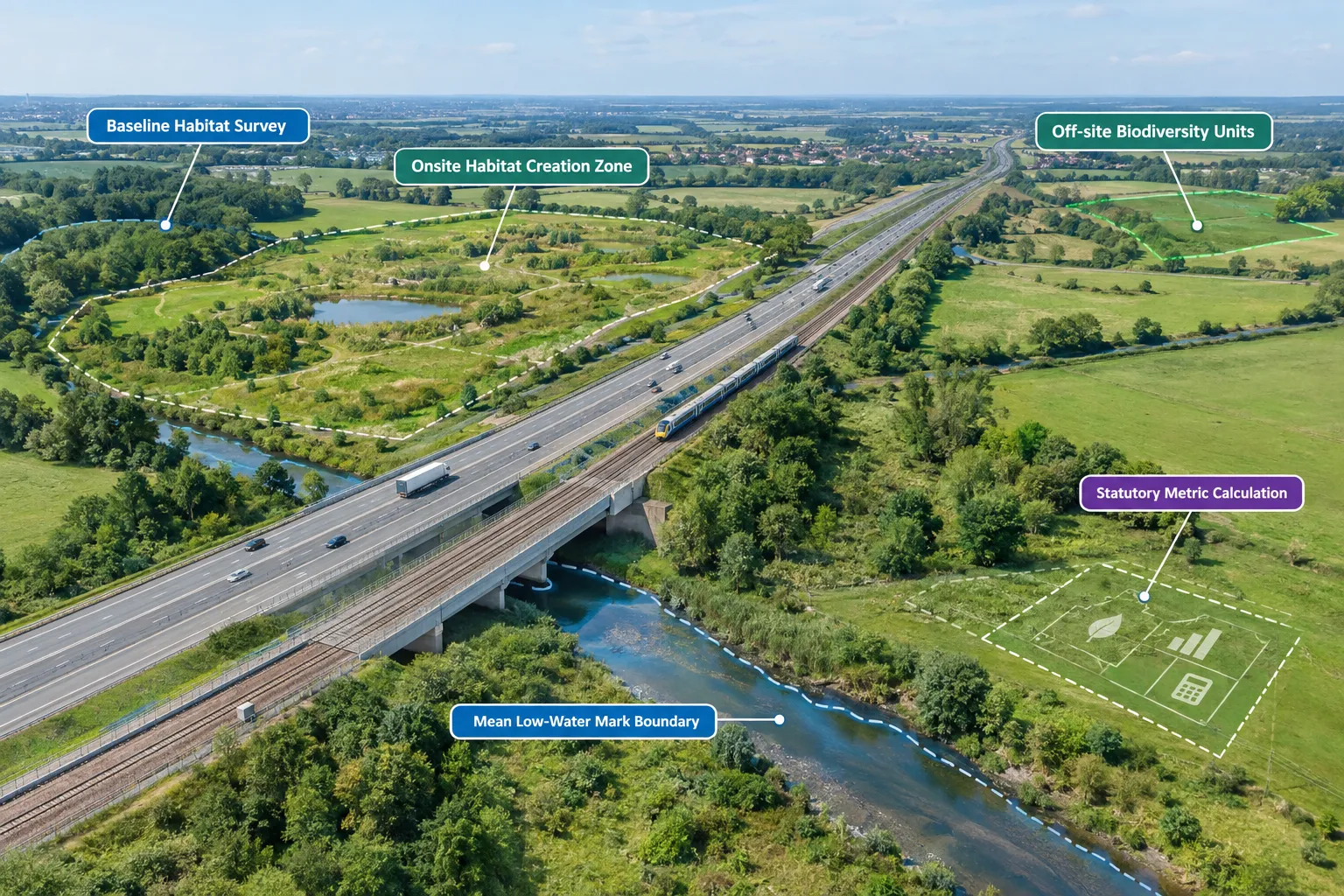
The 10% figure is calculated as the biodiversity value of the site after development exceeding the pre-development on-site habitat value by at least one-tenth, using the same underlying metric logic that has applied to smaller sites since 2024. Habitats that are retained, enhanced, or newly created on site can count toward this target, but only where they relate to habitats actually impacted by the NSIP.[9][10]
"The gain statements have the same effect as if they were included in a national policy statement, making BNG an integral part of the policy tests for NSIPs rather than an optional add-on."
This framing, drawn from the government's own guidance collection, signals that examining authorities and the Secretary of State will treat a failure to meet the gain objective as a fundamental barrier to consent, not a matter to be resolved through conditions after the fact.[6][7][10]
Which Projects Are Covered
The regime applies to NSIP applications determined under sections 104 or 105 of the Planning Act 2008 that meet nationally significant thresholds for:
- Major road schemes
- Rail infrastructure and strategic rail freight interchanges
- Energy generation and transmission projects
- National networks infrastructure
Crucially, the rules are territorial. Mandatory BNG applies only to the English onshore and intertidal components of a project, down to the mean low-water mark. Where a scheme's boundary extends into Wales, Scotland, Northern Ireland, or the marine environment beyond that line, the mandatory requirement stops at the English coastline.[2][10][13][14] Projects consented through Hybrid Bills, a route used for some rail schemes rather than the standard Planning Act 2008 process, sit outside the NSIP BNG regime entirely.[2]
What Defra's Gain Statements and Guidance Actually Require
Defra formally laid sector biodiversity gain statements before Parliament and published supporting guidance in May and June 2026, confirming the November implementation date and giving NSIP promoters the policy detail needed to design compliant schemes.[1][6][7] A consolidated government guidance page, last updated 27 August 2026, sets out precisely what information developers must submit with their DCO applications, including biodiversity metric outputs, habitat baseline data, and a clear account of how the gain hierarchy has been applied.[2][5]
Legal analysis from Burges Salmon notes that these gain statements effectively "lock in" the 2 November 2026 date and create a common biodiversity gain objective across all NSIPs, while allowing sector-specific tailoring so that linear infrastructure can use phased delivery and off-site solutions where onsite space is constrained.[4][11] Pinsent Masons' analysis, updated in early September 2026, goes further, describing the new legal duty as one that will materially affect project costs, land-take, and consenting risk, especially on sites with high existing biodiversity value or tight spatial constraints.[14]
The official consultation page on BNG for NSIPs, last updated 6 September 2026, confirms the statutory basis sits in amendments the Environment Act 2021 made to the Planning Act 2008, inserting Schedule 2A and related provisions that give the Secretary of State the legal hook to refuse consent where the gain objective is not met.[3][8][12]
Implications for Developers and SMEs
The practical consequences differ sharply depending on the scale and nature of a project.
Smaller developers and self-builders now navigate a narrower set of exemptions. The removal of the self/custom-build exemption means a wider pool of applicants must engage with the biodiversity metric for the first time, even if the 0.2-hectare threshold offers relief to the very smallest schemes. Anyone planning a project close to that threshold should seek an early professional assessment to confirm exemption status before committing to a design. Resources such as how to achieve 10% biodiversity net gain and 8 biodiversity net gain points on planning your project offer a practical starting point.
Mid-size developers working on minor development sites benefit from the eased gain hierarchy but should not mistake flexibility for exemption, a metric calculation and habitat baseline are still generally required. Guidance on what you need for a biodiversity net gain report remains directly relevant.
NSIP promoters and their consultants face the heaviest lift. Early-stage scheme design must now incorporate biodiversity baseline surveys, options appraisal for onsite enhancement, and contingency planning for off-site units or statutory credits well before DCO submission. Analysts expect greater reliance on strategic habitat creation along transport and energy corridors rather than isolated onsite patches, alongside long-term management agreements spanning decades.[4][11] Firms considering off-site delivery routes should review options for buying biodiversity units or explore off-site versus on-site delivery approaches early in scheme development.
What This Means for Biodiversity Surveyors and Ecologists
Ecological consultants sit at the intersection of both reform strands. On one hand, the 0.2-hectare exemption and eased hierarchy reduce demand for full metric assessments on the smallest sites, though surveyors will still need to confirm exemption eligibility, which itself requires site-level judgement. On the other hand, the NSIP rollout dramatically raises the bar for baseline habitat surveys on major infrastructure schemes.
Key practical shifts surveyors should prepare for include:
- More rigorous baseline mapping across large, often fragmented corridor sites, frequently spanning multiple habitat types and local authority boundaries.
- Metric calculations tailored to sector gain statements, particularly for energy and national networks, which specify how impacted habitats must be measured and offset.[10][13]
- Greater scrutiny during examination, with commentators warning that projects relying heavily on distant off-site units or failing to demonstrate genuine avoidance and minimisation face elevated legal challenge risk.[11][14]
- Long-term monitoring and management planning, since NSIP habitat creation typically requires multi-decade commitments rather than the standard 30-year TCPA baseline.
Surveyors advising on both small and large sites should review foundational material such as biodiversity net gain explained and how to conduct a biodiversity impact assessment to ensure baseline methodology aligns with the latest metric requirements ahead of November's deadline.
FAQ
What exactly changed on 6 August 2026?
A 0.2-hectare exemption threshold was introduced, along with a temporary development exemption where priority habitat is unaffected, an eased gain hierarchy for minor development, and removal of the self/custom-build exemption.[9]
When does mandatory BNG apply to NSIPs?
From 2 November 2026, all DCO applications submitted in England on or after that date must achieve at least 10% biodiversity net gain to be consented.[2][6][10]
Does the NSIP BNG rule apply to offshore projects?
Only up to the mean low-water mark, including the intertidal zone. The marine environment beyond that line and non-English components of cross-border projects fall outside the mandatory requirement.[2][10][13][14]
Are Hybrid Bill projects covered?
No. Infrastructure consented through Hybrid Bills, rather than the standard Planning Act 2008 DCO process, does not fall under the NSIP BNG regime.[2]
Can self-builders still avoid BNG requirements?
Not automatically. The self/custom-build exemption was removed on 6 August 2026, though the new 0.2-hectare threshold may still apply to very small plots.[9]
Where does the legal authority for NSIP BNG come from?
The Environment Act 2021 amended the Planning Act 2008, inserting Schedule 2A and related sections that empower the Secretary of State to refuse consent where the biodiversity gain objective is not met.[3][12]
Conclusion
The Biodiversity Net Gain changes September 2026 NSIP rollout represents a two-speed reform: smaller developments have gained targeted relief through the August 2026 amendments, while the country's largest infrastructure projects now face a fixed, non-negotiable 10% net gain requirement from 2 November 2026. Neither strand should be treated as static, Defra's guidance pages are being actively updated, most recently on 27 August and 6 September 2026, and sector gain statements carry the same legal force as national policy.
Developers should audit current and pipeline projects against the new exemption thresholds immediately, while NSIP promoters need to embed biodiversity baseline work into scheme design now, well ahead of the November deadline. Biodiversity surveyors and ecologists should revisit metric methodologies for both exempt small sites and complex infrastructure corridors, ensuring documentation is ready to withstand examination-stage scrutiny. Early engagement with a qualified ecologist remains the most reliable way to avoid consenting delays as this rollout takes full effect.
References
[1] Biodiversity Net Gain For Nsips Gain Statements Laid And Guidance Published – defraenvironment.blog.gov.uk
[2] Biodiversity Net Gain Nationally Significant Infrastructure Projects – gov.uk
[3] Biodiversity Net Gain For Nationally Significant Infrastructure Projects – gov.uk
[4] Bng Nsips Defra Response Rollout – burges-salmon.com
[5] Biodiversity Net Gain For Major Infrastructure Projects New Guidance – defraenvironment.blog.gov.uk
[6] Nsips Biodiversity Gain Statement For National Networks – gov.uk
[7] Biodiversity Gain Statements For Nationally Significant Infrastructure Projects – gov.uk
[8] Offsen Final Consultation On Bng For Nsips May 2025 – consult.defra.gov.uk
[9] Biodiversity Net Gain Whats Changing And What It Means For You – defraenvironment.blog.gov.uk
[10] Biodiversity Gain Statement For Energy – assets.publishing.service.gov.uk
biodiversity net gain, BNG 2026, NSIP rollout, Defra biodiversity amendments, mandatory biodiversity net gain, development consent order, habitat baseline survey, biodiversity metric calculation, planning act 2008, ecologist compliance, SME developers, statutory biodiversity credits