

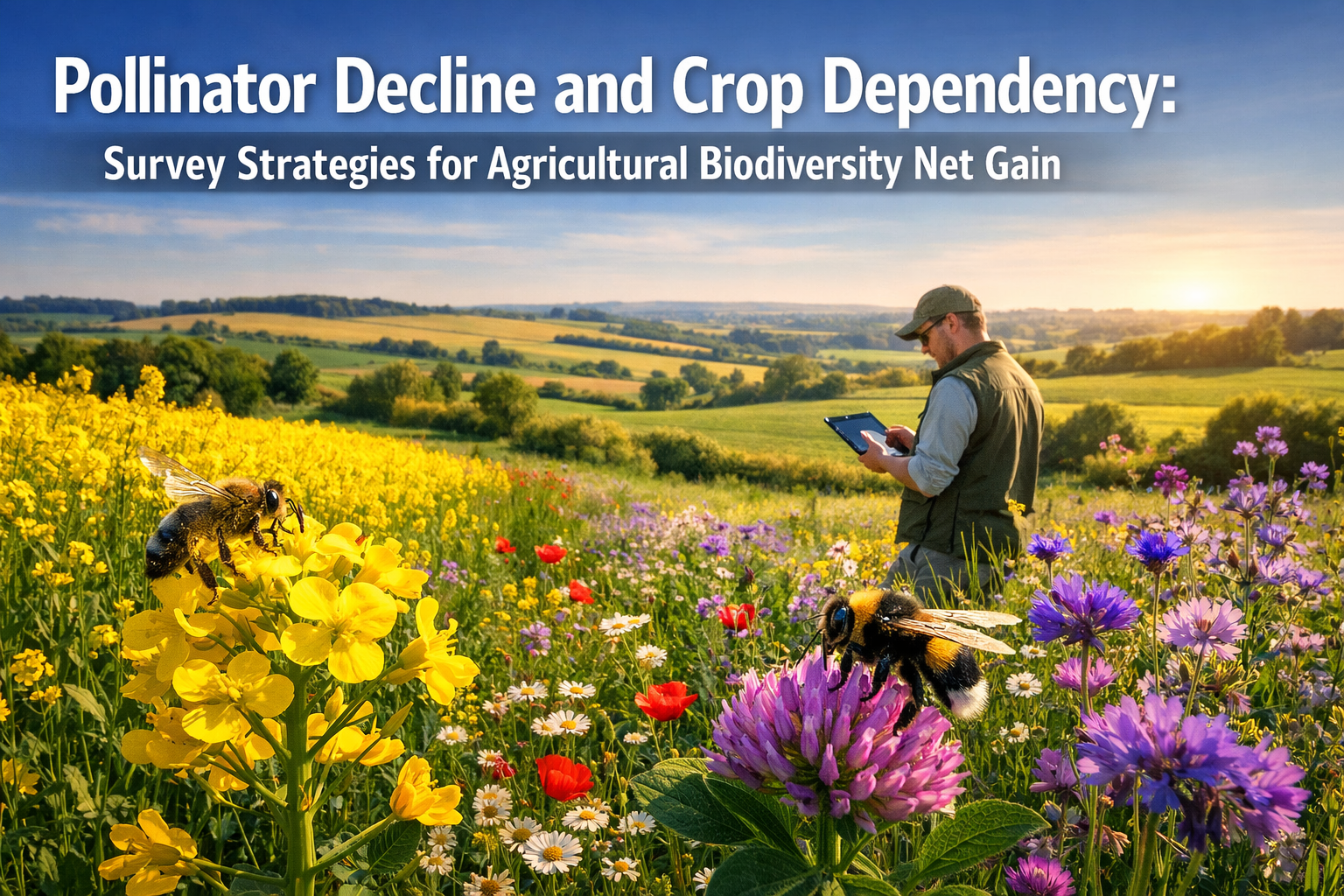
Between 28-61% of global crop systems currently experience yield limitations due to insufficient pollinator visitation[1]. This staggering statistic reveals a critical vulnerability in our food production systems—one that agricultural lands are uniquely positioned to address. The intersection of Pollinator Decline and Crop Dependency: Survey Strategies for Agricultural Biodiversity Net Gain represents not just an environmental challenge, but a significant economic opportunity for farmland managers, developers, and conservation professionals working on integrated landscape projects.
Agricultural lands cover vast territories and represent tremendous biodiversity opportunities when managed strategically. As pollinator populations decline globally due to habitat loss, pesticide use, climate change, and disease[2], the need for targeted survey protocols that quantify ecosystem services while meeting Biodiversity Net Gain (BNG) requirements has never been more urgent. Over 75% of the world's food crops depend on insect pollinators for reproduction and productivity[1], making pollinator conservation a fundamental agricultural concern.
Key Takeaways
- Global crop vulnerability: Up to 60% of crop systems face yield limitations from insufficient pollinator visitation, with blueberries, coffee, and apples most severely affected
- Quantifiable solutions: Increasing pollinator visitation to optimal levels could close 63% of current yield gaps between high- and low-yielding fields
- Strategic survey approaches: Targeted pollinator survey protocols enable agricultural lands to quantify ecosystem services while achieving BNG compliance
- Economic and ecological benefits: Pollinator-focused BNG strategies deliver measurable crop productivity improvements alongside biodiversity gains
- Integrated landscape management: Forested buffers, diverse field structures, and habitat corridors provide essential pollinator support across agricultural systems
Understanding the Scale of Pollinator Decline and Crop Dependency
The Global Pollinator Crisis 🐝
The evidence of pollinator decline has reached critical mass. Research analyzing 198,360 plant-pollinator interactions across 32 crop species in 120 study systems—spanning three decades and covering over 85% of the world's countries across all six inhabited continents—reveals that pollinator limitation affects 25 out of 49 crop species analyzed[1]. This phenomenon appears in 85% of countries included in comprehensive global studies[2].
The primary drivers of this decline include:
- Habitat loss and fragmentation from agricultural intensification
- Pesticide exposure affecting pollinator health and navigation
- Climate change disrupting seasonal synchronization between pollinators and flowering plants
- Disease transmission within and between managed and wild pollinator populations
- Invasive alien species competing with or preying upon native pollinators[3]
Economic Implications of Pollinator-Dependent Crops
The economic stakes are substantial. Coffee production alone—highly dependent on pollinator services—faces potential losses of hundreds of millions in annual revenue from insufficient pollination[4]. Beyond direct crop production, cascade effects ripple through connected industries:
Livestock and Dairy Industries: Pollinated fodder crops such as soybeans provide essential feed. Pollinator decline reduces feed production, creating secondary impacts on dairy and meat industries[4].
High-Value Specialty Crops: Blueberries, apples, and other pollinator-dependent crops command premium prices but show the greatest vulnerability to pollinator shortages[2].
Nutritional Security: Many pollinator-dependent crops provide essential micronutrients, vitamins, and dietary diversity. Their decline threatens not just food quantity but food quality globally.
Survey Strategies for Agricultural Biodiversity Net Gain
Establishing Baseline Pollinator Populations
Effective Pollinator Decline and Crop Dependency: Survey Strategies for Agricultural Biodiversity Net Gain begin with rigorous baseline assessments. These surveys establish current pollinator populations, diversity, and activity levels before any agricultural modifications or development projects.
Essential Survey Components:
- Transect Surveys: Establish fixed walking routes through agricultural areas, recording all pollinator observations within defined time periods and weather conditions
- Pan Trap Sampling: Deploy colored water-filled bowls (blue, yellow, white) to passively collect pollinator specimens for identification and abundance quantification
- Observation Quadrats: Monitor specific crop areas or wildflower patches, documenting pollinator visitation rates and behavior
- Nesting Site Surveys: Identify and map existing pollinator nesting habitats including bare ground patches, dead wood, and vegetation stems
Timing and Seasonal Considerations ⏰
Pollinator survey strategies must account for seasonal variation in pollinator activity and crop flowering periods:
| Season | Survey Focus | Target Pollinators |
|---|---|---|
| Early Spring | Orchard crops, early wildflowers | Queen bumblebees, solitary bees, early hoverflies |
| Late Spring | Berry crops, field margins | Honeybees, diverse wild bee species, butterflies |
| Summer | Field crops, hedgerows | Peak diversity—all pollinator groups |
| Late Summer/Autumn | Cover crops, late-flowering margins | Late-season bees, migrating butterflies |
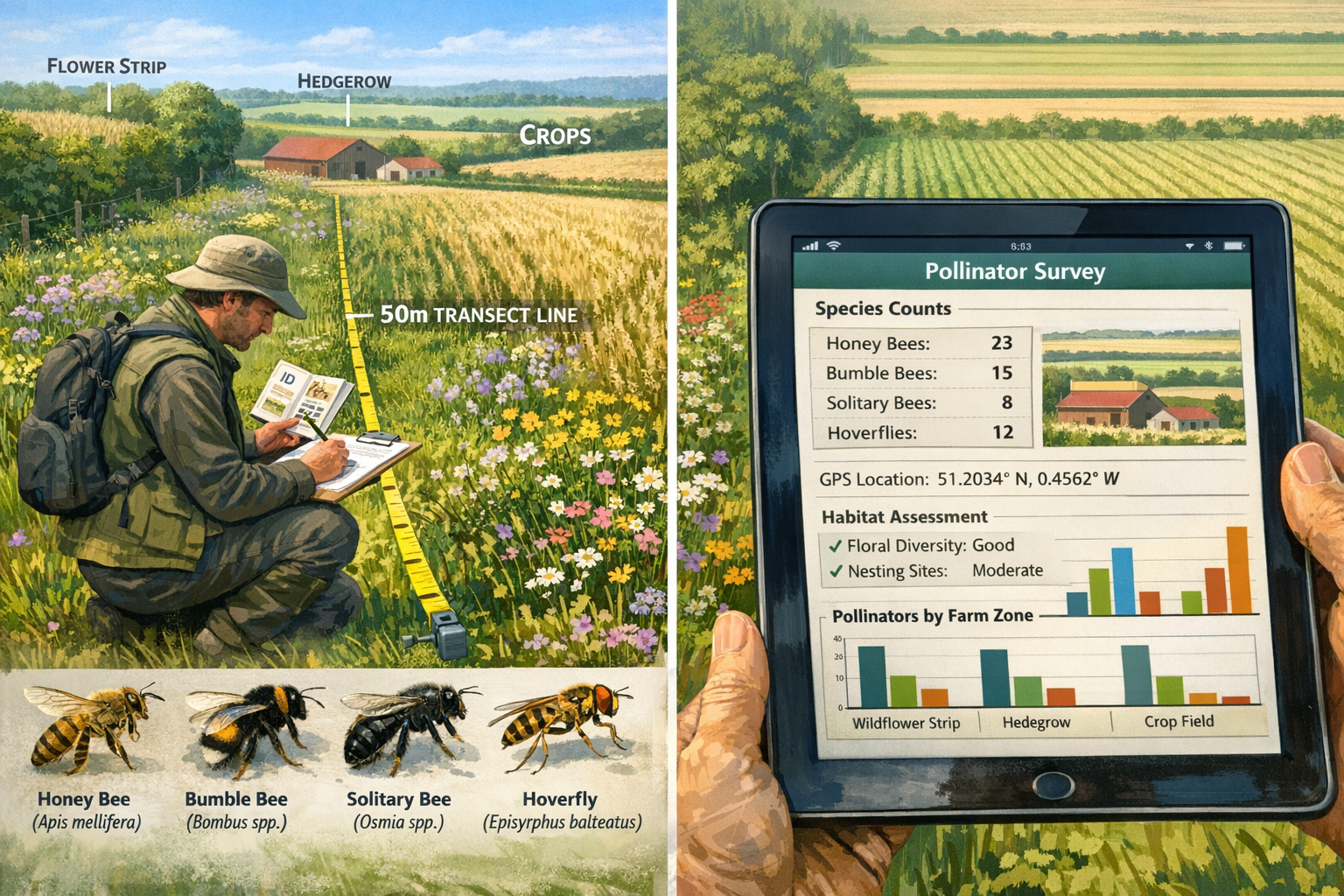
Comprehensive surveys require minimum three visits during the growing season, with additional visits for sites supporting particularly diverse pollinator communities or rare species. Weather conditions significantly impact results—surveys should occur during favorable conditions (temperatures above 13°C, wind speeds below 5 m/s, no precipitation).
Species Identification and Functional Groups
While detailed taxonomic identification provides valuable data, functional group approaches offer practical alternatives for large-scale agricultural surveys:
Key Functional Groups:
- Honeybees (Apis mellifera): Managed pollinators with high flower constancy
- Bumblebees (Bombus spp.): Important for crops requiring buzz pollination
- Solitary bees: Diverse group including mining bees, mason bees, leafcutter bees
- Hoverflies (Syrphidae): Important pollinators often overlooked in surveys
- Butterflies and moths: Contribute to pollination, indicator species for habitat quality
- Beetles and other insects: Secondary pollinators with specialized roles
Understanding which functional groups visit specific crops enables targeted habitat enhancement strategies within Biodiversity Net Gain frameworks.
Integrating Pollinator Surveys with BNG Requirements
Quantifying Ecosystem Services for BNG Compliance
The challenge facing agricultural land managers is translating pollinator survey data into measurable biodiversity units that satisfy BNG requirements. This integration requires systematic approaches that connect pollinator abundance and diversity to habitat condition assessments.
Linking Pollinator Data to Biodiversity Metrics:
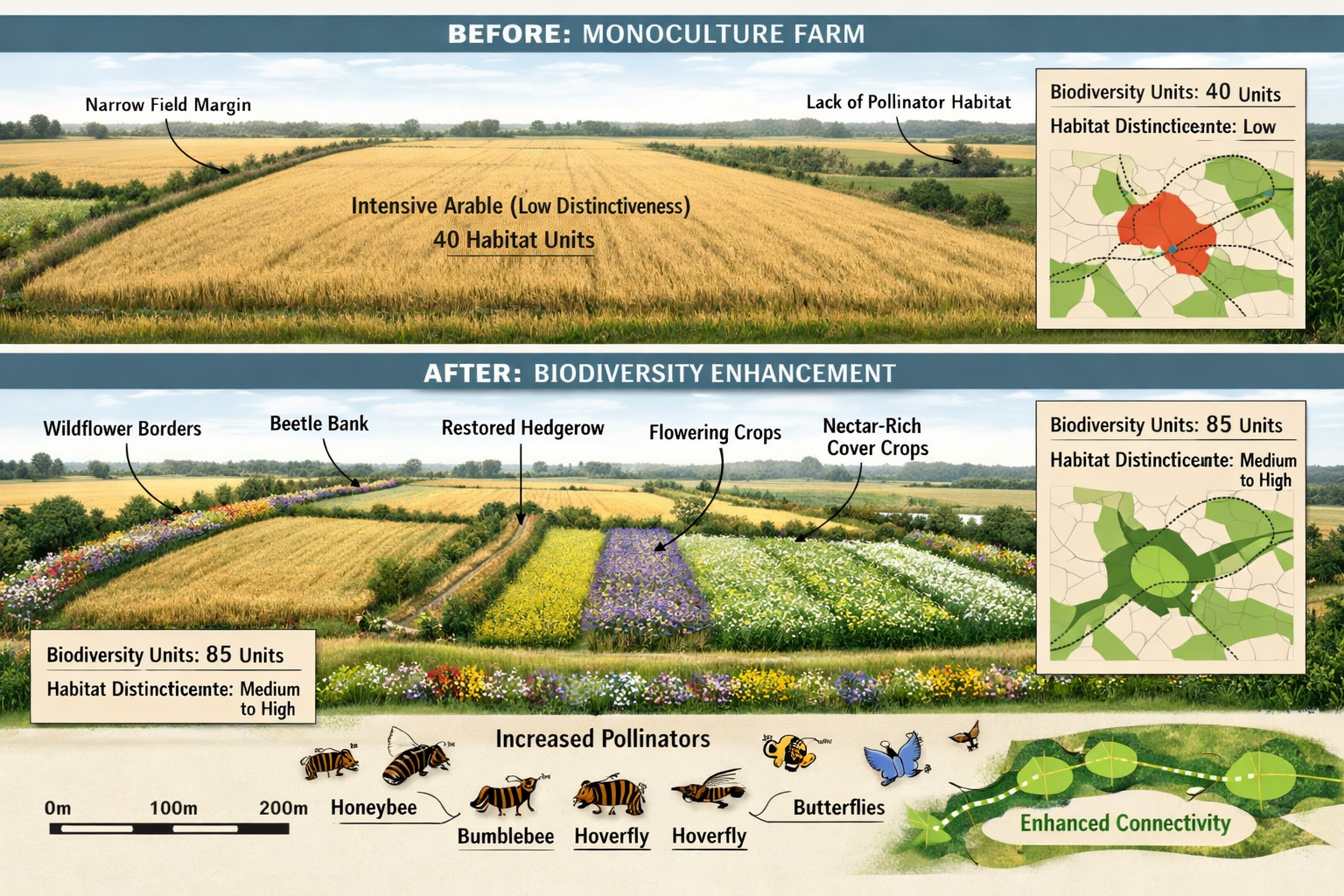
Habitat Distinctiveness Scores: Pollinator-rich areas with diverse species assemblages typically indicate higher habitat distinctiveness. Survey data documenting rare or specialist pollinator species strengthens arguments for elevated distinctiveness classifications.
Habitat Condition Assessments: Pollinator abundance serves as a functional indicator of habitat condition. Areas supporting robust pollinator communities demonstrate good structural diversity, appropriate management, and connectivity—all factors in condition scoring.
Strategic Habitat Creation: Survey results identify gaps in pollinator resources (nesting sites, forage across seasons) that targeted habitat creation can address, generating biodiversity units while improving crop pollination services.
For developers and planners working on agricultural sites, understanding what's included in a Biodiversity Net Gain assessment helps integrate pollinator considerations from project inception.
Habitat Enhancement Strategies for Dual Benefits
Agricultural lands pursuing BNG compliance while maintaining productivity can implement targeted enhancements that simultaneously support pollinators and generate biodiversity units:
Field Margin Management 🌼
- Wildflower strips: 6-meter margins with diverse native flowering plants provide continuous forage
- Beetle banks: Raised earth banks with tussocky grasses offer nesting sites and overwintering habitat
- Hedgerow restoration: Dense, species-rich hedgerows with flowering shrubs create connectivity corridors
In-Field Interventions
- Cover crop selection: Choose flowering cover crops (phacelia, buckwheat, clover) that provide off-season forage
- Crop variety diversification: Plant multiple flowering crop varieties with staggered bloom times
- Reduced tillage zones: Maintain areas of undisturbed ground for ground-nesting bee species
Landscape-Scale Connectivity
Research demonstrates that forested areas and diverse landscape structures significantly reduce the likelihood of yield limitations from insufficient pollination[1]. Agricultural BNG strategies should prioritize:
- Woodland buffers: Establish or enhance woodland edges providing shelter and diverse forage
- Connectivity corridors: Create habitat linkages between isolated pollinator populations
- Water source provision: Ensure accessible clean water sources throughout agricultural landscapes
These interventions align with guidance on achieving 10% Biodiversity Net Gain while delivering measurable improvements in crop pollination services.
Measuring Success: Pollinator Decline and Crop Dependency Survey Strategies
Quantifying Yield Improvements
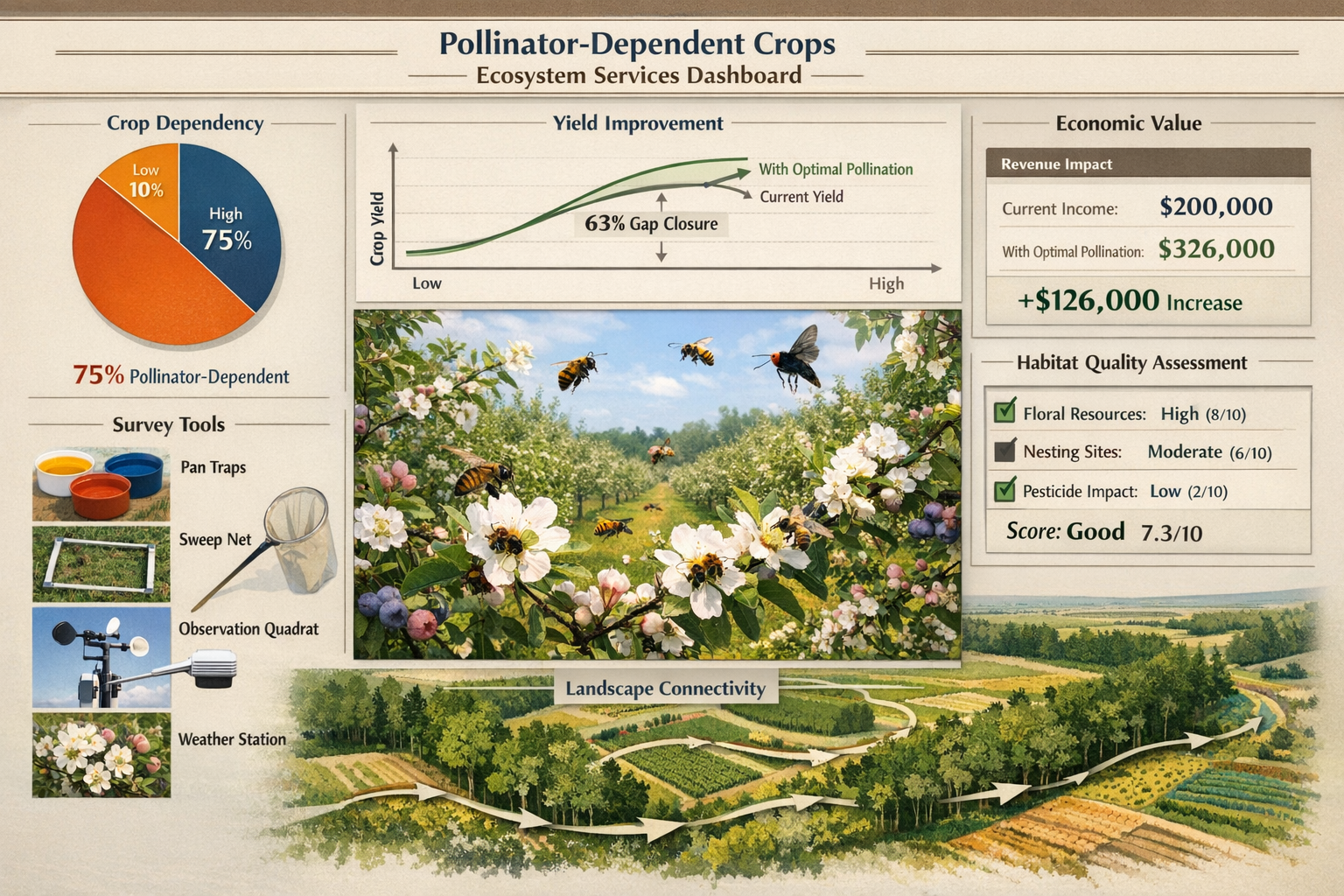
The ultimate validation of Pollinator Decline and Crop Dependency: Survey Strategies for Agricultural Biodiversity Net Gain comes through measurable crop productivity improvements. Research indicates that increasing pollinator visitation to levels observed in the 90th percentile of each study system could close 63% of current yield gaps between high- and low-yielding fields[1].
Measurement Protocols:
- Establish control areas: Maintain sections of farmland with standard management for comparison
- Monitor enhancement zones: Track pollinator abundance in areas with BNG interventions
- Measure crop outcomes: Document yield, fruit set, seed production, and quality metrics
- Calculate economic returns: Quantify revenue increases from improved pollination against enhancement costs
Long-Term Monitoring Frameworks
BNG requirements typically mandate 30-year management and monitoring commitments. For agricultural lands, this extended timeframe enables adaptive management based on pollinator survey results:
Years 1-3: Intensive monitoring establishing post-enhancement baselines, identifying successful interventions, and adjusting underperforming habitat creation.
Years 4-10: Reduced frequency monitoring (annual or biennial) tracking population trends and habitat maturation.
Years 11-30: Periodic condition assessments ensuring habitat maintenance standards and documenting long-term population stability.
This monitoring approach aligns with requirements outlined in Biodiversity Net Gain reporting, providing evidence of sustained biodiversity gains alongside agricultural productivity.
Data Management and Reporting
Professional pollinator survey strategies require robust data management systems capturing:
- Species records: Taxonomic identifications with confidence levels
- Abundance data: Count data standardized by survey effort
- Environmental conditions: Weather, phenology, and habitat state during surveys
- Spatial information: GPS coordinates enabling mapping and connectivity analysis
- Photographic documentation: Visual records supporting identifications and demonstrating habitat condition
Digital survey platforms increasingly enable real-time data capture, automated reporting, and integration with BNG metric calculations, streamlining compliance documentation.
Policy Context and 2026 Developments
Federal Pollinators Plan 2026-2028
The policy landscape supporting pollinator conservation continues evolving. Belgium's Federal Pollinators Plan 2026-2028, announced in March 2026, exemplifies comprehensive governmental approaches to halting pollinator decline[3]. The plan mobilizes multiple levers including:
- Scientific research expanding understanding of pollinator ecology and threats
- Targeted conservation projects implementing evidence-based habitat restoration
- Systemic policy changes within federal competences addressing root causes of decline
This holistic approach recognizes that effective pollinator conservation requires coordination across research, policy, and practical implementation—principles equally applicable to agricultural BNG strategies.
BNG Regulatory Framework in the UK
For UK agricultural projects, understanding BNG regulatory requirements remains essential. The mandatory BNG framework requires developments to deliver measurable biodiversity improvements, with specific considerations for small development projects and certain exempt projects.
Agricultural developments and land use changes must demonstrate how pollinator habitat enhancements contribute to overall BNG calculations, with survey data providing the evidence base for biodiversity unit generation.
Practical Implementation for Agricultural Stakeholders
For Farmers and Land Managers 🚜
Agricultural producers implementing pollinator-focused BNG strategies should:
- Engage early with ecological consultants specializing in pollinator surveys and agricultural biodiversity
- Identify pollinator-dependent crops within rotation systems requiring priority attention
- Map existing pollinator resources including hedgerows, margins, and natural areas
- Develop phased enhancement plans balancing productivity with biodiversity objectives
- Consider agri-environment schemes such as the Sustainable Farming Incentive complementing BNG efforts
For Developers and Planners
Development projects on agricultural land should integrate pollinator considerations throughout planning:
- Commission baseline pollinator surveys during initial ecological assessments
- Identify opportunities for pollinator habitat creation within landscape designs
- Consider off-site options where on-site provision proves challenging, exploring off-site versus on-site BNG delivery
- Engage with local farming communities to coordinate landscape-scale pollinator conservation
- Budget appropriately for long-term habitat management and monitoring commitments
Resources including guidance for developers provide detailed frameworks for navigating BNG requirements on agricultural sites.
For Landowners Considering Biodiversity Units
Agricultural landowners possess significant potential to generate biodiversity units through pollinator habitat creation. Those interested in selling biodiversity units should understand:
Revenue Potential: Pollinator-rich habitats command premium biodiversity unit values due to high distinctiveness and condition scores.
Management Requirements: Long-term commitments to habitat maintenance, monitoring, and reporting are mandatory.
Market Considerations: Understanding biodiversity unit costs and statutory credits helps landowners make informed decisions.
Professional Support: Engaging experienced ecological consultants ensures survey protocols, habitat creation, and monitoring meet regulatory standards.
Addressing Common Challenges
Balancing Productivity and Biodiversity
The perceived tension between agricultural productivity and biodiversity conservation represents a common concern. However, evidence increasingly demonstrates complementarity:
- Yield improvements from enhanced pollination often offset minor reductions in cultivated area
- Pest control services from diverse insect communities reduce pesticide requirements
- Soil health benefits from reduced tillage and diverse plantings improve long-term productivity
- Economic diversification through biodiversity unit sales provides additional revenue streams
Managing Pesticide Use
Pesticide applications represent a significant threat to pollinators. Integrated Pest Management (IPM) approaches minimize impacts while maintaining crop protection:
- Timing applications to avoid peak pollinator activity periods
- Selecting pollinator-friendly products with lower toxicity and shorter residual effects
- Implementing buffer zones around pollinator habitat areas
- Adopting biological control methods reducing chemical dependency
Climate Change Adaptation
Climate change disrupts pollinator-plant synchronization and shifts species distributions. Adaptive survey strategies should:
- Monitor phenological shifts in crop flowering and pollinator emergence
- Document range changes in pollinator species distributions
- Design flexible habitat networks accommodating future species movements
- Select climate-resilient plant species for pollinator habitat creation
Conclusion: Integrating Pollinators into Agricultural BNG Strategies
The convergence of pollinator decline and crop dependency creates both challenges and opportunities for agricultural land management. Strategic survey protocols that quantify pollinator populations, identify limiting factors, and measure ecosystem service delivery enable agricultural lands to achieve meaningful Biodiversity Net Gain while enhancing crop productivity.
The evidence is compelling: up to 60% of crop systems face yield limitations from insufficient pollination[2], yet increasing pollinator visitation to optimal levels could close 63% of yield gaps[1]. Agricultural lands pursuing BNG compliance possess unique opportunities to address both biodiversity conservation and food security simultaneously.
Actionable Next Steps:
✅ Commission baseline pollinator surveys on agricultural lands before planning applications or land use changes
✅ Engage with ecological specialists experienced in agricultural biodiversity and BNG compliance
✅ Develop integrated habitat enhancement plans delivering biodiversity units and ecosystem services
✅ Establish monitoring frameworks documenting both pollinator populations and crop productivity outcomes
✅ Explore funding mechanisms including agri-environment schemes, biodiversity unit sales, and carbon markets
✅ Coordinate with neighboring landowners to create landscape-scale pollinator conservation networks
The future of sustainable agriculture depends on recognizing agricultural lands not as biodiversity deserts but as vast opportunities for conservation innovation. By implementing rigorous Pollinator Decline and Crop Dependency: Survey Strategies for Agricultural Biodiversity Net Gain, stakeholders can transform farmland into productive landscapes supporting both human food security and thriving pollinator communities.
For professional guidance on implementing pollinator-focused BNG strategies on agricultural lands, contact experienced biodiversity surveyors who can develop customized survey protocols, habitat enhancement plans, and monitoring frameworks tailored to specific agricultural contexts.
References
[1] Global Crop Yields Threatened By Insufficient Pollinator Visitation According To New Study – https://www.bc3research.org/en/2024/07/global-crop-yields-threatened-by-insufficient-pollinator-visitation-according-to-new-study/
[2] How Declining Pollinators Are Impacting Global Food Production – https://www.aiu.edu/innovative/how-declining-pollinators-are-impacting-global-food-production/
[3] Public Consultation Federal Pollinators Plan 2026 2028 – https://www.biodiv.be/news/public-consultation-federal-pollinators-plan-2026-2028
[4] Declining Bees Global Food Security Nutrition – https://thrivabilitymatters.org/declining-bees-global-food-security-nutrition/