

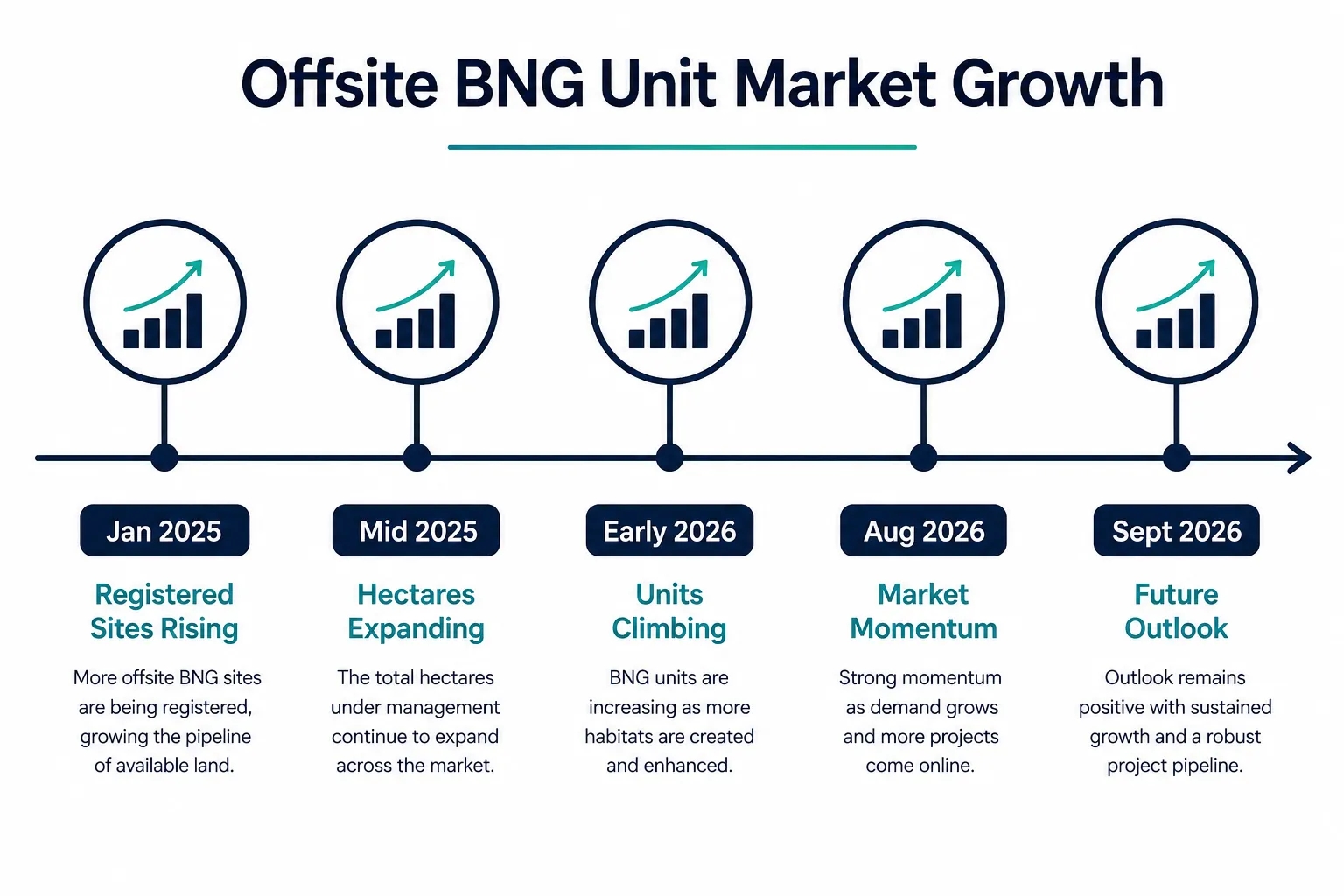
Three years ago the offsite Biodiversity Net Gain market barely existed as a tradeable asset class. Today it supports an estimated £93 to £100 million in unit value, spans nearly 7,000 hectares of English countryside, and underpins planning permission for thousands of homes and infrastructure projects [1][2]. The Offsite BNG Unit Market September 2026: 197 Registered Sites and 28,000 Habitat Units figures now confirm what many ecologists predicted: this is no longer a niche compliance mechanism, it is a functioning land-based market with real price signals, real brokers, and real supply constraints.
For developers still treating BNG as a last-minute planning condition, September 2026 is the moment to change course. Between the 6 August 2026 rule changes and the fast-approaching 2 November 2026 NSIP deadline, procurement timelines have compressed sharply. This article looks past the headline rule changes to focus on what the market data actually shows, and what developers, landowners and local planning authorities should be doing right now.
Key Takeaways
- Natural England's register shows roughly 197 offsite habitat bank sites, covering close to 7,000 hectares and generating around 28,000 habitat units as of September 2026 [1].
- The wider market, including pipeline sites not yet registered, is larger than the headline register suggests, with credible estimates of total market value approaching £93 to £100 million [2].
- Unit prices have shifted since the 6 August 2026 rule changes removed self-build and custom-build exemptions while introducing a 0.2 hectare small-site exemption [4].
- Statutory credits remain a minor share of overall market value but are growing steadily as a fallback option when private units are unavailable [6].
- NSIP developers face a 2 November 2026 compliance deadline that is already tightening demand for large, high-quality habitat parcels [10].
Inside the Offsite BNG Unit Market September 2026: 197 Registered Sites and 28,000 Habitat Units Snapshot
Natural England's public register is the closest thing the sector has to an official scoreboard, and the current numbers tell a clear growth story.
| Metric | September 2026 figure |
|---|---|
| Registered offsite sites | Approximately 197 [1] |
| Total registered area | Nearly 7,000 hectares [1] |
| Habitat units generated | Around 28,000 units [1] |
| Estimated market value | £93 million to £100 million [2] |
| Statutory credit share of value | Small but rising [6] |
Industry trackers, including habitat bank mapping projects and broker platforms, suggest the true pipeline is larger than the register implies, because many sites are agreed contractually before formal registration completes [5][7]. That lag matters for anyone assuming the register is a real-time picture of available supply.
Why the Market Tripled Since Early 2025
Growth has not been linear. Registered sites and units expanded rapidly through 2025 as mandatory BNG requirements matured beyond their initial rollout, and as more landowners recognised habitat banking as a viable long-term land use. Three forces explain most of the acceleration:
- Planning backlog clearing. Local authorities became more consistent in requiring BNG conditions, pushing developers toward offsite purchases when onsite gain was impossible.
- Landowner confidence. Farmers and estate owners gained clarity on 30-year management obligations, encouraging more land into habitat bank agreements [5].
- Broker and platform maturity. Trading platforms and specialist brokers reduced friction between buyers and sellers, shortening the time from enquiry to signed unit sale [8][9].
The 6 August 2026 Rule Changes and Their Market Impact
The 6 August 2026 regulatory update reshaped demand at the margins rather than overhauling the core system. Two changes matter most for the unit market specifically:
- 0.2 hectare small-site exemption. Very small development sites below this threshold no longer need to deliver biodiversity gain, removing a slice of low-volume offsite demand that brokers had previously served [4].
- Removal of self-build and custom-build exemptions. Individual self-builders now fall within scope, creating a new, smaller-scale buyer segment that habitat banks and statutory credits are starting to absorb [4].
Together these changes have nudged unit pricing. Broad ranges reported across market commentary since August 2026 show wide variation by habitat type and location, reflecting scarcity of certain habitat classes rather than a uniform market rate [2][3].
| Habitat unit type | Relative price positioning after August 2026 |
|---|---|
| Grassland (lower distinctiveness) | Lower end of the range |
| Hedgerow units | Mid-range, high demand in some regions |
| Woodland and scrub | Mid to upper range |
| Wetland and watercourse | Upper range, limited supply |
| Statutory credits (fallback) | Set nationally, generally higher than most private units [6] |
NSIP November 2026 Deadline: Procurement Implications
Nationally Significant Infrastructure Projects face their own biodiversity gain requirements, and the guidance confirms a compliance deadline of 2 November 2026 for schemes affected by the transition [10]. Unlike smaller housing developments, NSIP schemes typically need large, contiguous habitat parcels capable of delivering hundreds of units in a single transaction. That scale requirement is already pulling on the limited pool of larger habitat banks, particularly wetland and woodland sites, and is expected to put upward pressure on prices for those specific unit types through autumn 2026 [2][10].
Market Structure: Habitat Banks, Brokers and Platforms
The offsite market now operates through three overlapping channels:
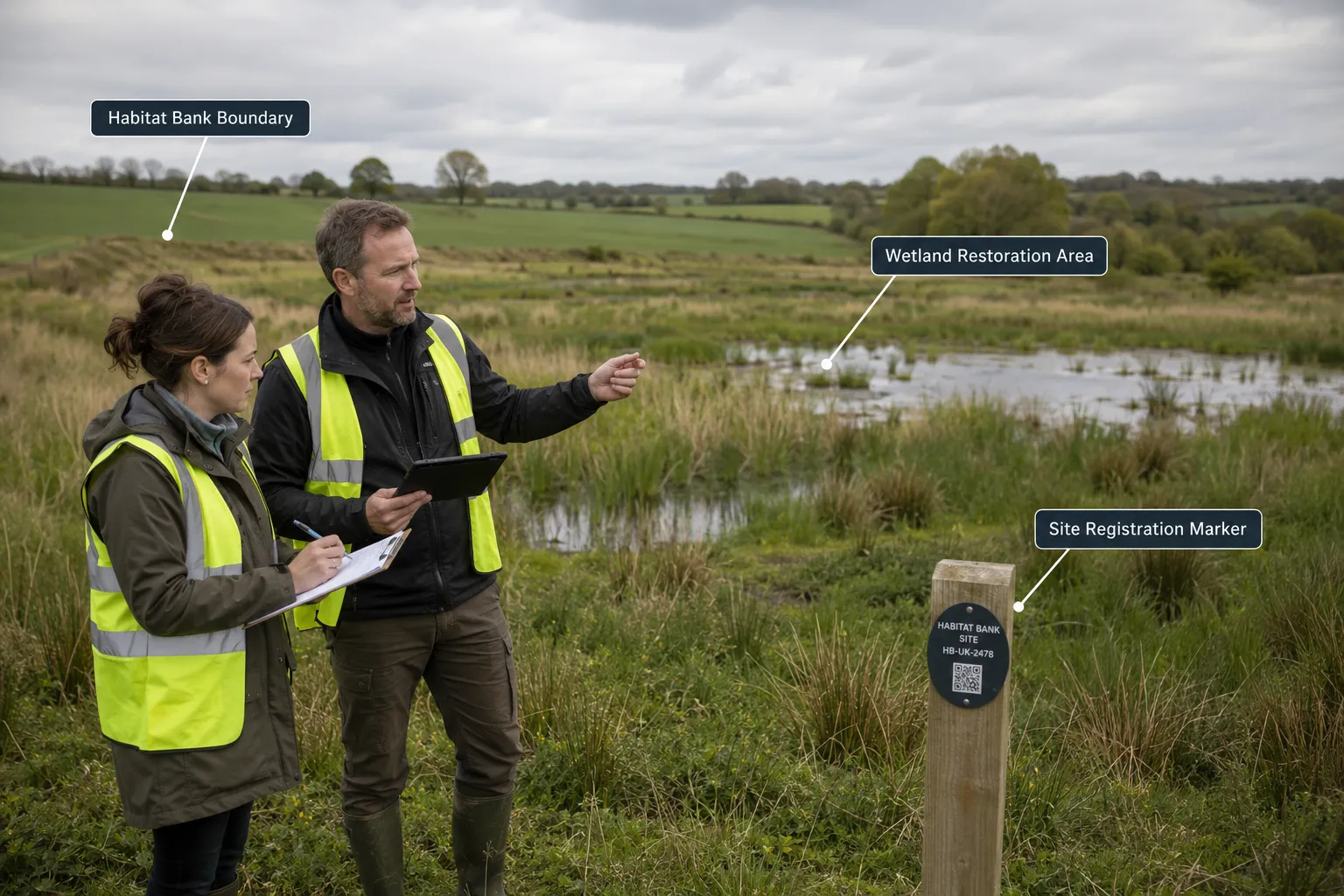
- Habitat banks, landowners who register land, create habitat, and sell units directly or through agents [5][7].
- Brokers and consultancies, intermediaries matching developer demand with available unit supply, often bundling ecological survey work with unit sourcing [1][9].
- Digital trading platforms, searchable marketplaces listing available units by habitat type, distinctiveness band and local planning authority area, reducing the need for cold outreach [8].
Authoritative mapping efforts covering operators and planning authorities through mid-2026 confirm this three-tier structure is now the default route to market for most developers, rather than direct landowner negotiation alone [5][7].
What Developers Should Do This Month
- Audit current and pipeline schemes against the 0.2 hectare exemption threshold before assuming BNG obligations apply.
- Secure larger habitat parcels early if any project touches NSIP scope, given the 2 November 2026 deadline pressure on big-unit supply.
- Compare private unit pricing against statutory credit costs before defaulting to credits, since private units are usually cheaper where supply exists [3][6].
- Build relationships with more than one broker or platform to avoid single-source pricing risk.
What Landowners Should Do This Month
- Confirm registration status with Natural England promptly; unregistered pipeline land cannot be sold as compliant units.
- Reassess unit pricing strategy given the post-August 2026 shift in relative demand across habitat types.
- Consider whether smaller parcels are still commercially viable now that the 0.2 hectare exemption has trimmed some low-volume buyer demand.
What Local Planning Authorities Should Watch
- Monitor whether self-build applicants understand their new obligations following the removal of exemptions.
- Track local habitat bank capacity, since concentrated NSIP demand in some regions could squeeze supply available to ordinary housing applicants.
- Update guidance documents to reflect the 0.2 hectare threshold clearly for smaller applicants.
FAQ
How many offsite BNG sites are registered as of September 2026?
Approximately 197 sites appear on the register, covering close to 7,000 hectares and around 28,000 habitat units [1].
Is the real market bigger than the register suggests?
Yes. Contractual pipeline activity and broker-tracked sites often exceed the formal register total because registration can lag behind agreed sales [5][7].
Did the 6 August 2026 changes reduce demand for offsite units?
Partly. The 0.2 hectare small-site exemption removed some low-volume demand, but removing self-build and custom-build exemptions created new smaller buyers, roughly offsetting the effect [4].
Why are wetland and woodland units more expensive?
These habitat types are harder to create, take longer to establish, and are in high demand from large infrastructure schemes, creating scarcity-driven pricing [2][3].
What happens if a developer misses the NSIP deadline?
Guidance points to compliance obligations tightening from 2 November 2026, meaning affected schemes should secure units well before that date to avoid planning delay risk [10].
Conclusion
September 2026 marks a turning point for the offsite BNG market. The register's 197 sites, nearly 7,000 hectares and roughly 28,000 units confirm sustained growth, but the real story is how quickly pricing, demand patterns and procurement urgency are shifting underneath those headline numbers. Developers should treat unit sourcing as an early-stage procurement task, not a late planning fix. Landowners should reassess pricing against the post-August 2026 landscape. And planning authorities should ensure their guidance keeps pace with a market that is maturing faster than many expected.
References
[1] Bng Habitat Bank Supply August 2026 197 Registered Gain Sites 28000 Units And What Uk Developer Procurement Looks Like Now – Bng habitat bank supply august 2026 197 registered gain sites 28000 units and what uk developer procurement looks like now
[2] Bng Habitat Unit Prices August 2026 Uk Developer Market Update – Bng habitat unit prices august 2026 uk developer market update
[3] Bng Units Prices – ww3.rics.org
[4] Biodiversity Net Gain Changes 6 August 2026 What Developers And Ecologists Must Know Now – Biodiversity net gain changes 6 august 2026 what developers and ecologists must know now
[5] Publications – natureequity.co.uk
[6] Biodiversity Net Gain Bng Statutory Credits Report 1 April 2025 To 31 March 2026 – gov.uk
[7] 04b51dnfxsf9cvmdcpzawc0nob9io9 – biodiversityunits.com
[8] bngfinder.co.uk – bngfinder.co.uk
[9] Biodiversity Net Gain Units Market August 2026 What Landowners And Developers Need To Know – Biodiversity net gain units market august 2026 what landowners and developers need to know
[10] Biodiversity Net Gain Nationally Significant Infrastructure Projects – gov.uk
.cg-bng-wrap{font-family:Arial,Helvetica,sans-serif;max-width:700px;margin:0 auto;background:#f4f8f5;border:1px solid #cfe0d4;border-radius:8px;padding:18px}
.cg-bng-wrap h3{color:#1c4a2e;margin:0 0 4px;font-size:18px}
.cg-bng-sub{color:#4a6b53;font-size:12px;margin:0 0 14px}
.cg-bar-row{display:flex;align-items:center;margin-bottom:10px;font-size:12px}
.cg-bar-label{width:78px;color:#274b32;font-weight:bold}
.cg-bar-track{flex:1;background:#e0ece2;border-radius:4px;height:20px;margin:0 8px;overflow:hidden}
.cg-bar-fill{height:100%;background:linear-gradient(90deg,#2e7d46,#69a97e);border-radius:4px;transition:width .8s ease}
.cg-bar-val{width:78px;font-size:12px;color:#1c4a2e;font-weight:bold;text-align:right}
.cg-toggle{display:flex;gap:8px;margin-bottom:12px}
.cg-toggle button{flex:1;padding:6px;border:1px solid #2e7d46;background:#fff;color:#2e7d46;border-radius:5px;cursor:pointer;font-size:12px;font-weight:bold}
.cg-toggle button.active{background:#2e7d46;color:#fff}
.cg-source{font-size:10px;color:#6b8071;margin-top:10px}
Offsite BNG Market Growth Tracker
Registered sites and habitat units, Jan 2025 to Sept 2026
Source: Natural England register data via biodiversitysurveyors.com market analysis [1]
var cgData={
sites:[[“Jan 2025”,70],[“Mid 2025”,120],[“Early 2026”,160],[“Aug 2026”,190],[“Sept 2026”,197]],
units:[[“Jan 2025”,9000],[“Mid 2025”,16000],[“Early 2026”,22000],[“Aug 2026”,26500],[“Sept 2026″,28000]]
};
function cgRender(key){
var data=cgData[key];
var max=Math.max.apply(null,data.map(function(d){return d[1];}));
var html=””;
data.forEach(function(d){
var pct=Math.round((d[1]/max)*100);
var val=key===”units”?d[1].toLocaleString():d[1];
html+=’
‘;
});
document.getElementById(“cg-bars”).innerHTML=html;
}
document.getElementById(“cg-btn-sites”).addEventListener(“click”,function(){
this.classList.add(“active”);
document.getElementById(“cg-btn-units”).classList.remove(“active”);
cgRender(“sites”);
});
document.getElementById(“cg-btn-units”).addEventListener(“click”,function(){
this.classList.add(“active”);
document.getElementById(“cg-btn-sites”).classList.remove(“active”);
cgRender(“units”);
});
cgRender(“sites”);