

Last updated: August 3, 2026
Quick Answer: From 6 August 2026, England's Biodiversity Net Gain (BNG) framework changes significantly. A new small-site exemption (0.2 hectares or less with no priority habitat) and a temporary development exemption (five years or less) reduce the burden on many minor projects, while the removal of the self-build exemption brings those applicants back into scope. Minor developments also gain a revised gain hierarchy, and BNG becomes mandatory for Nationally Significant Infrastructure Projects from November 2026. Every developer and ecologist with live or upcoming applications needs to act now. [1][4]
Key Takeaways
- From 6 August 2026, developments on sites of 0.2 hectares or less with no on-site priority habitat are exempt from mandatory BNG.
- Temporary developments granted permission for five years or less are also exempt, provided reinstatement conditions apply.
- The self-build and custom-build housing exemption is removed from 6 August 2026, those applicants must now meet the 10% BNG requirement.
- Minor (non-major) developments can now go directly to off-site biodiversity units without first exhausting on-site options.
- BNG becomes mandatory for Nationally Significant Infrastructure Projects (NSIPs) from 2 November 2026.
- The off-site market currently has approximately 197 registered sites, around 7,000 hectares, and roughly 28,000 habitat units available.
- Applications validated before 6 August 2026 are subject to transitional arrangements, the old rules apply.
- Ecologists must confirm site size and priority habitat status at baseline survey stage, as this now determines exemption eligibility.

What Is Biodiversity Net Gain and Why Does It Matter?
Biodiversity Net Gain is the legal requirement, under Schedule 7A of the Town and Country Planning Act 1990 (as inserted by the Environment Act 2021), for most new developments in England to deliver a measurable 10% improvement in biodiversity value compared to the pre-development baseline. It matters because England has lost significant proportions of its wildlife habitats over the past century, and BNG is the government's primary planning-led mechanism to reverse that trend. [3]
BNG is measured using Defra's Biodiversity Metric (currently version 4.0), which converts habitat area, condition, and strategic significance into tradeable "biodiversity units." Developers must show their planning application delivers at least 10% more units than the baseline, either on-site, off-site, or through statutory credits as a last resort. For a fuller explanation of how the metric works in practice, see this guide to Biodiversity Net Gain.
How Do the August 2026 Biodiversity Net Gain Changes Affect Developers?
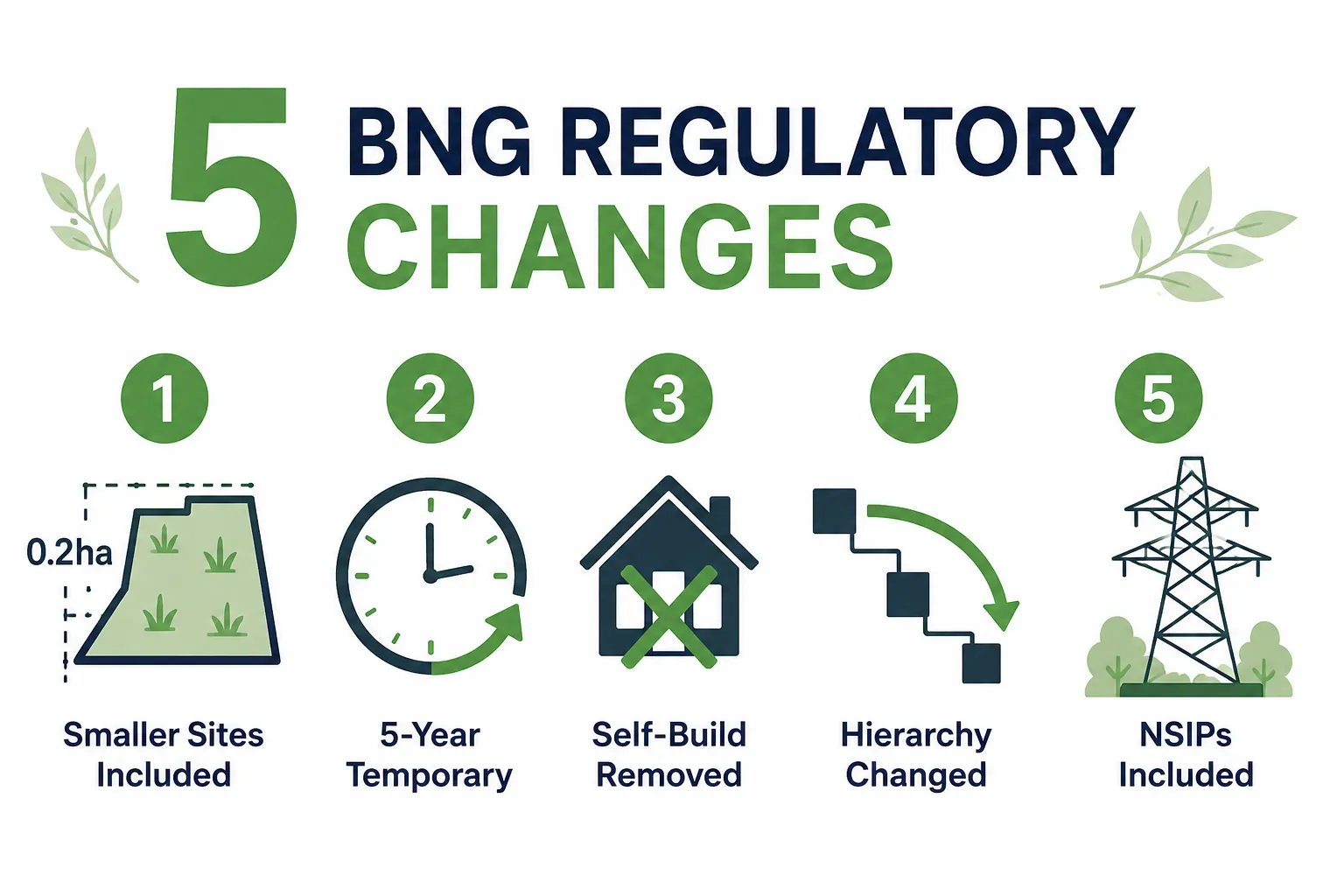
The Biodiversity Net Gain changes 6 August 2026 developers and ecologists need to understand fall into five distinct categories, each with direct planning and commercial implications. [1][4]
1. New 0.2-hectare small-site exemption
Developments where the total site area is 0.2 hectares or less, and where no on-site priority habitat is present, are now exempt from mandatory BNG. This is a significant relief for small infill plots, garden developments, and minor commercial extensions. However, the exemption is conditional: if a Phase 1 habitat survey identifies any priority habitat on the site, the exemption does not apply regardless of size. [4][7]
2. New temporary development exemption
Temporary developments granted planning permission for five years or less, such as construction compounds, temporary car parks, or event structures, are exempt, provided the permission includes reinstatement conditions. Developers must ensure their planning conditions explicitly reflect the temporary nature and reinstatement requirement. [4][6]
3. Removal of the self-build and custom-build exemption
Previously, self-build and custom-build homes were exempt from BNG. From 6 August 2026, that exemption is removed. Individual self-builders and custom-build developers must now demonstrate 10% BNG in their applications. For many single-plot self-builds, the new 0.2-hectare exemption may provide an alternative route, but only where no priority habitat exists. [1][5]
4. Revised biodiversity gain hierarchy for minor developments
Under the previous rules, all developers had to demonstrate they had exhausted on-site options before purchasing off-site units. For minor (non-major) developments from 6 August 2026, this sequential test is relaxed: they can go directly to off-site biodiversity units in the first instance. This reduces the planning burden on small housebuilders and commercial developers while maintaining the 10% target. [4][5]
5. BNG for NSIPs from November 2026
BNG will become mandatory for Nationally Significant Infrastructure Projects from 2 November 2026. Infrastructure promoters, including those delivering energy, transport, and water projects, should begin baseline surveys and metric calculations now to avoid delays. [1][4]
For a broader view of how these rules interact with your project type, the guidance for developers provides a useful starting framework.
Which Projects Are Exempt from the New August 2026 BNG Rules?
Not all development is caught by mandatory BNG. As of 6 August 2026, the following categories are exempt:
| Exemption Category | Condition |
|---|---|
| Small sites (0.2ha or less) | No on-site priority habitat present |
| Temporary development | Permission for 5 years or less, with reinstatement |
| Householder applications | Existing exemption retained |
| Permitted development rights | Existing exemption retained |
| Biodiversity gain sites | Existing exemption retained |
Self-build and custom-build homes are no longer on this list. Developers unsure whether their project qualifies should check the exempt projects guidance before submitting an application.
Common mistake: Assuming a site under 0.2 hectares is automatically exempt. If a Phase 1 survey finds marshy grassland, ancient hedgerow, or any other priority habitat, the exemption does not apply. The ecologist's baseline survey is therefore the critical gating document.
What Are the New Requirements for Ecologists Under the 2026 BNG Rules?
Ecologists now carry greater responsibility at the baseline survey stage. The Biodiversity Net Gain changes 6 August 2026 developers and ecologists face together mean that a habitat survey is no longer just a metric input, it is the document that determines whether a project is exempt at all. [5][6]
Specifically, ecologists must:
- Accurately measure and record total site area (to confirm the 0.2-hectare threshold).
- Identify and map all priority habitats to Phase 2 standard where any are suspected.
- Record whether planning permission is sought on a temporary or permanent basis, as this affects the exemption assessment.
- Apply Defra Metric 4.0 correctly for any non-exempt development, including the revised hierarchy rules for minor developments.
CIEEM guidance recommends that ecologists document their exemption assessment reasoning explicitly within the Biodiversity Net Gain report, so planning officers can verify the claim without requesting additional information. For a detailed breakdown of what a compliant report must contain, see what is in a Biodiversity Net Gain assessment.
Biodiversity Net Gain Calculator Changes August 2026
Defra has confirmed that metric and system updates are planned for later in 2026, though the core Metric 4.0 tool remains in use for applications submitted around the August 2026 transition. Ecologists should check the Defra biodiversity metric page for the latest version before running any new calculations. [3][4]
The key practical point: applications validated before 6 August 2026 will be assessed under the rules in force at validation, including the old gain hierarchy and self-build exemption. Applications validated on or after 6 August 2026 fall under the new rules. Ecologists and planning consultants must confirm the validation date with the local planning authority before finalising any metric submission.
Biodiversity Net Gain Alternatives to On-Site Habitat Creation
For minor developments in particular, off-site biodiversity units are now a first-resort option rather than a last resort. The off-site market has grown considerably since mandatory BNG launched in February 2024. As of mid-2026, approximately 197 registered habitat bank sites are selling units, covering around 7,000 hectares and offering roughly 28,000 habitat units across England. [2]
Developers have three routes for off-site delivery:
- Private off-site habitat banks, registered sites selling units directly; prices vary by habitat type, location, and strategic significance.
- Local Nature Recovery, units purchased through local authority-coordinated schemes aligned with Local Nature Recovery Strategies.
- Statutory biodiversity credits, purchased directly from Defra as a last resort when no off-site units are available. Prices are set by government and are intentionally high to incentivise private market solutions.
For a practical comparison of these routes, see off-site or on-site BNG delivery and the guide to biodiversity credits for developers.
How Much Will Biodiversity Net Gain Compliance Cost Developers?
Costs vary widely depending on site size, baseline habitat quality, and the route chosen to achieve the 10% gain. There is no single fixed price. The main cost components are:
- Ecological survey and metric calculation: Typically a few hundred to several thousand pounds depending on site complexity.
- On-site habitat creation: Costs depend on the habitat type, land value, and management commitment required (minimum 30 years).
- Off-site unit purchase: Private market unit prices vary significantly by habitat type and region. Statutory credits are priced by Defra and are generally more expensive than private units.
The removal of the self-build exemption means individual self-builders now face these costs for the first time. For many, the new 0.2-hectare small-site exemption will apply, but only after a survey confirms no priority habitat. See the cost of biodiversity units and statutory credits for current market context.
How Do You Measure Biodiversity Net Gain on a Development Site?
BNG is measured using Defra's Biodiversity Metric 4.0, a spreadsheet-based tool that calculates habitat units based on area, condition, and location. The process has four main steps:
- Commission a Phase 1 (and where needed Phase 2) habitat survey to establish the baseline.
- Enter baseline habitat data into the metric tool to calculate pre-development units.
- Model proposed habitat creation or enhancement to calculate post-development units.
- Confirm the net difference is at least +10%.
The metric also includes a small sites metric for sites under 0.5 hectares, which uses a simplified approach. Ecologists should confirm which version applies before starting. For a step-by-step walkthrough, see how to conduct a biodiversity impact assessment.
What Happens If a Developer Fails to Achieve Biodiversity Net Gain Targets?
Failure to demonstrate 10% BNG is a valid ground for planning refusal. Where a biodiversity gain plan is approved but subsequently not delivered, local planning authorities can enforce against the breach as a planning condition. [3]
For off-site delivery, the biodiversity gain plan must identify the registered off-site site and the number of units allocated. If a developer purchases units that are later found to be invalid or double-counted, the obligation remains, they must source replacement units. This makes due diligence on off-site providers essential. See achieving BNG without the risk for practical risk mitigation steps.
What's the Difference Between BNG and Environmental Impact Assessment?
BNG and Environmental Impact Assessment (EIA) are separate but complementary requirements. EIA assesses the likely significant environmental effects of a development and applies to projects above defined thresholds. BNG applies to most planning applications regardless of EIA status and requires a specific net gain calculation and gain plan. [3]
A project can require both: a major infrastructure scheme might need a full EIA covering biodiversity chapter impacts and a separate BNG metric calculation. The biodiversity chapter of an EIA does not substitute for a BNG metric submission.
Biodiversity Net Gain Timeline for Compliance After August 2026
The regulatory calendar for the rest of 2026 and into 2027 is as follows:
- 6 August 2026: New exemptions and hierarchy changes take effect for town and country planning applications.
- 2 November 2026: BNG becomes mandatory for Nationally Significant Infrastructure Projects.
- Late 2026 (date TBC): Defra metric and digital system updates expected.
- Ongoing: Local planning authorities continue to develop Local Nature Recovery Strategies, which will influence the strategic significance multipliers in the metric.
Applications validated before 6 August 2026 are subject to transitional arrangements and will be assessed under the rules in force at validation. [4]
What You Should Do Before and After 6 August 2026
Before 6 August 2026 (if you have live applications):
- Confirm validation date with your local planning authority, this determines which rules apply.
- If your application is not yet validated and your site is 0.2 hectares or less, consider whether delaying submission to benefit from the new exemption is viable (subject to no priority habitat being present).
- Self-build applicants with applications not yet validated should seek ecological advice immediately.
After 6 August 2026 (checklist for new applications):
- Commission a Phase 1 habitat survey to confirm site area and identify any priority habitat.
- Determine exemption status before proceeding to metric calculation.
- For minor developments, confirm with your planning consultant whether off-site units are the most efficient first step.
- If off-site units are needed, approach registered habitat banks early, supply in some habitat types and regions remains constrained.
- Ensure your biodiversity gain plan is prepared by a qualified ecologist and reviewed by the local planning authority's ecological officer.
- For NSIP promoters: begin baseline surveys now ahead of the November 2026 deadline.
- Document the exemption assessment rationale explicitly in all survey reports.
Frequently Asked Questions
Does the 0.2-hectare exemption apply to all development types?
Yes, the exemption applies to any development type where the total site area is 0.2 hectares or less and no on-site priority habitat is present. It is not limited to residential development. [4][7]
What counts as priority habitat for the exemption test?
Priority habitats are those listed under Section 41 of the Natural Environment and Rural Communities Act 2006. Common examples include traditional orchards, lowland meadows, hedgerows, and coastal and floodplain grazing marsh. A Phase 1 habitat survey by a qualified ecologist is the standard method for identifying them. [3]
Can a temporary development be made permanent later without triggering BNG?
No. If a developer seeks to extend or make permanent a development that was originally exempt as temporary, the new permanent application will be assessed under BNG rules at that point. [6]
Do self-builders need to hire an ecologist from 6 August 2026?
In most cases, yes. Unless the site qualifies for the new 0.2-hectare exemption, self-build applications validated on or after 6 August 2026 must demonstrate 10% BNG, which requires a habitat survey and metric calculation by a suitably qualified ecologist. [1][5]
How do minor developers find and purchase off-site biodiversity units?
Off-site units can be sourced through registered habitat banks listed on the Defra biodiversity gain site register, through local authority-coordinated schemes, or through brokers. The buy biodiversity units service provides access to registered units. Always verify registration status before purchase.
Will the metric tool change before the end of 2026?
Defra has indicated metric and system updates are planned for later in 2026. Ecologists should monitor the official Defra biodiversity metric guidance page for version updates and apply the current approved version for all submissions. [4]
Conclusion
The Biodiversity Net Gain changes 6 August 2026 developers and ecologists face represent the most significant recalibration of the BNG framework since mandatory requirements launched in early 2024. The new small-site and temporary development exemptions will genuinely reduce the compliance burden for a large number of minor projects. But the removal of the self-build exemption and the hierarchy change for minor developments mean that careful pre-application assessment is more important than ever.
The practical steps are clear: confirm your site's exemption status with a qualified ecologist before submitting any application validated on or after 6 August 2026, engage with the off-site market early if units are needed, and plan ahead for the NSIP extension in November 2026. With roughly 28,000 habitat units currently available across approximately 197 registered sites, the off-site market has capacity, but it is not evenly distributed across habitat types and regions, so early engagement matters.
For developers and ecologists who act now, these changes create a more proportionate and commercially workable system. For those who do not, they create new grounds for planning delay or refusal.
References
[1] Biodiversity Net Gain: What's Changing And What It Means For You – defraenvironment.blog.gov.uk
[2] David Hickinson LinkedIn Post: Biodiversity Net Gain Changes From 6 August – linkedin.com
[3] Understanding Biodiversity Net Gain (GOV.UK) – gov.uk
[4] Biodiversity Net Gain Amendments And Transitional Arrangements Published – defraenvironment.blog.gov.uk
[5] Biodiversity Net Gain Changes From 6 August 2026: What Developers Need To Know (Crossman Ecology) – crossmanecology.co.uk
[6] BNG August 2026 Regulations Confirmed (The Ferals) – the-ferals.co.uk
[7] New Biodiversity Net Gain Exemptions From August 2026: What Developers Need To Know (Foot Anstey) – footanstey.com