

Fewer than one in five small housing sites in England previously escaped Biodiversity Net Gain paperwork entirely. As of 6 August 2026, that changed overnight. A new area-based exemption now removes an entire category of small sites from mandatory biodiversity net gain calculations, but only if a specific condition is met, and thousands of self-builders who assumed they were safe under the old rules discovered in late summer that the ground had shifted beneath them.
The BNG 0.2 hectare exemption September 2026 SME developers self-builders reform is arguably the most consequential planning change of the year for small housebuilders. It simplifies life for many, but it also strips away a long-standing safety net for self-build projects. Understanding exactly where the new line sits is now essential reading for anyone planning a small site, extension, or custom home.
Key Takeaways
- From 6 August 2026, developments on sites under 0.2 hectares are exempt from BNG duties, provided no priority habitat is affected [1][2].
- The exemption is measured against the whole application site, not just the building footprint or area of disturbance [3][5].
- The old self-build and custom-build exemption has been withdrawn, though most small self-build plots now fall inside the 0.2ha threshold anyway [1][6].
- For minor development above 0.2ha, the biodiversity gain hierarchy has been amended so offsite gains carry equal weight to onsite gains [4][6].
- Section 73 variation applications can inadvertently trigger fresh BNG assessment, catching out developers who assumed their scheme was settled [8][10].
What Changed on 6 August 2026
Defra's consultation response, published earlier in the year, confirmed that a blanket area-based exemption would apply to sites of 0.2 hectares or less across all development types, not just residential [4][6]. This took legal effect on 6 August 2026, following months of industry pressure over the cost and complexity of applying full BNG metrics to modest schemes such as single dwellings, small infill plots, and minor commercial units [1][5].
Before this reform, exemptions were narrower and inconsistently applied, leaving many small developers navigating the same 10 percent net gain requirement, biodiversity metric calculations, and habitat management plans as major housebuilders. The Local Government Association had repeatedly flagged that planning authorities lacked capacity to process this volume of small-site ecological assessments, and Pinsent Masons' planning team noted that the disproportionate burden on micro-sites was becoming a bottleneck for local plan delivery. The 0.2ha threshold is Defra's answer to that pressure [4].
Crucially, this is a commencement date, not merely a policy intention. Some commentary earlier in the year suggested a later start, but the regulations were laid and came into force on 6 August 2026 as planned, giving planning officers and applicants a firm date to work against [1][3].
Scope of the Exemption: Whole Site, Priority Habitat Carve-Out
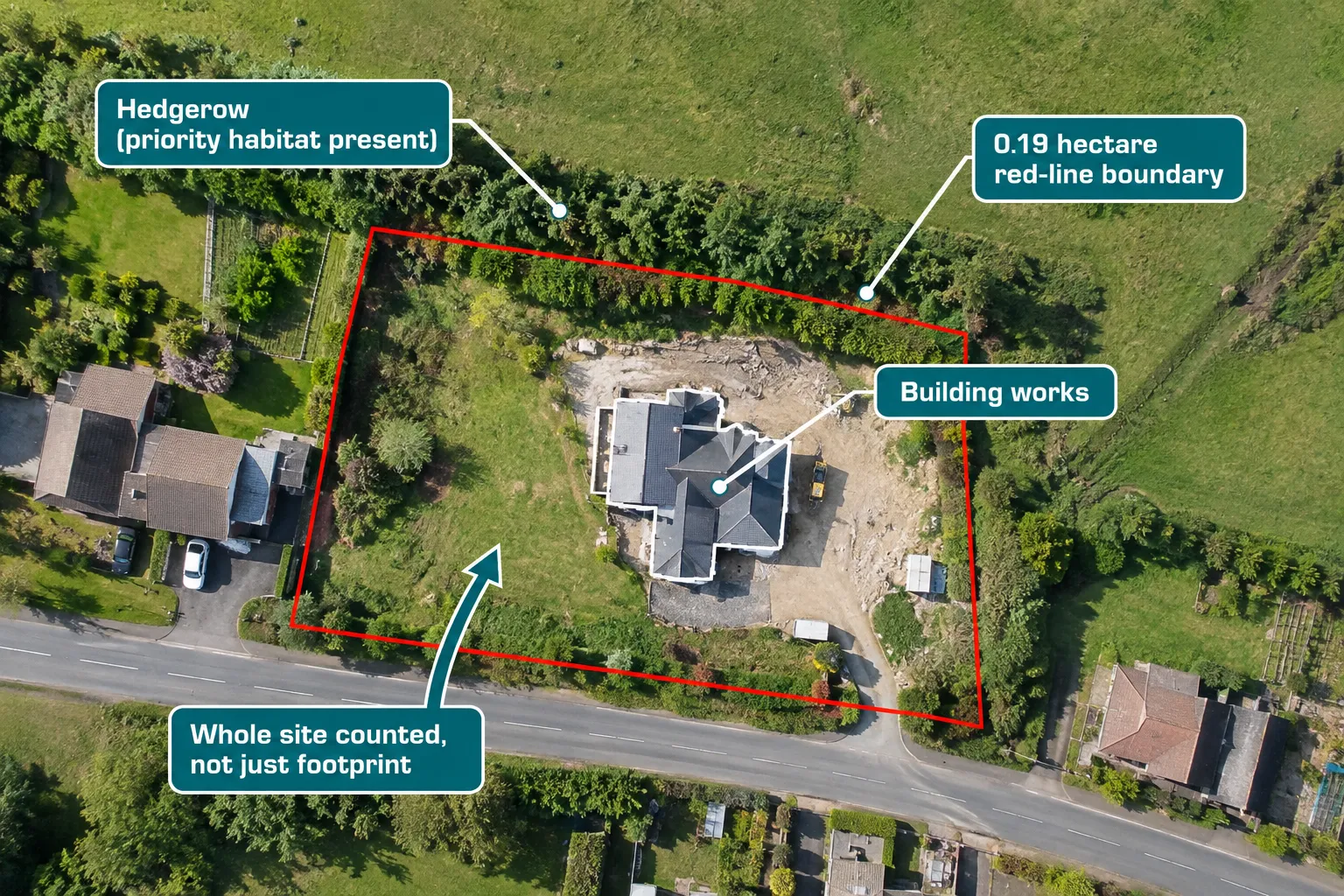
The exemption is generous in one respect and narrow in another. It applies to the entire planning application site area, meaning a self-builder or SME developer measures the whole red-line boundary, gardens, access roads, and any undeveloped land included in the application, not just the footprint of the building itself [3][5]. A site can therefore qualify even where the house occupies only a fraction of a larger plot.
The critical limiter is the priority habitat carve-out. If any part of the 0.2ha site contains a habitat classified as irreplaceable or priority habitat under the statutory habitat classification, ancient woodland, wildflower-rich grassland, or certain wetland types, for example, the exemption does not apply, regardless of site size [2][8]. This single condition is expected to disqualify a meaningful minority of small rural plots, particularly those with hedgerows, mature trees, or unmanaged grassland that ecologists would classify as priority habitat.
Gentian's analysis of the reform underlines that developers cannot simply assume exemption based on acreage alone; a proportionate habitat check remains a sensible first step even on tiny sites [8]. Planning officers are advised to request at minimum a basic habitat scoping note before waiving BNG conditions, to avoid later disputes or enforcement risk.
Self-Build and Custom-Build Exemption Removed, But Most Now Covered
Previously, self-build and custom-build projects benefited from a standalone exemption regardless of site size. That exemption has now been withdrawn as part of the same package of reforms [1][6]. On its face, this looks like a tightening of the rules for individual homebuilders.
In practice, the impact is softened because the vast majority of self-build plots are small enough to fall within the new 0.2 hectare threshold anyway. Gaia Company's review of the August 2026 changes estimates that most single-plot self-builds sit comfortably under the area limit [1]. The exceptions are self-builders on larger rural plots, smallholdings, or sites with paddocks and orchards exceeding 0.2ha, who now find themselves without either exemption and facing full biodiversity metric obligations for the first time.
A transitional protection applies to schemes that already had planning permission or a live application submitted before the removal date, meaning existing self-build projects mid-process are not retrospectively caught out, but any new application submitted after 6 August 2026 is assessed under the current rules [1][3].
Amended Biodiversity Gain Hierarchy for Minor Development Above 0.2ha
For sites that exceed 0.2 hectares but still qualify as "minor development", broadly, small residential schemes below the major development thresholds, the government has also revised the biodiversity gain hierarchy itself. Historically, onsite biodiversity gains were strongly preferred, with offsite gains (such as purchasing habitat units from a registered offsite site or the statutory credit scheme) treated as a fallback of last resort.
Under the amended hierarchy, offsite gains now carry equal priority to onsite gains for minor development above the 0.2ha threshold [4][6]. This is a significant practical shift. SME developers on tight urban infill sites, where there is little physical space to create meaningful onsite habitat, can now purchase offsite biodiversity units without needing to first demonstrate that onsite delivery was impossible. This removes a documentation burden that many smaller firms found disproportionate relative to the size of their schemes.
"The equal-priority change for minor sites is one of the most welcome parts of this reform, it stops small developers being forced into unworkable onsite habitat schemes on quarter-acre plots," reflects the tone of professional commentary following the change [6].
Practical Guidance for SME Developers, Self-Builders and Planning Officers
Different parties need different checklists under the new regime.
For SME developers:
- Measure the whole application site area first, not just the developable parcel.
- Commission an early habitat walkover to rule out priority habitat before relying on the exemption.
- Where a site sits just above 0.2ha, model both onsite and offsite gain routes now that they carry equal weight [6].
- Keep records of pre-development habitat condition even on exempt sites, councils may request evidence later.
For self-builders:
- Do not assume the old self-build exemption still applies; check the 0.2ha area rule directly against your plot boundary [1].
- If your plot includes an orchard, paddock, or wooded area, get a professional habitat assessment before assuming exemption.
- Check the submission date of your application against the 6 August 2026 commencement to understand which rules apply.
For planning officers:
- Apply the whole-site measurement consistently, and request scoping surveys where priority habitat is plausible but unconfirmed [2][8].
- For minor developments above 0.2ha, accept offsite gain proposals on equal footing with onsite proposals unless local plan policy states otherwise [4].
- Watch for schemes designed just under 0.2ha where boundary drawing looks artificial, and apply proportionate scrutiny.
Section 73 Applications, Timing Traps and Professional Response
One issue causing genuine anxiety among SME developers is the treatment of Section 73 applications to vary existing permissions. Because a Section 73 variation can, in some circumstances, be treated as a fresh assessment point, schemes that were originally approved before 6 August 2026, and therefore exempt or assessed under old rules, may find themselves unexpectedly pulled into the new regime if they seek even minor amendments after that date [8][10]. Vail Williams' guidance on the 2026 rules flags this as a genuine trap: developers should seek planning advice before submitting any variation application on a scheme that relied on a prior exemption.
Professional response through August and September 2026 has been broadly positive but cautious. Ecology consultancies and planning advisers have welcomed the reduced burden on genuinely small sites, while warning that the priority habitat carve-out will require more, not fewer, early-stage ecological checks in rural areas. The Local Government Association has emphasised that councils need clear internal guidance to apply the whole-site measurement consistently, to avoid inconsistent decisions between neighbouring authorities.
Frequently Asked Questions
Does the 0.2 hectare exemption apply automatically to all small sites?
No. It applies only where the whole application site is 0.2 hectares or less and no priority habitat is present or affected. Sites with hedgerows, ancient woodland fragments, or species-rich grassland may still require BNG assessment despite their small size [2][8].
I'm a self-builder, do I still need to worry about BNG?
The dedicated self-build exemption has been removed, but most individual self-build plots are small enough to qualify under the new 0.2ha rule instead. Larger rural self-build plots may not qualify and should get an early habitat check [1][6].
What counts as the "site" when measuring 0.2 hectares?
The entire application site within the red-line boundary, including gardens, access, and undeveloped land, not just the building footprint or construction disturbance area [3][5].
Can I use offsite biodiversity units instead of onsite habitat on a minor scheme?
Yes, for minor development above 0.2ha, offsite gains now have equal priority to onsite gains under the amended biodiversity gain hierarchy, removing the previous requirement to justify why onsite delivery was not feasible [4][6].
My scheme was approved before August 2026, does the new rule affect me?
Generally no, due to transitional protections, but submitting a Section 73 variation after 6 August 2026 could trigger reassessment under the new rules, so seek advice before applying [8][10].
Where can I check the official exemption criteria?
Defra's guidance on exempt developments and the wider BNG guidance pages set out the statutory criteria in full and should be checked directly for any live application [2][7][9].
Conclusion
The BNG 0.2 hectare exemption September 2026 SME developers self-builders reform genuinely simplifies the picture for the smallest schemes in England, but it replaces one set of assumptions with another. Site size alone is not enough, priority habitat status is now the decisive factor, and self-builders can no longer rely on a bespoke exemption that no longer exists. SME developers working just above the threshold gain welcome flexibility through the amended gain hierarchy, but should document their reasoning carefully.
The practical next step for anyone planning a small development is straightforward: measure the whole site against the 0.2ha threshold, commission a proportionate habitat check before assuming exemption, and take advice before submitting a Section 73 variation on any scheme approved under the old rules. Planning officers should align internal guidance now to avoid inconsistent decisions across neighbouring authorities. Six weeks into the new regime, the direction is clear, smaller sites are simpler, but only for those who check the detail first.
References
[1] Biodiversity Net Gain Changes August 2026 – gaiacompany.io
[2] Biodiversity Net Gain Exempt Developments – gov.uk
[3] New Exemptions And Revised Thresholds For Biodiversity Net Gain From 6th August England Only – cla.org.uk
[4] Biodiversity Net Gain Whats Changing And What It Means For You – defraenvironment.blog.gov.uk
[5] Biodiversity Net Gain Changes 6 August 2026 Developers Guide To The New Rules – Biodiversity net gain changes 6 august 2026 developers guide to the new rules
[6] Key Changes Confirmed To Biodiversity Net Gain – cla.org.uk
[7] Biodiversity Net Gain – gov.uk
[8] Bng 0.2ha Exemption 2026 Is Your Site Still In Scope – gentian.io
[9] Understanding Biodiversity Net Gain – gov.uk
[10] Biodiversity Net Gain Rules 2026 – vailwilliams.com
biodiversity net gain, BNG exemption, 0.2 hectare rule, SME developers, self-builders, custom-build exemption, planning permission UK, priority habitat, biodiversity gain hierarchy, Defra planning reform, Section 73 applications, small site development