

Three-quarters of the world's countries have written national biodiversity targets into law. Almost none of them are on track to hit a single one of the 23 global goals by 2030. That gap between promise and delivery is the backdrop against which COP17 biodiversity October 2026 UK developers must now plan every site, every survey, and every planning application.
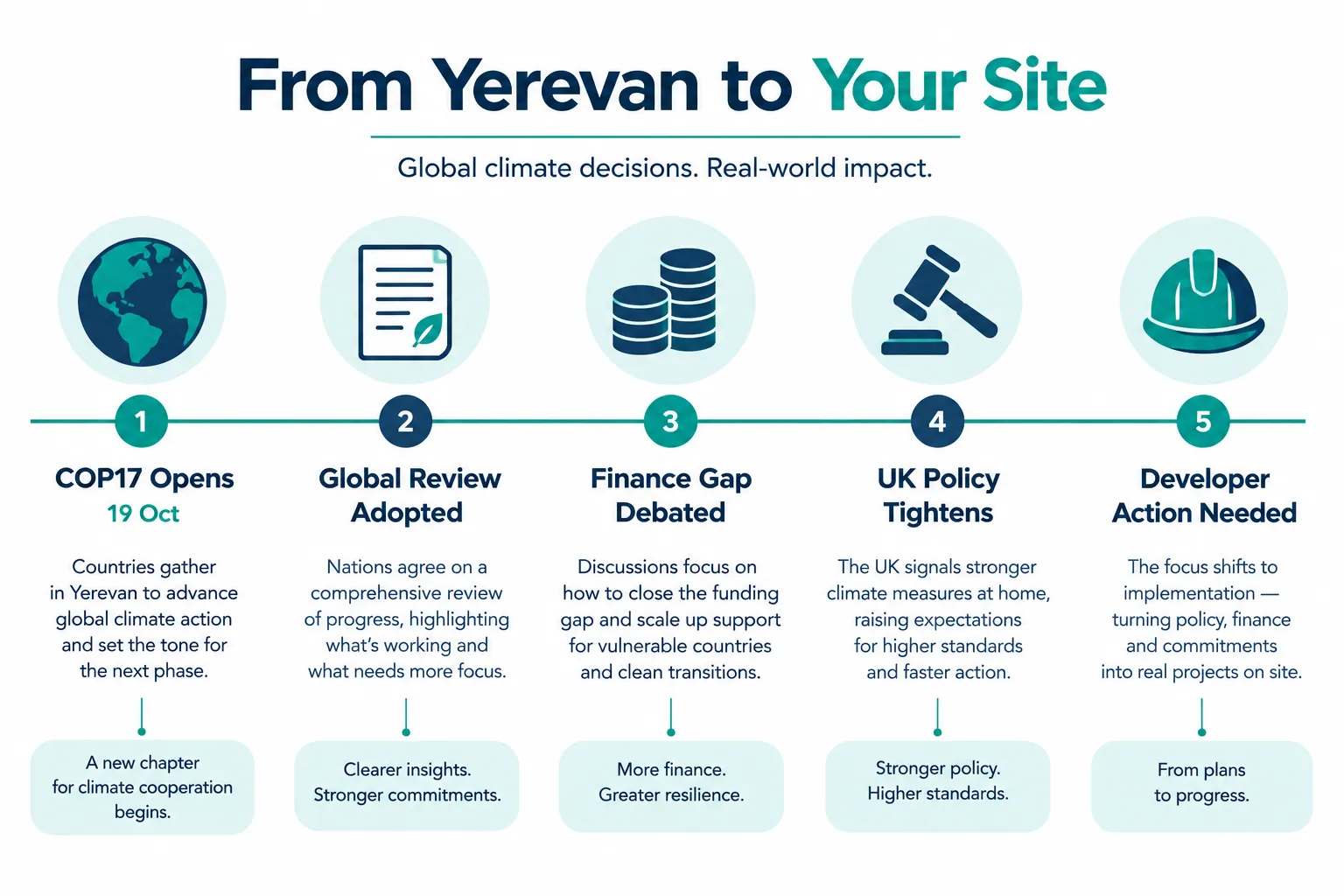
From 19 to 30 October 2026, delegates from 196 parties gather in Yerevan, Armenia, for the 17th Conference of the Parties to the Convention on Biological Diversity, under the banner "Taking Action for Nature." It sounds like a distant diplomatic event. For anyone involved in UK land development, it is not. The Global Review being adopted in Yerevan will set the tone for how seriously governments treat nature loss, and the UK's own Biodiversity Net Gain (BNG) regime is already tightening in parallel, with real deadlines in August and November 2026.
Key Takeaways
- COP17 runs 19-30 October 2026 in Yerevan and will adopt a provisional "Global Review" assessing progress on the Kunming-Montreal Global Biodiversity Framework's 23 targets.
- Global finance for nature remains roughly 60% short of the USD 200 billion annual target agreed by parties; the Cali Fund for genetic-data benefit-sharing is still nearly empty.
- Protected area coverage has crept up to 18.4% of land and 10% of sea, still well short of the 30×30 goal, progress is real but too slow.
- In England, a new 0.2-hectare BNG exemption and a temporary-development exemption apply only to applications made from 6 August 2026 onward; the self- and custom-build exemption has been removed.
- From 2 November 2026, Nationally Significant Infrastructure Projects (NSIPs) must deliver at least 10% net gain under BNG for DCO applications submitted from that date.
What COP17 Biodiversity October 2026 UK Developers Should Actually Watch
COP17's core agenda is implementation, not new promises. Negotiators will review how the Kunming-Montreal Global Biodiversity Framework, agreed at COP15 in 2022, is being put into practice, alongside outcomes carried over from COP16. The centrepiece is the provisional Global Review, an interim stocktake of the 23 targets covering habitat restoration, species protection, pollution reduction, and sustainable finance.
The headline numbers are sobering. Protected areas now cover 18.4% of land (up from 17.6%) and 10% of sea (up from 8.4%), against the 30×30 target of protecting 30% of land and sea by 2030. Progress exists, but the trajectory is too flat to close the gap in four years.
Finance is the sharpest fault line. Parties agreed to mobilise at least USD 200 billion a year for biodiversity. The OECD estimates actual funding sits at USD 78-91 billion a year, a shortfall of roughly 60%. The Cali Fund, designed to channel corporate benefit-sharing from genetic data back into conservation, remains nearly empty. Expect Yerevan's talks on finance mechanisms to be tense, and expect the resulting pressure to filter down into stricter domestic enforcement of existing commitments, including the UK's own biodiversity law.
Pull quote: "International targets rarely change planning law overnight, but they shape the political appetite for enforcing the rules already on the books."
Why COP17 Biodiversity October 2026 UK Developers Face Tighter BNG Rules Right Now
While Yerevan debates global finance gaps, England's domestic BNG framework is quietly getting stricter, and the timing with COP17 is not a coincidence of calendars so much as a reminder that international scrutiny and domestic delivery are now linked in the public mind.
According to a Thomson Snell & Passmore briefing dated 13 October 2026, several changes take effect from 6 August 2026:
- A new 0.2-hectare exemption from mandatory BNG for smaller developments, but only where no onsite priority habitat is negatively affected.
- A temporary-development exemption, provided the land is reinstated within five years.
- Minor, non-exempt sites may go straight to offsite compensation rather than attempting onsite gains.
- The previous self- and custom-build exemption has been removed entirely.
Crucially, these exemptions apply only to planning applications made after 6 August 2026, earlier applications remain under the old rules. The Regulatory Policy Committee has already flagged that the government's impact assessment for these changes was "not fit for purpose," signalling continued scrutiny of how the exemptions perform in practice.
Then, from 2 November 2026, Nationally Significant Infrastructure Projects become subject to BNG, requiring at least 10% net gain for Development Consent Order (DCO) applications made on or after that date. This brings major infrastructure, energy, transport, water, into the same biodiversity accounting regime that smaller housing sites have faced since 2024.
| Date | Change | Who it affects |
|---|---|---|
| 19-30 Oct 2026 | COP17 Global Review adopted in Yerevan | Global policy tone, finance debate |
| 6 Aug 2026 | 0.2ha and temporary-development exemptions begin | Smaller sites, applications filed after this date |
| 6 Aug 2026 | Self- and custom-build exemption removed | Individual self-builders |
| 2 Nov 2026 | BNG mandatory for NSIPs (10% minimum) | Major infrastructure DCO applicants |
Practical Steps for Developers and Landowners
Whatever happens in Yerevan, the practical reality in England has not softened, it has become more nuanced. Developers now need to work out which exemption category, if any, applies to their site, and plan ecology work accordingly.
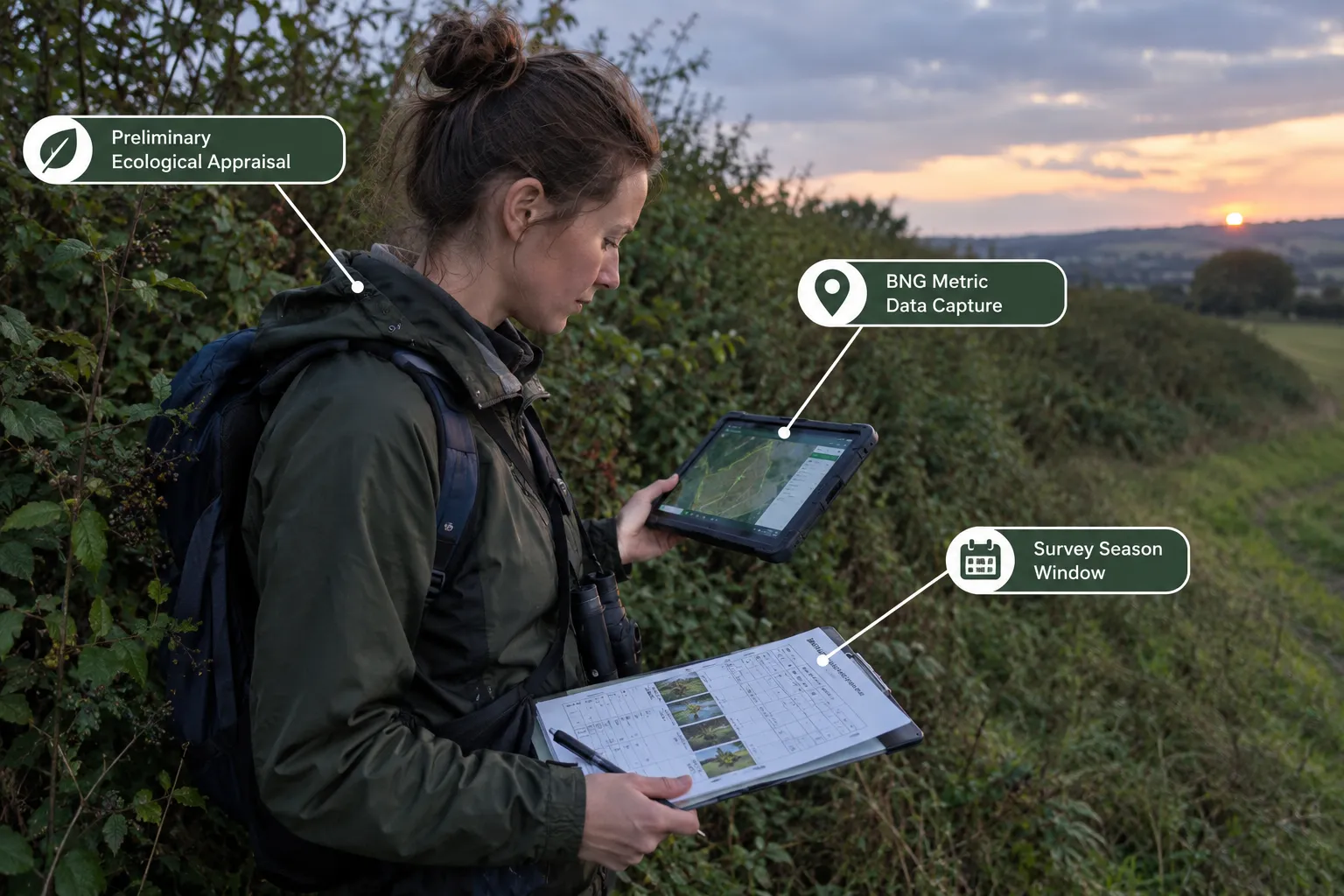
Recommended actions before submitting any application:
- Commission a Preliminary Ecological Appraisal (PEA) early, to establish whether priority habitat is present on site, this single factor determines eligibility for the new 0.2-hectare exemption.
- Run a BNG metric assessment using the current statutory metric, even on sites that may qualify for exemption, since habitat condition data informs offsite compensation calculations if needed.
- Check the application date carefully, exemptions apply only to applications made from 6 August 2026 onward, so phased or resubmitted applications may fall under different rules.
- Build in survey seasonality, many habitat and protected species surveys (bats, great crested newts, breeding birds, botanical surveys) are restricted to specific months, typically spring and summer. Leaving surveys until late in the year risks delaying the whole application by a full season.
- Flag NSIP-adjacent projects now if submission could occur close to 2 November 2026, since crossing that date changes the net gain requirement entirely.
Interactive: 2026 BNG and COP17 Key Dates
Use the tool below to see what matters and when, from the COP17 opening in Yerevan through to the NSIP BNG deadline.
Frequently Asked Questions
Does COP17 directly change UK planning law?
No. COP17 is an international review of the Global Biodiversity Framework. It does not itself amend English planning law, but it raises political pressure on governments, including the UK, to demonstrate delivery against targets they have already signed up to.
What is the Global Review being adopted at COP17?
It is a provisional interim assessment of progress against the Kunming-Montreal Global Biodiversity Framework's 23 targets, agreed at COP15 in 2022, covering habitat protection, species recovery, and finance.
When do the new BNG exemptions apply?
Only to planning applications made on or after 6 August 2026. Applications submitted earlier remain subject to the prior BNG requirements.
Is the self-build BNG exemption still available?
No. The self- and custom-build exemption has been removed as part of the changes taking effect from 6 August 2026.
What changes for infrastructure projects?
From 2 November 2026, Nationally Significant Infrastructure Projects must achieve at least 10% biodiversity net gain for Development Consent Order applications made from that date.
How far ahead should ecology surveys be booked?
Given seasonal restrictions on protected species and habitat surveys, developers should commission Preliminary Ecological Appraisals and metric assessments as early as possible, ideally months before a planning submission is planned.
Conclusion
COP17 biodiversity October 2026 UK developers face a clear message from Yerevan: global progress on nature is too slow, finance is short by roughly 60%, and scrutiny is rising. That international pressure lands on a domestic BNG regime that is already becoming more complex, new exemptions from 6 August 2026, a removed self-build exemption, and mandatory net gain for major infrastructure from 2 November 2026.
The practical response is straightforward. Get a Preliminary Ecological Appraisal done early, run the BNG metric regardless of exemption status, confirm the exact application date against the new thresholds, and respect survey seasonality so a single missed window does not cost months. Developers and landowners who treat ecology survey planning as a project-critical task, not an afterthought, will move through 2026's tightened rules with far fewer surprises.
.cg-wrap{font-family:Arial,Helvetica,sans-serif;max-width:700px;margin:0 auto;padding:16px;background:#f4f7f5;border-radius:10px;border:1px solid #d7e2dc}
.cg-wrap h3{color:#1c3d2e;margin:0 0 10px;font-size:19px}
.cg-item{background:#fff;border-left:5px solid #2e6b4f;border-radius:6px;padding:10px 12px;margin-bottom:8px;cursor:pointer;transition:background.2s}
.cg-item:hover{background:#eef5f0}
.cg-date{font-weight:bold;color:#2e6b4f;font-size:14px}
.cg-title{font-size:14px;color:#222;margin-top:2px}
.cg-detail{display:none;font-size:13px;color:#444;margin-top:6px;line-height:1.4;padding-top:6px;border-top:1px dashed #cfe0d6}
.cg-item.cg-open.cg-detail{display:block}
.cg-badge{display:inline-block;font-size:11px;background:#2e6b4f;color:#fff;padding:2px 7px;border-radius:10px;margin-left:6px}
2026 Biodiversity and BNG Key Dates
Tap any row to expand details. Source: Thomson Snell & Passmore briefing, 13 Oct 2026; CBD COP17 schedule.
document.querySelectorAll(‘.cg-item’).forEach(function(i){i.addEventListener(‘keyup’,function(){});});