

Just two days from now, on 6 August 2026, the rules governing Biodiversity Net Gain (BNG) in England will shift in ways that affect thousands of planning applications every year. The BNG changes 6 August 2026 small site exemption package, confirmed by DEFRA on 14 July 2026, introduces a new size-based exemption, removes an existing one, and fundamentally rebalances how minor developments can meet their BNG obligations [1]. Whether you are a small developer trying to understand your new position, a self-builder who has just lost a previous protection, or a local authority planner updating your validation checklists, the next 48 hours matter.
Key Takeaways
- From 6 August 2026, development on sites under 0.2 hectares (2,000 sqm) with no onsite priority habitat is exempt from mandatory BNG.
- Temporary development is also newly exempt from 6 August 2026.
- The self-build and custom-build exemption is removed from the same date.
- For minor residential and non-residential development, offsite biodiversity gains are now treated equally to onsite gains in the biodiversity gain hierarchy.
- BNG will become mandatory for Nationally Significant Infrastructure Projects (NSIPs) from November 2026.
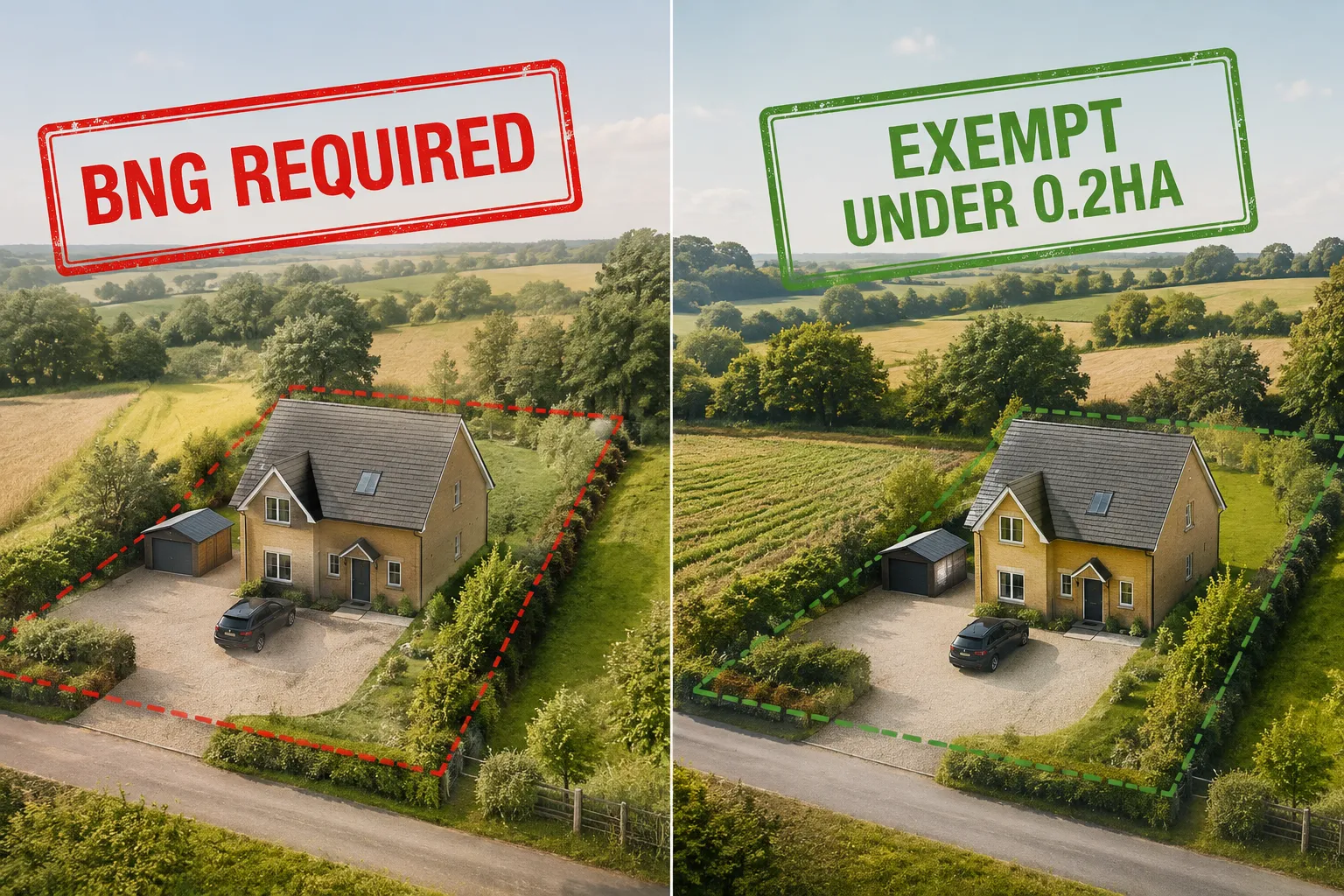
What the BNG Changes 6 August 2026 Small Site Exemption Actually Introduces
The New 0.2 Hectare (2,000 sqm) Exemption
The headline change is a new area-based exemption. From 6 August 2026, any development on a site measuring less than 0.2 hectares (2,000 sqm), provided it does not impact any onsite priority habitat, is exempt from the mandatory 10% BNG requirement [1][4]. This is a meaningful threshold. A typical urban infill plot or a small rural conversion will often fall below this size, removing the need for a Biodiversity Metric calculation, a Biodiversity Gain Plan, or a BNG condition on the planning permission.
Two conditions must both be met for the exemption to apply:
- The development footprint is under 0.2 ha (2,000 sqm).
- No onsite priority habitat is present or affected.
If priority habitat is present, even on a very small site, the exemption does not apply. Applicants should still commission a basic habitat check to confirm eligibility. For a fuller understanding of which project types are exempt, see the full list of BNG-exempt projects.
The New Exemption for Temporary Development
Alongside the size-based exemption, temporary development is now formally exempt from BNG from 6 August 2026 [1][9]. This covers development that is time-limited by condition and where the land will be restored to its previous state. Construction compounds, temporary event infrastructure, and similar short-term uses are the primary beneficiaries.
The Removal of the Self-Build and Custom-Build Exemption
This is the change that will catch many applicants off guard. The previous exemption for self-build and custom-build development is removed from 6 August 2026 [1][4]. Self-builders who submit planning applications from this date onwards must comply with mandatory BNG in the same way as any other developer, unless their site qualifies under a different exemption (such as the new 0.2 ha threshold).
For self-builders on larger plots, or where priority habitat is present, this is a material new cost and process to plan for. See the BNG guidance for developers for practical steps on how to approach compliance.
The Biodiversity Gain Hierarchy Change for Minor Development
One of the most practically significant BNG changes 6 August 2026 brings is the adjustment to the biodiversity gain hierarchy for minor development [1][6].
What Counts as Minor Development?
Minor development is defined as:
- Residential: Fewer than 10 dwellings, or a site area under 0.5 hectares.
- Non-residential: Under 1,000 sqm of floorspace, or a site area under 1 hectare.
Previously, the biodiversity gain hierarchy required developers to prioritise onsite habitat creation before turning to offsite options. For small sites, this was often impractical, there simply is not enough space to create meaningful habitat on a plot of 8 houses or a small commercial unit.
From 6 August 2026, offsite gains are treated equally to onsite gains for minor development [1][9]. Developers of minor sites can go directly to purchasing offsite biodiversity units or statutory credits without first exhausting onsite options. This significantly simplifies the compliance pathway for small schemes. For a detailed look at how offsite and onsite delivery compare, see this guide to biodiversity net gain off-site or on-site delivery.
Before vs After 6 August 2026: A Comparison
| Rule / Exemption | Before 6 August 2026 | From 6 August 2026 |
|---|---|---|
| 0.2 ha / 2,000 sqm sites (no priority habitat) | BNG mandatory | Exempt |
| Temporary development | BNG mandatory | Exempt |
| Self-build and custom-build | Exempt | BNG mandatory (unless another exemption applies) |
| Offsite gains for minor development | Lower priority than onsite in hierarchy | Equal priority to onsite |
| NSIPs (major infrastructure) | BNG not mandatory | Mandatory from November 2026 |
What This Means for You
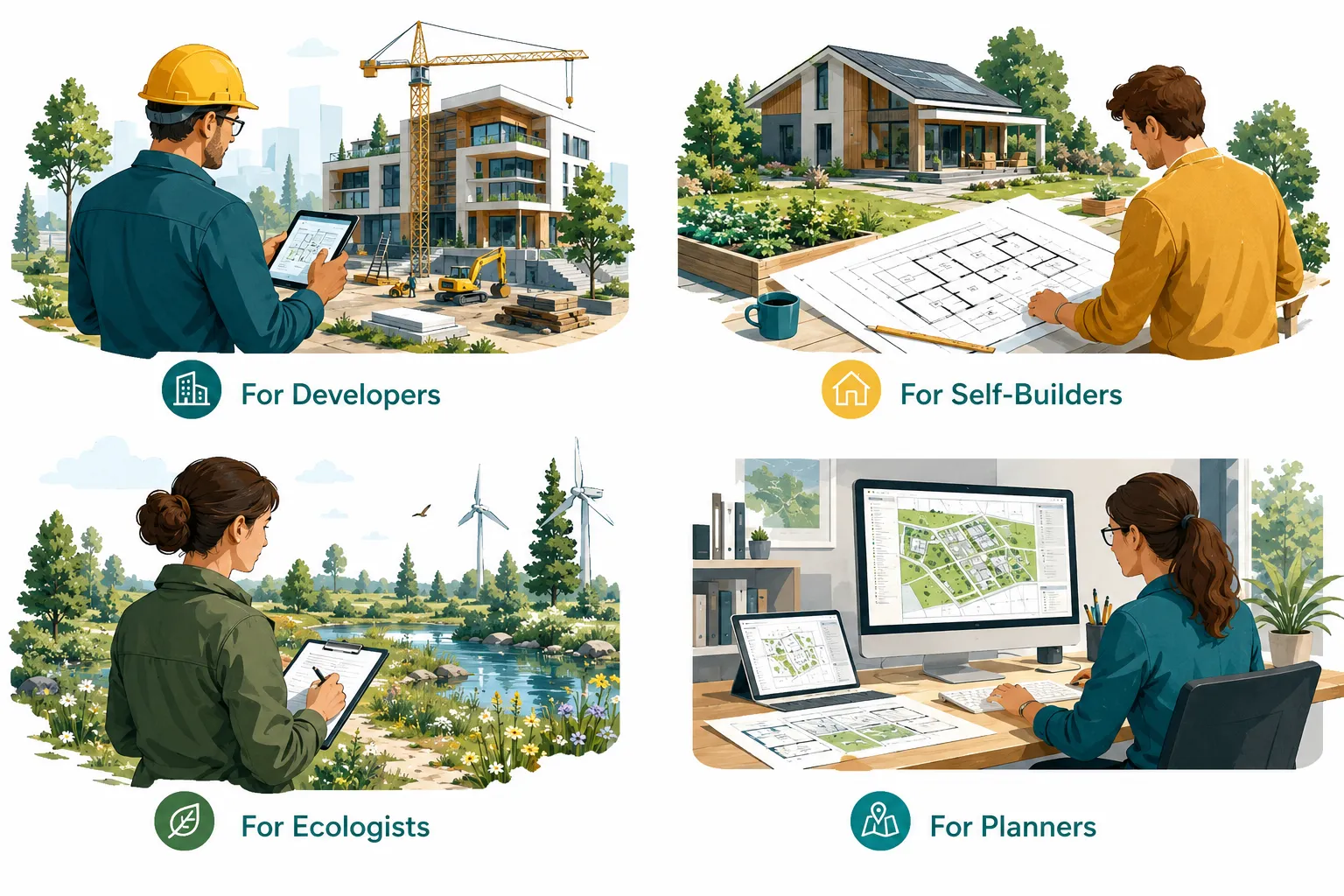
Small Developer
If your site is under 0.2 ha and contains no priority habitat, you are exempt from BNG from 6 August 2026. Confirm this with a basic habitat check before relying on the exemption. If your scheme is minor (under 10 dwellings or under 0.5 ha), you can now source offsite biodiversity units directly without needing to demonstrate that onsite options are exhausted first. This reduces cost and complexity. Review the BNG guidance for small development projects to understand your specific obligations.
Self-Builder
The exemption you may have relied upon no longer exists from 6 August 2026 [1][4]. If your plot is under 0.2 ha and free of priority habitat, the new size-based exemption may still protect you. If not, you will need to commission a Biodiversity Metric assessment, prepare a Biodiversity Gain Plan, and either deliver onsite habitat or purchase offsite biodiversity units. Budget and timeline planning should reflect this new requirement.
Ecologist
The BNG changes 6 August 2026 small site exemption package creates both reduced demand on the smallest sites and new demand from self-builders who are no longer exempt. Expect an increase in enquiries for habitat presence/absence checks on sub-0.2 ha sites, as applicants seek to confirm exemption eligibility. For minor sites, the simplified hierarchy means clients will want faster routes to offsite units, understanding the off-site land banking and habitat banking landscape will be essential advisory knowledge.
Local Planning Authority (LPA)
Validation checklists and pre-application guidance must be updated before 6 August 2026. The removal of the self-build exemption and the introduction of the 0.2 ha threshold will require updated screening questions. LPAs should also note that the equal treatment of offsite gains for minor development means BNG conditions on these schemes can reference offsite unit purchases without applicants needing to demonstrate onsite exhaustion [9]. DEFRA's April 2026 government response signalled further changes are forthcoming, so monitoring future secondary legislation will be important [3].
What Comes Next: NSIPs and Further DEFRA Changes
The BNG changes 6 August 2026 are not the end of the reform programme. BNG will become mandatory for Nationally Significant Infrastructure Projects (NSIPs) from November 2026 [1][3]. This brings major infrastructure, nationally significant road, rail, energy, and water schemes, into the mandatory BNG framework for the first time.
DEFRA's April 2026 government response also indicated that further amendments are expected, including potential changes for medium and brownfield development [3][6]. Practitioners should monitor DEFRA's environment blog and secondary legislation for updates. For a broader overview of the BNG framework, the biodiversity net gain explained guide provides useful context.
Interactive BNG Exemption Checker
Use the tool below to quickly assess whether your site may qualify for a BNG exemption from 6 August 2026.
.bng-checker{font-family:sans-serif;max-width:480px;margin:0 auto;padding:20px;border:2px solid #2d6a4f;border-radius:8px;background:#f9fafb}
.bng-checker h3{color:#2d6a4f;margin:0 0 14px;font-size:1.1em}
.bng-checker label{display:block;margin:10px 0 4px;font-size:.9em;font-weight:600;color:#333}
.bng-checker select{width:100%;padding:8px;border:1px solid #ccc;border-radius:4px;font-size:.9em}
.bng-checker button{margin-top:14px;width:100%;padding:10px;background:#2d6a4f;color:#fff;border:none;border-radius:4px;font-size:1em;cursor:pointer}
.bng-checker button:hover{background:#1b4332}
.bng-result{margin-top:14px;padding:12px;border-radius:4px;font-size:.9em;font-weight:600;display:none}
.bng-exempt{background:#d1fae5;color:#065f46;border:1px solid #6ee7b7}
.bng-required{background:#fee2e2;color:#991b1b;border:1px solid #fca5a5}
.bng-check{background:#fef9c3;color:#713f12;border:1px solid #fde68a}
BNG Exemption Checker (from 6 Aug 2026)
— Select –Under 0.2 ha (2,000 sqm)0.2 ha or larger
— Select –No priority habitatYes, priority habitat present
— Select –Temporary developmentSelf-build / custom-buildMinor (under 10 dwellings / under 1,000 sqm)Other permanent development
function checkBNG(){
var q1=document.getElementById(‘q1’).value,q2=document.getElementById(‘q2’).value,q3=document.getElementById(‘q3’).value,r=document.getElementById(‘result’);
if(!q1||!q2||!q3){r.className=’bng-result bng-check’;r.style.display=’block’;r.textContent=’Please answer all three questions.’;return;}
if(q3===’temp’){r.className=’bng-result bng-exempt’;r.textContent=’Likely EXEMPT: Temporary development is exempt from BNG from 6 Aug 2026.’;}
else if(q1===’under’&&q2===’no’){r.className=’bng-result bng-exempt’;r.textContent=’Likely EXEMPT: Site under 0.2 ha with no priority habitat qualifies for the new small site exemption.’;}
else if(q1===’under’&&q2===’yes’){r.className=’bng-result bng-required’;r.textContent=’BNG REQUIRED: Priority habitat is present, the 0.2 ha exemption does not apply.’;}
else if(q3===’selfbuild’){r.className=’bng-result bng-required’;r.textContent=’BNG REQUIRED: The self-build exemption was removed on 6 Aug 2026. Check if another exemption applies.’;}
else if(q3===’minor’){r.className=’bng-result bng-check’;r.textContent=’BNG REQUIRED (minor site): Offsite gains now treated equally to onsite, simplified compliance pathway available.’;}
else{r.className=’bng-result bng-required’;r.textContent=’BNG REQUIRED: Standard mandatory BNG applies. Commission a Biodiversity Metric assessment.’;}
r.style.display=’block’;}
Frequently Asked Questions
Does the 0.2 ha exemption apply automatically, or does it need to be declared?
Applicants must declare the exemption to the LPA as part of the planning application. A basic habitat check confirming the absence of priority habitat is strongly recommended to support that declaration [4][9].
What happens to self-build applications submitted before 6 August 2026?
Transitional arrangements apply. Applications validated before 6 August 2026 under the previous rules should not be affected by the removal of the self-build exemption. DEFRA's 14 July 2026 publication sets out the transitional provisions in detail [1].
Can a minor development site still deliver onsite BNG if it wants to?
Yes. The change to the biodiversity gain hierarchy means offsite is now an equal option, it does not prevent applicants from choosing onsite delivery. It simply removes the obligation to prioritise onsite first [1][6].
When does BNG become mandatory for NSIPs?
BNG will become mandatory for Nationally Significant Infrastructure Projects from November 2026 [1][3].
Where can I buy statutory biodiversity credits if offsite units are unavailable?
Statutory credits are available directly from DEFRA as a last resort. Guidance on costs and the process is available in the guide to biodiversity credits for developers.
Are there further BNG changes expected beyond August 2026?
Yes. DEFRA's April 2026 government response indicated further amendments for medium and brownfield development are in preparation [3][6]. Practitioners should monitor DEFRA's environment blog for secondary legislation updates.
Conclusion
The BNG changes 6 August 2026 small site exemption package represents the most significant recalibration of the mandatory BNG framework since it was introduced for major development in February 2024. The new 0.2 ha threshold will exempt a meaningful proportion of the smallest sites from compliance burdens, while the removal of the self-build exemption closes a gap that was always intended to be temporary. The equalisation of offsite and onsite gains for minor development is a practical acknowledgment that small sites cannot always deliver meaningful habitat in situ.
Actionable next steps before and after 6 August 2026:
- LPAs: Update validation checklists and pre-application guidance immediately.
- Self-builders: Confirm whether the 0.2 ha exemption applies to your plot; if not, commission a Biodiversity Metric assessment promptly.
- Small developers: Review site areas against the new threshold and obtain a habitat presence/absence check to confirm exemption eligibility.
- Ecologists: Prepare to advise clients on the simplified minor development hierarchy and the new exemption boundaries.
- All practitioners: Monitor DEFRA's environment blog for further changes expected from the April 2026 government response.
For tailored support on navigating the updated framework, contact the Biodiversity Surveyors team or explore the comprehensive BNG guidance for developers.
References
[1] Biodiversity Net Gain Amendments And Transitional Arrangements Published – defraenvironment.blog.gov.uk
[2] Biodiversity Net Gain Small Sites Exemption 2026 – hampsteadarchitecture.co.uk
[3] Biodiversity Net Gain Whats Changing And What It Means For You – defraenvironment.blog.gov.uk
[4] New Biodiversity Net Gain Exemptions From August 2026 What Developers Need To Know – footanstey.com
[6] Improving The Implementation Of Biodiversity Net Gain For Minor Medium And Brownfield Development – gov.uk
[9] New BNG Rules And Exemptions Apply From 6 August 2026 – cieem.net