

September 2026: England's biodiversity net gain regime has just absorbed its biggest structural change since the rules went live in February 2024, and a second major shift is already on the horizon. A new 0.2 hectare exemption has quietly removed an estimated half of residential planning applications from mandatory biodiversity duties, while a 2 November 2026 deadline is bearing down on every developer working on nationally significant infrastructure projects [9][2].
For anyone tracking the Biodiversity Net Gain September 2026 update: NSIP November deadline and 0.2 hectare exemption, this is the month the picture finally comes into focus. Small-site developers have new breathing room. Infrastructure promoters have none. And the habitat bank market that underpins the whole system is scaling up fast, with nearly 200 registered sites now trading biodiversity units across England.
This article sets out exactly where the rules stand, what changed on 6 August 2026, what happens on 2 November 2026, and what developers, landowners and ecologists should be doing right now.
Key Takeaways
- The 0.2 hectare (2,000 m²) exemption took effect on 6 August 2026, removing many small residential schemes from mandatory BNG, but not where priority habitat is affected [4][10].
- Government estimates suggest the exemption could exclude roughly half of all residential planning permissions from BNG obligations [9][5].
- From 2 November 2026, all Nationally Significant Infrastructure Project (NSIP) applications under the Planning Act 2008 must deliver at least 10% biodiversity net gain, using the statutory biodiversity metric [2][3].
- England's habitat bank market has grown to roughly 197 registered sites, covering 7,000 hectares, offering around 28,000 habitat units, with about 1,500 units sold so far.
- The self-build exemption was withdrawn on 31 July 2026, meaning custom-build projects now need to check eligibility for the 0.2 ha exemption or other statutory exclusions [9][6].
Biodiversity Net Gain September 2026 Update: What Has Actually Changed
The Environment Act 2021 established the legal foundation for mandatory biodiversity net gain across England, requiring most developments to deliver a measurable 10% improvement in biodiversity value compared with pre-development conditions [3][6]. Since February 2024, that duty has applied to most town and country planning applications. But throughout 2026, Defra and Natural England have been actively recalibrating the regime's edges, tightening it for major infrastructure while loosening it for the smallest schemes.
Two regulatory milestones define this month's update:
- 6 August 2026, the Biodiversity Gain (Town and Country Planning) (Amendments and Transitional Provisions) (England) Regulations 2026 came into force, introducing the 0.2 hectare exemption and updated transitional provisions [4][6].
- 2 November 2026, the date from which Nationally Significant Infrastructure Projects submitting Development Consent Order (DCO) applications must deliver mandatory 10% BNG [2][3].
Between these dates sits September 2026, a transitional month where planning authorities, ecologists and infrastructure promoters are simultaneously adjusting to a looser small-site regime and preparing for a stricter infrastructure regime. Understanding both halves of this Biodiversity Net Gain September 2026 update: NSIP November deadline and 0.2 hectare exemption is now essential reading for anyone submitting applications this autumn.
The 0.2 Hectare Exemption in Practice
Defra's guidance on exempt developments confirms that, from 6 August 2026, biodiversity net gain does not apply where the site area within the red-line planning boundary is 0.2 hectares (2,000 square metres) or below [10][4]. This is a meaningful change for small housing schemes, infill plots, and minor commercial developments that previously had to commission a full biodiversity metric calculation regardless of scale.
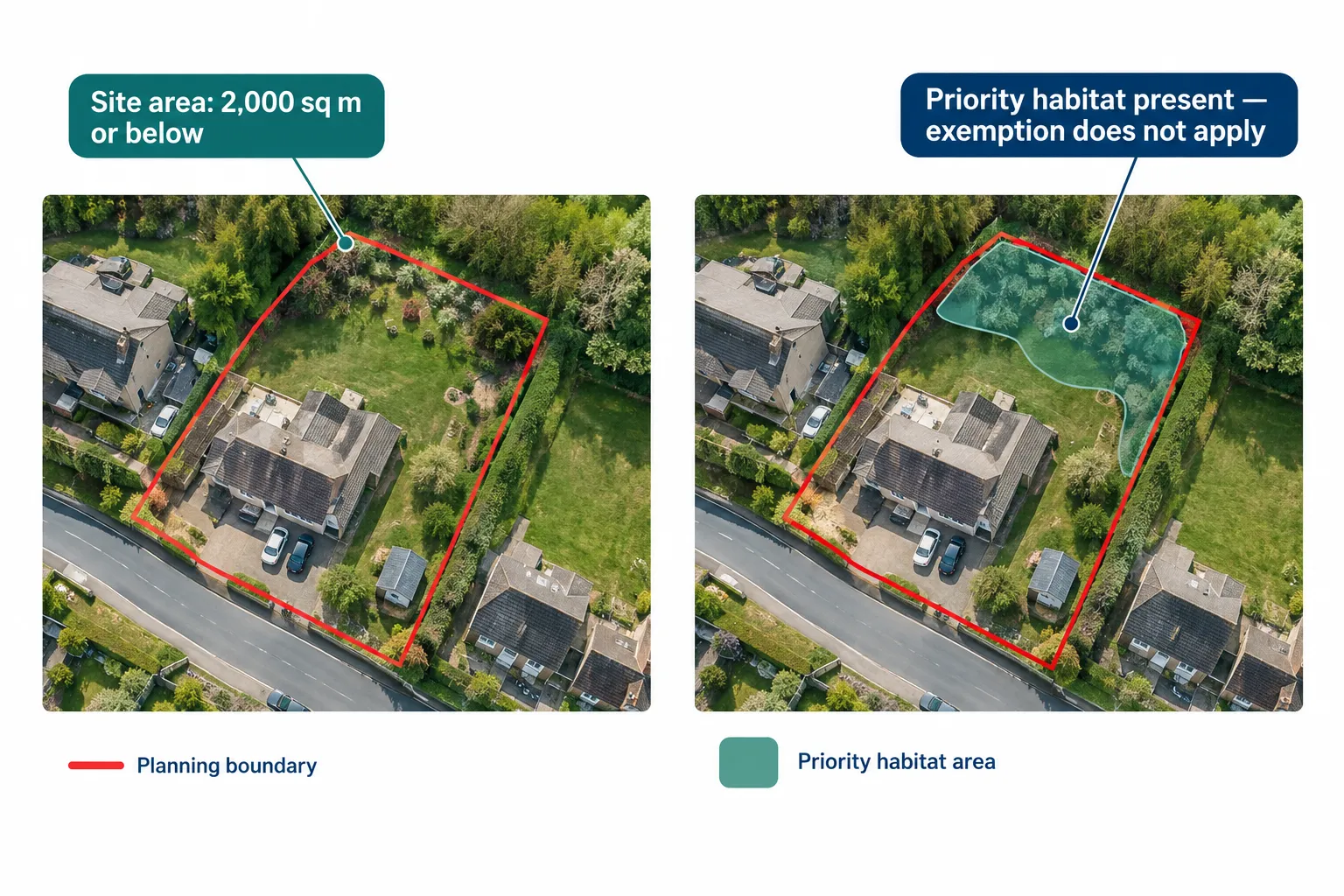
However, the exemption is not automatic. Defra's July 2026 blog on transitional arrangements is explicit that the exemption is aimed at "the smallest developments" and carries important restrictions [4]:
- It applies only to planning applications made on or after 6 August 2026, earlier applications remain under the pre-existing rules [4][6].
- It does not apply where onsite priority habitat would be negatively impacted, regardless of how small the site is [4][7].
- The 0.2 ha threshold is measured against the full red-line site area, not just the developed footprint, a distinction that has already generated debate among planning practitioners over how local authorities interpret "site area" versus "habitat area affected" [7][11].
- The self-build and custom-build exemption was withdrawn around 31 July 2026, so self-builders must now check whether their plot qualifies under the new 0.2 ha threshold instead [9][6].
Industry estimates suggest the practical effect is substantial: government's own impact assessments imply the exemption could remove around 50% of residential planning permissions from mandatory BNG duties [9][5]. For volume housebuilders working across many small sites, and for individual landowners bringing forward single plots, this is a genuine reduction in compliance burden, but only where an ecologist has confirmed there is no priority habitat on site.
Who Should Still Commission a Habitat Survey
Legal and planning commentators are near-unanimous on one point: developers cannot simply assume exemption based on acreage alone [12][13][14]. A preliminary ecological appraisal remains the safest way to confirm:
- Whether the red-line boundary genuinely sits at or below 0.2 hectares.
- Whether any part of the site contains priority habitat (such as species-rich grassland, ancient woodland indicators, or wetland features).
- Whether adjoining protected sites could bring the scheme back into scope through other planning conditions.
Skipping this step risks a refused or delayed application if a local planning authority later determines the exemption does not apply.
NSIP November Deadline: Mandatory 10% BNG for Major Infrastructure
While small developers have gained flexibility, the opposite is true for major infrastructure. Defra's updated NSIP guidance confirms that developers submitting DCO applications on or after 2 November 2026 must deliver at least 10% biodiversity net gain, bringing Nationally Significant Infrastructure Projects fully into line with the wider Environment Act 2021 regime [2][3].
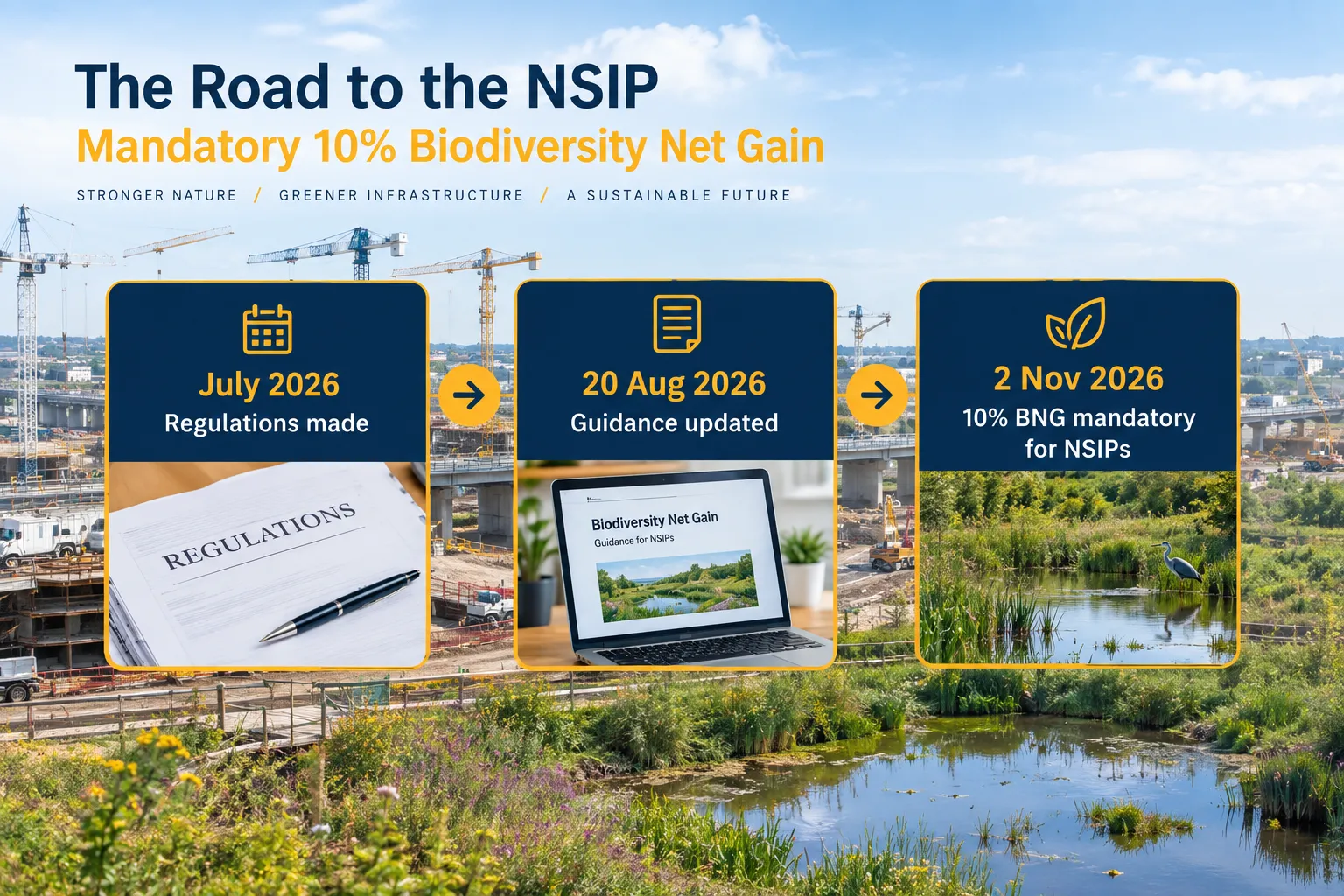
This affects the full range of NSIP sectors, energy generation, transmission infrastructure, transport schemes, water resources, and waste facilities, all of which follow the Planning Act 2008 consenting process rather than standard town and country planning routes. Key details from the GOV.UK guidance, updated 20 August 2026, include [3][6]:
| Requirement | Detail |
|---|---|
| Net gain threshold | Minimum 10% biodiversity net gain |
| Applicable date | DCO applications submitted on or after 2 November 2026 |
| Metric | Statutory biodiversity metric (as used across the wider BNG regime) |
| Legal basis | Environment Act 2021, aligned with Planning Act 2008 process |
| Guidance source | Defra / GOV.UK NSIP-specific guidance |
Defra's 27 August 2026 blog on implementation stresses that infrastructure promoters should not treat BNG as a late-stage add-on. It recommends early ecological baseline assessment, integration of net gain calculations into scheme design from the outset, and proactive engagement with habitat bank operators where onsite or offsite mitigation cannot deliver the full 10% uplift [1][2].
Given the scale and lead times of infrastructure projects, promoters preparing DCO applications for late 2026 and into 2027 should already be running biodiversity metric calculations now, well ahead of the November deadline, rather than waiting for submission.
Habitat Bank Market Growth: Supply Meeting Demand
One of the clearest signs that BNG has matured from policy concept to functioning market is the scale of England's habitat banking sector. As of September 2026, Natural England's biodiversity gain sites register reflects a market that has grown steadily since 2024:
- Approximately 197 registered habitat bank sites across England.
- Around 7,000 hectares of land committed to habitat creation and enhancement.
- Roughly 28,000 biodiversity units currently available for sale.
- Approximately 1,500 units sold to date, reflecting steadily rising demand as more developments reach the offsetting stage of their BNG obligations.
This growth matters directly for the Biodiversity Net Gain September 2026 update: NSIP November deadline and 0.2 hectare exemption story, because NSIP promoters facing the November deadline will increasingly rely on this market where onsite mitigation is insufficient. With unit supply currently outstripping sales by a wide margin, buyers are in a relatively strong negotiating position, for now. That balance is likely to shift as NSIP demand ramps up from November onward, pushing more infrastructure promoters into the same limited pool of high-quality habitat bank stock as housebuilders and commercial developers.
Landowners considering entering the market should note that habitat bank registration, baseline surveying, and legal agreement (via conservation covenant or planning obligation) typically take several months, meaning land brought forward now may not be sale-ready before the NSIP deadline pressure increases demand later this year.
What Developers, Landowners and Ecologists Should Do Now
For developers on small sites:
- Confirm red-line site area precisely, do not estimate.
- Commission a preliminary ecological appraisal before assuming exemption.
- Retain documentation proving the absence of priority habitat, in case a planning authority queries eligibility.
For NSIP promoters:
- Begin biodiversity metric calculations now, ahead of the 2 November 2026 deadline.
- Engage Natural England and ecological consultants early in scheme design, not at consent stage.
- Identify potential habitat bank partners in case onsite delivery cannot meet the 10% threshold.
For landowners considering habitat banking:
- Start baseline ecological surveys promptly, given lead times for registration.
- Monitor rising NSIP-driven demand, which may improve unit pricing over the coming months.
- Seek legal advice on conservation covenants versus section 106 obligations before entering the market.
For ecologists and planning consultants:
- Update client-facing guidance to reflect the 6 August 2026 exemption and withdrawn self-build exemption.
- Build NSIP-specific BNG expertise ahead of rising infrastructure-sector demand from November 2026.
- Advise clearly on the distinction between red-line site area and habitat area affected, given ongoing interpretation debate [7][11].
Frequently Asked Questions
Does the 0.2 hectare exemption apply to all small developments?
No. It applies only to planning applications made on or after 6 August 2026, where the red-line site area is 0.2 hectares or below, and where the site does not contain priority habitat that would be negatively affected [4][10].
When does BNG become mandatory for infrastructure projects?
From 2 November 2026, developers submitting DCO applications for Nationally Significant Infrastructure Projects must deliver at least 10% biodiversity net gain [2][3].
Has the self-build exemption been removed?
Yes. The self-build and custom-build exemption was withdrawn around 31 July 2026. Such schemes now fall under the general BNG regime unless they qualify for the 0.2 ha exemption or another statutory exclusion [9][6].
How big is the habitat bank market right now?
As of September 2026, roughly 197 sites are registered, covering around 7,000 hectares and offering about 28,000 units, with approximately 1,500 units sold so far.
What happens to applications made before 6 August 2026?
They remain governed by the transitional provisions that applied before this date, including the earlier BNG start dates of 12 February 2024 for most developments and 2 April 2024 for minor developments [4][6].
Can a small site still be exempt if it has some wildlife value?
Only if that value does not amount to priority habitat under the statutory definition. Any negative impact on priority habitat removes eligibility for the 0.2 hectare exemption regardless of overall site size [4][7].
Conclusion
September 2026 marks a genuine inflection point for England's biodiversity net gain regime. The 0.2 hectare exemption has already reshaped compliance obligations for small-site developers, while the 2 November 2026 NSIP deadline is about to bring the country's largest infrastructure projects fully into the mandatory 10% net gain framework. Running alongside both changes is a habitat bank market that has grown large enough to support serious offsetting demand, but which is likely to tighten as infrastructure promoters enter the market later this year.
The practical takeaway is straightforward: small-site developers should verify exemption eligibility with proper ecological input rather than assumption, NSIP promoters should treat November as a hard deadline requiring immediate metric work, and landowners weighing habitat banking should move now, before demand intensifies. Ecologists and planning consultants who master both ends of this Biodiversity Net Gain September 2026 update: NSIP November deadline and 0.2 hectare exemption story will be best placed to advise clients through what is shaping up to be the regime's busiest year yet.
References
[1] Biodiversity Net Gain For Major Infrastructure Projects New Guidance – defraenvironment.blog.gov.uk
[2] Biodiversity Net Gain Nationally Significant Infrastructure Projects – gov.uk
[3] Understanding Biodiversity Net Gain – gov.uk
[4] Biodiversity Net Gain Amendments And Transitional Arrangements Published – defraenvironment.blog.gov.uk
[5] Biodiversity Net Gain Changes 6 August 2026 Developers New Exemptions Explained – Biodiversity net gain changes 6 august 2026 developers new exemptions explained
[6] Biodiversity Net Gain – gov.uk
[7] Bng 0.2ha Exemption Individual Trees – bristoltreeforum.org
[8] planninggeek.co.uk – planninggeek.co.uk
[9] Biodiversity Net Gain August 2026 Update The 0 2 Hectare Exemption Developers Need To Know – Biodiversity net gain august 2026 update the 0 2 hectare exemption developers need to know
[10] Biodiversity Net Gain Exempt Developments – gov.uk
biodiversity net gain, BNG 2026, NSIP biodiversity net gain, 0.2 hectare exemption, Environment Act 2021, habitat banking, Natural England, Defra guidance, planning permission England, ecology consultants, biodiversity metric, nationally significant infrastructure projects