

Half of all residential planning applications in England may no longer require a mandatory Biodiversity Net Gain assessment, and that shift took effect on 6 August 2026. For developers, ecologists and planning consultants who have spent the past year embedding BNG into their workflows, the amendments introduced on that date represent the most significant recalibration of the regime since mandatory BNG launched in February 2024.
This article explains every change in force from 6 August 2026, what remains unchanged, and what action is needed now for applications already in the system.
Key Takeaways
- Developments on sites of 0.2 hectares or smaller with no priority habitat are now exempt from mandatory BNG, Defra and Natural England estimate this covers roughly half of residential applications.
- A new exemption applies to temporary developments permitted for five years or less.
- The self-build and custom-build exemption has been removed; those applicants must now comply fully with mandatory BNG.
- For minor developments above the threshold, off-site biodiversity gains now sit on equal footing with on-site habitat creation.
- The mandatory 10% net gain requirement is unchanged for all developments that remain within scope.
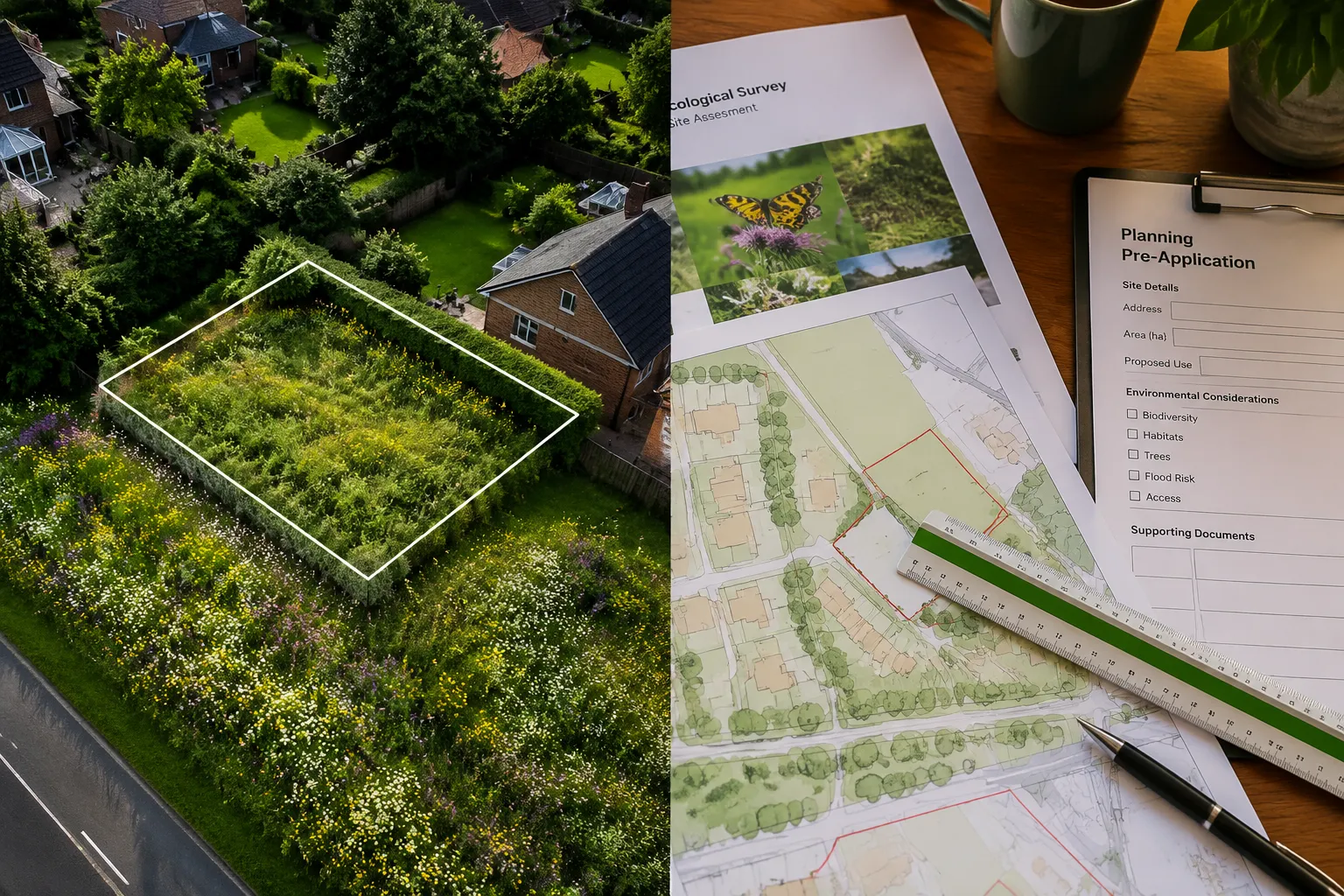
What Changed on 6 August 2026: The Four Core Amendments
1. New Small Sites Exemption (0.2 Hectares or Smaller)
The headline change is a new statutory exemption for residential and commercial developments on sites of 0.2 hectares or smaller, provided the development does not affect any priority habitat. Defra and Natural England estimate this single measure removes approximately half of all residential planning applications from the scope of mandatory BNG.
Before 6 August 2026, only a narrow set of exemptions existed, principally householder applications, developments with a de minimis impact of less than 25 square metres of habitat, and self-build or custom-build homes. Small housebuilders and infill developers routinely faced the full BNG assessment process for modest plots.
Under the new rules, a developer bringing forward a site of 0.2 ha or less can confirm the exemption by demonstrating:
- The gross site area does not exceed 0.2 hectares; and
- No priority habitat (as mapped by Natural England) is present on or immediately adjacent to the site in a way that would be affected.
Where both conditions are met, no Biodiversity Gain Plan is required and no biodiversity metric calculation need be submitted with the planning application.
Important: Local planning authorities retain the power to seek ecological information where they consider it necessary. The exemption removes the mandatory BNG obligation, it does not remove all ecological considerations from the planning process.
2. New Exemption for Temporary Developments of Five Years or Less
A second new exemption covers certain temporary developments that are permitted for a period of five years or less. This addresses a practical gap in the original regime, where short-term construction compounds, temporary event structures, and time-limited agricultural buildings were technically caught by mandatory BNG despite their reversible nature.
Applicants relying on this exemption should ensure the planning permission itself contains a condition or time limit confirming the five-year (or shorter) duration. An open-ended permission will not qualify.
3. Removal of the Self-Build and Custom-Build Exemption
The 6 August 2026 amendments simultaneously remove the existing exemption for self-build and custom-build homes. This is the one change that increases the regulatory burden for a specific group.
Self-builders and custom-builders whose sites exceed 0.2 hectares, or whose smaller sites contain priority habitat, will now be subject to the full mandatory BNG regime. Those with sites at or below 0.2 hectares and no priority habitat will benefit from the new small sites exemption instead, so many self-builders will find themselves in a neutral or improved position overall. However, self-builders with larger plots must now budget for a biodiversity metric assessment, a Biodiversity Gain Plan, and potentially off-site or biodiversity unit purchases.
4. Relaxed Hierarchy for Minor Developments: Off-Site Gains on Equal Footing
Under the original BNG framework, developers were required to follow a strict mitigation hierarchy: on-site habitat creation first, then registered off-site gains, and only then statutory biodiversity credits as a last resort. For minor developments (as defined in the Town and Country Planning (Development Management Procedure) Order 2015), the 6 August 2026 amendments relax this hierarchy so that off-site biodiversity gains now sit on equal footing with on-site habitat creation.
This is a pragmatic recognition that small urban infill sites often have little or no capacity to deliver meaningful on-site habitat. Developers of minor schemes can now proceed directly to purchasing off-site biodiversity units without first having to demonstrate that on-site options are exhausted or impractical.
Before and After: BNG Rules at a Glance
| Scenario | Before 6 August 2026 | From 6 August 2026 |
|---|---|---|
| Site of 0.2 ha or less, no priority habitat | Mandatory BNG applies | Exempt |
| Temporary development (5 years or less) | Mandatory BNG applies | Exempt |
| Self-build / custom-build home | Exempt | Mandatory BNG applies |
| Minor development, off-site gains | Third in hierarchy (after on-site) | Equal to on-site |
| 10% net gain requirement | Mandatory for in-scope sites | Unchanged, still mandatory |
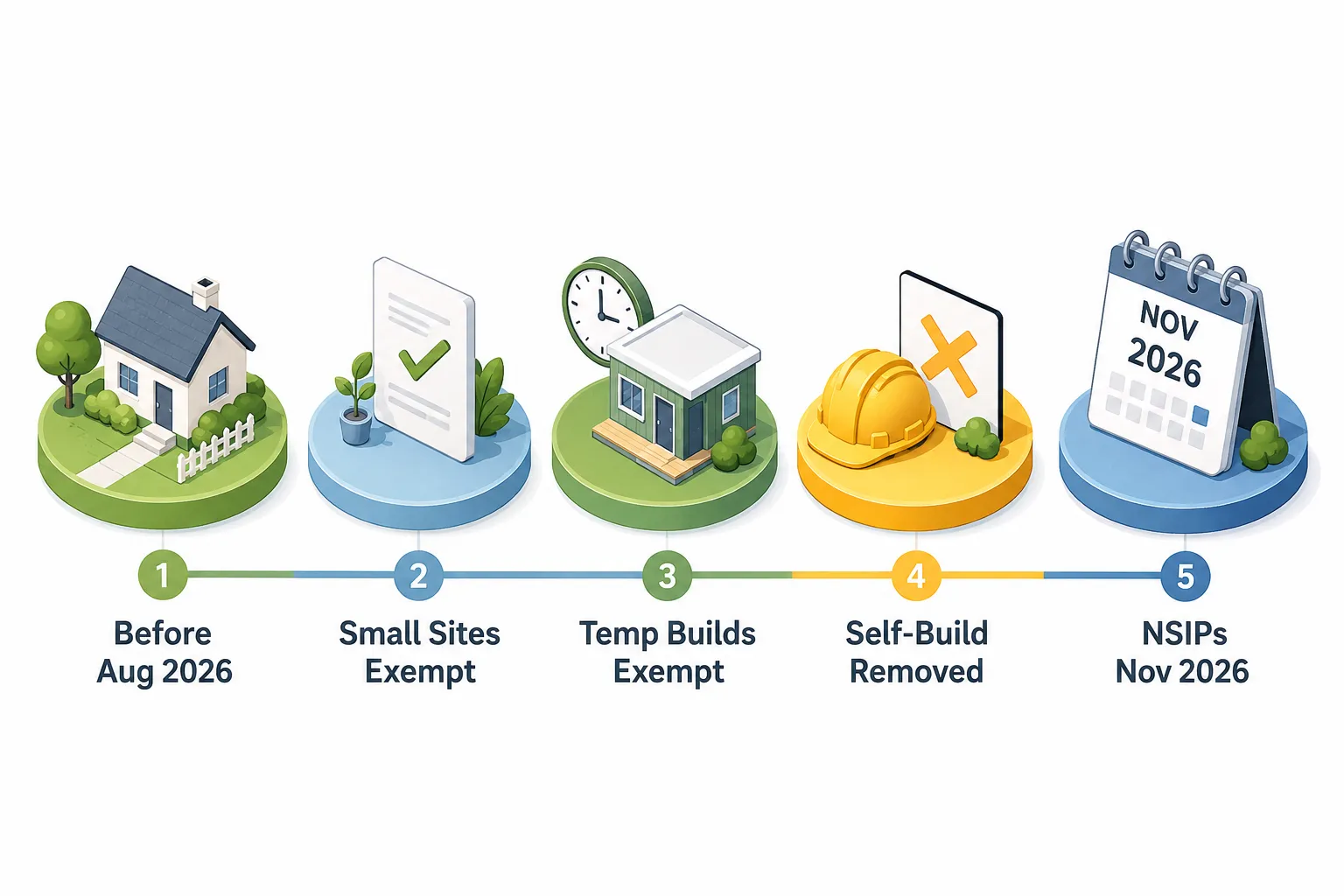
Looking Ahead: BNG Extends to NSIPs on 2 November 2026
Separate from the August amendments, 2 November 2026 marks the date on which mandatory BNG is extended to Nationally Significant Infrastructure Projects (NSIPs), major energy, transport, water and waste schemes consented under the Planning Act 2008. Developers and promoters of NSIPs should be actively preparing their biodiversity baseline assessments and Biodiversity Gain Plans now, as the lead times for large infrastructure schemes are considerable.
Practical Impact for Developers, Ecologists and Planning Consultants
Small and medium housebuilders will see the most immediate benefit. Sites of 0.2 ha or less, typically plots for one to three dwellings, are now outside mandatory BNG, reducing pre-application costs and programme risk. However, ecological due diligence remains good practice, particularly where protected species surveys are required independently of BNG.
Ecologists should update their scoping advice to reflect the new thresholds. The priority habitat question becomes the critical gateway: if any priority habitat is present, the small sites exemption does not apply regardless of plot size. Early habitat surveys remain essential.
Planning consultants need to revisit any pending applications and advise clients on whether the 6 August 2026 changes affect their position. Applications validated before 6 August 2026 require careful attention, see the transitional provisions section below.
Self-builders with larger plots should seek ecological advice promptly. The removal of their exemption is immediate; there is no grace period.
Transitional Provisions: Applications Validated Before 6 August 2026
The transitional position is straightforward in principle but requires careful case-by-case assessment:
- Applications validated before 6 August 2026 that were subject to mandatory BNG under the original rules remain subject to those rules unless the applicant withdraws and resubmits. The new small sites exemption does not apply retrospectively to already-validated applications.
- Applications validated on or after 6 August 2026 are assessed under the amended rules from the outset.
- Self-build applications validated before 6 August 2026 under the old exemption are unaffected, the removal of the exemption applies to new applications only.
Developers with applications currently pending determination should confirm their validation date with the local planning authority before assuming any exemption applies.
What You Should Do Now
If you have a pending application or a site in pre-application:
- Check your validation date. If validated before 6 August 2026, the old rules apply unless you resubmit.
- Measure your site area accurately. The 0.2-hectare threshold is gross site area. Confirm this with your surveyor.
- Commission a priority habitat check. Use Natural England's Priority Habitats Inventory to confirm whether any priority habitat falls within or adjacent to your site.
- If you are a self-builder with a site over 0.2 ha, instruct an ecologist immediately to scope your BNG obligations.
- For minor developments above the threshold, explore off-site biodiversity unit markets now that the hierarchy has been relaxed, this may offer cost and programme savings.
- NSIP promoters should begin biodiversity baseline work ahead of the 2 November 2026 extension date.
Frequently Asked Questions
Does the 10% net gain requirement change on 6 August 2026?
No. For all developments that remain within the scope of mandatory BNG, the requirement to achieve a minimum 10% biodiversity net gain is unchanged.
Can a developer split a larger site into sub-0.2-hectare parcels to claim the exemption?
No. Artificial subdivision to circumvent the threshold is likely to be treated as a single development by the local planning authority and may constitute a breach of planning control.
Does the small sites exemption apply if a single tree covered by a Tree Preservation Order is present?
A TPO tree is not in itself a priority habitat designation. However, if the site contains or adjoins priority habitat as mapped by Natural England, the exemption does not apply regardless of other features.
What counts as a "temporary development" for the five-year exemption?
The planning permission itself must be time-limited to five years or fewer. Generic temporary permissions without a fixed end date will not qualify. Applicants should ensure the relevant condition is explicit.
Does the relaxed hierarchy for minor developments remove the need for statutory biodiversity credits entirely?
No. Statutory credits remain available as a last resort. The change simply means off-site registered habitat units are no longer required to be exhausted before off-site options are considered, on-site and off-site now carry equal weight for minor schemes.
When does BNG apply to NSIPs?
The extension of mandatory BNG to Nationally Significant Infrastructure Projects takes effect on 2 November 2026.
Conclusion
The Biodiversity Net Gain changes of 6 August 2026 represent a targeted recalibration rather than a wholesale retreat from the regime. The new small sites exemption delivers meaningful relief for small housebuilders and infill developers, while the removal of the self-build exemption closes a loophole that sat uneasily alongside the policy's ambitions. The relaxed hierarchy for minor developments is a practical improvement that acknowledges the realities of urban sites.
What has not changed is the core obligation: a mandatory 10% biodiversity net gain for every development that remains in scope. Developers, ecologists and planning consultants should treat 6 August 2026 as a prompt to audit their current project pipelines, confirm which sites now fall outside mandatory BNG, and ensure that those still within scope have robust Biodiversity Gain Plans in place. With the NSIP extension arriving on 2 November 2026, the pace of change in this area shows no sign of slowing.
.cg-wrap{font-family:Arial,sans-serif;max-width:520px;margin:2rem auto;border:2px solid #2d6a4f;border-radius:8px;overflow:hidden}
.cg-head{background:#2d6a4f;color:#fff;padding:14px 18px;font-size:1.05rem;font-weight:700}
.cg-body{padding:18px;background:#f9fdf9}
.cg-label{font-size:.9rem;font-weight:600;color:#1b4332;margin-bottom:6px;display:block}
.cg-row{margin-bottom:14px}
select,input[type=radio]{accent-color:#2d6a4f}
.cg-radios label{margin-right:16px;font-size:.9rem;cursor:pointer}
.cg-btn{background:#2d6a4f;color:#fff;border:none;padding:10px 22px;border-radius:5px;cursor:pointer;font-size:.95rem;font-weight:700;width:100%}
.cg-btn:hover{background:#1b4332}
.cg-result{margin-top:14px;padding:12px;border-radius:6px;font-size:.9rem;line-height:1.5;display:none}
.cg-exempt{background:#d8f3dc;border-left:4px solid #52b788;color:#1b4332}
.cg-inscope{background:#fff3cd;border-left:4px solid #f4a261;color:#7d4e00}
— Select —
0.2 ha or smaller
Larger than 0.2 ha
function cg_check(){
var sz=document.getElementById(‘cg-size’).value;
var ph=document.querySelector(‘input[name=”cg-ph”]:checked’);
var tmp=document.querySelector(‘input[name=”cg-tmp”]:checked’);
var el=document.getElementById(‘cg-result’);
el.style.display=’block’;
if(!sz||!ph||!tmp){el.className=’cg-result cg-inscope’;el.innerHTML=’Please answer all three questions.’;return;}
if(tmp.value===’yes’){el.className=’cg-result cg-exempt’;el.innerHTML=’Likely Exempt, Temporary development of 5 years or less. No Biodiversity Gain Plan required. Confirm the time limit is explicit in the permission condition.’;}
else if(sz===’small’&&ph.value===’no’){el.className=’cg-result cg-exempt’;el.innerHTML=’Likely Exempt, Site is 0.2 ha or smaller with no priority habitat. Mandatory BNG does not apply from 6 August 2026. Ecological due diligence is still recommended.’;}
else{el.className=’cg-result cg-inscope’;el.innerHTML=’Mandatory BNG Applies, A 10% biodiversity net gain is required. Prepare a Biodiversity Metric assessment and Biodiversity Gain Plan. Consult a qualified ecologist.’;}
}