

Last updated: September 14, 2026
Quick Answer
As of September 2026, biodiversity net gain rules in England have split into two tracks. Small sites under 0.2 hectares have been exempt from BNG since 31 July 2026, removing roughly half of residential planning applications from the requirement [9][2]. At the same time, Nationally Significant Infrastructure Projects (NSIPs) face a new mandatory 10% biodiversity net gain requirement starting 2 November 2026, raising the bar for major energy, transport, and water schemes [5][8][10].
Key Takeaways
- The 0.2 hectare small site exemption has applied since 31 July 2026, cutting an estimated half of residential planning applications out of BNG obligations [9][2].
- The exemption does not apply where a site contains, or is adjacent to, irreplaceable or priority habitat, those sites still need biodiversity assessment [6][3].
- A "de minimis" exemption still covers very small habitat impacts below the 0.2 ha threshold, but only within tight limits [6].
- The old self-build and custom-build exemption has been removed, so individual plot builders no longer get an automatic pass [9][2].
- Off-site biodiversity gains now sit on equal footing with on-site delivery for minor development, giving small developers more flexibility [1][9].
- BNG becomes legally mandatory for NSIPs from 2 November 2026, requiring a documented 10% net gain against the Order Limits boundary [5][8][10].
- Developers just over 0.2 hectares still face full BNG duties, there is no partial or tapered exemption [3][6].
- Surveyors and consultants should expect more work concentrated on medium and major sites, and on NSIP gain statements, rather than small residential plots.
What Is the 0.2 Hectare Small Site Exemption Under BNG Changes September 2026
The 0.2 hectare small site exemption removes the statutory biodiversity net gain requirement for qualifying minor developments in England, and it has been in force since 31 July 2026 [9][2]. It is one of the two headline reforms behind the BNG changes September 2026: 0.2 hectare small site exemption and NSIP mandate impact on UK developers story, alongside the new NSIP mandate.
Before this reform, BNG applied to almost all planning applications above a very low bar, catching small housing schemes, extensions, and minor commercial plots. Defra's own guidance confirms the policy intent was to reduce administrative burden on smaller schemes while keeping full BNG duties for larger, more impactful developments [1][3]. Practical points:
- The exemption is measured against the total site area of the planning application, not just the developable footprint.
- Government estimates cited in the reform consultation suggest around half of residential planning applications in England fall under 0.2 hectares and are now exempt [9][2].
- The change is a genuine legal exemption, not a discount, qualifying sites have no biodiversity gain obligation at all, unless a priority habitat caveat applies (covered below).
Which UK Developers Are Exempt From BNG Under the New 0.2 Hectare Rule
Developers building on sites below 0.2 hectares are exempt from BNG, provided the land does not contain irreplaceable or priority habitat. Small housebuilders, infill developers, and single-plot residential schemes are the main beneficiaries.
Who is genuinely exempt:
- Small residential infill and backland sites under 0.2 hectares with no protected habitat present.
- Minor commercial or extension projects that fall under the same area threshold.
- Some self-build plots, but only by virtue of falling under 0.2 hectares, not because of any special self-build status (see below).
Who is not exempt, even on a tiny plot:
- Any site containing or adjacent to priority habitat (such as ancient woodland, lowland meadow, or certain wetland types), regardless of size [6][3].
- NSIP applicants, who face a separate and stricter mandatory regime from 2 November 2026 [5][8].
- Sites that were previously covered by the self-build/custom-build exemption but exceed 0.2 hectares, that carve-out has been removed [9][2].
What Counts as a Small Site Under the 0.2 Hectare Exemption
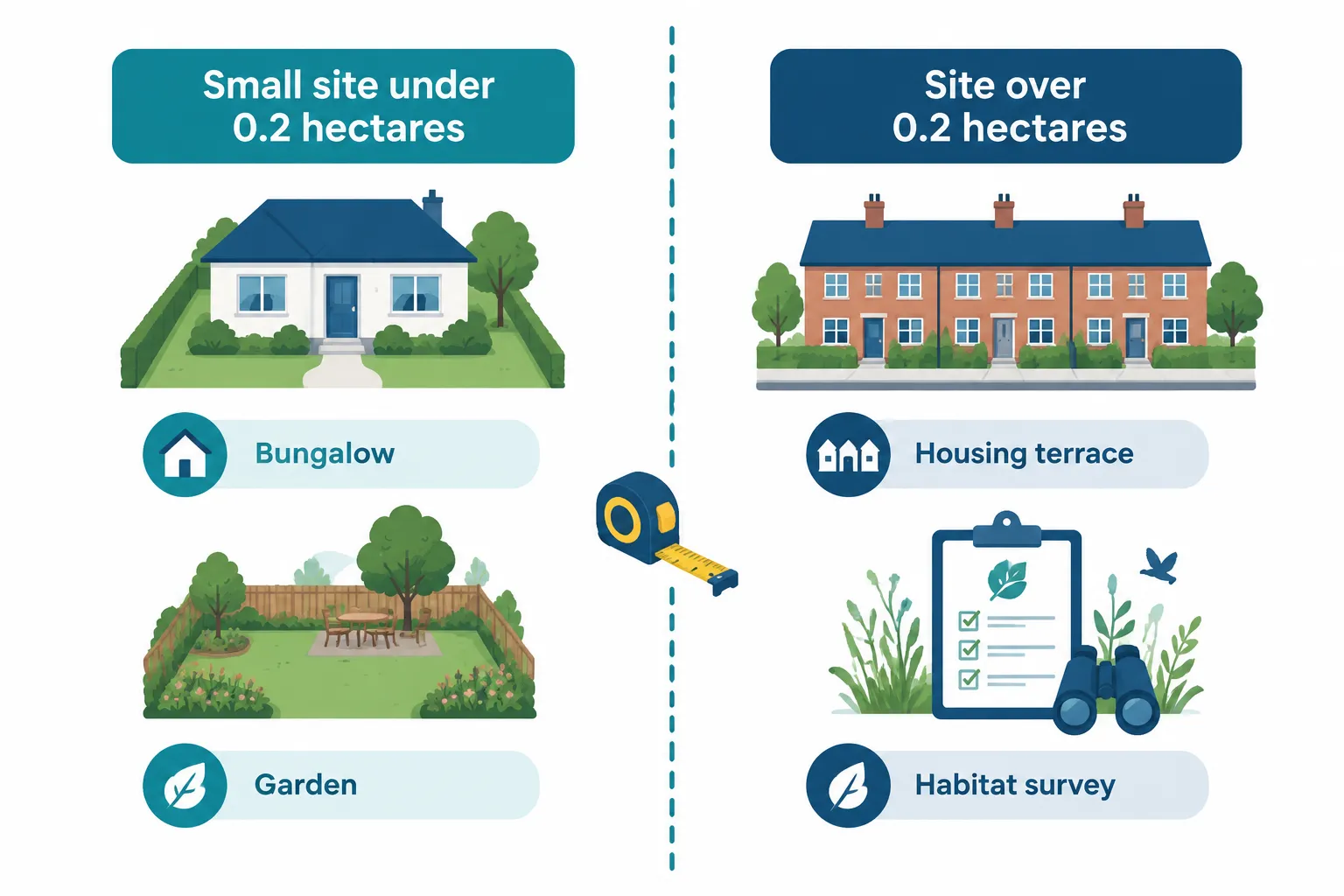
A small site, for BNG purposes, is a planning application site with a total area under 0.2 hectares that does not trigger the priority habitat caveat. This is a hard area cut-off, not a sliding scale.
Key details for planning consultants and landowners:
- Area is calculated using the boundary of the application red line, as submitted to the local planning authority.
- The priority habitat caveat means a 0.15 hectare garden plot that touches designated ancient woodland can still require a biodiversity assessment [6][3].
- A separate de minimis exemption exists for developments that cause only a very small habitat impact, but it has narrower conditions than the 0.2 hectare rule and should not be assumed automatically [6].
- The self-build/custom-build exemption that previously gave individual builders an automatic pass has been withdrawn. Self-builders now rely solely on the 0.2 hectare threshold, and must check for priority habitat just like any other applicant [9][2].
A common mistake is assuming "self-build equals exempt." That is no longer true. Self-build applicants over 0.2 hectares, or on sites touching priority habitat, must comply fully.
What Happens If Your Project Is Just Over 0.2 Hectares
Projects that exceed 0.2 hectares, even marginally, receive no partial exemption and must meet full BNG obligations, including the standard 10% biodiversity net gain requirement for minor and major development outside the NSIP regime.
Practical implications:
- A 0.21 hectare site is treated the same as a 2 hectare site for BNG purposes, there is no tapering or reduced percentage.
- Developers close to the threshold should get an accurate site area measurement early, ideally verified by a chartered surveyor, before assuming exemption.
- For minor developments just over the line, off-site gains now sit on equal footing with on-site provision, which gives more flexibility on cost and delivery timing [1][9]. This is a meaningful shift from the previous hierarchy that pushed on-site delivery first.
- Developers exploring off-site options should understand the practical trade-offs between the two routes; see this comparison of off-site land banking versus habitat banking and this guide to on-site versus off-site delivery.
What's the Difference Between Old and New BNG Rules September 2026
The clearest way to see the reform's scale is a direct comparison of pre-reform and post-reform requirements.
| Requirement | Pre-Reform (before 31 July 2026) | Post-Reform (from September 2026) |
|---|---|---|
| Small residential sites | BNG required on nearly all applications, including small plots | Exempt under 0.2 hectares, subject to priority habitat check [9][2] |
| Self-build / custom-build | Automatic exemption regardless of size | Exemption removed; relies on 0.2 ha rule only [9][2] |
| Off-site gains for minor development | Secondary to on-site delivery in the biodiversity gain hierarchy | Equal footing with on-site delivery [1][9] |
| NSIP schemes | No mandatory BNG requirement | Mandatory 10% net gain from 2 November 2026 [5][8][10] |
| Priority habitat sites | Full BNG requirement | Still fully required, regardless of site size [6][3] |
How Does the NSIP Mandate Affect Biodiversity Net Gain Requirements
The NSIP mandate makes biodiversity net gain a compulsory legal requirement for Nationally Significant Infrastructure Projects from 2 November 2026, requiring applicants to demonstrate at least a 10% biodiversity net gain within their Order Limits [5][8][10]. This is the second pillar of the BNG changes September 2026: 0.2 hectare small site exemption and NSIP mandate impact on UK developers story, and it pulls in the opposite direction to the small site exemption, tightening requirements for the largest projects while relaxing them for the smallest.
Key features developers and their legal teams need to know:
- The BNG boundary for NSIPs is defined against the Order Limits, not the wider project area, which has design and cost implications for how habitat corridors and mitigation land are planned [5][8].
- Defra has laid biodiversity gain statements and published supporting guidance specifically for NSIPs, which sets out documentation expectations [8][10].
- Applicants must engage with the core NSIP documentation collection early in the Development Consent Order process, since biodiversity gain statements now form part of the formal application package [10].
Which NSIP Project Types Are Covered and Do National Significant Infrastructure Projects Need BNG Compliance
Nationally Significant Infrastructure Projects across energy, transport, water, and waste sectors are covered by the mandate, and yes, they now need formal BNG compliance from 2 November 2026 [5][8][10]. This includes new generating stations, major road and rail schemes, and large water infrastructure that go through the Development Consent Order route.
- Projects already in the examination pipeline before 2 November 2026 should check transitional guidance published alongside the mandate [8][10].
- NSIP promoters should budget for habitat surveys, gain statement preparation, and long-term monitoring commitments as standard project costs going forward.
- Legal and planning advisers, including firms such as Bird & Bird and A&O Shearman, have flagged the NSIP mandate as a significant compliance shift for infrastructure clients, given the scale of land and habitat management now tied to consent conditions.
How Much Will BNG Costs Change for Small Developers After September 2026
Costs fall for small developers under 0.2 hectares because they no longer need habitat surveys, metric calculations, or a 30-year monitoring and management plan for BNG purposes. Larger and NSIP developers face higher and more predictable compliance costs.
- Small developers save on ecologist fees, biodiversity metric calculations, and legal agreements previously needed to secure gains.
- Medium and major developments retain full 10% net gain obligations, and now benefit from equal-footing off-site options, which can be cheaper than forcing gains onto a constrained urban site [1][9].
- NSIP promoters should expect new line items for gain statement preparation, habitat bank agreements, and long-term monitoring across the Order Limits [5][8].
For a broader view of how habitat credits and off-site markets work, see this guide to biodiversity credits for developers.
How Do I Calculate If My Site Qualifies for the Small Site Exemption
Calculate the total application site area from the submitted red line boundary, then check whether any part of the site contains or adjoins priority or irreplaceable habitat. If the area is under 0.2 hectares and no priority habitat caveat applies, the site qualifies for exemption.
Step-by-step:
- Measure the full red-line planning application boundary, not just the footprint of new buildings.
- Cross-reference the site against Natural England's priority habitat inventory and any local ancient woodland or ancient tree records.
- If under 0.2 hectares with no priority habitat present, the site is exempt from BNG.
- If any part touches priority habitat, treat the site as fully in scope and commission a habitat assessment.
- If close to the threshold, get a professional area survey rather than relying on an estimate, planning authorities can challenge borderline claims.
For a detailed walkthrough of assessment methods, see this guide on how to conduct a biodiversity impact assessment for developers, and the government's own exempt projects guidance.
What Should Developers Do Now to Prepare for September 2026 BNG Changes
Developers should audit their live and pipeline sites now against the 0.2 hectare threshold and the priority habitat caveat, and NSIP promoters should start gain statement preparation well ahead of the 2 November 2026 deadline.

Practical checklist:
- Re-run site area calculations on any application still in preparation to confirm exemption status.
- Do not assume self-build status still grants automatic exemption, check area and habitat status independently.
- Weigh off-site gain options now that they carry equal weight to on-site delivery for minor development [1][9]; this guide to BNG for small development projects covers practical routes.
- NSIP teams should engage ecologists and legal advisers early to build the biodiversity gain statement into the Development Consent Order timetable, referencing published NSIP guidance [8][10].
- Landowners considering habitat banking should review current guidance for developers and speak to a qualified ecologist before committing land.
Frequently Asked Questions
Is the 0.2 hectare small site exemption retrospective?
No. It applies to planning applications submitted from 31 July 2026 onward; it does not retroactively remove BNG conditions already attached to earlier permissions [9][2].
Are residential developments affected by the NSIP BNG changes?
Standard residential developments are not covered by the NSIP mandate. NSIP rules apply only to nationally significant infrastructure consented through the Development Consent Order process, such as major energy and transport schemes [5][10].
Can I still get an exemption if my site is exactly 0.2 hectares?
The exemption applies to sites under 0.2 hectares. A site measuring exactly 0.2 hectares should be checked carefully against official guidance, since the threshold is a cut-off rather than an "up to and including" limit [3][6].
Does the small site exemption apply to commercial developments too?
Yes, the 0.2 hectare threshold is based on site area, not use class, so qualifying minor commercial schemes benefit in the same way as residential ones, subject to the priority habitat caveat [9][3].
What is the 10% net gain requirement for NSIPs?
From 2 November 2026, NSIP applicants must demonstrate at least a 10% biodiversity net gain measured against their Order Limits boundary, documented in a formal biodiversity gain statement [5][8][10].
Will there be further changes to BNG rules after September 2026?
Government guidance suggests ongoing review of BNG implementation for minor, medium, and brownfield development, so further adjustments are possible, though nothing beyond the current exemption and NSIP mandate has been confirmed [9][1].
Conclusion
The BNG changes September 2026: 0.2 hectare small site exemption and NSIP mandate impact on UK developers mark a genuine fork in England's biodiversity net gain regime. Small developers and self-builders under 0.2 hectares gain real relief, provided their land avoids priority habitat, while NSIP promoters face a stricter, mandatory 10% net gain duty from 2 November 2026. Developers should check site areas now, confirm habitat status before assuming exemption, and treat off-site gain options as a genuine equal alternative to on-site delivery. Surveyors and consultants should expect demand to shift toward medium, major, and NSIP-scale work as the small site pipeline moves outside BNG scope. Anyone unsure where a specific site sits should get a professional area survey and habitat check before relying on exemption.
References
[1] Biodiversity Net Gain Whats Changing And What It Means For You – defraenvironment.blog.gov.uk
[2] Biodiversity Net Gain Changes August 2026 – gaiacompany.io
[3] Understanding Biodiversity Net Gain – gov.uk
[4] Biodiversity Net Gain – gov.uk
[5] Biodiversity Net Gain For Major Infrastructure Projects New Guidance – defraenvironment.blog.gov.uk
[6] Biodiversity Net Gain Exempt Developments – gov.uk
[7] planninggeek.co.uk – planninggeek.co.uk
[8] Biodiversity Net Gain For Nsips Gain Statements Laid And Guidance Published – defraenvironment.blog.gov.uk
[9] Improving The Implementation Of Biodiversity Net Gain For Minor Medium And Brownfield Development – gov.uk
[10] Biodiversity Gain Statements For Nationally Significant Infrastructure Projects – gov.uk