

Last updated: August 7, 2026
Quick Answer: On 6 August 2026, Defra's amendments to the Biodiversity Net Gain (BNG) regime came into force, introducing a new exemption for developments of 0.2 hectares or smaller that do not affect onsite priority habitat. The BNG small sites exemption August 2026 is what UK developers and ecologists must know about right now, because it fundamentally changes who must deliver BNG, how offsite gains can be used, and which earlier exemptions have been removed. Applications submitted from 6 August onwards are subject to these new rules immediately.
Key Takeaways
- Developments of 0.2 hectares or smaller qualify for the new small sites exemption, provided no onsite priority habitat is present or affected.
- The self-build and custom-build exemption has been removed for applications made on or after 6 August 2026, though many such projects will qualify under the 0.2 ha rule instead.
- The on-site-first hierarchy now applies only to major development. Minor developments may use registered offsite gains without first demonstrating that onsite delivery was considered.
- Temporary planning permissions of five years or less are exempt from BNG requirements.
- Nationally Significant Infrastructure Projects (NSIPs) will be brought into the BNG regime from November 2026, confirmed by Defra in July 2026.
- Minor developments using offsite gains must still use a registered biodiversity gain site or statutory biodiversity credits.
- Ecologists advising on applications from 6 August must reassess which exemption route applies to each project, as the transitional rules differ depending on the application date.
What Is the BNG Small Sites Exemption Coming Into Force in August 2026?
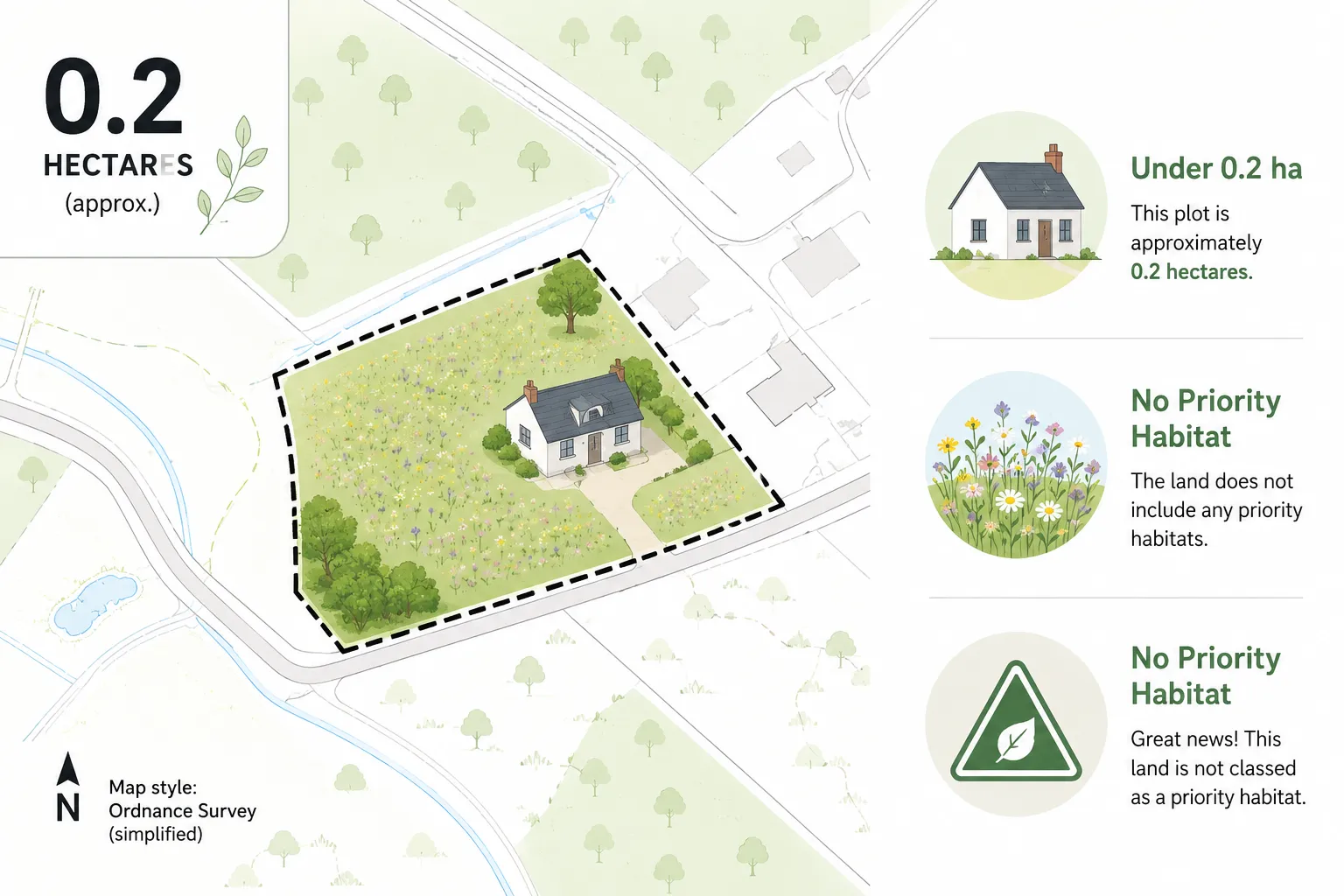
The BNG small sites exemption is a new category of development that is entirely exempt from the 10% biodiversity net gain requirement under Schedule 7A of the Environment Act 2021. It applies to developments with a site area of 0.2 hectares or smaller, where no onsite priority habitat is present or would be affected by the works.
Defra announced the amendments in July 2026 alongside transitional arrangements, and the changes took legal effect on 6 August 2026 via secondary legislation. The exemption sits alongside existing BNG exemptions (such as householder applications and permitted development) but is new and distinct. It does not require developers to submit a biodiversity gain plan, register a biodiversity gain site, or purchase statutory biodiversity credits.
Key condition: The 0.2 ha threshold applies to the development footprint, not the wider site ownership boundary. If any part of the development affects a mapped priority habitat (as defined under Section 41 of the Natural Environment and Rural Communities Act 2006), the exemption does not apply and full BNG obligations are triggered.
Which Developments Qualify for the BNG Small Sites Exemption?
A development qualifies if it meets both of the following criteria simultaneously:
- The total area of the development is 0.2 hectares or smaller
- The development does not affect onsite priority habitat
This covers a wide range of minor residential and commercial projects, including small infill housing, minor commercial extensions, and small mixed-use schemes. The exemption applies to both residential and non-residential development, so the common misconception that it is residential-only is incorrect.
Edge case to watch: A developer who owns a 1-hectare site but proposes to develop only 0.18 hectares of it must ensure the application clearly delineates the development area. Local planning authorities (LPAs) will scrutinise red-line boundaries carefully. PAS guidance from the Local Government Association advises LPAs to check that the red-line boundary accurately reflects the land being developed, not simply the land in ownership.
What does not qualify:
- Any development, regardless of size, that affects a Section 41 priority habitat
- Developments exceeding 0.2 ha in area
- Major development (10 or more dwellings, or 0.5 ha or more for non-residential), which remains subject to full BNG obligations
How Does the Small Sites Exemption Change BNG Requirements for Minor Development?
Before 6 August 2026, minor development (fewer than 10 dwellings, or under 0.5 ha for non-residential) was subject to BNG but benefited from a relaxed regime compared to major development. From 6 August, minor developments at or below 0.2 ha with no priority habitat are simply exempt. Those above 0.2 ha but still classed as minor development remain subject to BNG, but with one significant change: the on-site-first hierarchy no longer applies to them.
Under the original BNG framework, developers were expected to demonstrate a sequential approach: deliver gains onsite first, then use registered offsite gains, and only purchase statutory biodiversity credits as a last resort. From 6 August 2026, this hierarchy applies only to major development. Minor developments above the 0.2 ha threshold can now go directly to registered offsite biodiversity gain sites without needing to demonstrate that onsite delivery was considered or ruled out first.
This is a material change for ecologists preparing biodiversity gain plans for minor schemes. The plan no longer needs to evidence the onsite-first reasoning for minor development, which reduces the assessment burden and speeds up the process for smaller schemes.
What Happened to the Self-Build and Custom-Build Exemption?
The self-build and custom-build exemption has been removed for all applications made on or after 6 August 2026. Under the previous rules, self-build and custom-build projects were automatically exempt from BNG regardless of site size or habitat. That blanket exemption no longer exists.
However, many self-build projects will still avoid BNG obligations because they will qualify under the new 0.2 ha small sites exemption. A single self-build dwelling on a plot of 0.2 ha or less, with no priority habitat, is exempt. The practical effect for most self-builders is therefore limited, but ecologists and planning consultants must not assume the old exemption still applies. The legal basis has changed, and the correct exemption route must be cited in any application documentation.
Transitional note: Applications made before 6 August 2026 that relied on the self-build exemption are unaffected. The removal applies only to applications submitted from 6 August onwards, per Defra's transitional arrangements published in July 2026.
Does the Temporary Planning Permission Exemption Apply to Your Project?
Temporary planning permissions of five years or less are exempt from BNG requirements under the August 2026 amendments. This is a straightforward exemption: if the permission granted is time-limited to five years or fewer, no biodiversity gain plan is required.
This is relevant for temporary construction compounds, short-term agricultural buildings, and event infrastructure. Ecologists should confirm the permission duration is explicitly stated in the application and that the LPA grants a time-limited consent, as a permanent permission for the same development would not qualify.
What Is the Confirmed Timeline for NSIPs Entering the BNG Regime?
Nationally Significant Infrastructure Projects will be brought into the mandatory BNG regime from November 2026, as confirmed by Defra in its July 2026 announcement. NSIPs, which include major roads, railways, energy infrastructure, and ports consented through the Development Consent Order process, were excluded from the original BNG rollout in February 2024 and the subsequent extension to small sites.
Ecologists and environmental consultants working on NSIP applications should begin preparing biodiversity gain plans now. The 10% net gain requirement will apply, and the on-site-first hierarchy will apply to NSIPs as major development. Defra has indicated that further guidance specific to NSIPs will be published before November 2026.
Practical Checklist for Surveyors and Ecologists: Applications from 6 August 2026
Use this checklist when advising clients on applications submitted on or after 6 August 2026.
Step 1: Determine the development area
Measure the red-line application boundary accurately. Is it 0.2 ha or smaller?
Step 2: Check for priority habitat
Consult Magic Map (Natural England's mapping tool) and conduct a Phase 1 habitat survey. Does the site contain or directly affect any Section 41 priority habitat?
Step 3: Apply the correct exemption
- Area is 0.2 ha or less AND no priority habitat: claim the small sites exemption. No biodiversity gain plan required.
- Area is 0.2 ha or less but priority habitat is present: full BNG applies. Proceed to Step 4.
- Area is above 0.2 ha but below major development threshold: BNG applies, but no onsite-first hierarchy. Offsite gains may be used directly.
- Major development: full BNG with onsite-first hierarchy applies.
Step 4: For self-build applications
Do not cite the self-build exemption. If the plot is 0.2 ha or less with no priority habitat, cite the small sites exemption instead.
Step 5: For temporary permissions
Confirm the application seeks a time-limited consent of five years or fewer. Document this explicitly.
Step 6: Record the exemption route
LPAs will require confirmation of which exemption applies. Prepare a short exemption statement citing the relevant statutory instrument and the August 2026 amendments.
Step 7: For minor development above 0.2 ha
Proceed directly to identifying a registered biodiversity gain site or statutory biodiversity credits. No need to evidence onsite-first consideration.
Common Mistakes Developers Are Making About the Small Sites Exemption
Several errors are already emerging in the 48 hours since the rules changed.
Mistake 1: Assuming the self-build exemption still exists. It does not, for applications from 6 August. Agents filing applications using the old self-build exemption wording risk objections from LPA ecology officers.
Mistake 2: Confusing site ownership area with development area. The 0.2 ha threshold applies to the development, not the total landholding. A developer with a 0.5 ha plot proposing works on 0.15 ha must still define the development area precisely.
Mistake 3: Overlooking priority habitat on small sites. A 0.1 ha brownfield site may contain Section 41 priority habitat such as open mosaic habitat. Skipping the habitat check because the site is small is a significant error.
Mistake 4: Applying the onsite-first hierarchy to minor development. Ecologists trained under the pre-August 2026 framework may default to the sequential approach. For minor development above 0.2 ha, this step is no longer required.
Is There a Financial Contribution Required Under the Small Sites Exemption?
No financial contribution is required in place of BNG for developments that qualify for the small sites exemption. Exempt developments are not required to submit a biodiversity gain plan, purchase statutory biodiversity credits, or make any payment to an LPA biodiversity fund as a condition of the exemption.
This distinguishes the small sites exemption from some earlier proposals that considered a simplified financial contribution route for minor development. The August 2026 amendments take a cleaner approach: qualifying sites are simply outside the BNG regime entirely.
FAQ
Does the 0.2 ha small sites exemption apply to commercial development as well as residential?
Yes. The exemption applies to all development types, residential and commercial, provided the site area is 0.2 ha or smaller and no onsite priority habitat is affected.
What counts as priority habitat for the purpose of the exemption?
Priority habitat means habitat listed under Section 41 of the Natural Environment and Rural Communities Act 2006. Examples include lowland meadow, ancient woodland, blanket bog, and open mosaic habitats on previously developed land. Natural England's Magic Map is the standard reference tool.
If a small site has priority habitat on part of it, does the whole site lose the exemption?
Yes. If any part of the development affects priority habitat, the exemption does not apply and full BNG obligations are triggered for the entire development.
Can a developer opt into BNG voluntarily if their site qualifies for the small sites exemption?
Yes. The exemption is not mandatory. Developers who wish to demonstrate biodiversity credentials or satisfy a planning condition may still prepare a biodiversity gain plan voluntarily, but LPAs cannot require one for exempt developments.
Do applications submitted before 6 August 2026 need to comply with the new rules?
No. Defra's transitional arrangements confirm that applications submitted before 6 August 2026 are assessed under the rules in force at the time of submission. The new rules apply only to applications made on or after 6 August 2026.
When will NSIPs be required to deliver BNG?
Defra confirmed in July 2026 that NSIPs will enter the mandatory BNG regime from November 2026. Developers and promoters of NSIPs should begin ecological baseline assessments and biodiversity gain planning now.
Does the five-year temporary permission exemption apply to phased developments?
No. If a development is phased and the overall project extends beyond five years, the temporary exemption does not apply to the phased elements. Each phase must be assessed individually, and any phase without a time-limited consent of five years or fewer is subject to BNG.
Conclusion
The BNG small sites exemption August 2026 represents the most significant recalibration of the biodiversity net gain regime since mandatory BNG was introduced in February 2024. For the majority of small residential and commercial applications, the 0.2 ha threshold will remove the BNG requirement entirely, provided no priority habitat is involved. But the removal of the self-build exemption, the revised onsite-first hierarchy, and the incoming NSIP extension mean that ecologists and planning professionals cannot simply apply old habits to new applications.
Actionable next steps:
- Audit all live applications submitted on or after 6 August 2026 to confirm which exemption route applies.
- Update internal checklists and biodiversity gain plan templates to reflect the removal of the onsite-first hierarchy for minor development.
- Brief clients with self-build projects on the change in exemption basis.
- Begin NSIP ecological baseline work ahead of the November 2026 deadline.
- Monitor Defra's environment blog and GOV.UK planning guidance pages for the NSIP-specific guidance expected before November.
The rules are clear. The window to catch errors before LPAs begin issuing objections is short.
References
- Defra, Biodiversity Net Gain: Amendments and Transitional Arrangements, GOV.UK, July 2026. gov.uk
- Defra Environment Blog, BNG small sites exemption and August 2026 amendments explained, July 2026. deframedia.blog.gov.uk
- Planning Advisory Service (PAS), Local Government Association, BNG: Guidance for Local Planning Authorities, 2024. pas.org.uk
- Natural England, Magic Map Application (Section 41 priority habitat mapping). magic.defra.gov.uk
- Environment Act 2021, Schedule 7A (as amended). legislation.gov.uk
- Natural Environment and Rural Communities Act 2006, Section 41. legislation.gov.uk