

Six weeks. That is all the time separating UK developers from the most significant revision to mandatory Biodiversity Net Gain rules since the framework became law in February 2024. On 6 August 2026, four substantive amendments to the BNG regime take legal effect, and every planning application submitted from that date onward must be assessed against the new rules [1][6].
Understanding the BNG changes 6 August 2026 what UK developers must do now is not optional. Getting the transition wrong risks delayed consents, abortive survey costs, and non-compliance with a statutory requirement that carries real planning consequences.
Key Takeaways
- Four BNG amendments become law on 6 August 2026, applying to all planning applications submitted on or after that date.
- A new 0.2 ha size threshold will exempt most small sites from the mandatory 10% BNG requirement.
- Temporary developments that restore land within five years and avoid priority habitats will no longer require BNG compliance.
- The self-build and custom-build exemption is removed; the biodiversity gain hierarchy is eased for minor development.
- BNG becomes mandatory for Nationally Significant Infrastructure Projects (NSIPs) from November 2026.
What the 6 August 2026 Statutory Instrument Actually Changes
DEFRA confirmed the amendments package in its July 2026 statutory instrument and set out the policy rationale on the DEFRA environment blog [6]. The changes were trailed in April 2026 when DEFRA signalled its intent to recalibrate the framework to reduce disproportionate burdens on smaller schemes while preserving the ecological integrity of the wider system [1].
Four distinct changes take effect simultaneously on 6 August 2026.
1. The 0.2 Hectare Small-Site Exemption
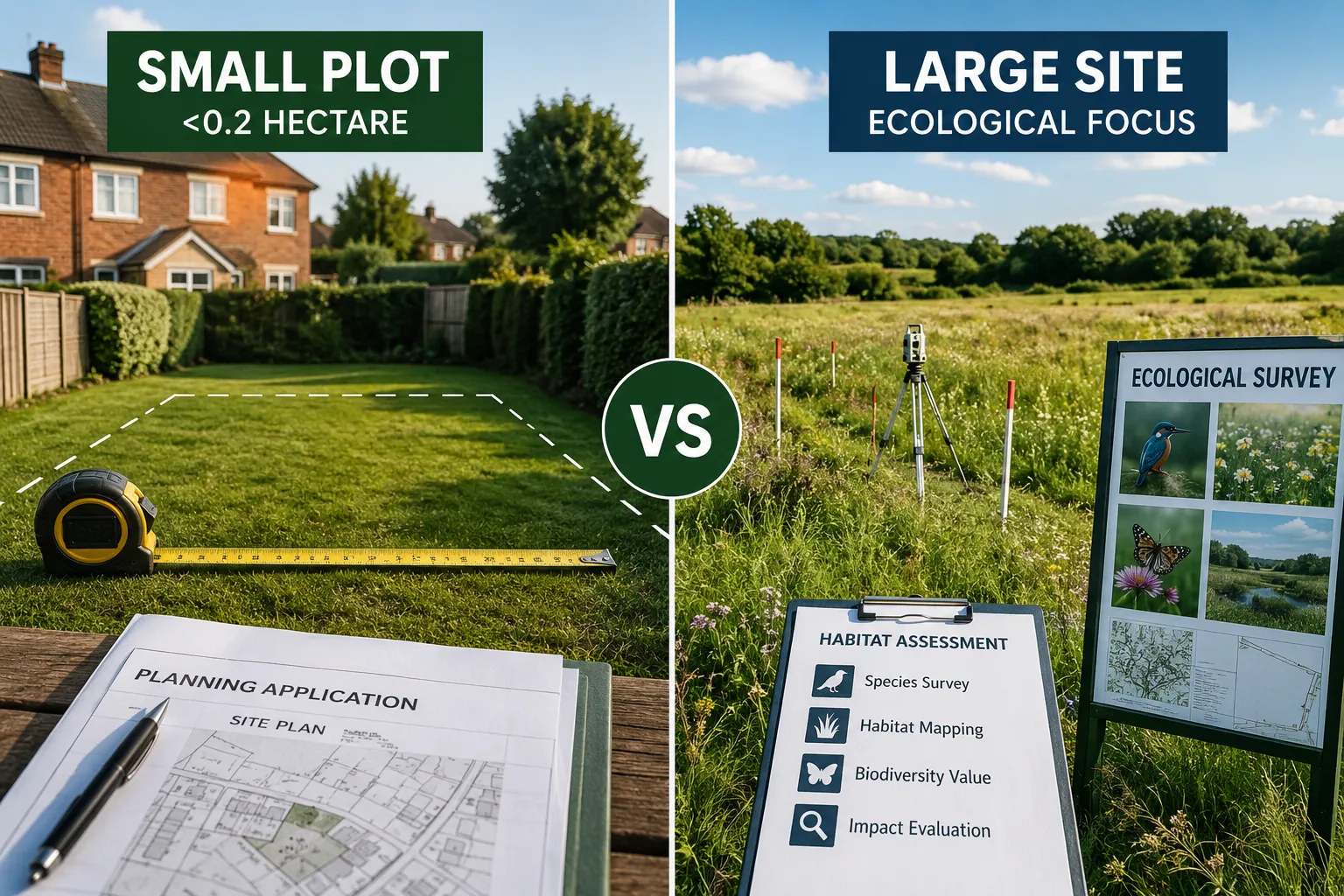
The headline change is a new area-based threshold. Planning applications for development on sites smaller than 0.2 hectares, and where no priority habitat is affected, will be exempt from the mandatory 10% BNG requirement [3][9]. This is a meaningful shift. A large proportion of infill plots, garden developments, and minor residential schemes fall below this threshold.
What this does not do: it does not exempt sites that contain or directly affect priority habitats, regardless of size. Developers must still obtain a pre-application ecological appraisal to confirm whether priority habitats are present before relying on this exemption.
For a full picture of which project types are currently exempt, the BNG exempt projects guidance provides a useful reference point.
2. The Temporary Development Exemption
A second new exemption covers temporary developments. Where a planning application proposes development that will be fully reversed within five years, and where no priority habitat is present on the site, BNG will not be required [3][7]. This addresses a long-standing concern from sectors such as construction compounds, temporary infrastructure, and event facilities that faced disproportionate compliance costs for short-term land use changes.
The five-year clock runs from the date development commences. Conditions attached to the planning permission will typically enforce the restoration obligation.
3. Easing of the Biodiversity Gain Hierarchy for Minor Development
The biodiversity gain hierarchy, which requires developers to first deliver BNG on-site, then off-site, and only then use statutory biodiversity credits as a last resort, has been eased for minor development [6][9]. Under the amended rules, minor development schemes will have greater flexibility to move more readily to off-site delivery or statutory credits without the same level of justification previously required for larger schemes.
This is a practical acknowledgement that small sites often cannot physically accommodate meaningful on-site habitat creation. Developers working on minor schemes should review their current approach to off-site versus on-site BNG delivery to understand where the new flexibility applies.
4. Removal of the Self-Build and Custom-Build Exemption
This is the change that will catch some developers off guard. The previous exemption for self-build and custom-build dwellings is removed entirely from 6 August 2026 [2][8]. Applications for self-build plots submitted on or after that date will be subject to full BNG requirements in the same way as any other residential development, unless another exemption (such as the 0.2 ha threshold) applies.
Landowners and plot vendors who market self-build plots should update their due diligence processes immediately.
Transitional Arrangements: The Date That Matters
DEFRA has been clear that these changes apply only to planning applications submitted on or after 6 August 2026 [6][9]. Applications already validated before that date continue under the existing rules for the duration of their determination.
This creates a short but meaningful window. Developers with applications at an advanced pre-application stage should consider whether submitting before 6 August, under the current framework, or after, under the amended one, is more advantageous for their specific scheme. That calculation will depend on site size, habitat baseline, and the nature of the development proposed.

BNG for NSIPs: November 2026 Is the Next Horizon
While the 6 August changes dominate the immediate agenda, developers in the infrastructure sector must also prepare for the November 2026 extension of mandatory BNG to Nationally Significant Infrastructure Projects [1][6]. NSIPs, including major roads, energy installations, airports, and large-scale utilities, have until now sat outside the mandatory BNG framework. That changes in November.
NSIP promoters should begin baseline ecological surveys and biodiversity metric assessments now. The lead times for securing off-site habitat units or negotiating conservation covenants are significant. Understanding the cost of biodiversity units and statutory credits is an essential early step for any NSIP project team.
BNG Changes 6 August 2026: What UK Developers Must Do Now, Checklist
The following actions are time-sensitive. Developers, planners, and ecologists should work through this list before the 6 August 2026 effective date.
Before 6 August 2026:
- Audit your pipeline. Identify every application not yet submitted. Determine whether each scheme benefits more from the pre-August or post-August framework.
- Confirm site size against the 0.2 ha threshold. For sites approaching this boundary, obtain a precise site area calculation. Do not assume exemption without verification.
- Commission priority habitat surveys. The 0.2 ha and temporary development exemptions both fail if priority habitat is present. Early ecological appraisals remove this uncertainty. A biodiversity net gain assessment will identify habitat constraints at the outset.
- Review self-build plot marketing materials. Remove any reference to a BNG exemption for self-build. Update heads of terms and plot sale agreements accordingly.
- Reassess minor development BNG strategies. If you have been planning on-site BNG delivery for a minor scheme where it is impractical, the eased hierarchy now gives you a cleaner route to off-site or statutory credit solutions.
- Brief your planning consultants and ecologists. Ensure everyone on the project team understands which rule set applies to each application in the pipeline.
- For NSIP promoters: initiate baseline ecological surveys and begin engagement with habitat bank providers ahead of the November 2026 deadline.
For developers who want structured support navigating these requirements, the guidance for developers resource provides a practical starting point.
What These Changes Mean for the Biodiversity Unit Market
The removal of the self-build exemption and the easing of the hierarchy for minor development will have opposing effects on demand for biodiversity units. Bringing self-build plots into scope adds new buyers to the market. Simultaneously, the 0.2 ha exemption removes a segment of previously liable sites from the demand pool.
Net effect: the market for biodiversity units is likely to remain robust, with demand increasingly concentrated in mid-size residential and commercial schemes. Landowners considering entering the habitat bank market should assess whether the amended framework changes the viability calculation for their land. The guide to biodiversity credits for developers sets out how the statutory credit system interacts with private unit supply.
Frequently Asked Questions
Does the 0.2 ha exemption apply automatically, or does it need to be declared?
Developers must still demonstrate eligibility. A pre-application ecological appraisal confirming the absence of priority habitats is the standard way to evidence the exemption. Local planning authorities will expect this documentation [3][9].
Can a developer submit before 6 August to avoid the removal of the self-build exemption?
Yes. Applications validated before 6 August 2026 continue under the existing framework, which retains the self-build exemption. However, the application must be properly submitted and validated, not merely in preparation [6].
Does the temporary development exemption apply to construction phases of larger projects?
No. The exemption covers the development itself, not construction activity associated with a permanent scheme. A construction compound ancillary to a larger consented development would need to be assessed on its own merits [7].
What counts as a "minor development" for the eased hierarchy?
The definition follows existing planning terminology: minor development generally means fewer than 10 dwellings for residential schemes, or a floor area below 1,000 square metres for non-residential development. Local planning authorities retain discretion in borderline cases [5].
When does BNG become mandatory for NSIPs?
The mandatory BNG requirement for Nationally Significant Infrastructure Projects takes effect in November 2026. NSIP promoters should begin ecological baseline work immediately [1][6].
Where can developers find the updated DEFRA guidance?
DEFRA published the transitional arrangements and amended statutory instrument in July 2026 via the DEFRA environment blog. The official government guidance page on understanding BNG is also updated to reflect the new rules [5][6].
Conclusion
The BNG changes taking effect on 6 August 2026 represent a genuine recalibration of the framework, not a wholesale reversal. The 0.2 ha exemption and temporary development exemption reduce compliance burdens on the smallest and most transient schemes. The removal of the self-build exemption closes a loophole. The eased hierarchy for minor development acknowledges physical reality on constrained sites.
For most developers, the immediate priority is pipeline management: knowing which applications to submit before 6 August and which to hold. Beyond that, the November 2026 NSIP extension signals that the direction of travel remains toward broader, not narrower, BNG coverage.
Developers who act now, auditing their pipeline, commissioning early ecological surveys, and briefing their teams, will avoid the delays and abortive costs that come from being caught unprepared. Those who wait risk submitting applications under the wrong rule set or missing the exemption criteria for want of a survey that could have been completed weeks earlier.
For tailored support on meeting the August 2026 requirements, contact the Biodiversity Surveyors team to discuss your specific project pipeline.
References
[1] Biodiversity Net Gain Whats Changing And What It Means For You – defraenvironment.blog.gov.uk
[2] Bng August 2026 Regulations Confirmed – the-ferals.co.uk
[3] Biodiversity Net Gain Changes From 6 August 2026 What Developers Need To Know – crossmanecology.co.uk
[5] Understanding Biodiversity Net Gain – gov.uk
[6] Biodiversity Net Gain Amendments And Transitional Arrangements Published – defraenvironment.blog.gov.uk
[7] Bng Changes 2026 – arbtech.co.uk
[8] Biodiversity Net Gain Bng Changes From 6 August 2026 What You Need To Know – union4.co.uk
[9] New Bng Rules And Exemptions Apply From 6 August 2026 – cieem.net